
Deep research
About IGF-1 DES (1-3)
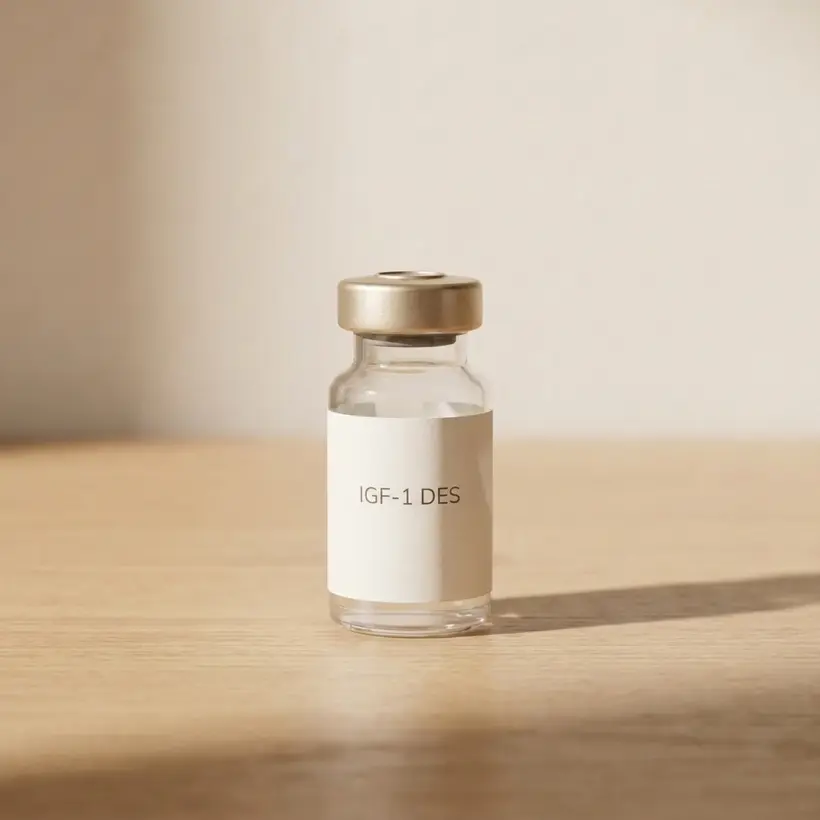
IGF-1 DES, formally designated Des(1-3)IGF-1, is a truncated variant of Insulin-like Growth Factor 1 consisting of 67 amino acids (residues 4-70 of the full 70-amino-acid IGF-1 sequence). The missing N-terminal tripeptide is Gly-Pro-Glu (GPE). This deletion yields a molecular weight of approximately 7,372 Da compared to 7,649 Da for full-length IGF-1. IGF-1 DES is not purely synthetic: it occurs naturally in human brain tissue, where it was first identified by Sara et al. using radioimmunoassay, and in bovine colostrum.
The biological significance of the N-terminal truncation lies entirely in its effect on IGF binding protein (IGFBP) interactions. In circulation, approximately 99% of full-length IGF-1 is bound to one of six IGFBPs (primarily IGFBP-3 in a 150 kDa ternary complex with acid-labile subunit). The Gly-Pro-Glu tripeptide is critical for IGFBP recognition: its removal virtually eliminates binding to IGFBP-1 through IGFBP-6. Because IGF-1 DES cannot be sequestered by binding proteins, it exists entirely in the free, bioavailable form, producing approximately 10 times greater potency at the IGF-1 receptor (IGF-1R) compared to equimolar concentrations of full-length IGF-1.
IGF-1 DES binds the IGF-1 receptor with affinity comparable to native IGF-1 (Kd approximately 0.2-0.5 nM). Upon binding, it activates two major intracellular signaling cascades. The PI3K/Akt pathway promotes cell survival by phosphorylating and inactivating pro-apoptotic proteins (Bad, caspase-9) while activating mTOR for protein synthesis. The MAPK/ERK pathway drives cellular proliferation and differentiation. In skeletal muscle, these combined signals promote satellite cell activation, myoblast proliferation and fusion, and increased muscle protein synthesis. In connective tissue, they stimulate fibroblast proliferation and collagen production.
In cell culture studies, IGF-1 DES stimulated myoblast proliferation 3 times more potently than full-length IGF-1 at equivalent concentrations, as measured by tritiated thymidine incorporation. Studies in L6 rat myoblasts showed that IGF-1 DES at 10 nM produced proliferative responses equivalent to 100 nM full-length IGF-1, confirming the 10-fold potency advantage. In MCF-7 breast cancer cell proliferation assays (a standard IGF-1R bioactivity model), IGF-1 DES was similarly approximately 10-fold more potent than IGF-1.
The pharmacokinetic trade-off for enhanced potency is a dramatically shortened half-life. Without IGFBP binding to protect it from renal clearance and proteolytic degradation, IGF-1 DES has an estimated circulating half-life of only 20-30 minutes, compared to 12-15 hours for IGFBP-3-bound IGF-1. This rapid clearance makes IGF-1 DES suited for localized, time-limited IGF-1R activation rather than sustained systemic elevation.
The N-terminal tripeptide GPE that is cleaved to form IGF-1 DES has its own biological activity. GPE is neuroprotective and has been investigated as a potential therapeutic for ischemic brain injury. The natural occurrence of both IGF-1 DES and free GPE in brain tissue suggests that IGF-1 cleavage is a regulated process that generates two distinct bioactive molecules from a single precursor.
Recombinant IGF-1 DES is produced in E. coli expression systems and purified by multi-step chromatography. Identity is confirmed by mass spectrometry (expected MW 7,372 Da), HPLC purity analysis, and bioactivity assay (typically MCF-7 proliferation or IGF-1R phosphorylation). Lyophilized IGF-1 DES should be stored at -20 degrees C and reconstituted with sterile acidified water (10 mM HCl) or acetic acid (0.1 M) for optimal stability. Reconstituted solutions should be stored at 2-8 degrees C and used within 14 days. IGF-1 DES is less stable at neutral pH than full-length IGF-1 and should not be reconstituted in PBS without acidification.
The safety considerations for IGF-1 DES relate primarily to its potent mitogenic activity. Because it bypasses the IGFBP buffering system that normally regulates IGF-1 bioavailability, careful attention to dosing is important. Published in vitro studies consistently show clear dose-response relationships, reinforcing the importance of precise quantification. No clinical trials of IGF-1 DES in humans have been completed, so safety data derives from preclinical models and the extensive clinical literature on full-length IGF-1 (mecasermin/Increlex).