Key Takeaway
Learn how NAD+ supports skin health through DNA repair, cellular energy, collagen maintenance, and protection against UV damage. Evidence-based guidance from FormBlends.
Quick Answer: NAD+ supports skin health by powering DNA repair in skin cells, maintaining mitochondrial function, supporting collagen production, and protecting against UV-induced damage. Preclinical research shows that declining NAD+ levels contribute to skin aging, and restoring them may help preserve skin integrity. Human clinical data specific to dermatological outcomes is still limited. NAD+ therapy isn't FDA-approved for any medical condition .
What Is NAD+?
NAD+ (nicotinamide adenine dinucleotide) is a coenzyme found in every cell of your body, including the keratinocytes, fibroblasts, and melanocytes that make up your skin. It's important for cellular energy production, DNA repair, and the activity of sirtuins, a family of enzymes that regulate aging, inflammation, and stress responses .
Your skin is the largest organ in the body and one of the most exposed to environmental stressors. Ultraviolet radiation, pollution, and normal metabolic processes all generate DNA damage and oxidative stress in skin cells. NAD+ is consumed in the repair of this damage, and its levels decline with age, leaving skin cells increasingly vulnerable .
This guide explores the relationship between NAD+ and skin health, what the research shows, and what it means for people interested in supporting their skin from a cellular level.
How NAD+ Supports Skin Health
DNA Repair in Skin Cells
Skin cells endure more DNA damage than almost any other cell type due to their constant exposure to UV radiation. PARP enzymes, which require NAD+ as a substrate, are the primary first responders to UV-induced DNA breaks in skin cells .
View data table
| Category | Clinical Interest Score | Detail |
|---|---|---|
| BPC-157 | 88 | Tissue repair and gut healing |
| TB-500 | 82 | Injury recovery |
| Sermorelin | 78 | Growth hormone support |
| Ipamorelin | 75 | Anti-aging and recovery |
| GHK-Cu | 70 | Skin and tissue repair |
When NAD+ levels are adequate, PARP enzymes efficiently repair DNA damage, maintaining the health and function of skin cells. When NAD+ is depleted, repair efficiency declines, leading to accumulation of mutations that contribute to photoaging and increase skin cancer risk .
Nicotinamide (a form of vitamin B3 and NAD+ precursor) has been studied in a landmark human clinical trial for skin cancer prevention. The trial demonstrated a 23% reduction in new non-melanoma skin cancers in high-risk individuals who took 500 mg of nicotinamide twice daily . This is one of the strongest pieces of human evidence connecting NAD+ metabolism to skin health.
Mitochondrial Function and Cellular Energy
Skin cells require significant energy to maintain their barrier function, produce protective melanin, synthesize structural proteins, and continuously renew the epidermis. NAD+ powers this energy production through its role in mitochondrial oxidative phosphorylation .
In aged skin, mitochondrial function declines, contributing to reduced collagen production, impaired wound healing, and the thinning of the epidermis that's characteristic of aging skin. Restoring NAD+ levels has been shown to improve mitochondrial function in skin cells in preclinical models .
Collagen and Extracellular Matrix
Collagen provides the structural framework that keeps skin firm, smooth, and resilient. Collagen production declines with age, and existing collagen is broken down by matrix metalloproteinases (MMPs) that become more active as we get older.
SIRT1, an NAD+-dependent enzyme, has been shown to regulate collagen metabolism. In cell culture studies, SIRT1 activation reduced MMP expression and supported collagen synthesis in dermal fibroblasts . By providing the NAD+ needed to fuel sirtuin activity, NAD+ therapy may help maintain the collagen balance that keeps skin looking youthful.
UV Protection and Photodamage
UV radiation is the single largest external contributor to skin aging (a process called photoaging). UV exposure directly damages DNA, depletes NAD+ through PARP activation, and generates reactive oxygen species (ROS) that cause oxidative damage to skin cells .
Research has shown that maintaining higher NAD+ levels enhances the skin's ability to repair UV damage. In preclinical models, NAD+ precursor supplementation improved UV damage repair and reduced the inflammatory response to UV exposure .
This doesn't mean NAD+ replaces sunscreen. Rather, it supports the cellular repair mechanisms that deal with the damage UV light inevitably causes.
Inflammation and Skin Aging
Chronic low-grade inflammation in the skin contributes to collagen breakdown, uneven pigmentation, redness, and accelerated aging. This process is sometimes called "inflammaging" when it occurs systemically, and it affects skin tissue significantly.
NAD+-activated sirtuins help suppress inflammatory pathways, including NF-kB signaling, which drives much of the chronic inflammation in aging skin . By maintaining adequate NAD+ levels, the skin's inflammatory tone may be kept in better balance.
Cellular Senescence in Skin
Senescent cells accumulate in aging skin and contribute to the visible signs of aging. These dysfunctional cells secrete inflammatory molecules, MMPs, and other factors that degrade surrounding healthy tissue, contributing to wrinkles, sagging, and uneven skin tone .
NAD+ and sirtuins help regulate the pathways that determine whether damaged cells repair themselves or become senescent. In preclinical studies, boosting NAD+ levels reduced the accumulation of senescent cells in skin tissue .
Wound Healing
Skin wound healing requires coordinated cell migration, proliferation, inflammation resolution, and new tissue formation. All of these processes are energy-intensive and depend on NAD+.
In animal models, NAD+ depletion impaired wound healing, while supplementation improved healing speed and quality . NAD+ supports wound healing through multiple mechanisms: enhancing cellular energy for proliferating cells, supporting angiogenesis (new blood vessel formation), and modulating inflammation to promote the transition from inflammatory to repair phases.
NAD+ and Specific Skin Concerns
Fine Lines and Wrinkles
Wrinkles form primarily due to collagen degradation and loss of skin elasticity. NAD+'s role in supporting sirtuin-mediated collagen maintenance and reducing MMP activity positions it as a potential support for maintaining smoother skin. While direct human evidence is limited, the mechanistic rationale is well supported.
From the FormBlends catalog
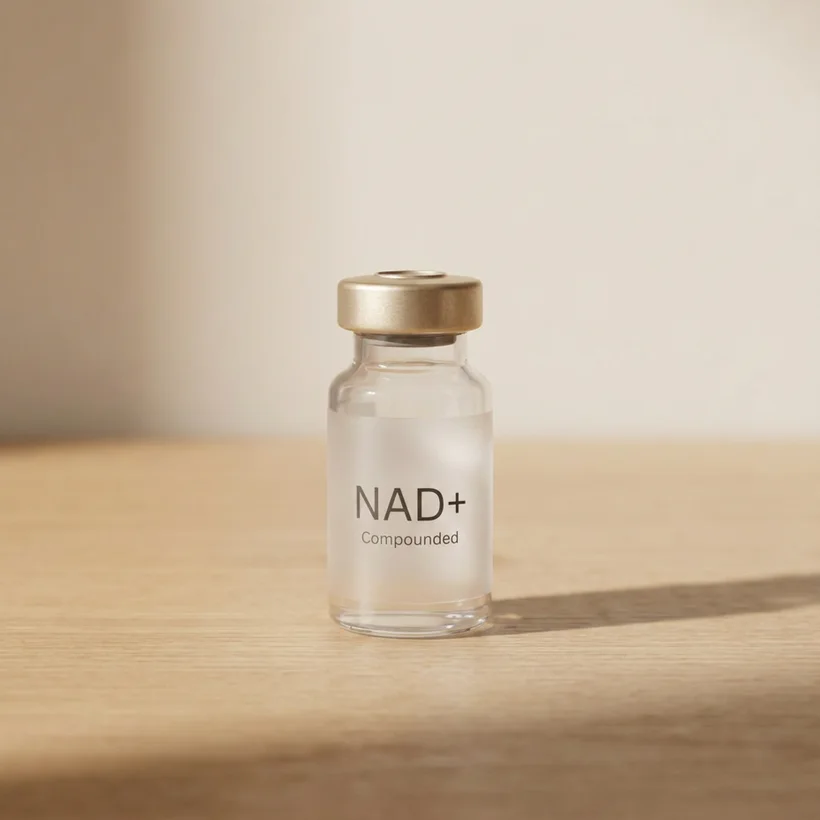
NAD+ Peptide Complex
Restore cellular energy and DNA repair capacity · From $179/mo · compounded by a licensed 503A pharmacy, dispensed only after provider review.
View NAD+ Peptide Complex →Hyperpigmentation and Uneven Tone
Age spots and uneven pigmentation are driven partly by oxidative stress and chronic inflammation in the skin. NAD+'s antioxidant support and anti-inflammatory effects may help address some of the cellular processes behind uneven pigmentation, though clinical data specific to hyperpigmentation is lacking.
Skin Cancer Prevention
As noted above, nicotinamide (a NAD+ precursor) has demonstrated a 23% reduction in new non-melanoma skin cancers in a randomized controlled trial . This makes NAD+ precursors one of the few supplements with strong clinical evidence for a dermatological outcome. This benefit is attributed to enhanced DNA repair capacity in skin cells exposed to UV radiation.
What the Research Shows (and What It Does Not)
- Strong mechanistic evidence: The roles of NAD+, PARPs, and sirtuins in skin cell biology are well characterized at the molecular level.
- Landmark clinical trial: The nicotinamide skin cancer prevention trial provides strong human evidence for the dermatological relevance of NAD+ metabolism.
- Consistent preclinical data: Animal and cell culture studies consistently show that NAD+ restoration supports skin DNA repair, collagen maintenance, and wound healing.
- Limited cosmetic outcome data: Large human trials measuring wrinkles, skin elasticity, or other cosmetic endpoints with NAD+ therapy haven't been published.
- Not a topical treatment: The evidence discussed here pertains to systemic NAD+ restoration (oral, injectable, or IV), not topical NAD+ application.
Safety and Side Effects
NAD+ therapy has a favorable safety profile. Common side effects are mild and include flushing, nausea, and injection site reactions. Nicotinamide has been used safely as a supplement for decades with minimal side effects .
There are no known skin-specific adverse effects of systemic NAD+ therapy. For complete safety information, see our NAD+ side effects guide. For dosing details, visit our NAD+ dosage guide.
How FormBlends Can Help
At FormBlends, we recognize that skin health reflects overall cellular health. Our licensed physicians can assess whether NAD+ therapy may support your skin health goals as part of a thorough wellness plan.
When you work with us, you receive:
- A personalized consultation with a licensed physician
- Pharmaceutical-grade NAD+ from licensed compounding pharmacies
- A protocol designed to support your skin health and broader wellness goals
- Ongoing medical supervision and adjustments as needed
We believe that healthy skin starts at the cellular level, and NAD+ therapy addresses skin health at its most fundamental.
Frequently Asked Questions
Can NAD+ improve the appearance of my skin?
The preclinical evidence suggests that NAD+ supports collagen maintenance, DNA repair, and reduced inflammation in skin cells. Some individuals report improvements in skin quality after starting NAD+ therapy. But large clinical trials measuring cosmetic skin outcomes haven't been published, so results can't be guaranteed.
Is NAD+ better than retinol for skin aging?
They work through entirely different mechanisms. Retinol (vitamin A) directly stimulates collagen production and cell turnover in skin. NAD+ works at a more fundamental cellular level, supporting energy production, DNA repair, and sirtuin activity. They aren't mutually exclusive and may complement each other as part of a thorough approach to skin health.
Should I use topical or systemic NAD+ for skin?
The research discussed in this guide pertains to systemic NAD+ restoration (oral, injectable, or IV). Topical NAD+ or nicotinamide products exist, but the evidence for systemic approaches is stronger and more extensive. Your physician can advise on the best approach for your goals.
Can NAD+ prevent skin cancer?
A randomized controlled trial showed that nicotinamide (500 mg twice daily) reduced new non-melanoma skin cancers by 23% in high-risk individuals. This is one of the strongest pieces of clinical evidence in the NAD+ field. But NAD+ isn't a substitute for sun protection, regular skin checks, or medical treatment for skin cancer.
How long does it take for NAD+ to affect skin health?
Skin cell turnover takes approximately 28 days, so visible changes may require at least one to two full turnover cycles. Internal improvements in DNA repair and cellular energy may begin sooner but take time to manifest as visible changes. Most individuals report noticing skin-related improvements after 4 to 8 weeks of consistent therapy.
Ready to Learn More?
If you're interested in supporting your skin health from the cellular level, FormBlends can connect you with a licensed physician for a personalized consultation. Our team is here to help you make informed decisions about NAD+ therapy and skin health.
Disclaimer: This article is for informational purposes only and doesn't constitute medical advice. NAD+ therapy isn't FDA-approved for any medical condition, including skin conditions. The information presented here is based on a combination of preclinical and clinical research and shouldn't be used as a substitute for professional medical guidance or dermatological care. Always consult with a licensed healthcare provider before beginning any therapy. Individual results may vary. FormBlends doesn't claim that NAD+ cures, treats, or prevents any disease.
Ready when you are
NAD+ Peptide Complex
Restore cellular energy and DNA repair capacity · From $179/mo · compounded by a licensed 503A pharmacy, dispensed only after provider review.
View NAD+ Peptide Complex →