
Deep research
About Oxytocin
Oxytocin is a cyclic nonapeptide hormone with the sequence Cys-Tyr-Ile-Gln-Asn-Cys-Pro-Leu-Gly-NH2, featuring a disulfide bond between Cys1 and Cys6 that creates the characteristic 20-membered ring structure important for receptor binding. Its molecular weight is approximately 1007 Da. Oxytocin is synthesized as a larger precursor (prepro-oxytocin) in magnocellular neurons of the paraventricular nucleus (PVN) and supraoptic nucleus (SON) of the hypothalamus, then transported along axons to the posterior pituitary gland for release into systemic circulation. It is also released centrally within the brain from dendritic processes, where it acts as a neuromodulator.
The mechanism of action involves binding to the oxytocin receptor (OXTR), a Gq/11-coupled G-protein-coupled receptor expressed in uterine smooth muscle, mammary myoepithelial cells, brain limbic structures (amygdala, hippocampus, nucleus accumbens, ventral tegmental area), cardiac tissue, and skin fibroblasts. Receptor activation triggers phospholipase C, IP3-mediated calcium release, and downstream signaling cascades. In the brain, oxytocin modulates neural circuits involved in social recognition, fear extinction, reward processing, and attachment behavior. In the amygdala specifically, oxytocin attenuates the fear response by reducing the excitability of output neurons that project to brainstem fear centers.
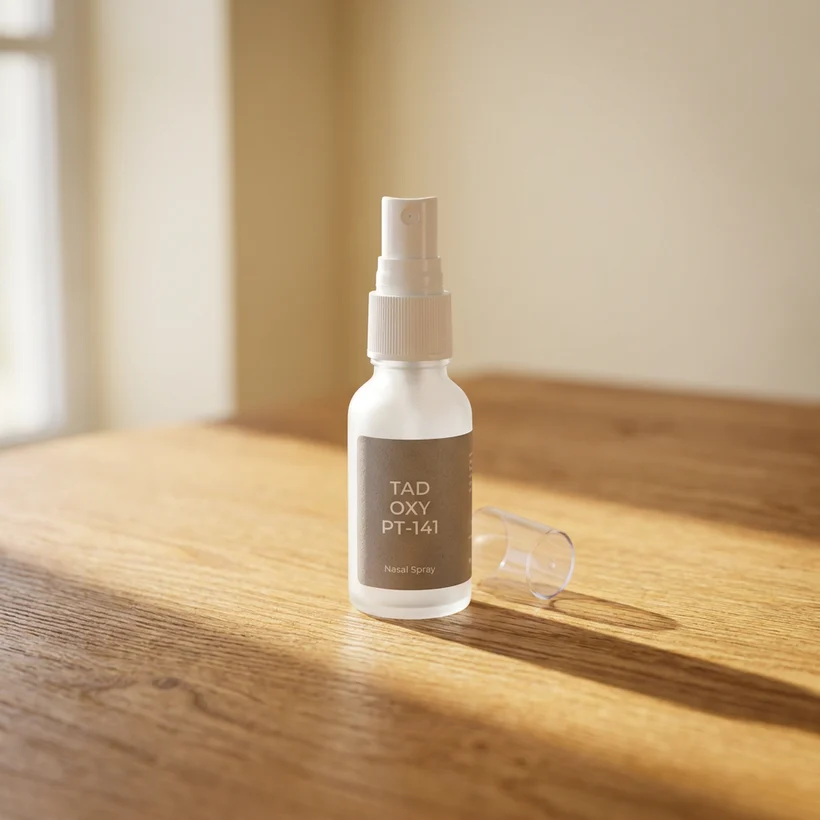
Intranasal oxytocin reaches the brain via the olfactory and trigeminal nerve pathways, bypassing the blood-brain barrier. CSF concentrations of oxytocin increase significantly within 30-45 minutes of intranasal administration, as demonstrated by lumbar puncture studies. A landmark study published in PNAS (2005, Kosfeld et al.) demonstrated that intranasal oxytocin (24 IU) increased trust behavior by 44% in an economic trust game paradigm. Subsequent studies in Nature Neuroscience confirmed that oxytocin enhances social memory, eye contact, and facial emotion recognition while reducing amygdala reactivity to threatening social stimuli.
In sexual wellness research, oxytocin is released endogenously during physical touch, arousal, and orgasm, with plasma levels peaking at 3-5 times baseline during orgasm. Exogenous intranasal oxytocin has been shown to enhance sexual arousal, increase orgasm intensity, and promote feelings of closeness and partner satisfaction in randomized controlled trials. A study in Psychoneuroendocrinology demonstrated improved sexual function scores in both men and women receiving intranasal oxytocin before sexual activity. Oxytocin also reduces cortisol responses to psychosocial stress by approximately 30%, as measured in the Trier Social Stress Test.
Pharmacokinetically, oxytocin has a plasma half-life of approximately 3-5 minutes when administered intravenously, due to rapid degradation by oxytocinase (placental leucine aminopeptidase) and renal clearance. Intranasal administration extends the effective CNS duration to approximately 2-4 hours, as the peptide deposited on the nasal mucosa is gradually absorbed. Intranasal bioavailability to the CNS is estimated at 2-5% of the administered dose, which is nonetheless sufficient to produce strong behavioral effects due to the high receptor density in target brain regions.
For storage and handling, oxytocin should be stored as lyophilized powder at -20C for long-term stability or at 2-8C for up to 90 days. Reconstituted solutions for nasal use should be kept at 2-8C and used within 4-6 weeks. The disulfide bond between Cys1 and Cys6 is critical for biological activity; reducing agents, extreme pH (below 3 or above 8), and prolonged exposure to temperatures above 25C can disrupt this bond and inactivate the peptide. Protect from light. Do not freeze reconstituted nasal spray solutions.
Oxytocin has one of the most extensive safety profiles of any peptide, based on decades of FDA-approved clinical use as Pitocin for labor induction and management of postpartum hemorrhage. At intranasal doses used in behavioral research (typically 20-40 IU), adverse effects are minimal and transient. The most commonly reported effects are mild nasal irritation and occasional drowsiness. Intranasal oxytocin does not cause uterine contractions at behavioral research doses. No dependence, tolerance, or withdrawal has been documented with repeated intranasal use. Rare reports of hyponatremia (water intoxication) exist only with intravenous infusion at obstetric doses, not with intranasal administration.