


Deep research
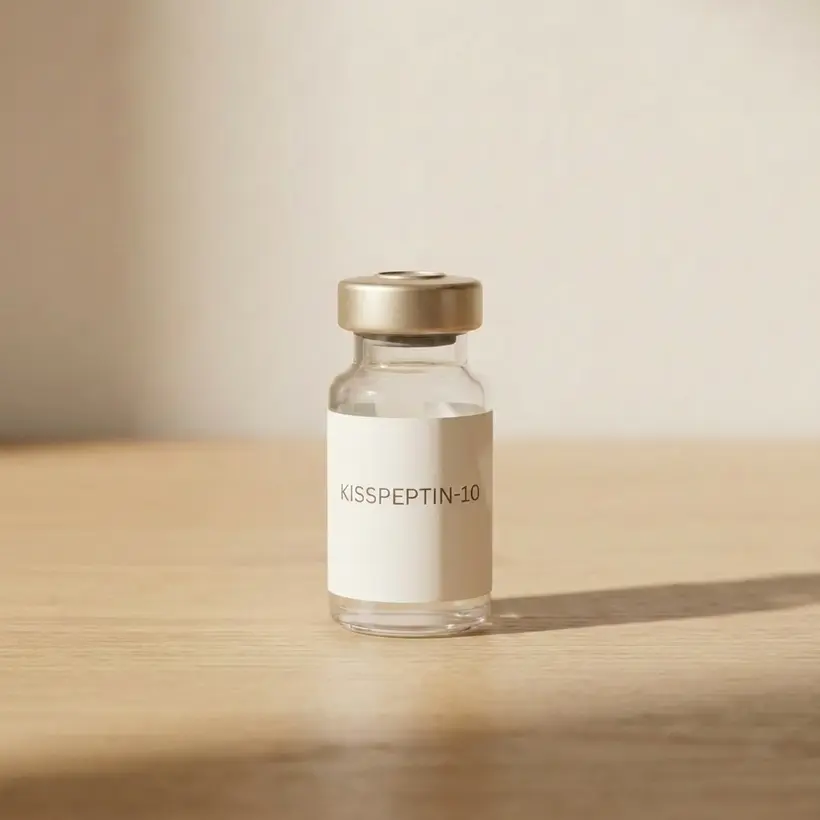
About Kisspeptin-10
Kisspeptin-10 is the minimal bioactive fragment of the KISS1 gene product, consisting of the C-terminal 10 amino acids (Tyr-Asn-Trp-Asn-Ser-Phe-Gly-Leu-Arg-Phe-NH2) with an approximate molecular weight of 1302 Da. The full-length kisspeptin (kisspeptin-54, also called metastin) was originally discovered as a metastasis-suppressor gene product, but its role as the master regulator of the reproductive axis was established when loss-of-function mutations in its receptor KISS1R (formerly GPR54) were found to cause hypogonadotropic hypogonadism and absent puberty in humans, published in the New England Journal of Medicine in 2003.
The mechanism of action is hierarchically positioned at the very top of the hypothalamic-pituitary-gonadal (HPG) axis. Kisspeptin neurons in the arcuate nucleus and anteroventral periventricular nucleus (AVPV) of the hypothalamus project directly to GnRH neurons, which express KISS1R on their cell surface. Kisspeptin binding to KISS1R activates Gq/11-coupled signaling, triggering phospholipase C, IP3-mediated calcium release, and PKC activation in GnRH neurons. This depolarizes the GnRH neuron and stimulates pulsatile release of GnRH into the hypothalamic-hypophyseal portal system. GnRH then acts on anterior pituitary gonadotrophs to release LH and FSH, which drive gonadal steroidogenesis (testosterone, estrogen) and gametogenesis (sperm, oocytes).
What distinguishes kisspeptin from other reproductive peptides is its unique effect on sexual arousal that is independent of its hormonal actions. A landmark study by Dhillo and colleagues published in the Journal of Clinical Investigation (2017) used functional MRI (fMRI) to demonstrate that intravenous kisspeptin-54 enhanced brain activity in limbic and paralimbic regions (including the amygdala, cingulate cortex, and globus pallidus) specifically in response to sexual stimuli. Kisspeptin also increased penile tumescence in response to erotic visual content and reduced negative mood, as measured by validated psychometric scales. These effects were observed even when controlling for the hormonal (LH/testosterone) changes, demonstrating a direct central nervous system effect on sexual processing.
Intravenous kisspeptin-10 produces a rapid and strong LH secretory response, with LH levels increasing 5- to 10-fold within 30 minutes of administration. This response is used clinically and in research as a diagnostic test of hypothalamic-pituitary integrity. The LH response to kisspeptin is absent in patients with GnRH neuron deficiency (Kallmann syndrome) and blunted in hypothalamic amenorrhea, making it a useful tool for differential diagnosis of reproductive disorders.
Pharmacokinetically, kisspeptin-10 has a plasma half-life of approximately 4 minutes after intravenous administration, rapidly degraded by circulating proteases. Subcutaneous administration extends the effective duration to approximately 30-60 minutes. The short half-life may actually be advantageous, as it allows pulsatile-like stimulation of GnRH neurons that mimics the natural kisspeptin secretory pattern, avoiding the receptor desensitization that occurs with continuous GnRH agonist exposure.
For storage and handling, kisspeptin-10 should be stored as lyophilized powder at -20C for long-term stability or 2-8C for up to 30 days. Reconstitute with bacteriostatic water or sterile 0.9% saline. Reconstituted solutions should be kept at 2-8C and used within 2-4 weeks. The peptide is stable at pH 4-7 in aqueous solution. Avoid repeated freeze-thaw cycles and protect from light.
Safety data from clinical research studies (published in JCI, Lancet Diabetes & Endocrinology, and Journal of Clinical Endocrinology & Metabolism) shows kisspeptin administration is well-tolerated. No serious adverse events have been reported in studies involving over 500 human subjects. The most common effects are transient facial flushing and warmth, consistent with the expected hormonal changes. Kisspeptin does not cause ovarian hyperstimulation syndrome (OHSS) when used to trigger ovulation in IVF protocols, a significant safety advantage over hCG triggers. No cardiovascular, hepatic, or renal adverse effects have been documented.