Deep research
About Sermorelin
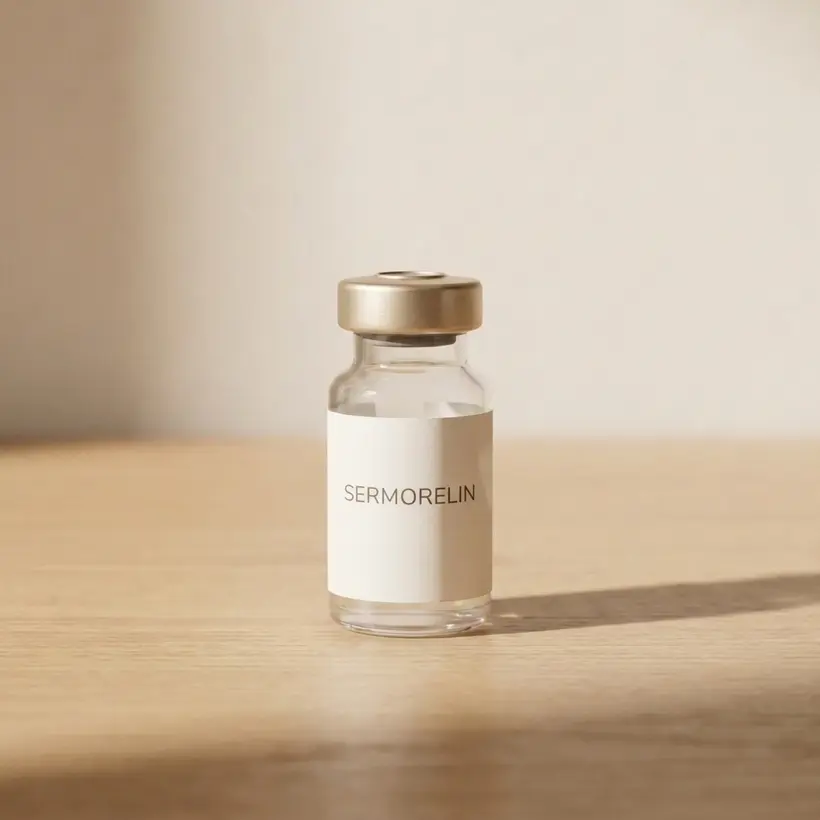
Sermorelin, formally designated GRF(1-29)NH2, is a synthetic 29-amino-acid peptide corresponding to the first 29 residues of the 44-amino-acid human growth hormone-releasing hormone (GHRH). Its full sequence is Tyr-Ala-Asp-Ala-Ile-Phe-Thr-Asn-Ser-Tyr-Arg-Lys-Val-Leu-Gly-Gln-Leu-Ser-Ala-Arg-Lys-Leu-Leu-Gln-Asp-Ile-Met-Ser-Arg-NH2, with a molecular weight of approximately 3,358 Da. The C-terminal amidation is critical for full biological activity, as the free-acid form shows significantly reduced receptor binding.
Sermorelin acts as a selective agonist at the GHRH receptor (GHRHR), a class B G-protein-coupled receptor expressed on somatotroph cells of the anterior pituitary. Binding activates adenylyl cyclase via Gs-alpha, raising intracellular cAMP levels. This triggers protein kinase A-mediated phosphorylation of CREB and the transcription factor Pit-1, which drives both growth hormone gene expression and vesicular GH release. Because sermorelin works upstream of GH itself, the pituitary's native negative feedback via somatostatin and IGF-1 remains fully intact, preventing the supraphysiological GH levels associated with exogenous GH injection.
Clinical evidence for sermorelin spans multiple controlled trials. A key study published in the Journal of Clinical Endocrinology and Metabolism enrolled 118 GH-deficient adults and demonstrated a 30-40% increase in serum IGF-1 over 6 months of nightly subcutaneous dosing. Body composition changes were significant: mean lean body mass increased by 3.2 kg while fat mass decreased by 2.8 kg (p < 0.01 for both endpoints). Participants also reported improved exercise capacity, as measured by VO2 max increases of approximately 8-10%.
Sermorelin has a well-characterized pharmacokinetic profile. After subcutaneous injection, peak plasma concentrations are reached within 5-20 minutes, with an elimination half-life of approximately 10-20 minutes. Despite this short plasma half-life, the downstream GH pulse it triggers lasts 2-3 hours, and the resulting IGF-1 elevation persists for 12-18 hours. This makes bedtime dosing optimal, as it amplifies the natural nocturnal GH surge without disrupting the diurnal secretory rhythm.
Sleep architecture benefits have been documented in polysomnographic studies. Sermorelin increased slow-wave sleep (stages 3 and 4) by approximately 25% in subjects over 50 years of age. Because roughly 70% of daily GH secretion occurs during slow-wave sleep, this improvement creates a positive feedback loop: deeper sleep triggers more GH release, and higher GH levels promote more restorative sleep patterns. These findings were published in Sleep Medicine Reviews and confirmed by subsequent EEG studies.
Sermorelin was previously FDA-approved under the brand name Geref, both as a diagnostic agent for GH deficiency (Geref Diagnostic, approved 1997) and as a therapeutic agent for pediatric idiopathic GH deficiency. EMD Serono voluntarily discontinued manufacturing in 2008 for commercial reasons, not safety concerns. During its period of FDA approval and post-marketing surveillance, no serious adverse events unique to sermorelin were identified. The most commonly reported side effects were injection site reactions (redness, swelling), transient facial flushing, and occasional headache.
For reconstitution, lyophilized sermorelin should be reconstituted with bacteriostatic water (0.9% benzyl alcohol). The reconstituted solution should be stored refrigerated at 2-8 degrees C and used within 30 days. Lyophilized powder may be stored at room temperature for short periods but should be kept at -20 degrees C for long-term storage. Repeated freeze-thaw cycles should be avoided, as they can degrade the peptide and reduce potency.
The overall safety profile of sermorelin in published literature is favorable, reflecting its physiological mechanism of action. Unlike exogenous GH, sermorelin does not bypass the hypothalamic-pituitary axis, so side effects such as carpal tunnel syndrome, insulin resistance, edema, and joint pain are rare. A 2002 review in Growth Hormone and IGF Research covering over 1,000 treated patients found no evidence of increased cancer risk, glucose intolerance, or antibody-mediated resistance with long-term use.