Key Takeaway
Learn about the Sermorelin and CJC-1295/Ipamorelin growth hormone stack protocol. Understand how these peptides work together, what the research supports, and protocol considerations.
Quick Answer: The Sermorelin and CJC-1295/Ipamorelin growth hormone stack combines three growth hormone secretagogues (GHS) that stimulate the body's natural production of growth hormone through different but complementary mechanisms. Sermorelin acts as a GHRH analog with a short half-life, CJC-1295 extends GHRH signaling with a longer duration, and Ipamorelin stimulates GH release through the ghrelin receptor without significantly affecting cortisol or prolactin. This stack is designed to improve the GH pulse pattern. All protocols should be physician-supervised. Sermorelin has FDA approval history. CJC-1295 and Ipamorelin aren't FDA-approved .
Stack Overview
Growth hormone (GH) production declines naturally with age, a process sometimes called somatopause. By the time most adults reach their 40s and 50s, GH output has decreased significantly from its peak during adolescence and early adulthood . This decline is associated with changes in body composition, recovery capacity, sleep quality, and skin health, though the degree varies widely among individuals.
Rather than replacing GH directly (as with synthetic HGH), growth hormone secretagogues work by stimulating the pituitary gland to produce and release more of its own growth hormone. This approach preserves the body's natural pulsatile release pattern and feedback mechanisms, which is a meaningful distinction from exogenous GH administration.
This stack combines three secretagogues that operate through different receptors and timeframes:
- Sermorelin: A 29-amino-acid analog of growth hormone-releasing hormone (GHRH). It was previously FDA-approved for diagnostic use and pediatric GH deficiency . It has a short half-life, producing acute GH pulses that mimic the body's natural secretion pattern.
- CJC-1295: A modified GHRH analog with an extended half-life, often formulated with Drug Affinity Complex (DAC) or without DAC (sometimes called modified GRF 1-29 or CJC-1295 no DAC). The DAC version provides sustained GHRH receptor activation over days, while the no-DAC version has a shorter but still extended duration compared to Sermorelin .
- Ipamorelin: A selective growth hormone secretagogue that acts on the ghrelin (GHS) receptor to stimulate GH release. It's notable for its selectivity, producing GH release without significantly increasing cortisol, prolactin, or ACTH at typical doses .
Why These Work Together
The rationale for this three-peptide stack is rooted in the biology of growth hormone regulation. GH release from the pituitary is controlled by two primary signals:

- GHRH (growth hormone-releasing hormone): Stimulates GH synthesis and release.
- Ghrelin/GHS receptor signaling: Amplifies GH release, particularly in the context of existing GHRH signaling.
A third factor, somatostatin, acts as a brake on GH release. The interplay between these signals creates the pulsatile pattern of GH secretion that's characteristic of healthy physiology.
Sermorelin + CJC-1295: Dual GHRH Signaling
Sermorelin provides a rapid, acute GHRH signal that closely mimics natural GHRH pulses. Its short half-life (approximately 10 to 20 minutes) means it creates a sharp but brief GH pulse . CJC-1295 extends GHRH receptor activation, maintaining improved baseline GH signaling between Sermorelin-driven pulses. Together, they create both the sharp peaks and the improved baseline that characterize a more youthful GH secretion pattern.
Adding Ipamorelin: Amplification Through a Second Pathway
Ipamorelin acts on the ghrelin receptor, which is a separate receptor from the GHRH receptor. Research has demonstrated that simultaneous stimulation of both the GHRH and ghrelin pathways produces a combined (greater than additive) GH response . By adding Ipamorelin to the GHRH-based signals from Sermorelin and CJC-1295, the stack amplifies GH output through two distinct receptor systems.
Ipamorelin's selectivity is a key advantage. Unlike older ghrelin mimetics (such as GHRP-6 or GHRP-2), Ipamorelin doesn't significantly increase appetite, cortisol, or prolactin, making it a cleaner addition to the stack .
Preserving Pulsatility
One of the most important aspects of this stack design is that it works with the body's natural GH regulation rather than overriding it. Exogenous GH administration delivers a constant, non-pulsatile supply that can suppress the body's own GH production through negative feedback. Secretagogues, by contrast, stimulate the pituitary to release GH in its natural pulsatile pattern, preserving the feedback loop .
What the Research Shows
Established Evidence
- Sermorelin: Has the most strong clinical data in this stack. It was FDA-approved (as Geref) for the diagnosis and treatment of growth hormone deficiency in children. Clinical studies demonstrated its ability to increase GH production, improve body composition, and enhance sleep quality in adults . Its manufacturing was discontinued for commercial reasons, not safety concerns, and it remains available through compounding pharmacies.
- CJC-1295: Phase I and Phase II clinical studies demonstrated significant, sustained increases in GH and IGF-1 levels with generally good tolerability . The DAC version showed particularly prolonged effects.
- Ipamorelin: Clinical studies confirmed dose-dependent GH release with minimal effects on cortisol, ACTH, and prolactin . Studies also evaluated its potential for post-surgical gut recovery.
- GHRH + GHS combined effect: Published research supports the concept that combined GHRH and ghrelin-pathway stimulation produces combined GH release. This has been demonstrated with GHRH and GHRP-6, and the principle extends to the specific compounds in this stack .
Theoretical
- The specific three-way combination of Sermorelin + CJC-1295 + Ipamorelin hasn't been evaluated in a published controlled clinical trial.
- Long-term outcomes data for this particular stack is based on clinical experience rather than multi-year prospective studies.
- The optimal ratio and timing of all three peptides together hasn't been established through comparative clinical research.
Protocol Considerations
Protocols for this stack are individualized by the prescribing physician. The following outlines general concepts that practitioners consider.
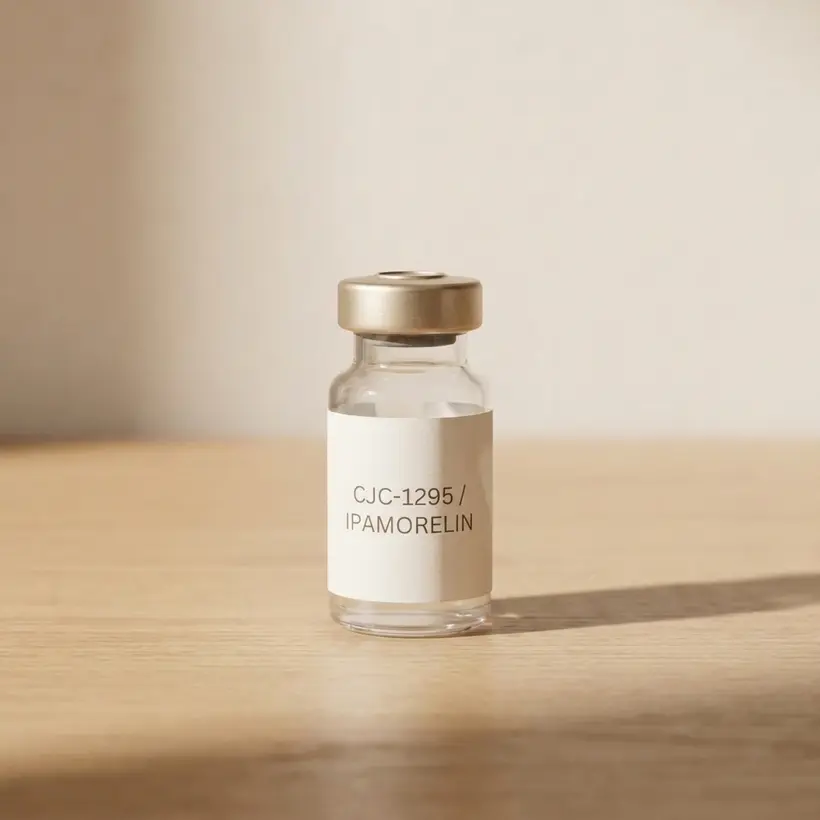
From the FormBlends catalog
CJC-1295 / Ipamorelin Blend
The gold standard growth hormone secretagogue stack · From $69/mo · compounded by a licensed 503A pharmacy, dispensed only after provider review.
Learn about CJC-1295 / Ipamorelin Blend →Administration
All three peptides are typically administered via subcutaneous injection. Many practitioners recommend evening administration (before bed) to align with the body's natural nocturnal GH pulse, which is the largest of the day . Some protocols use split dosing (morning and evening) depending on the specific formulation and the patient's goals.
Timing Relative to Food
GH release is blunted by improved blood sugar and insulin. Most protocols specify that peptides should be administered on an empty stomach, typically at least 60 to 90 minutes after the last meal, and that food should be avoided for a period after injection . This is one of the more important practical details for maximizing the stack's effectiveness.
CJC-1295 Variants
The choice between CJC-1295 with DAC and CJC-1295 without DAC (modified GRF 1-29) significantly affects protocol design. The DAC version has a half-life of approximately 6 to 8 days, allowing for less frequent administration (often once or twice per week) . The no-DAC version has a shorter half-life and is typically administered daily alongside Sermorelin and Ipamorelin. Your physician will select the variant best suited to your situation.
Duration and Cycling
GH secretagogue protocols are often designed as extended courses running several months, as the benefits of improved GH status (body composition changes, recovery enhancement, skin and sleep improvements) develop gradually. Some practitioners incorporate cycling (periods on, followed by breaks) to maintain pituitary sensitivity, while others use continuous protocols with periodic reassessment.
Monitoring
Physicians typically monitor IGF-1 levels (a stable marker of GH status) through periodic blood work. This provides an objective measure of whether the stack is producing the desired hormonal response and helps guide protocol adjustments. Other markers that may be monitored include fasting glucose, insulin, and general metabolic panels.
Safety
Growth hormone secretagogues have a different safety profile from exogenous GH because they work within the body's natural regulatory framework.
Sermorelin has the longest clinical track record in this stack and has demonstrated a favorable safety profile across its history of clinical use . CJC-1295 was well tolerated in early-phase clinical trials. Ipamorelin's selectivity (minimal effects on cortisol and prolactin) gives it a cleaner side effect profile compared to older ghrelin mimetics .
Because this stack improves GH and IGF-1, the same contraindications that apply to growth hormone therapy apply here:
- Active cancer or history of cancer (GH and IGF-1 can promote cell proliferation)
- Active diabetic retinopathy
- Certain pituitary conditions
Physician monitoring, including periodic IGF-1 testing, helps ensure that GH levels remain within a safe and therapeutic range.
Frequently Asked Questions
Why use three peptides instead of just one?
Each peptide addresses GH release through a different mechanism or timeframe. Sermorelin provides acute pulses, CJC-1295 provides sustained baseline signaling, and Ipamorelin amplifies the response through a separate receptor pathway. The combination is designed to produce a more complete and strong GH response than any single peptide alone. This combined effect principle is supported by published research on dual-pathway GH stimulation.
How does this stack compare to injectable HGH?
Exogenous HGH delivers growth hormone directly and bypasses the pituitary gland, which can suppress natural GH production over time. This stack stimulates your own pituitary to produce more GH, preserving the natural pulsatile release pattern and feedback mechanisms. The trade-off is that the GH increases are generally more moderate than what pharmacological HGH doses produce, but the approach is considered more physiological.
How long before I notice results?
GH-related improvements develop gradually. Improved sleep quality is often the earliest reported benefit (within the first few weeks). Body composition changes, skin improvements, and enhanced recovery typically become noticeable over two to three months. Your physician will track IGF-1 levels to confirm the biochemical response independent of subjective observations.
Can I use this stack if I am over 60?
Age-related GH decline is actually one of the primary reasons this stack is considered. But older individuals may have different contraindications or baseline health considerations. A thorough medical evaluation is important before starting, and monitoring may be more frequent. Your physician will assess your individual suitability.
Get a Physician-Designed GH Protocol
Growth hormone improvement requires precise protocol design and medical monitoring. At FormBlends, our licensed physicians evaluate your hormonal status, health history, and goals to determine whether this stack is appropriate and to design a protocol tailored to your physiology.
Disclaimer: This article is for informational purposes only and doesn't constitute medical advice. CJC-1295 and Ipamorelin aren't FDA-approved for any medical condition. Sermorelin was previously FDA-approved but is currently available through compounding pharmacies. The information presented here is based on published clinical and preclinical research and shouldn't be used as a substitute for professional medical guidance. Always consult with a licensed healthcare provider before beginning any peptide therapy. Individual results may vary. FormBlends doesn't claim that any peptide cures, treats, or prevents any disease.
Ready when you are
CJC-1295 / Ipamorelin Blend
The gold standard growth hormone secretagogue stack · From $69/mo · compounded by a licensed 503A pharmacy, dispensed only after provider review.
Learn about CJC-1295 / Ipamorelin Blend →