

Deep research
About VIP (Vasoactive Intestinal Peptide)
Vasoactive Intestinal Peptide (VIP) is a 28-amino-acid linear neuropeptide with the sequence His-Ser-Asp-Ala-Val-Phe-Thr-Asp-Asn-Tyr-Thr-Arg-Leu-Arg-Lys-Gln-Met-Ala-Val-Lys-Lys-Tyr-Leu-Asn-Ser-Ile-Leu-Asn-NH2, with a molecular weight of approximately 3326 Da. First isolated from porcine small intestine by Said and Mutt in 1970, VIP is now recognized as one of the most functionally diverse neuropeptides in human physiology, with roles spanning immunology, neuroscience, pulmonary medicine, and circadian biology.
VIP signals through two G-protein-coupled receptors: VPAC1 (widely expressed on immune cells, epithelial cells, and neurons) and VPAC2 (predominant in smooth muscle, the suprachiasmatic nucleus, and pancreatic beta cells). Both receptors couple to Gs proteins, activating adenylyl cyclase and raising intracellular cAMP levels. The downstream cAMP/PKA/CREB signaling cascade mediates most of VIP's biological effects, including anti-inflammatory gene transcription, smooth muscle relaxation, and neuroprotective gene expression.
VIP's anti-inflammatory mechanism is among the most thoroughly characterized of any endogenous peptide. It shifts T-cell differentiation from pro-inflammatory Th1/Th17 phenotypes toward regulatory Th2/Treg phenotypes by modulating dendritic cell maturation. It suppresses NF-kB-dependent transcription in macrophages, reducing production of TNF-alpha, IL-6, IL-12, and nitric oxide. Simultaneously, it promotes generation of CD4+CD25+FoxP3+ regulatory T-cells that actively suppress autoimmune and inflammatory responses. These mechanisms have been demonstrated in models of rheumatoid arthritis, multiple sclerosis, inflammatory bowel disease, and septic shock, published in PNAS, Journal of Immunology, and Journal of Experimental Medicine.
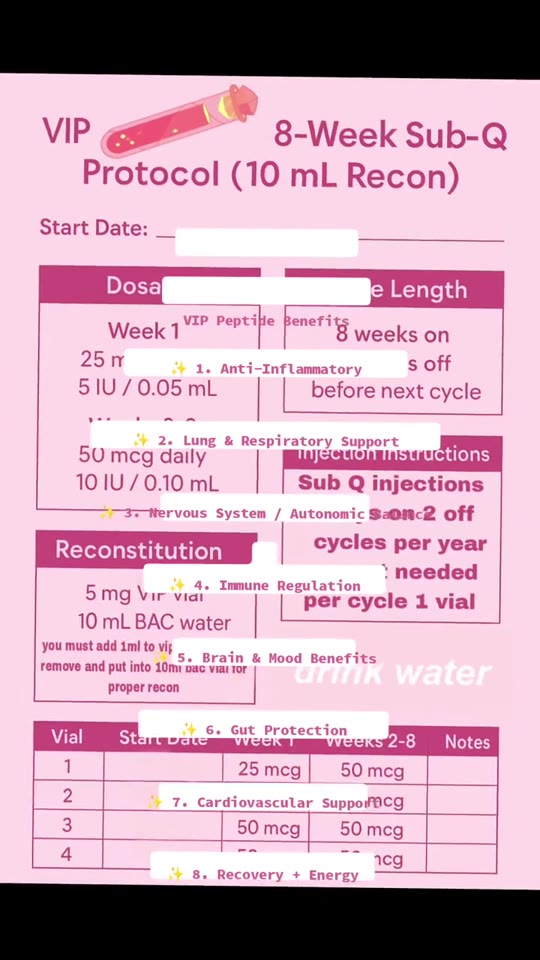
In clinical practice, VIP nasal spray is used as the final step in Dr. Ritchie Shoemaker's protocol for Chronic Inflammatory Response Syndrome (CIRS), a multisystem illness triggered by biotoxin exposure (typically water-damaged buildings). Clinical data from CIRS treatment cohorts shows that VIP nasal spray (50 mcg four times daily) normalizes TGF-beta1, MMP-9, VEGF, and C4a complement levels in over 90% of patients who have completed prior protocol steps. VIP also restores the characteristic gray matter nuclear atrophy seen on NeuroQuant MRI in CIRS patients.
VIP serves as the dominant synchronizing signal in the suprachiasmatic nucleus (SCN), the brain's master circadian clock. VIP-expressing neurons in the SCN coordinate the firing patterns of neighboring clock neurons, maintaining coherent circadian rhythms. VIP knockout mice show severely disrupted sleep-wake cycles, feeding rhythms, and hormonal cycles. This circadian role makes VIP relevant to jet lag, shift work, and age-related circadian disruption.
Pharmacokinetically, VIP has a plasma half-life of approximately 1-2 minutes due to rapid degradation by dipeptidyl peptidase IV (DPP-IV) and neutral endopeptidase (NEP). Intranasal administration bypasses systemic degradation and delivers VIP directly to brain tissue via the olfactory pathway and to pulmonary tissue via mucosal absorption. The FDA has granted VIP Orphan Drug designation for the treatment of pulmonary arterial hypertension, based on its potent bronchodilatory and vasodilatory effects in the pulmonary vasculature.
Storage and handling: VIP is supplied as a lyophilized powder that should be stored at -20C for long-term stability. Reconstitute with bacteriostatic water for injection. Reconstituted solutions for nasal use should be stored at 2-8C and used within 30 days. VIP is sensitive to oxidation at the methionine-17 residue; minimize air exposure and protect from light. Do not freeze reconstituted nasal spray solutions, as freeze-thaw cycles can degrade the peptide.
Safety data for VIP comes from both clinical trials and the CIRS treatment literature. At intranasal doses of 50 mcg four times daily, VIP is well-tolerated with no significant adverse events reported in published CIRS cohorts. Potential side effects at higher systemic doses include transient hypotension (consistent with its vasodilatory activity), facial flushing, and watery diarrhea (consistent with its enteric secretomotor function). VIP does not cause immunosuppression; rather, it redirects immune responses from destructive inflammatory patterns toward regulated, tolerogenic patterns.