
Deep research
About LL-37
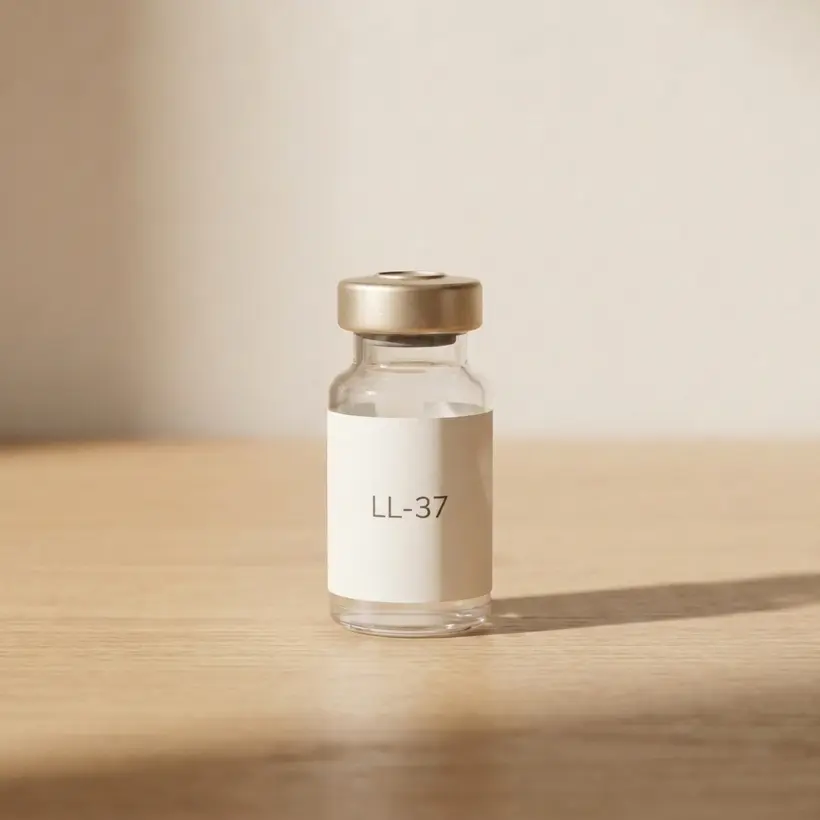
LL-37 is the only member of the cathelicidin antimicrobial peptide family found in humans. It is a 37-amino acid peptide with a molecular weight of approximately 4,493 Da, beginning with two leucine residues (hence the name LL-37). The full sequence is LLGDFFRKSKEKIGKEFKRIVQRIKDFLRNLVPRTES. LL-37 is cleaved from its precursor protein hCAP18 (human cationic antimicrobial protein, 18 kDa) by the serine protease proteinase 3 in neutrophils and by kallikreins in keratinocytes. The gene encoding hCAP18/LL-37 is CAMP (cathelicidin antimicrobial peptide), located on chromosome 3.
The antimicrobial mechanism of LL-37 relies on its amphipathic alpha-helical structure. In aqueous solution, LL-37 adopts a random coil conformation, but upon contact with bacterial membranes, it transitions to an alpha-helix that inserts into the lipid bilayer. This creates toroidal pores that disrupt membrane integrity, leading to rapid bacterial lysis. Minimum inhibitory concentrations (MIC) against common pathogens include 1-4 ug/mL for Staphylococcus aureus, 1-2 ug/mL for Escherichia coli, and 2-4 ug/mL for Pseudomonas aeruginosa. LL-37 also shows antifungal activity against Candida species and antiviral activity against enveloped viruses including influenza and respiratory syncytial virus.
Beyond direct antimicrobial killing, LL-37 functions as a potent immunomodulatory signaling molecule. It acts as a chemoattractant for neutrophils, monocytes, and T-cells through formyl peptide receptor-like 1 (FPRL1) activation. It promotes wound healing by stimulating keratinocyte migration and proliferation, induces angiogenesis via VEGF upregulation, and modulates dendritic cell differentiation. LL-37 neutralizes lipopolysaccharide (LPS/endotoxin) at nanomolar concentrations by directly binding the lipid A moiety, preventing TLR4 activation and the subsequent inflammatory cascade that can lead to septic shock.
LL-37 demonstrates significant anti-biofilm activity, disrupting established biofilms of Pseudomonas aeruginosa, Staphylococcus epidermidis, and Staphylococcus aureus by 60-80% at sub-MIC concentrations (published in PLoS ONE and Antimicrobial Agents and Chemotherapy). This is clinically relevant because biofilm-associated infections on medical devices and chronic wounds are notoriously resistant to conventional antibiotics. LL-37 both prevents biofilm formation and penetrates existing biofilm matrices.
Clinical relevance of LL-37 deficiency is well-documented. Patients with morbus Kostmann (severe congenital neutropenia) lack LL-37 expression and suffer from severe periodontal disease despite normal neutrophil counts after G-CSF treatment. Individuals with low vitamin D levels (vitamin D directly regulates CAMP gene transcription) have reduced LL-37 production and increased susceptibility to respiratory infections, urinary tract infections, and chronic wound healing impairment. This vitamin D-LL-37 axis has been proposed as a mechanism underlying the association between vitamin D deficiency and infectious disease susceptibility.
LL-37 is administered subcutaneously in research protocols, with typical doses ranging from 50-200 mcg. The peptide has a plasma half-life of approximately 30-60 minutes and is degraded by serum proteases. Local tissue concentrations at injection sites remain elevated for several hours. LL-37 is also produced endogenously in response to infection, vitamin D signaling, and tissue injury, primarily by neutrophils (stored in specific granules at 630 ug per 10^9 cells), macrophages, and epithelial cells of the skin, respiratory tract, and urinary tract.
Lyophilized LL-37 should be stored at -20C and is stable for 18+ months. Reconstituted solutions should be refrigerated at 2-8C and used within 14 days. The peptide is soluble in water at concentrations up to 5 mg/mL. LL-37 can adsorb to glass and plastic surfaces at low concentrations, so polypropylene tubes with low-binding surfaces are recommended. Solutions should be clear; turbidity indicates aggregation and loss of activity.
The safety profile of LL-37 reflects its endogenous origin. At physiological concentrations, LL-37 is well-tolerated. At high concentrations (above 25 ug/mL), LL-37 can exhibit cytotoxicity to mammalian cells through the same membrane-disrupting mechanism used against bacteria, though selectivity for bacterial membranes is approximately 10-fold. In preclinical studies, subcutaneous injection at research doses produced no systemic toxicity. Excessive LL-37 expression has been associated with inflammatory skin conditions (rosacea, psoriasis), underscoring the importance of appropriate dosing in research settings.