Key Takeaway
If your provider has prescribed a lyophilized peptide, you need to know how to reconstitute a peptide with bacteriostatic water before your first injection. This how reconstitute peptide bacteriostatic water resource covers the important information you need to make informed decisions.
If your provider has prescribed a lyophilized peptide, you need to know how to reconstitute a peptide with bacteriostatic water before your first injection. This how reconstitute peptide bacteriostatic water resource covers the important information you need to make informed decisions. Reconstitution simply means adding sterile water to a freeze-dried powder to create an injectable solution. It sounds intimidating, but the process takes about two minutes once you have done it a few times. This guide covers every step, every common mistake, and exactly what supplies you need.
Key Takeaways: - Understand what you need before you start - Step-by-Step Reconstitution Process - Common Mistakes That Ruin Your Peptide - Learn how to tell if your reconstituted peptide is still good
What You Need Before You Start
Before you open anything, gather all your supplies on a clean surface. You'll need your lyophilized peptide vial, a vial of bacteriostatic (BAC) water, alcohol swabs, and a sterile syringe for drawing the water.
Bacteriostatic water is sterile water that contains 0.9% benzyl alcohol. The benzyl alcohol prevents bacterial growth, which means your reconstituted peptide stays safer for multiple draws over several weeks. Never use plain sterile water, saline, or tap water. These don't have the preservative and increase contamination risk.
Use a standard 1mL insulin syringe or a 3mL syringe with a separate needle to draw and transfer the BAC water. A 25-gauge or 27-gauge needle works well for piercing the rubber stoppers without coring them.
Make sure your hands are freshly washed. Work on a clean, flat surface away from pets, dust, and drafts. Some people wear disposable gloves for an extra layer of cleanliness, though it isn't strictly required if your hands are clean.
If you're unsure how much BAC water to add, use the FormBlends to find the right volume based on your vial size and prescribed dose.
"GLP-1 receptor agonists represent the most significant advance in obesity pharmacotherapy in decades. For the first time, we have medications that produce weight loss approaching what was previously only achievable through bariatric surgery.") Dr. Robert Kushner, MD, Northwestern University, speaking at ObesityWeek 2023
Step-by-Step Reconstitution Process
Follow these steps in order every time you reconstitute a new vial.
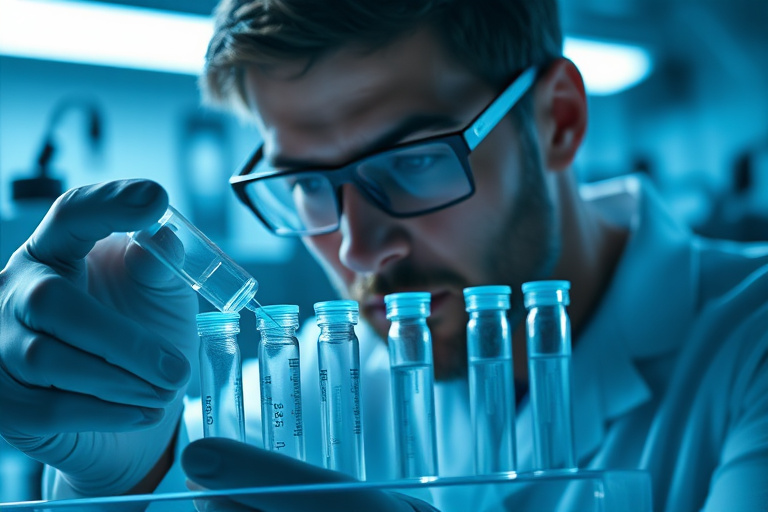
Step 1[1]: Swab both vial tops. Use a fresh alcohol swab on the rubber stopper of your peptide vial. Use another swab on the BAC water vial. Rub in a circular motion and let each air dry for about 30 seconds. Don't blow on them.
Step 2: Draw BAC water into the syringe. Pierce the BAC water vial stopper with your syringe needle. Turn the vial upside down. Pull back the plunger slowly to draw the amount of water your calculator or provider specified. Common amounts are 1mL or 2mL.
Step 3: Remove air bubbles. With the syringe pointing up, flick it gently to move any air bubbles to the top. Push the plunger up slightly to expel the air. This step matters because air takes up volume and throws off your measurement.
Free Download: Dose Conversion Table Never second-guess your syringe readings again. Our dose conversion table covers every common vial size and BAC water combination so you can confirm your draw volume at a glance. Get yours free (we'll email it to you instantly. [Download Now]
Step 4: Inject water into the peptide vial. Pierce the peptide vial stopper. Here is the critical part. Aim the needle at the inside wall of the vial, not directly at the powder. Depress the plunger slowly. Let the water trickle down the glass wall and onto the powder gently. This prevents damaging the peptide structure.
Step 5: Swirl gently. Never shake. Once the water is in, remove the needle. Pick up the vial and roll it gently between your palms. You can also swirl it in small circles. Don't shake the vial. Shaking creates bubbles and can denature the peptide, reducing its effectiveness.
Step 6: Wait for the powder to dissolve. Most peptides dissolve within one to two minutes. The solution should be clear or slightly tinted depending on the peptide. If particles remain after five minutes of gentle swirling, wait a bit longer. Don't inject a solution that's cloudy or has visible particles.
Step 7: Store properly. Your reconstituted peptide goes in the refrigerator at 36 to 46 degrees Fahrenheit (2 to 8 degrees Celsius). Write the reconstitution date on the vial with a marker. Most reconstituted peptides should be used within 28 days.
Common Mistakes That Ruin Your Peptide
Knowing what not to do is just as important as the steps above. Here are the mistakes that can waste your vial or reduce peptide potency.
Get pre-measured GLP-1 doses shipped to your door
No mixing, no guesswork. FormBlends medications come ready to inject with clear dosing instructions.
Start Free Assessment →Spraying water directly onto the powder. Firing the water straight down onto the lyophilized cake can damage peptide bonds. Always aim for the vial wall and let gravity do the work.
Shaking the vial. This is the most common mistake. Vigorous shaking introduces air bubbles and can break down fragile peptide chains. Gentle swirling is all you need.
Using the wrong water. Sterile water without preservative is fine for single-use vials but risky for multi-dose vials. BAC water is the standard for peptides you'll draw from multiple times.
Touching the needle or stopper after swabbing. If you accidentally touch either one, re-swab before proceeding. Contamination is the biggest risk with multi-dose vials.
Forgetting to note the reconstitution date. After 28 days, the preservative in BAC water may not fully prevent bacterial growth. Mark the date and discard any remaining solution after four weeks.
For a complete guide to storing your peptides after reconstitution, read our . And if you want to double-check your dose math after mixing, try the .
How to Tell if Your Reconstituted Peptide Is Still Good
After reconstitution, keep an eye on your vial each time you draw from it. A few signs indicate the peptide may have degraded or become contaminated.
Cloudiness or particles. A good reconstituted peptide solution is clear. If it turns cloudy or you see floating particles, don't use it. This could indicate bacterial contamination or peptide degradation.
Color change. Some peptides have a slight tint, but a significant color change from one draw to the next is a red flag.
Unusual smell. Peptide solutions should be importantly odorless. A strong or unusual smell suggests contamination.
It has been more than 28 days. Even if the solution looks fine, discard reconstituted peptides after four weeks. The preservative has limits.
When in doubt, throw it out. Peptide vials aren't worth risking an infection. Your can help you get a replacement vial quickly if needed. You can also track your reconstitution dates and vial usage with the .
Frequently Asked Questions
Can I reconstitute a peptide with sterile water instead of bacteriostatic water?
You can, but it isn't recommended for multi-dose vials. Sterile water has no preservative, so bacteria can grow after the first needle puncture. BAC water contains 0.9% benzyl alcohol to inhibit bacterial growth and is the standard choice for peptides you'll draw from multiple times.
How fast should I inject the BAC water into the vial?
Slowly. Take about 15 to 30 seconds to depress the plunger fully. Let the water run down the inside wall of the vial. Rushing can damage the peptide and create excess foam.
What if the powder doesn't dissolve completely?
Give it more time. Some peptides take up to five minutes of gentle swirling. If particles remain after ten minutes, the vial may have been damaged during shipping or storage. Contact your pharmacy or provider before using it.
Can I pre-mix multiple vials at once?
It's better to reconstitute one vial at a time and use it within 28 days. Pre-mixing multiple vials means some will sit reconstituted longer than necessary, potentially reducing potency.
Does the amount of BAC water I use change the peptide dose?
No. The total amount of peptide in the vial stays the same. More water means a more dilute solution, so you draw a larger volume for the same dose. Less water means a more concentrated solution and a smaller draw volume. The actual dose in micrograms or milligrams doesn't change.
Start your weight loss Today
Every transformation starts with a single step. Talk to a licensed FormBlends provider about whether this approach is right for you) consultations are free and confidential.
Medical References
- Wilding JPH, Batterham RL, Calanna S, et al. Once-Weekly Semaglutide in Adults with Overweight or Obesity. N Engl J Med. 2021;384(11):989-1002. [PubMed | ClinicalTrials.gov | DOI]
- Davies M, Færch L, Jeppesen OK, et al. Semaglutide 2.4 mg once a week in adults with overweight or obesity, and type 2 diabetes (STEP 2). Lancet. 2021;397(10278):971-984. [PubMed | ClinicalTrials.gov | DOI]
- Wadden TA, Bailey TS, Billings LK, et al. Effect of Subcutaneous Semaglutide vs Placebo as an Adjunct to Intensive Behavioral Therapy on Body Weight in Adults With Overweight or Obesity (STEP 3). JAMA. 2021;325(14):1403-1413. [PubMed | ClinicalTrials.gov | DOI]
- Rubino D, Abrahamsson N, Davies M, et al. Effect of Continued Weekly Subcutaneous Semaglutide vs Placebo on Weight Loss Maintenance in Adults With Overweight or Obesity (STEP 4). JAMA. 2021;325(14):1414-1425. [PubMed | ClinicalTrials.gov | DOI]
- Garvey WT, Batterham RL, Bhatt DL, et al. Two-year effects of semaglutide in adults with overweight or obesity (STEP 5). Nat Med. 2022;28(10):2083-2091. [PubMed | ClinicalTrials.gov | DOI]
Sources &. References
- Sikiric P, Hahm KB, Blagaic AB, et al. Stable Gastric Pentadecapeptide BPC 157, Robert's Cytoprotection, Adaptive Cytoprotection, and Therapeutic Effects. Curr Pharm Des. 2018;24(18):1990-2001. Doi:10.2174/1381612824666180515125918
- Chang CH, Tsai WC, Lin MS, et al. The promoting effect of pentadecapeptide BPC 157 on tendon healing involves tendon outgrowth, cell survival, and cell migration. J Appl Physiol. 2011;110(3):774-780. Doi:10.1152/japplphysiol.00945.2010
- Seiwerth S, Brcic L, Vuletic LB, et al. BPC 157 and blood vessels. Curr Pharm Des. 2014;20(7):1121-1125. Doi:10.2174/13816128113199990421
- Bock-Marquette I, Saxena A, White MD, et al. Thymosin beta4 activates integrin-linked kinase and promotes cardiac cell migration, survival and cardiac repair. Nature. 2004;432(7016):466-472. Doi:10.1038/nature03000
- Malinda KM, Sidhu GS, Mani H, et al. Thymosin beta4 accelerates wound healing. J Invest Dermatol. 1999;113(3):364-368. Doi:10.1046/j.1523-1747.1999.00708.x
- Ionescu M, Frohman LA. Pulsatile secretion of growth hormone (GH) persists during continuous stimulation by CJC-1295, a long-acting GH-releasing hormone analog. J Clin Endocrinol Metab. 2006;91(12):4792-4797. Doi:10.1210/jc.2006-1702
The information in this article is intended for educational use only and shouldn't be considered medical advice. Consult a qualified healthcare provider before making any changes to your medication or supplement regimen. FormBlends helps with connections with licensed providers for personalized medical guidance.
Last updated: 2026-03-24
See your options in about 2 minutes
Take the free quiz and see what fits you. Quick, private, and no commitment to continue.
See my options →