Key Takeaway
Step-by-step instructions for reconstituting Sermorelin with bacteriostatic water. Includes mixing ratios, sterile technique, dosing calculations, and storage tips.
Reconstituting Sermorelin means mixing the freeze-dried (lyophilized) peptide powder with bacteriostatic water to create an injectable solution. This guide walks you through every step of the process, from gathering your supplies to calculating your dose per injection. Proper reconstitution is important for maintaining peptide potency, ensuring accurate dosing, and preventing contamination. Our team has put together the clearest instructions possible so you can reconstitute your Sermorelin safely and confidently at home.
What You Will Need
Before you start, gather all of your supplies. Having everything ready in advance helps you maintain a sterile environment and complete the process efficiently.
Required Supplies
- Sermorelin lyophilized vial: The vial containing the freeze-dried peptide powder (commonly available in 3mg, 6mg, 9mg, or 15mg vials)
- Bacteriostatic water (BAC water): Sterile water containing 0.9% benzyl alcohol as a preservative. This allows the reconstituted solution to remain stable for multiple uses.
- Insulin syringes: 1mL (100 unit) insulin syringes with 29-31 gauge needles for both reconstitution and injection
- Alcohol swabs: For sterilizing vial tops before each use
- Clean, flat work surface: A clean table or countertop, ideally wiped down with isopropyl alcohol
Optional but Recommended
- Disposable gloves
- A mixing syringe with a larger needle (25 gauge) for easier reconstitution
- Sharps container for used needles
Why Bacteriostatic Water and Not Sterile Water?
This is one of the most common questions we hear. Bacteriostatic water contains a small amount of benzyl alcohol (0.9%) that inhibits bacterial growth. This is critical because you'll be drawing from the same vial multiple times over days or weeks. Sterile water, by contrast, contains no preservative. Once punctured, a vial of sterile water can harbor bacteria within 24 hours.
View data table
| Category | Clinical Interest Score | Detail |
|---|---|---|
| BPC-157 | 88 | Tissue repair and gut healing |
| TB-500 | 82 | Injury recovery |
| Sermorelin | 78 | Growth hormone support |
| Ipamorelin | 75 | Anti-aging and recovery |
| GHK-Cu | 70 | Skin and tissue repair |
If your Sermorelin vial is a single-use formulation and you plan to use the entire vial in one injection, sterile water is acceptable. For multi-dose vials (which is the standard for most Sermorelin prescriptions), always use bacteriostatic water.
Step-by-Step Reconstitution Process
Step 1[1]: Wash Your Hands
Wash your hands thoroughly with soap and water for at least 20 seconds. If you have disposable gloves, put them on after drying your hands.
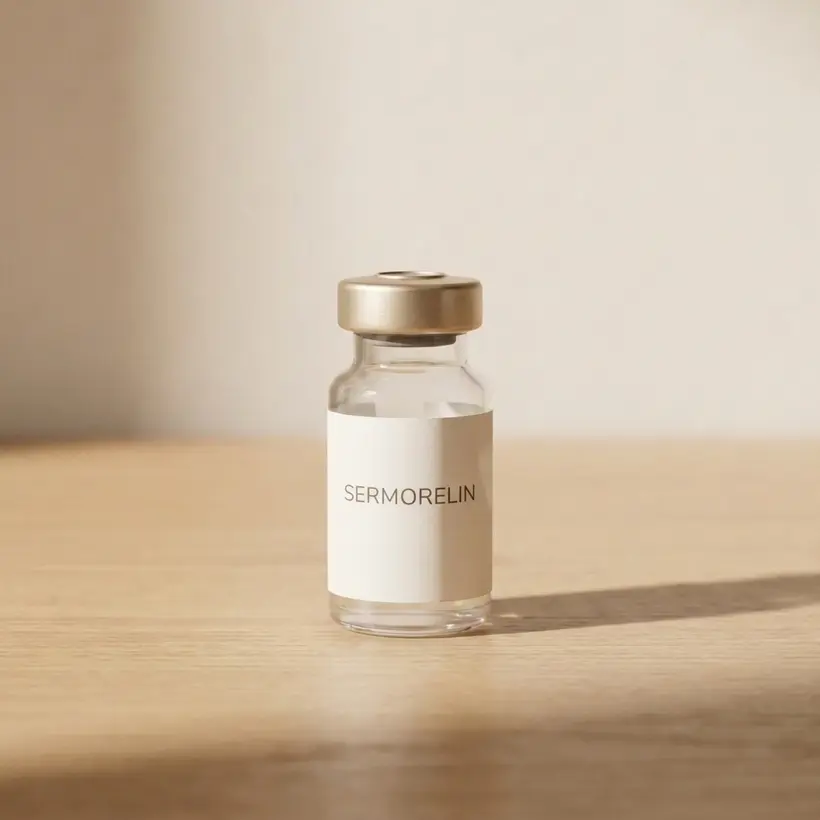
From the FormBlends catalog
Sermorelin
Bioidentical GHRH analog for natural growth hormone pulsatility · From $175/mo · compounded by a licensed 503A pharmacy, dispensed only after provider review.
View Sermorelin →Step 2: Clean the Vial Tops
Swab the rubber stopper of both the Sermorelin vial and the bacteriostatic water vial with an alcohol pad. Let them air dry for a few seconds. Don't blow on them or wipe them with anything else.
Step 3: Draw Up Bacteriostatic Water
Using a clean syringe, draw up the desired amount of bacteriostatic water. The amount you use determines the concentration of your solution. We cover specific mixing ratios in the next section.
For most protocols, we recommend adding either 1mL or 2mL of bacteriostatic water to your Sermorelin vial. Using a round number makes dose calculations much simpler.
Step 4: Inject Water Into the Sermorelin Vial
Insert the needle through the rubber stopper of the Sermorelin vial at an angle. Slowly release the bacteriostatic water down the inside wall of the vial. Don't squirt the water directly onto the powder, as this can damage the peptide structure. Let the water trickle gently down the glass wall and reach the powder at the bottom.
Step 5: Let It Dissolve
Once the water is added, gently swirl the vial in small circles. Don't shake it. Shaking creates bubbles and can denature (damage) the peptide. The powder should dissolve within 1-3 minutes of gentle swirling. If small clumps remain, let the vial sit for a few minutes and then swirl again.
Step 6: Inspect the Solution
The reconstituted solution should be clear and colorless. If the liquid appears cloudy, contains visible particles, or has any discoloration, don't use it. Contact your pharmacy for a replacement vial.
Step 7: Store Properly
Once reconstituted, immediately place the vial in your refrigerator. Reconstituted Sermorelin should be stored at 36-46 degrees Fahrenheit (2-8 degrees Celsius). Sermorelin storage instructions
Mixing Ratios and Dose Calculations
Getting your dose right after reconstitution requires a simple calculation. The key numbers are: the total amount of Sermorelin in the vial (in milligrams) and the total volume of bacteriostatic water you added (in milliliters).
Common Mixing Ratios
| Vial Size (Sermorelin) | BAC Water Added | Concentration per 0.1mL (10 units) |
|---|---|---|
| 3mg (3,000 mcg) | 1mL | 300 mcg per 10 units |
| 3mg (3,000 mcg) | 2mL | 150 mcg per 10 units |
| 6mg (6,000 mcg) | 2mL | 300 mcg per 10 units |
| 9mg (9,000 mcg) | 3mL | 300 mcg per 10 units |
| 15mg (15,000 mcg) | 5mL | 300 mcg per 10 units |
How to Calculate Your Specific Dose
Use this formula:
Dose in mcg = (Total mcg in vial / Total mL of water added) x mL drawn in syringe
For example, if you have a 3mg (3,000 mcg) vial and added 1mL of bacteriostatic water, the concentration is 3,000 mcg per 1mL. If your prescribed dose is 300 mcg, you would draw 0.1mL (10 units on an insulin syringe).
If you added 2mL of water to the same 3mg vial, the concentration drops to 1,500 mcg per 1mL, or 150 mcg per 0.1mL. For a 300 mcg dose, you would draw 0.2mL (20 units).
Reading an Insulin Syringe
A standard 1mL insulin syringe is marked in "units" from 0 to 100. Each unit equals 0.01mL. So:
- 10 units = 0.1mL
- 20 units = 0.2mL
- 50 units = 0.5mL
- 100 units = 1.0mL
Common Reconstitution Mistakes to Avoid
- Squirting water directly onto the powder: This can damage the peptide. Always aim the stream of water down the side of the vial wall.
- Shaking the vial: Vigorous shaking can denature the peptide, reducing its potency. Gentle swirling only.
- Using too little water: While this creates a more concentrated solution, very small injection volumes are harder to measure accurately and increase the margin for dosing errors.
- Using tap water or non-sterile water: Only use bacteriostatic water from a sealed, sterile vial. Any other water source introduces contamination risk.
- Skipping the alcohol swab: Always sterilize the rubber stopper before every puncture. Bacteria on the stopper can contaminate your entire vial.
- Reusing syringes: Each injection should use a fresh, sterile syringe. Reusing syringes increases infection risk and dulls the needle, making injections more painful.
How Many Doses Per Vial?
This depends on your prescribed dose and the vial size. Here is a quick reference:
| Vial Size | Prescribed Dose | Approximate Doses Per Vial |
|---|---|---|
| 3mg | 200 mcg/day | 15 doses |
| 3mg | 300 mcg/day | 10 doses |
| 6mg | 300 mcg/day | 20 doses |
| 9mg | 300 mcg/day | 30 doses |
| 15mg | 300 mcg/day | 50 doses |
Keep in mind that reconstituted Sermorelin stored in bacteriostatic water should generally be used within 28-30 days. If your vial contains more doses than you'll use in a month, the remaining solution may lose potency before you finish it. Work with your physician to choose a vial size that matches your dosing schedule and cycle length. Sermorelin cycling protocol
After Reconstitution: Drawing Your Dose
Each time you prepare an injection from your reconstituted vial, follow this procedure:
- Remove the vial from the refrigerator. Let it sit for 1-2 minutes to take the chill off (optional, but cold solution can sting slightly more).
- Swab the rubber stopper with a fresh alcohol pad.
- Draw air into a fresh syringe equal to the volume of your dose. Insert the needle into the vial and push the air in. This equalizes pressure and makes drawing easier.
- Invert the vial so the needle tip is submerged in the solution.
- Slowly draw back the plunger to your prescribed dose volume.
- Check for large air bubbles. If present, tap the syringe gently and push the bubbles back into the vial, then redraw to your correct volume.
- Remove the syringe from the vial. You're ready to inject.
Troubleshooting
The powder isn't dissolving
Let the vial sit at room temperature for 5-10 minutes, then gently swirl again. If the powder still doesn't dissolve after 15-20 minutes, the peptide may have been damaged during shipping or storage. Contact your pharmacy.
The solution looks cloudy or has particles
Don't inject a cloudy solution. Cloudiness or visible particles can indicate bacterial contamination, peptide degradation, or a problem with the water used. Discard the vial and use a fresh one.
I accidentally shook the vial vigorously
If you shook the vial, let it sit for 10-15 minutes to allow bubbles to dissipate. While aggressive shaking isn't ideal, a single instance is unlikely to completely destroy the peptide. Going forward, stick to gentle swirling.
I used sterile water instead of bacteriostatic water
If you used sterile water, the solution should be used within 24 hours and kept refrigerated. For future reconstitutions, switch to bacteriostatic water to allow multi-dose use over several weeks.
Medical References
- Wilding JPH, Batterham RL, Calanna S, et al. Once-Weekly Semaglutide in Adults with Overweight or Obesity. N Engl J Med. 2021;384(11):989-1002. [PubMed | ClinicalTrials.gov | DOI]
- Davies M, Færch L, Jeppesen OK, et al. Semaglutide 2.4 mg once a week in adults with overweight or obesity, and type 2 diabetes (STEP 2). Lancet. 2021;397(10278):971-984. [PubMed | ClinicalTrials.gov | DOI]
- Wadden TA, Bailey TS, Billings LK, et al. Effect of Subcutaneous Semaglutide vs Placebo as an Adjunct to Intensive Behavioral Therapy on Body Weight in Adults With Overweight or Obesity (STEP 3). JAMA. 2021;325(14):1403-1413. [PubMed | ClinicalTrials.gov | DOI]
- Rubino D, Abrahamsson N, Davies M, et al. Effect of Continued Weekly Subcutaneous Semaglutide vs Placebo on Weight Loss Maintenance in Adults With Overweight or Obesity (STEP 4). JAMA. 2021;325(14):1414-1425. [PubMed | ClinicalTrials.gov | DOI]
- Garvey WT, Batterham RL, Bhatt DL, et al. Two-year effects of semaglutide in adults with overweight or obesity (STEP 5). Nat Med. 2022;28(10):2083-2091. [PubMed | ClinicalTrials.gov | DOI]
Frequently Asked Questions
Can I use more or less bacteriostatic water than recommended?
Yes, you can adjust the volume of water to create a more concentrated or more dilute solution. Just recalculate your injection volume accordingly. Using more water makes it easier to measure smaller doses but requires larger injection volumes.
How long does reconstituted Sermorelin last?
When stored properly in the refrigerator (36-46 degrees Fahrenheit) and reconstituted with bacteriostatic water, Sermorelin typically remains potent for 28-30 days. Some sources suggest up to 6 weeks, but potency may decline after the first month.
Can I freeze reconstituted Sermorelin?
Freezing reconstituted peptide solutions is generally not recommended. The freeze-thaw process can damage the peptide structure and reduce potency. If you need longer storage, keep the peptide in its original lyophilized (powder) form. Sermorelin storage instructions
What if I can't find bacteriostatic water?
Bacteriostatic water is available from most compounding pharmacies that supply peptides, and it can also be purchased online from medical supply retailers. If your peptide prescription came from FormBlends, we can supply bacteriostatic water alongside your medication.
Do I need a special syringe for reconstitution?
A standard 1mL insulin syringe works fine for both reconstitution and injection. Some patients prefer to use a larger syringe (3mL) with a 25-gauge needle for reconstitution, as the wider bore makes it easier to draw and dispense the bacteriostatic water. You would then switch to an insulin syringe for the actual injection.
Ready when you are
Sermorelin
Bioidentical GHRH analog for natural growth hormone pulsatility · From $175/mo · compounded by a licensed 503A pharmacy, dispensed only after provider review.
View Sermorelin →