Key Takeaway
How to reconstitute CJC-1295 step by step. Learn the correct bacteriostatic water ratio, mixing technique, and storage requirements for safe, effective reconstitution calculator.
Quick Answer: To reconstitute CJC-1295, you add bacteriostatic water to the lyophilized (freeze-dried) peptide powder using a sterile syringe. Direct the water stream against the side of the vial and let it run down gently rather than spraying directly onto the powder. Swirl gently to mix. Never shake. The typical ratio is 1 to 2 mL of bacteriostatic water per vial, though your prescribing physician or pharmacy will provide specific instructions based on your vial concentration and prescribed dose.
What Is CJC-1295?
CJC-1295 is a synthetic growth hormone-releasing hormone (GHRH) analog used to stimulate natural growth hormone production. It arrives from compounding pharmacies as a lyophilized (freeze-dried) powder in a sealed vial. Before it can be injected, this powder must be reconstituted (mixed with liquid) to create an injectable solution.
Proper reconstitution is important because CJC-1295 is a fragile molecule. Rough handling, contamination, or incorrect technique can damage the peptide or introduce bacteria, reducing effectiveness and potentially causing harm.
What You Need Before Starting
Gather all supplies before you begin. You'll need:

- CJC-1295 lyophilized vial: The sealed vial containing the freeze-dried peptide powder. Common concentrations are 2 mg or 5 mg per vial.
- Bacteriostatic water (BAC water): Sterile water containing 0.9% benzyl alcohol as a preservative. This is the standard reconstitution fluid for peptides. Don't use sterile water for injection (which lacks preservative) unless directed by your pharmacy, as it doesn't prevent bacterial growth in multi-use vials.
- Sterile syringe: An insulin syringe (1 mL, with markings in units) for drawing and adding the bacteriostatic water. A separate syringe from the one you'll use for injection is recommended.
- Alcohol swabs: For cleaning vial tops before piercing them.
- Clean workspace: A clean, flat surface away from drafts, dust, and moisture.
How Reconstitution Ratios
The amount of bacteriostatic water you add determines the concentration of the final solution. Your physician or pharmacy should specify the exact ratio, but here are common examples:
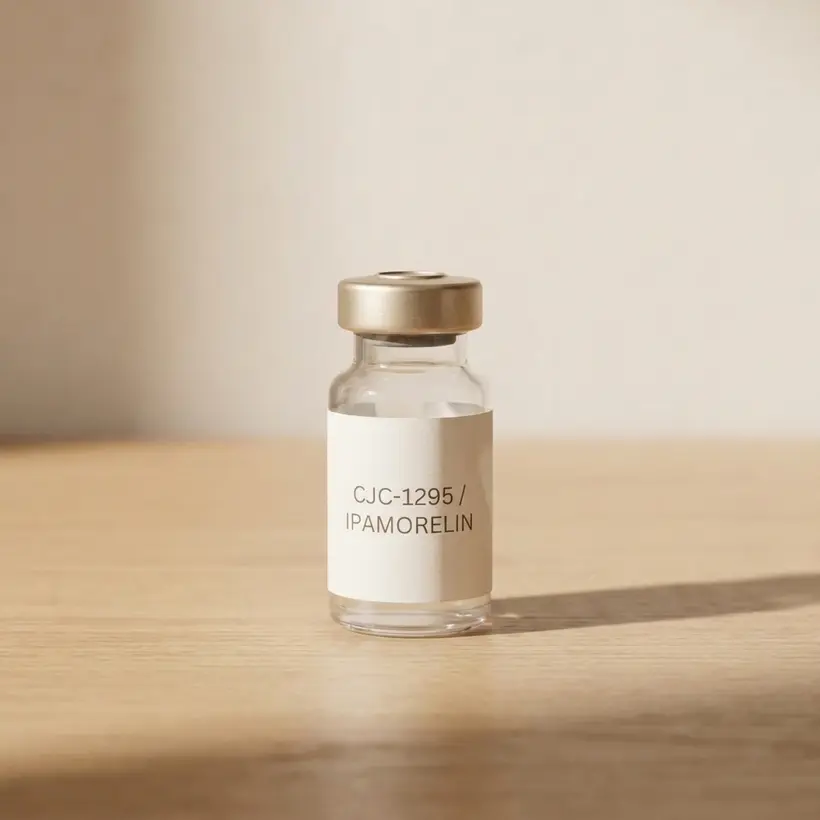
From the FormBlends catalog
CJC-1295 / Ipamorelin Blend
The gold standard growth hormone secretagogue stack · From $69/mo · compounded by a licensed 503A pharmacy, dispensed only after provider review.
Learn about CJC-1295 / Ipamorelin Blend →For a 2 mg Vial
- Add 1 mL BAC water: Each 0.1 mL (10 units on insulin syringe) = 200 mcg of CJC-1295.
- Add 2 mL BAC water: Each 0.1 mL = 100 mcg of CJC-1295.
For a 5 mg Vial
- Add 1 mL BAC water: Each 0.1 mL = 500 mcg of CJC-1295.
- Add 2 mL BAC water: Each 0.1 mL = 250 mcg of CJC-1295.
- Add 2.5 mL BAC water: Each 0.1 mL = 200 mcg of CJC-1295.
Using more water makes dose measurement easier (larger volumes per dose, reducing measurement error) but means each vial produces a larger total volume. Using less water makes each dose smaller (fewer units to draw) but requires more precise measurement.
Step-by-Step Reconstitution Process
Step 1[1]: Prepare Your Workspace
Wash your hands thoroughly with soap and water. Lay out your supplies on a clean surface. Remove the CJC-1295 vial and bacteriostatic water from the refrigerator and allow them to reach room temperature for 5 to 10 minutes. Working with room-temperature fluids reduces thermal shock to the peptide.
Step 2: Clean the Vial Tops
Use alcohol swabs to clean the rubber stopper on both the CJC-1295 vial and the bacteriostatic water vial. Allow the alcohol to air dry for 10 to 15 seconds before piercing. This step prevents bacteria from entering the vials.
Step 3: Draw the Bacteriostatic Water
Using a sterile syringe, draw the prescribed amount of bacteriostatic water. For example, if you're adding 1 mL to a 2 mg vial, draw 1 mL (100 units on a standard insulin syringe). Pull back slowly to minimize air bubbles.
Step 4: Add Water to the CJC-1295 Vial
This is the most important step. Insert the needle through the rubber stopper of the CJC-1295 vial. Here is the critical technique:
- Aim the needle at the inside wall of the vial, not directly at the powder.
- Depress the plunger slowly, allowing the water to trickle down the glass wall and onto the powder gently.
- Don't spray the water directly onto the powder. This can damage the peptide's molecular structure.
- Don't inject the water forcefully. Let gravity and gentle pressure do the work.
Step 5: Let It Dissolve
After adding all the water, remove the syringe. Set the vial on the counter and let it sit for 1 to 2 minutes. The powder will begin dissolving on its own. If needed, pick up the vial and roll it gently between your palms or tilt it side to side to help dissolution.
Never shake the vial. Shaking creates foam and can denature (damage) the peptide by disrupting its molecular structure. Gentle swirling is fine. vigorous shaking isn't.
Step 6: Check for Complete Dissolution
The solution should be clear and free of visible particles or cloudiness. CJC-1295 typically dissolves quickly (within 1 to 3 minutes of gentle mixing). If particles remain after 5 minutes of gentle swirling, allow the vial to sit in the refrigerator for 30 minutes and check again.
Don't use a solution that remains cloudy, discolored, or contains undissolved particles. Contact your pharmacy for guidance if the peptide doesn't dissolve properly.
Step 7: Label and Store
Write the reconstitution date on the vial with a marker or adhesive label. Store the reconstituted vial in the refrigerator immediately. For complete storage guidance, see our CJC-1295 storage instructions guide.
Common Mistakes to Avoid
- Shaking the vial: This is the most common and most damaging mistake. It denatures the peptide. Always swirl gently.
- Using tap water or non-sterile water: Only use bacteriostatic water or sterile water for injection as directed. Never use tap water, distilled water from a store, or any non-pharmaceutical-grade water.
- Spraying water directly onto the powder: Direct the stream against the vial wall. The force of liquid hitting the lyophilized peptide can cause degradation.
- Using a dirty needle or skipping alcohol swabs: Contamination can introduce bacteria that grow in the reconstituted solution over its multi-use life span.
- Leaving the reconstituted vial at room temperature: Reconstituted CJC-1295 must be refrigerated. Leaving it out accelerates degradation.
- Using the wrong amount of water: Adding too much or too little water changes the concentration, leading to incorrect dosing. Double-check your prescribed ratio before adding water.
After Reconstitution: Drawing Your Dose
Once the CJC-1295 is reconstituted, you draw individual doses from the vial as needed:
- Clean the vial top with an alcohol swab.
- Using a fresh insulin syringe, draw air equal to the volume of your dose.
- Insert the needle and inject the air into the vial (this equalizes pressure).
- Invert the vial and draw your prescribed dose slowly.
- Tap the syringe to move any air bubbles to the top, then push them back into the vial.
- Remove the syringe and proceed with your injection per your physician's instructions.
For detailed injection technique, see our CJC-1295 how to inject guide.
Side Effects and Safety
Reconstitution itself doesn't introduce side effects beyond those associated with CJC-1295 therapy in general. But improper reconstitution can create problems:
- Bacterial contamination from non-sterile technique can cause injection site infections.
- Degraded peptide from rough handling may produce less GH stimulation than expected and could theoretically cause injection site irritation.
- Incorrect concentration from wrong water volume can lead to under- or over-dosing.
Following proper technique eliminates these risks. If you're uncertain about any step, your prescribing physician or pharmacist can provide hands-on guidance or video demonstration.
For general CJC-1295 side effects, see our CJC-1295 side effects guide.
Frequently Asked Questions
Can I use sterile water instead of bacteriostatic water?
Sterile water for injection can be used, but it lacks the benzyl alcohol preservative found in bacteriostatic water. Without preservative, the reconstituted solution must be used within 24 hours or discarded. Bacteriostatic water allows the vial to be used for up to 28 days when properly refrigerated.
How long does reconstituted CJC-1295 last?
Reconstituted CJC-1295 in bacteriostatic water is generally considered stable for up to 28 days when stored at 2 to 8 degrees Celsius (standard refrigerator temperature). After 28 days, discard any remaining solution and reconstitute a fresh vial.
What if I see bubbles in the solution?
Small bubbles from the reconstitution process are normal and will dissipate over time. Large foam on the surface indicates the vial was shaken too aggressively. If heavy foaming occurs, let the vial sit undisturbed in the refrigerator for an hour before use.
Can I travel with reconstituted CJC-1295?
Yes, but you must keep it refrigerated. Use an insulated travel case with ice packs. Avoid freezing. Air travel with prescribed peptides is legal when you carry your prescription documentation. For full storage details, see our CJC-1295 storage instructions guide.
What if I accidentally add the wrong amount of water?
If you added too much water, the solution is simply more dilute. You'll need to draw a larger volume for each dose. Calculate the new concentration: total peptide in vial divided by total water added. If you added too little water, the solution is more concentrated. Adjust your dose volume accordingly, or add more bacteriostatic water to reach the intended concentration. Don't discard the vial.
Medical References
- Wilding JPH, Batterham RL, Calanna S, et al. Once-Weekly Semaglutide in Adults with Overweight or Obesity. N Engl J Med. 2021;384(11):989-1002. [PubMed | ClinicalTrials.gov | DOI]
- Davies M, Færch L, Jeppesen OK, et al. Semaglutide 2.4 mg once a week in adults with overweight or obesity, and type 2 diabetes (STEP 2). Lancet. 2021;397(10278):971-984. [PubMed | ClinicalTrials.gov | DOI]
- Wadden TA, Bailey TS, Billings LK, et al. Effect of Subcutaneous Semaglutide vs Placebo as an Adjunct to Intensive Behavioral Therapy on Body Weight in Adults With Overweight or Obesity (STEP 3). JAMA. 2021;325(14):1403-1413. [PubMed | ClinicalTrials.gov | DOI]
- Rubino D, Abrahamsson N, Davies M, et al. Effect of Continued Weekly Subcutaneous Semaglutide vs Placebo on Weight Loss Maintenance in Adults With Overweight or Obesity (STEP 4). JAMA. 2021;325(14):1414-1425. [PubMed | ClinicalTrials.gov | DOI]
- Garvey WT, Batterham RL, Bhatt DL, et al. Two-year effects of semaglutide in adults with overweight or obesity (STEP 5). Nat Med. 2022;28(10):2083-2091. [PubMed | ClinicalTrials.gov | DOI]
Get Physician Support for Your Peptide Protocol
Reconstitution is simple once you learn the technique, but having physician guidance makes the process even easier. FormBlends provides detailed instructions with every prescription and offers support from our medical team throughout your therapy.
Disclaimer: This article is for informational purposes only and doesn't constitute medical advice. CJC-1295 isn't FDA-approved for any medical condition. Reconstitution should follow the specific instructions provided by your prescribing physician and compounding pharmacy. Always consult with a licensed healthcare provider before beginning any peptide therapy. FormBlends doesn't claim that CJC-1295 cures, treats, or prevents any disease.
Ready when you are
CJC-1295 / Ipamorelin Blend
The gold standard growth hormone secretagogue stack · From $69/mo · compounded by a licensed 503A pharmacy, dispensed only after provider review.
Learn about CJC-1295 / Ipamorelin Blend →