Key Takeaway
If you're taking a GLP-1 medication, you need a plan to prevent muscle loss. This prevent muscle loss GLP-1 resource covers the important information you need to make informed decisions.
If you're taking a GLP-1 medication, you need a plan to prevent muscle loss. This prevent muscle loss GLP-1 resource covers the important information you need to make informed decisions. Clinical trials show that 25-40% of total weight lost on semaglutide and tirzepatide can come from lean body mass. That's muscle, bone density, and organ tissue you want to keep.
Key Takeaways: - Understanding Why GLP-1 Causes Muscle Loss - The Protein Strategy - The Training Strategy - Recovery and Lifestyle Factors - Setting Realistic Expectations
This strategy covers every angle: what to eat, how to train, when to rest, and what to track. Follow these steps and you can shift the ratio dramatically in favor of fat loss.
How Why GLP-1 Causes Muscle Loss
Your body doesn't selectively burn fat. When you eat fewer calories than you burn, your body pulls energy from whatever is available. Fat stores are one source. Muscle protein is another.
GLP-1 medications suppress appetite effectively. Many users eat 30-50% fewer calories than before treatment. That creates a large calorie deficit. The bigger the deficit, the more muscle you risk losing.
Several factors make this worse: - Low protein intake. When you eat less overall, protein intake often drops below the threshold needed for muscle maintenance. - Inactivity. Without resistance training, your body has no reason to preserve muscle tissue. - Rapid weight loss. Losing more than 1-2% of body weight per week increases the proportion of muscle loss. - Age. Adults over 40 are already losing muscle naturally. GLP-1-related calorie restriction accelerates this process.
Every one of these factors is manageable. You don't need to accept muscle loss as inevitable.
Learn more about to understand the full metabolic picture.
The Protein Strategy
Protein is your first line of defense against muscle loss on GLP-1. Getting enough of it requires intention, especially when your appetite is suppressed.
View data table
| Category | Impact on Treatment Outcomes (%) | Detail |
|---|---|---|
| Protein Intake | 90 | Preserves muscle mass |
| Exercise | 85 | Enhances weight loss |
| Sleep Quality | 78 | Supports metabolism |
| Hydration | 72 | Reduces side effects |
| Stress Mgmt | 65 | Cortisol reduction |

Free Download: 12-Week Strength Program Includes protein timing guidelines, meal templates, and progressive workout plans designed specifically for GLP-1 users. Get yours free) we'll email it to you instantly. [Download Your Free Program]
"The conversation about obesity needs to shift from willpower to biology. These medications work because obesity is a neuroendocrine disease, not a character flaw.", Dr. Fatima Cody Stanford, MD, MPH, Massachusetts General Hospital
How much protein you need: - Minimum: 0.7 grams per pound of body weight daily - Optimal: 1.0 grams per pound of body weight daily - Example: A 200-pound person needs 140-200 grams of protein per day
How to hit your protein target on reduced appetite: - Eat protein first at every meal before other foods - Use liquid protein sources when solid food feels difficult (protein shakes, bone broth, Greek yogurt smoothies) - Spread protein across 3-4 eating occasions, not one large meal - Keep high-protein snacks accessible: jerky, cheese sticks, hard-boiled eggs - Choose protein-dense foods with the highest protein-to-calorie ratio
Timing matters: - Consume 20-40 grams of protein within 2 hours of resistance training - Have protein at your first meal of the day - A casein-rich food before bed (cottage cheese, casein shake) supports overnight muscle protein synthesis
Check out our for ready-made meal ideas.
Patient Perspective: "I started resistance training three times a week when I began semaglutide, specifically to protect muscle mass. After 6 months, my body fat dropped from 38% to 27%, but I actually gained 2 pounds of lean mass. The strength training made a huge difference.", Tom H., 50, FormBlends patient (name changed for privacy)
The Training Strategy
Resistance training tells your body to keep muscle. Without this signal, your body has no reason to maintain metabolically expensive muscle tissue during a calorie deficit.
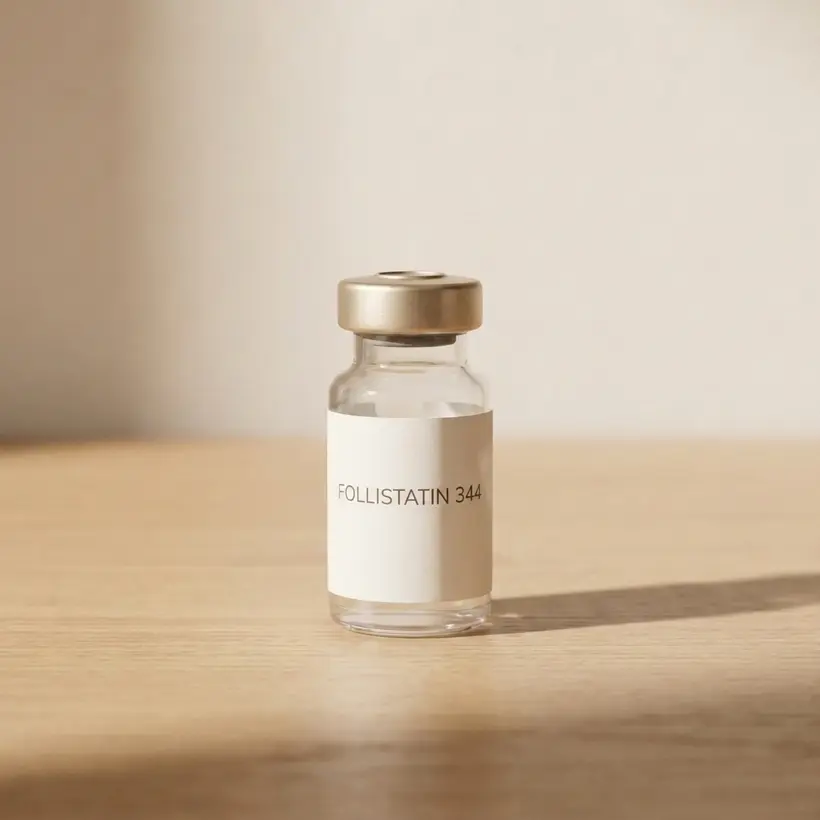
From the FormBlends catalog
Follistatin 344
Myostatin inhibitor studied for enhanced muscle growth · From $149/mo · compounded by a licensed 503A pharmacy, dispensed only after provider review.
Learn about Follistatin 344 →Non-negotiable training principles: - Train with weights or resistance at least 3 times per week - Focus on compound movements that work multiple muscle groups - Use progressive overload: gradually increase weight, reps, or sets over time - Train each major muscle group at least twice per week
A simple, effective program:
Day 1: Push - Bench press or push-ups: 3x10 - Overhead press: 3x10 - Dips or tricep pushdowns: 3x12
Day 2: Pull - Rows: 3x10 - Pull-ups or lat pulldowns: 3x10 - Bicep curls: 3x12
Day 3: Legs - Squats: 3x10 - Romanian deadlifts: 3x10 - Leg press or lunges: 3x12
Keep cardio moderate. Walking is ideal. Excessive cardio on top of a calorie deficit accelerates muscle loss.
Use the to log your workouts and track strength progress over time.
Recovery and Lifestyle Factors
Training and nutrition set the foundation. Recovery determines how well your body actually builds and maintains muscle.
Sleep: Aim for 7-9 hours per night. Growth hormone peaks during deep sleep. Poor sleep increases cortisol, which promotes muscle breakdown. If GLP-1 medication affects your sleep, talk to your provider about timing adjustments.
Stress management: Chronic stress improves cortisol levels. High cortisol promotes muscle catabolism and fat storage, especially around the midsection. Find stress reduction methods that work for you: meditation, walking, time in nature.
Hydration: Dehydrated muscles perform worse and recover slower. Aim for at least half your body weight in ounces of water daily. More if you exercise or live in a hot climate.
Supplements that may help (discuss with your provider): - Creatine monohydrate: 3-5 grams daily. Well-studied for muscle preservation. - Vitamin D: Many adults are deficient. Important for muscle function. - Omega-3 fatty acids: May support muscle protein synthesis.
What to monitor: - Body measurements every 2 weeks (waist, arms, legs) - Strength levels in key lifts - Energy and recovery between sessions - Body composition scans every 8-12 weeks if available
Your can order relevant blood work and adjust your protocol based on your progress.
Setting Realistic Expectations
Even with a perfect plan, some lean mass loss may occur during significant weight loss. The goal is to minimize it, not eliminate it entirely.
Realistic outcomes with a strong muscle preservation strategy: - 80-90% of weight lost comes from fat - Strength maintains or increases during the first 3-6 months - Body composition improves dramatically even if the scale moves slowly - Metabolic rate stays healthier, reducing rebound risk
Without a muscle preservation strategy: - 60-75% of weight lost comes from fat - Strength declines steadily - Metabolic rate drops significantly - Rebound weight gain is more likely after stopping medication
The difference between these outcomes is entirely within your control. Protein, resistance training, and recovery are the three pillars.
Read our for additional strategies to stay on track during treatment.
Frequently Asked Questions
How soon should I start strength training after beginning GLP-1 medication?
Start immediately, even if you begin with light bodyweight exercises. The sooner you send the muscle-preservation signal, the better. Scale intensity up as your body adjusts to the medication.
Can I take BPC-157 alongside my GLP-1 for muscle and joint recovery?
Some providers prescribe BPC-157 for tissue healing and recovery support. It may complement your training program. Discuss this with your to see if it's appropriate for your situation.
Will I regain muscle after I stop GLP-1 medication?
If you maintain your training and increase calories strategically when coming off medication, you can rebuild any lost muscle. Muscle memory makes regaining lost muscle faster than building it the first time.
How do I know if I am losing too much muscle?
Watch for declining strength in the gym, excessive fatigue, and losing inches from your arms and legs rather than your waist. A DEXA scan or body composition test every 2-3 months gives you objective data.
Is it harder to maintain muscle on tirzepatide versus semaglutide?
Both medications create similar muscle loss risk because both suppress appetite significantly. The key factor isn't which medication you take but whether you follow a muscle preservation strategy while taking it.
Your Personalized Plan Is Waiting
No two patients are the same, and your protocol shouldn't be either. FormBlends providers create customized treatment plans based on your health profile, goals, and preferences.
Medical References
- Wilding JPH, Batterham RL, Calanna S, et al. Once-Weekly Semaglutide in Adults with Overweight or Obesity. N Engl J Med. 2021;384(11):989-1002. [PubMed | ClinicalTrials.gov | DOI]
- Davies M, Færch L, Jeppesen OK, et al. Semaglutide 2.4 mg once a week in adults with overweight or obesity, and type 2 diabetes (STEP 2). Lancet. 2021;397(10278):971-984. [PubMed | ClinicalTrials.gov | DOI]
- Wadden TA, Bailey TS, Billings LK, et al. Effect of Subcutaneous Semaglutide vs Placebo as an Adjunct to Intensive Behavioral Therapy on Body Weight in Adults With Overweight or Obesity (STEP 3). JAMA. 2021;325(14):1403-1413. [PubMed | ClinicalTrials.gov | DOI]
- Garvey WT, Batterham RL, Bhatt DL, et al. Two-year effects of semaglutide in adults with overweight or obesity (STEP 5). Nat Med. 2022;28(10):2083-2091. [PubMed | ClinicalTrials.gov | DOI]
Sources &. References
- Wilding JPH, et al. STEP 1[1] (Wilding et al., NEJM, 2021) Supplementary Appendix. Body composition analysis via DXA. N Engl J Med. 2021;384(11). Doi:10.1056/NEJMoa2032183
- Stierman B, Afful J, Carroll MD, et al. National Health and Nutrition Examination Survey 2017-March 2020 Prepandemic Data Files. NCHS Data Brief. No. 492. CDC/NCHS. 2023.
- Sumithran P, Prendergast LA, Delbridge E, et al. Long-Term Persistence of Hormonal Adaptations to Weight Loss. N Engl J Med. 2011;365(17):1597-1604. Doi:10.1056/NEJMoa1105816
- Wilding JPH, Batterham RL, Calanna S, et al. Once-Weekly Semaglutide in Adults with Overweight or Obesity. N Engl J Med. 2021;384(11):989-1002. Doi:10.1056/NEJMoa2032183
- Davies M, Færch L, Jeppesen OK, et al. Semaglutide 2.4 mg once a week in adults with overweight or obesity, and type 2 diabetes (STEP 2 (Davies et al., Lancet, 2021)). Lancet. 2021;397(10278):971-984. Doi:10.1016/S0140-6736(21)00213-0
- Wadden TA, Bailey TS, Billings LK, et al. Effect of Subcutaneous Semaglutide vs Placebo as an Adjunct to Intensive Behavioral Therapy on Body Weight in Adults With Overweight or Obesity (STEP 3 (Wadden et al., JAMA, 2021)). JAMA. 2021;325(14):1403-1413. Doi:10.1001/jama.2021.1831
- Garvey WT, Batterham RL, Bhatt DL, et al. Two-Year Effects of Semaglutide in Adults with Overweight or Obesity (STEP 5 (Garvey et al., Nat Med, 2022)). Nat Med. 2022;28:2083-2091. Doi:10.1038/s41591-022-02026-4
- Lincoff AM, Brown-Frandsen K, Colhoun HM, et al. Semaglutide and Cardiovascular Outcomes in Obesity without Diabetes. N Engl J Med. 2023;389(24):2221-2232. Doi:10.1056/NEJMoa2307563
Nothing in this article should be construed as medical advice. The information provided is educational only. Always consult with your healthcare provider before beginning, modifying, or discontinuing any medication or treatment. FormBlends connects patients with licensed providers for individualized care.
Last updated: 2026-03-24
Ready when you are
Follistatin 344
Myostatin inhibitor studied for enhanced muscle growth · From $149/mo · compounded by a licensed 503A pharmacy, dispensed only after provider review.
Learn about Follistatin 344 →