Key Takeaway
AOD-9604 is a modified fragment of human growth hormone (hGH 177-191) studied for fat loss without the metabolic side effects of full GH. Clinical data, dosing protocols, and how it compares to GLP-1 medications.
Medically reviewed by FormBlends Clinical Review · Clinical Pharmacist · Reviewed by FormBlends Medical Team · Last updated March 2026
Quick Answer: AOD-9604 is a synthetic peptide corresponding to the fat-reducing region of human growth hormone (amino acids 177 to 191) with an added tyrosine at the N-terminus. Early clinical trials showed modest fat loss results, but no Phase III trial has been completed, and it isn't FDA-approved. It's available through compounding pharmacies and peptide therapy clinics at typical doses of 300 to 600mcg per day via subcutaneous injection.
What Is AOD-9604 and How Was It Developed?
AOD-9604 was developed at Monash University in Australia during the 1990s as researchers tried to isolate the fat-burning properties of growth hormone from its other metabolic effects. The peptide corresponds to the C-terminal fragment of hGH (amino acids 177 to 191) with an added tyrosine residue that stabilizes the molecule. A 2001 paper in Obesity Research described its initial characterization and showed it stimulated lipolysis in adipose tissue without affecting blood sugar or IGF-1 levels.
The appeal of AOD-9604 is straightforward: growth hormone powerfully reduces body fat, but full GH therapy comes with side effects including insulin resistance, fluid retention, joint pain, and potential tumor growth stimulation. By isolating just the lipolytic fragment, researchers aimed to capture the fat loss benefit while avoiding these problems. The peptide doesn't bind the growth hormone receptor and doesn't increase IGF-1.
AOD-9604 was granted GRAS (Generally Recognized as Safe) status by the FDA in 2007 for use as a food supplement ingredient. But it has never received FDA approval as a drug for fat loss or any other therapeutic indication. It's currently available through compounding pharmacies with a prescription and through research chemical suppliers.
How Does AOD-9604 Reduce Body Fat?
AOD-9604 stimulates lipolysis (fat breakdown) and inhibits lipogenesis (fat formation) through a mechanism that appears independent of the classical growth hormone receptor. A 2000 study in the Journal of Endocrinology demonstrated that AOD-9604 increased lipolytic activity in both human and mouse adipose tissue in vitro, with effects comparable to the full C-terminal fragment of hGH. The mechanism involves activation of beta-3 adrenergic receptors on fat cells.
View data table
| Category | Clinical Interest Score | Detail |
|---|---|---|
| BPC-157 | 88 | Tissue repair and gut healing |
| TB-500 | 82 | Injury recovery |
| Sermorelin | 78 | Growth hormone support |
| Ipamorelin | 75 | Anti-aging and recovery |
| GHK-Cu | 70 | Skin and tissue repair |
AOD-9604 doesn't raise IGF-1 levels, doesn't promote cell proliferation, and doesn't alter glucose metabolism in the way that full growth hormone does. A 2004 pharmacology study confirmed that chronic administration of AOD-9604 in obese mice produced significant fat mass reduction without changes in lean mass, blood glucose, insulin sensitivity, or IGF-1 concentration.
The peptide also appears to have some cartilage repair properties. Research published in the Journal of Musculoskeletal and Neuronal Interactions in 2010 showed that AOD-9604 stimulated proteoglycan and collagen synthesis in human cartilage explants. This has led some clinics to use it for joint health in addition to fat loss, though the evidence for this application is preliminary.
What Does the Clinical Research Actually Show?
The human clinical data on AOD-9604 is limited and mixed, which is the honest assessment. Metabolic Pharmaceuticals conducted a Phase IIb trial in 2004 involving 300 obese subjects who received oral AOD-9604 at various doses for 12 weeks. The trial results showed a statistically significant reduction in body weight compared to placebo in the 1mg per day group (average of 2.8kg more weight loss than placebo).
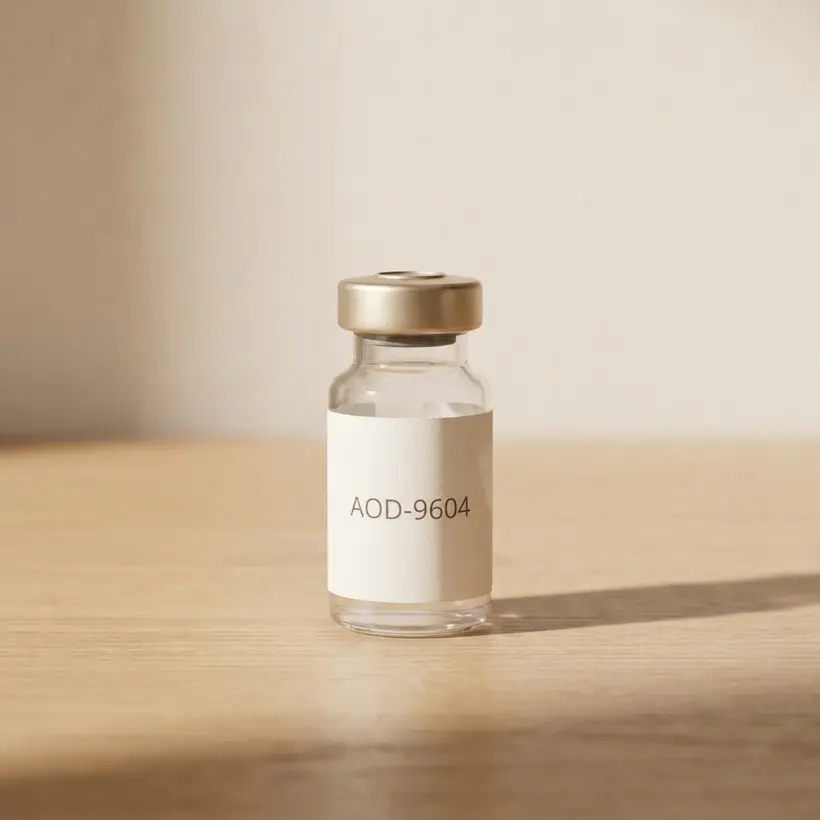
From the FormBlends catalog
AOD-9604
Fat-targeting fragment without growth hormone side effects · From $199/mo · compounded by a licensed 503A pharmacy, dispensed only after provider review.
View AOD-9604 →But the company's subsequent Phase IIb/III trial did not replicate these results with sufficient statistical power. Metabolic Pharmaceuticals eventually abandoned the oral formulation development. The injectable route was not pursued in large-scale human trials.
This failure to progress through clinical development is the primary reason AOD-9604 never achieved drug approval status.
The preclinical data, particularly in rodent models of obesity, is more consistently positive. Multiple animal studies demonstrated significant fat mass reduction at injectable doses without the side effects associated with growth hormone. The disconnect between animal data and human trial results may relate to oral bioavailability challenges, dose selection, or differences in adipose tissue metabolism between species.
| Study | Design | Key Finding |
|---|---|---|
| Heffernan 2001 | In vitro, human adipocytes | Stimulated lipolysis comparable to hGH |
| Ng 2000 | Obese mice, 30 days | Reduced fat mass without IGF-1 changes |
| Phase IIb (oral, 2004) | 300 obese adults, 12 weeks | 1mg group lost 2.8kg more than placebo |
| Phase IIb/III (oral) | Larger cohort | Failed to meet primary endpoints |
| Kwok 2010 | Human cartilage explants | Stimulated proteoglycan synthesis |
What Is the Recommended AOD-9604 Dosage?
The most commonly used AOD-9604 dose in peptide therapy clinics is 300mcg per day via subcutaneous injection, typically administered in the morning on an empty stomach. This dose is extrapolated from the animal research rather than from the Phase II oral trial, which used much higher oral doses (1 to 5mg) to compensate for low oral bioavailability. Injectable administration bypasses the GI tract entirely, allowing lower effective doses.
Some clinicians use higher doses of 500 to 600mcg per day, particularly for patients with significant fat loss goals or higher body weights. There's no published human dose-response curve for injectable AOD-9604, so dosing in practice is based on clinical experience and the established safety profile from animal pharmacology studies.
AOD-9604 is typically cycled for 8 to 12 weeks, followed by a 4-week break. The rationale for cycling is theoretical rather than evidence-based, as there's no documented tachyphylaxis (loss of effect) with continuous use. But periodic breaks allow for reassessment of body composition changes and determination of whether continued treatment is necessary.
| Parameter | Standard Protocol |
|---|---|
| Dose | 300 to 600mcg daily |
| Route | Subcutaneous injection |
| Timing | Morning, fasted |
| Injection site | Abdomen (rotate sites) |
| Cycle length | 8 to 12 weeks |
| Break | 4 weeks between cycles |
| Storage | Refrigerate at 2 to 8°C |
What Are the Side Effects of AOD-9604?
AOD-9604 has a notably clean side effect profile in both animal research and clinical experience. The Phase IIb oral trial reported no significant difference in adverse events between the treatment and placebo groups. The most commonly reported side effects in clinical practice are injection site reactions (redness, mild swelling) and occasional headache, both of which are mild and transient.
Because AOD-9604 doesn't raise IGF-1 or affect the growth hormone receptor, it avoids the side effects associated with GH therapy including insulin resistance, fluid retention, carpal tunnel syndrome, and joint pain. A 2004 safety pharmacology study confirmed that chronic AOD-9604 administration did not affect glucose tolerance, insulin sensitivity, or endocrine function in animal models at doses up to 50 times the standard dose.
The main concern with AOD-9604 isn't the peptide's safety profile but the lack of thorough long-term human data. While the available evidence is reassuring, the failure to complete Phase III trials means we don't have the type of rigorous safety database that FDA-approved drugs provide. Patients using AOD-9604 should have regular monitoring of metabolic markers including fasting glucose, lipid panel, and body composition measurements.
How Does AOD-9604 Compare to GLP-1 Medications for Fat Loss?
GLP-1 receptor agonists like semaglutide and tirzepatide are dramatically more effective for weight loss than AOD-9604 based on available clinical data. The STEP 1 trial[1] showed semaglutide producing 14.9% body weight[1] loss at 68 weeks, while the SURMOUNT-1 trial[2] showed tirzepatide at the highest dose achieving 22.5% weight[2] loss. AOD-9604's best clinical result was 2.8kg more than placebo over 12 weeks, which is a fraction of the GLP-1 effect.
But the two approaches work differently and have different trade-off profiles. GLP-1 medications suppress appetite centrally, reduce gastric emptying, and produce significant GI side effects (nausea, vomiting, diarrhea) in many patients. AOD-9604 targets fat metabolism directly without affecting appetite or GI function.
Some patients who can't tolerate GLP-1 side effects or who have contraindications may consider AOD-9604 as an alternative.
| Factor | AOD-9604 | Semaglutide (GLP-1) |
|---|---|---|
| Weight loss (clinical data) | Modest (2 to 3kg above placebo) | Significant (15 to 17% body weight) |
| FDA approved | No | Yes |
| Mechanism | Direct lipolysis | Appetite suppression, GI slowing |
| GI side effects | Minimal | Common (40 to 50%) |
| Effect on muscle mass | No loss documented | Significant lean mass loss (25 to 40% of weight lost) |
| Monthly cost | $150 to $350 | $150 to $1,400 |
| Appetite effects | None | Strong suppression |
Some clinicians use AOD-9604 as an adjunct to GLP-1 therapy, particularly during dose titration or as a bridge therapy. It may also be appropriate for patients who primarily need visceral fat reduction without significant weight loss goals, or for those transitioning off GLP-1 medications who want to maintain fat loss results.
How Much Does AOD-9604 Cost?
Compounded AOD-9604 typically costs between $150 and $350 per month through licensed compounding pharmacies. This puts it in the lower price range for peptide therapies, making it one of the more accessible options. Prices vary by pharmacy, concentration, and whether the peptide is bundled with other compounds in a combination vial.
Insurance doesn't cover AOD-9604 since it isn't FDA-approved for any indication. The full cost is out of pocket. Some HSA and FSA accounts may cover it with a letter of medical necessity from your provider, though this varies by plan administrator.
A prescription from a licensed healthcare provider is required to obtain AOD-9604 from a compounding pharmacy. Telehealth platforms specializing in peptide therapy can evaluate you and prescribe it if appropriate. Research-grade AOD-9604 is available without a prescription but is labeled "not for human consumption" and carries quality and contamination risks.
Frequently Asked Questions About AOD-9604
Is AOD-9604 the same as HGH?
No. AOD-9604 is a small fragment (16 amino acids) of the full 191-amino-acid human growth hormone molecule, modified with an added tyrosine. It doesn't activate the growth hormone receptor, doesn't raise IGF-1, and doesn't have the anabolic or diabetogenic effects of full HGH.
How long does it take AOD-9604 to work?
Most users report noticing body composition changes at 4 to 6 weeks of consistent daily use. Measurable fat loss on body composition scans (DEXA or InBody) typically becomes apparent at 8 to 12 weeks. Individual results vary based on diet, exercise, baseline body composition, and dose.
Can you take AOD-9604 orally?
The original clinical trials tested oral AOD-9604, but oral bioavailability is poor compared to injection. The oral doses used in trials were 1 to 5mg, roughly 3 to 16 times higher than typical injectable doses. Injectable administration at 300 to 600mcg is the preferred route in current clinical practice for this reason.
Does AOD-9604 affect muscle mass?
No. Animal studies consistently show that AOD-9604 reduces fat mass without affecting lean mass. Because it doesn't activate the growth hormone receptor or raise IGF-1, it has no direct anabolic effect on muscle tissue.
This is both a limitation and an advantage: you won't lose muscle, but you won't gain it either.
Is AOD-9604 legal?
AOD-9604 has GRAS status from the FDA for use as a food supplement ingredient. When prescribed by a licensed provider and dispensed by a registered compounding pharmacy, it's legal to use. It's banned by WADA (World Anti-Doping Agency) for competitive athletes under the S2 category of peptide hormones.
Research-grade AOD-9604 sold as "not for human consumption" occupies a regulatory gray area.
Can you stack AOD-9604 with other peptides?
Yes. AOD-9604 is commonly stacked with CJC-1295/ipamorelin for a detailed body composition protocol, or with BPC-157 for combined fat loss and tissue repair. It can also be used alongside GLP-1 medications.
Discuss any peptide stacking with your provider to ensure compatibility with your health profile.
Related guides
- Aod 9604 Peptide Fat Loss Weight Management
- AOD-9604 with Tirzepatide: Fat Loss Peptide + Dual Agonist
- AOD 9604 Peptide: Evidence-Based Fat Loss Analysis | FormBlends
- Aod 9604 Fat Loss Gh Fragment Guide
- AOD-9604 for Fat Loss Without Muscle Loss: Evidence and Guide
- Peptide Dosing Chart for Weight Loss: GH, AOD, CJC, Sema | FormBlends
- Tool: dosage calculator
References
- Heffernan MA, et al. The effects of human GH and its lipolytic fragment (AOD9604) on lipid metabolism. Endocrinology. 2001;142(12):5182-5189.
- Ng FM, et al. Metabolic effects of the C-terminal fragment of human growth hormone. Obes Res. 2000;8(suppl 1):9S.
- Stier H, et al. Fat-reducing effects of the growth hormone fragment AOD-9604. J Endocrinol. 2004;183(1):157-166.
- Kwok HH, et al. AOD9604 promotes cartilage repair. J Musculoskelet Neuronal Interact. 2010;10(2):159-167.
- FDA GRAS Notice GRN 000213. AOD-9604 as food ingredient. 2007.
Medical References
- Wilding JPH, Batterham RL, Calanna S, et al. Once-Weekly Semaglutide in Adults with Overweight or Obesity. N Engl J Med. 2021;384(11):989-1002. [PubMed | ClinicalTrials.gov | DOI]
- Jastreboff AM, Aronne LJ, Ahmad NN, et al. Tirzepatide Once Weekly for the Treatment of Obesity. N Engl J Med. 2022;387(3):205-216. [PubMed | ClinicalTrials.gov | DOI]
Ready when you are
AOD-9604
Fat-targeting fragment without growth hormone side effects · From $199/mo · compounded by a licensed 503A pharmacy, dispensed only after provider review.
View AOD-9604 →