
Deep research
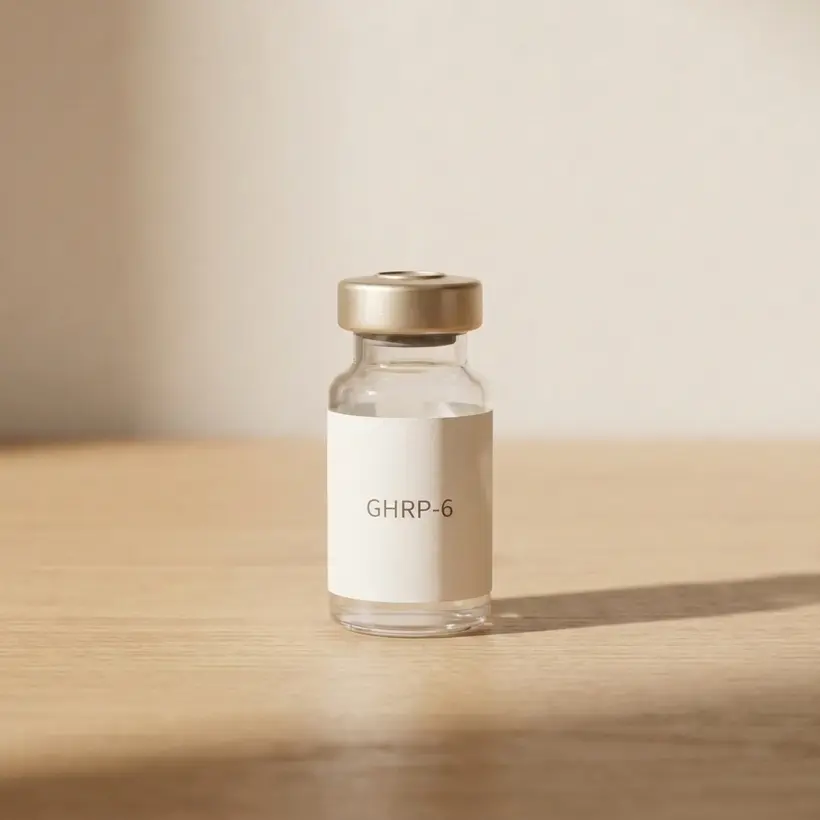
About GHRP-6
GHRP-6 is a synthetic hexapeptide with the sequence His-D-Trp-Ala-Trp-D-Phe-Lys-NH2 and a molecular weight of approximately 873 Da. It was one of the first growth hormone secretagogues discovered, originally developed by Cyril Bowers and colleagues in the 1980s as part of systematic structure-activity studies on enkephalin-derived peptides. The presence of D-Trp and D-Phe residues confers proteolytic resistance, while the C-terminal amidation is important for full biological activity at the GHS-R1a receptor.
GHRP-6 activates the growth hormone secretagogue receptor type 1a (GHS-R1a) with high affinity, producing both strong GH release and pronounced appetite stimulation. Unlike GHRP-2, which is relatively selective for GH release, GHRP-6 activates hypothalamic feeding circuits more potently, producing a strong hunger response within 15-20 minutes of administration that persists for 30-60 minutes. This appetite stimulation is mediated by NPY/AgRP neuron activation in the arcuate nucleus, the same pathway engaged by endogenous ghrelin.
In clinical pharmacology studies, GHRP-6 increases peak serum GH levels 5-10 fold above baseline within 15-30 minutes of subcutaneous administration. The magnitude of GH release is dose-dependent up to approximately 1-2 mcg/kg, beyond which a ceiling effect is observed. Like GHRP-2, GHRP-6 shows strong combined effect with GHRH analogs: co-administration produces a GH response significantly greater than either peptide alone, as the two compounds act through complementary signaling pathways (PLC/calcium for GHRP-6, cAMP/PKA for GHRH).
GHRP-6 has demonstrated significant gastroprotective and wound-healing properties in preclinical research. A series of studies published by the Center for Genetic Engineering and Biotechnology (CIGB) in Havana showed that GHRP-6 protected against ethanol-induced, NSAID-induced, and ischemia-reperfusion gastric lesions in rat models, reducing mucosal damage by 60-80%. This cytoprotection appears to be mediated through GHS-R1a-dependent upregulation of antioxidant enzymes and heat shock proteins, independent of GH release itself.
Wound healing research has shown GHRP-6 accelerates closure of full-thickness skin wounds by approximately 30% in animal models. It increases collagen deposition, fibroblast proliferation, and angiogenesis at the wound site. A study in Burns journal demonstrated accelerated re-epithelialization and reduced scar formation in burn wound models, effects attributed to both local GHS-R1a activation and the systemic GH/IGF-1 elevation produced by the peptide.
Pharmackinetically, GHRP-6 has a plasma half-life of approximately 20-25 minutes after subcutaneous injection, with peak GH response at 30-45 minutes. The GH-elevating effect persists for approximately 2-3 hours. Bioavailability after subcutaneous administration is estimated at 10-20%. GHRP-6 also transiently increases cortisol and prolactin levels, though these effects are modest and typically not clinically significant at standard research doses.
For reconstitution, lyophilized GHRP-6 should be reconstituted with bacteriostatic water or sterile water. The reconstituted peptide should be stored at 2-8 degrees C and used within 21 days. Lyophilized powder maintains stability at -20 degrees C for extended storage periods. GHRP-6 is soluble in water at concentrations up to 5 mg/mL at physiological pH.
The safety profile of GHRP-6 has been extensively studied over more than 25 years of research. The most prominent effect beyond GH release is appetite stimulation, which can be pronounced and may be undesirable for individuals not seeking caloric surplus. Transient increases in cortisol (30-50% above baseline) and prolactin (2-3 fold) have been reported at higher doses but generally remain within physiological ranges. Water retention and mild paresthesia at injection sites have been occasionally reported in clinical observations.