
Deep research
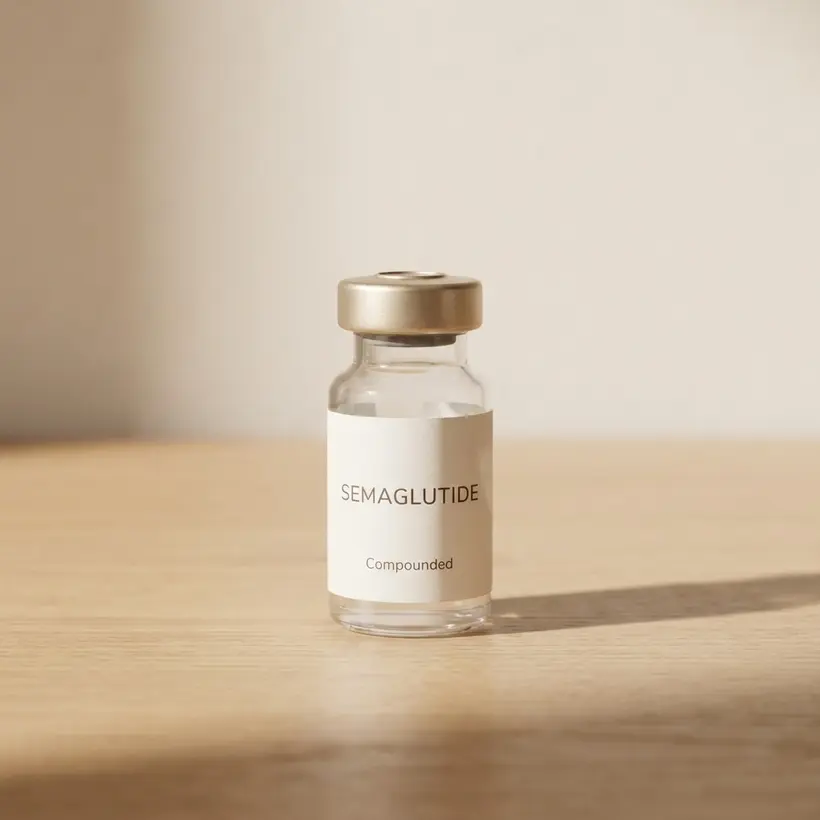
About Compounded Semaglutide
Semaglutide (chemical name: N-epsilon26-[2-(2-[2-(2-[2-(2-((S)-2-carboxy-3-((1S,2R)-3-carboxy-1-(carboxymethyl-carbamoyl)-propylcarbamoyl)-propionylamino)-ethoxy)-ethoxy)-acetylamino]-ethoxy)-ethoxy)-acetyl]-[Aib8,Arg34]-GLP-1-(7-37)-peptide) is a 39-amino-acid peptide with a molecular weight of 4,113.58 Da. It is an acylated analog of human GLP-1, sharing 94% sequence homology with native GLP-1(7-37). The key structural modification is a C18 fatty diacid chain attached at position 26 (lysine) via a linker, which enables non-covalent binding to albumin in the bloodstream. CAS number: 910463-68-2.
Semaglutide activates the GLP-1 receptor (GLP-1R), a class B G-protein-coupled receptor expressed in pancreatic beta cells, the hypothalamic arcuate nucleus, the area postrema, the nucleus tractus solitarius, and vagal afferent neurons. Receptor binding triggers Gs-mediated cAMP production, which in beta cells potentiates glucose-dependent insulin secretion. In the hypothalamus, GLP-1R activation stimulates POMC/CART neurons and inhibits NPY/AgRP neurons, producing satiety. In the brainstem, it activates neurons in the area postrema and NTS that relay visceral fullness signals. Semaglutide also slows gastric emptying by approximately 10-20% through vagal efferent modulation, extending post-prandial satiety.
The STEP 1 trial (N=1,961) published in the New England Journal of Medicine in 2021 (DOI: 10.1056/NEJMoa2032183) demonstrated 14.9% mean body weight reduction with semaglutide 2.4mg weekly versus 2.4% with placebo over 68 weeks. 86.4% of participants lost at least 5% of body weight, and 69.1% lost at least 10%. The STEP 2 trial in participants with type 2 diabetes showed 9.6% weight loss. The STEP 3 trial combining semaglutide with intensive behavioral therapy achieved 16.0% weight loss. The STEP 5 extension trial confirmed weight loss durability at 104 weeks.
The SELECT cardiovascular outcomes trial (N=17,604), published in NEJM 2023 (DOI: 10.1056/NEJMoa2307563), demonstrated a 20% reduction in major adverse cardiovascular events (MACE) -- the composite of cardiovascular death, non-fatal myocardial infarction, and non-fatal stroke -- in overweight or obese adults without diabetes. This was the first trial to demonstrate cardiovascular benefit from a weight-loss intervention in a non-diabetic population.
Semaglutide has a plasma half-life of approximately 165 hours (roughly 7 days), enabling once-weekly dosing. Peak plasma concentration is reached at 1-3 days post-injection. The long half-life is driven by albumin binding (greater than 99% bound), reduced DPP-4 degradation due to the Aib8 substitution, and slowed renal clearance of the larger albumin-bound complex. Semaglutide is metabolized by proteolytic cleavage of the peptide backbone and sequential beta-oxidation of the fatty acid side chain. The primary route of elimination is renal (approximately 53%) and fecal (approximately 19%).
Lyophilized semaglutide should be stored at -20C prior to reconstitution. Reconstitute with bacteriostatic water (0.9% benzyl alcohol) by gently swirling -- do not vortex. Once reconstituted, store at 2-8C and use within 28 days. Avoid repeated freeze-thaw cycles. Semaglutide is stable in solution at pH 7.0-8.0. Protect from light during storage.
Semaglutide has been studied for GLP-1 receptor signaling, incretin biology, central appetite regulation, beta-cell preservation, cardiovascular inflammation, NASH/NAFLD resolution, and neurodegenerative disease. Emerging preclinical work explores its potential effects on alcohol use disorder, Alzheimer's disease biomarkers, and kidney disease progression.
In clinical trials, the most common observations were gastrointestinal effects: nausea (44.2% vs 17.4% placebo in STEP 1), diarrhea (30.0%), vomiting (24.8%), and constipation (24.2%). These were predominantly mild to moderate, transient, and most frequent during dose escalation. Serious adverse events occurred at similar rates between semaglutide and placebo groups. Gallbladder-related events occurred in 2.6% of semaglutide vs 1.2% of placebo participants.