Pharmacy Safety Lookup
Check the FDA safety record of any GLP-1 telehealth company or compounding pharmacy. All data comes from public government sources.
Sources checked by FormBlends Editorial Research · Last reviewed 2026-11-19 · 12 sources
Check any GLP-1 company or pharmacy
Enter a name above to see their FDA registration status, warning letters, and recall history from public government records.
Compounding pharmacy safety checks: what the public records show
- Compounded GLP-1 drugs are not FDA approved. The FDA does not review compounded drugs for safety, effectiveness or quality before they are sold. That makes the pharmacy's own licensing and inspection record the main check a patient can run.
- There are two kinds of compounder, with different oversight. 503A pharmacies are overseen mainly by state boards of pharmacy and compound for individual prescriptions. 503B outsourcing facilities register with the FDA, must follow current good manufacturing practice, and are inspected on a risk based schedule.
- A 503A pharmacy missing from FDA registration lists is normal. 503A pharmacies are not required to register with the FDA as outsourcing facilities. For them, the state board license is the record to check.
- The FDA keeps a weekly updated list of registered outsourcing facilities. It shows each facility's last inspection and whether a Form 483 or recall followed. Facilities that do not renew registration by January 1 are removed.
- The FDA has logged hundreds of adverse event reports for compounded GLP-1 drugs. As of May 31, 2026, it had received 990 reports for compounded semaglutide and more than 730 for compounded tirzepatide. The FDA notes these are likely underreported.
- Salt forms are a red flag. The FDA says semaglutide sodium and semaglutide acetate are different active ingredients from the semaglutide in approved drugs, and it is not aware of any lawful basis for compounding them.
What the pharmacy safety lookup searches and shows
The lookup searches the FormBlends safety newsroom index, a list of GLP-1 telehealth companies and compounders built from public FDA records. You type at least 2 characters. As you type, the tool matches your text against company names and returns up to 10 results. The pharmacy safety lookup also matches the name used in a company's profile URL, so a shorter part of the name can help when your first spelling returns nothing.
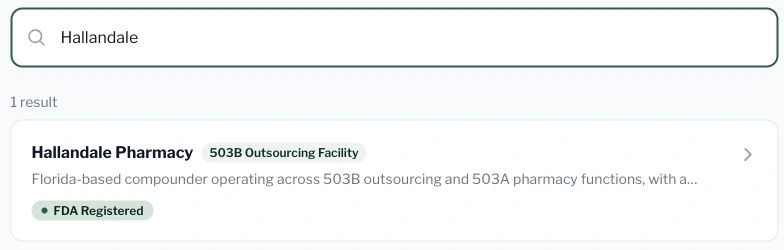
Each result shows a type badge (telehealth company, 503A pharmacy or 503B outsourcing facility), an FDA status badge, and counts of FDA warning letters and recalls tied to that company. Each result links to a company page with the details. If nothing matches, the tool says the company has not been verified yet and offers a form to request a check.
The index is small and dated. Its last update is April 25, 2026, and it holds 25 companies: 16 telehealth companies, 7 listed as 503B facilities and 2 listed as 503A pharmacies. Seven companies have an FDA registration marked active, last verified April 10, 2026. One has a warning letter on record and one has a recall. A company not in the index is not a sign of a problem. It only means the index does not cover it yet.
What each pharmacy safety lookup badge means, and what it cannot tell you
Every badge reflects a public record at a point in time. None of them is a quality rating, and none of them can tell you whether a specific vial is correct.
| Badge or field | What it means | What it does not show |
|---|---|---|
| Telehealth company | A company that connects patients with prescribers; it may not compound or dispense itself | Which pharmacy actually fills the order |
| 503A pharmacy | A state licensed pharmacy compounding for individual prescriptions | State inspection results or license discipline |
| 503B outsourcing facility | A facility registered with the FDA that must follow good manufacturing practice | Results of inspections after the index date |
| FDA status: active | An FDA registration was found and marked active when last verified | That any product is FDA approved, which compounded drugs are not |
| FDA status: inactive or not found | No current FDA registration was matched | A problem, for a 503A pharmacy, since 503A pharmacies are not required to register |
| No FDA data | The index holds no registration record for the company | Anything about safety either way |
| Warning letters | Count of FDA warning letters matched to the company | Whether the issue was fixed; check for a close-out letter |
| Recalls | Count of recalls matched to the company | Recall class, scope, or the products involved |
Worked example: verifying a GLP-1 compounding pharmacy step by step
Say a telehealth company tells you your compounded semaglutide will be filled by a pharmacy in another state. The lookup shows the telehealth company, but not the pharmacy. Here is how to check the pharmacy yourself using only free public records. Each step takes a few minutes.
- Step 1. Ask which pharmacy fills the prescription and whether it is a 503A pharmacy or a 503B outsourcing facility. A legitimate seller can answer both.
- Step 2. If it is a 503A pharmacy, look it up on the board of pharmacy website for its home state and for your state. Check that the license is active, that it allows sterile compounding if the product is an injection, and whether any discipline is listed.
- Step 3. If it is a 503B facility, find it on the FDA list of registered outsourcing facilities. Note the date of its last inspection and whether a Form 483 or a recall followed.
- Step 4. Search the FDA warning letter database for the pharmacy's name. If a letter exists, read what it cites, and check whether the FDA later issued a close-out letter.
- Step 5. Search FDA recall records, which are also open through the openFDA enforcement data, for the pharmacy's name.
- Step 6. Read the label on what you receive. Check the active ingredient name for salt forms such as semaglutide sodium or acetate, the strength per mL, and the beyond use date.
| Check | Where | Pass looks like | Stop and ask looks like |
|---|---|---|---|
| Pharmacy type | Ask the seller | Clear answer: 503A or 503B, with the name | Vague answer or no pharmacy named |
| State license | State board of pharmacy | Active, sterile compounding allowed | Expired, restricted, or not found |
| FDA registration (503B only) | FDA outsourcing facility list | Listed and current | Claims 503B but not listed |
| Warning letters | FDA warning letter database | None, or closed out | Recent open letter about sterility or ingredients |
| Recalls | FDA recalls and openFDA | None | Recent recall of injectable products |
| Product label | The vial and paperwork | Semaglutide or tirzepatide base, clear strength | Salt form named, or strength missing |
Online pharmacy red flags for GLP-1 drugs
The FDA's guidance on buying medicine online, which backs its BeSafeRx program, lists the signs of a safe online pharmacy. It always requires a prescription, has a physical address and phone number in the United States, has a licensed pharmacist available to answer questions, and is licensed by the state board of pharmacy where it operates.
The FDA also lists warning signs. These include not requiring a prescription, no licensed pharmacist on staff, deep discounts or prices that seem too good to be true, and medicine that looks different from what you got before or arrives damaged, in a foreign language or without an expiration date. For GLP-1 drugs the FDA has added its own concerns about unapproved products sold online, including products labeled for research use only and products with the wrong salt form.
- Sold without a prescription or with only an online form and no prescriber review.
- Labeled "for research use only" or "not for human consumption."
- Active ingredient listed as semaglutide sodium or semaglutide acetate.
- Claims that a compounded product is FDA approved or the same as a brand name drug. Compounded drugs are not FDA approved.
- No named pharmacy, or a pharmacy that does not appear in any state board lookup.
More questions about checking a GLP-1 pharmacy
What is the difference between a 503A pharmacy and a 503B outsourcing facility? A 503A pharmacy compounds drugs for individual patients based on a prescription and is overseen mainly by its state board. A 503B outsourcing facility can compound larger batches, registers with the FDA, must follow current good manufacturing practice, and is inspected by the FDA on a risk based schedule. The 503B category was created by the Drug Quality and Security Act of 2013.
Does FDA registered mean FDA approved? No. Registration means the FDA knows the facility exists and can inspect it. Approval applies to a specific drug product after the FDA reviews its safety and effectiveness. Registration does not establish eligibility to compound GLP-1 drugs from bulk substances. Compounded drugs are not FDA-approved.
Where can I check a drug establishment registration myself? The FDA's Drug Establishments Current Registration Site (DECRS) lists registered drug establishments, and its Drug Registration and Listing database covers listed products. 503A pharmacies usually do not appear in either, which is expected.
Is a telehealth company the same as a pharmacy? Usually not. Many telehealth companies connect patients with prescribers and send prescriptions to a separate pharmacy. The pharmacy that fills the order is the one whose license and FDA record matter for product quality.
How should I handle a compounded multi-dose vial? The FDA advises using compounded products only from a state licensed pharmacy and following the label. It recommends throwing out a multi-dose vial within 28 days after first use, even if medicine remains and even if the compounder's instructions say it can be used longer, because contamination risk rises after 28 days.
How do I report a problem with a compounded GLP-1 drug? The FDA takes reports through MedWatch, its safety information and adverse event reporting program, from both patients and health professionals.
Sources
- FDA: Concerns with unapproved GLP-1 drugs used for weight loss
- FDA: Compounding and the FDA, questions and answers
- FDA: Registered outsourcing facilities
- FDA: Information for outsourcing facilities
- FDA: Warning letters database
- FDA: About warning and close-out letters
- openFDA: Drug recall enforcement reports API
- FDA: Drug recalls
- FDA: Drug Establishments Current Registration Site (DECRS)
- FDA: How to buy medicines safely from an online pharmacy
- FDA: BeSafeRx, your source for online pharmacy information
- FDA MedWatch safety information and adverse event reporting
How this page was made
We read the lookup's client code to confirm what it searches, how many results it returns and what each badge and count means. We then opened the safety newsroom index it searches and counted its 25 companies by type, registration status, warning letters and recalls, as of its April 25, 2026 update. The 503A and 503B rules, registration and inspection facts, adverse event counts and online pharmacy signs were taken from the FDA pages listed below, each opened and read for this guide.
What this tool is and is not. The lookup only covers companies in the FormBlends safety newsroom index, which held 25 companies at its last update; a missing company is not a finding either way. It does not check state board licenses, product quality or individual batches, and its records can lag behind new FDA actions. FormBlends connects patients with licensed providers and pharmacies; it does not prescribe or dispense medicine.
GLP-1 Safety Alerts
Get notified when the FDA issues warning letters, recalls, or regulatory updates affecting GLP-1 medications and compounding pharmacies.
Free. No spam. Unsubscribe anytime.
What this tool checks
- FDA Registration Status: Whether the company appears in the FDA Drug Establishment Registration database
- Warning Letters: FDA warning letters for violations like misleading marketing claims
- Recall History: Drug recalls from the openFDA enforcement database
- 503A vs 503B Status: Whether the pharmacy operates as a 503A or 503B facility
Frequently Asked Questions
How do I check the actual pharmacy and its public records?
This tool searches public FDA-history profiles; it is not a current licence check or pharmacy certification. For a traditional 503A pharmacy, verify state licenses and product-specific records. A 503B registration is a different pathway, not FDA approval or proof of GLP-1 compounding eligibility.
What does it mean if a pharmacy has an FDA warning letter?
An FDA warning letter indicates the FDA found violations during a review. It's not a recall or ban.
What if my pharmacy isn't in the database?
We're continuously adding new companies. You can verify FDA registration directly at the FDA Drug Establishment Registration database.
Do I need to press a Search button after typing a pharmacy name?
No. Results appear as you type once the search has at least two characters. The list shows up to 10 matching companies, and each result opens its company profile.
Disclaimer: This tool searches our database of publicly available FDA and regulatory data. It is for informational purposes only. Not finding a company does not mean it is unsafe, and appearing in the database does not constitute an endorsement. Always verify with official FDA sources.