Key Takeaways
- Eli Lilly allows Zepbound at room temperature below 86 degrees Fahrenheit for up to 21 days, then discard
- The 21-day window is shorter than Ozempic's 56 days because tirzepatide and semaglutide have different stability profiles and different manufacturer data
- Zepbound is dispensed as single-dose pens, so the 21-day window applies per pen and per dose
- Freezing is a discard condition. Returning a warm pen to the fridge stops new exposure but does not reset the clock
- Mounjaro and Zepbound share storage rules because both are tirzepatide made by Lilly
Direct answer
A Zepbound pen can stay at room temperature below 86 degrees Fahrenheit for up to 21 days. This applies whether the pen is unopened or has been used. After 21 days of cumulative room-temperature exposure, the pen should be discarded. Refrigeration at 2 to 8 degrees Celsius (36 to 46 degrees Fahrenheit) is the default storage mode and preserves the pen to the printed expiration date. Freezing voids the medication.
Table of contents
- The Eli Lilly storage spec for Zepbound
- How Zepbound compares to other GLP-1 medications
- The single-dose pen design and what it changes
- Why 21 days, not 28 or 56
- The tirzepatide molecule and its stability profile
- Cumulative room-temperature time
- What heat does to Zepbound
- Freezing and the do-not-use rule
- The contrary view: margin in the 21-day spec
- Decision framework: keep or discard
- FAQ
- Sources
The Eli Lilly storage spec for Zepbound
The Zepbound prescribing information from Eli Lilly specifies the following:
Get medications from a trusted source
FormBlends sources through 503A compounding pharmacies with third-party purity testing on every batch.
Start Free Assessment →- Refrigerated storage: 2 to 8 degrees Celsius (36 to 46 degrees Fahrenheit), preferred until use
- Room-temperature storage: below 30 degrees Celsius (86 degrees Fahrenheit), up to 21 days
- Do not freeze. Do not use Zepbound if it has been frozen
- Protect from light. Store in original carton until time of use
The 21-day room-temperature allowance is the key number that separates Zepbound (and its diabetes-indicated sibling Mounjaro) from the Novo Nordisk products. The number is not a single-shot allowance after which the medication immediately fails. It is the limit beyond which Lilly's stability data does not support continued labeled potency.
The Lilly label treats the 21-day allowance as a one-way commitment. Once a pen has cumulatively spent 21 days at room temperature, it should be discarded. Returning the pen to refrigeration during that period stops the room-temperature clock but does not reset it. A pen that spent 10 days on the counter, then went back in the fridge for 6 months, then came back out has 11 days of room-temperature window remaining.
How Zepbound compares to other GLP-1 medications
The room-temperature storage spec varies meaningfully across the major GLP-1 medications. The table below summarizes manufacturer labeling as of 2026.
| Medication | Active ingredient | Manufacturer | Room-temperature allowance | Temperature ceiling |
|---|---|---|---|---|
| Ozempic | Semaglutide | Novo Nordisk | 56 days after first use | 86 F (30 C) |
| Wegovy | Semaglutide | Novo Nordisk | 28 days after first use | 86 F (30 C) |
| Mounjaro | Tirzepatide | Eli Lilly | 21 days, total | 86 F (30 C) |
| Zepbound | Tirzepatide | Eli Lilly | 21 days, total | 86 F (30 C) |
Two patterns emerge. First, the Lilly products have a shorter room-temperature window than the Novo Nordisk products. Second, even between two Novo Nordisk products with the same active ingredient (Ozempic and Wegovy, both semaglutide), the labeling differs (56 days vs 28 days).
The differences reflect each manufacturer's stability testing and the specific formulations of each product. Wegovy contains the same semaglutide as Ozempic but at different concentrations, in different pens, with different excipients tailored for the weight-loss indication. Each formulation has its own stability data. The numbers are not interchangeable.
For Zepbound users, the relevant comparison is between Zepbound and Mounjaro: identical. Both products are tirzepatide from Lilly in essentially the same delivery format, and the labeling matches.
The single-dose pen design and what it changes
Zepbound is dispensed as a prefilled single-dose pen. Each pen contains one dose of tirzepatide. The pen is activated by pressing it against the injection site; the medication is delivered automatically once activation completes. After the dose, the pen is discarded.
This design changes the storage math compared to multi-dose pens like Ozempic. Key implications:
- No 56-day in-use window applies because the pen is used once and discarded
- The 21-day room-temperature window covers the period from receiving the pen to using it
- A patient receiving four pens for a month of weekly dosing has four separate 21-day clocks, one per pen
- Patients typically use pens within a week of activation, well inside the 21-day window
The single-dose design eliminates one of the most common patient errors with multi-dose pens: forgetting when the pen was first used. Zepbound pens cannot be partially used. They are either unused (discard if outside spec) or fully used and discarded automatically.
It also means that an unused pen, kept at room temperature too long, must be discarded with all of its contents unused. This is a more significant waste than a multi-dose pen losing a few remaining doses near its in-use expiration.
Why 21 days, not 28 or 56
The 21-day window is what Eli Lilly demonstrated to the FDA during the Zepbound approval process. Lilly conducted stability testing at controlled room temperature (typically 25 degrees Celsius with stress testing at 30 degrees) and observed potency, sterility, and physical appearance over time. The 21-day allowance represents the duration through which Lilly could commit to maintaining specification under the room-temperature condition.
The shorter window compared to Ozempic does not mean Zepbound degrades faster in absolute terms. Several non-clinical factors contribute to the difference:
- Tirzepatide is a dual GIP/GLP-1 receptor agonist with a different molecular structure than semaglutide
- The pen formulation includes different excipients and preservatives
- Lilly used different stability test conditions during development
- Single-dose pens have different cartridge configurations than multi-dose pens
- Manufacturers commit only to the windows their data supports; they have no incentive to test beyond commercial needs
The honest reading: 21 days is what Lilly tested and certified. Whether tirzepatide could be stable for longer at room temperature is a question that has not been publicly answered. The label is the commitment, not the absolute limit of the chemistry.
The tirzepatide molecule and its stability profile
Tirzepatide is a 39-amino-acid peptide with a fatty acid side chain. It activates both the GLP-1 receptor and the glucose-dependent insulinotropic polypeptide (GIP) receptor, which is why it is called a dual agonist. Semaglutide, by contrast, is a 31-amino-acid peptide that activates only the GLP-1 receptor.
Both molecules are vulnerable to similar degradation pathways: deamidation, oxidation, aggregation. Both are designed for once-weekly subcutaneous injection. Both require cold-chain handling.
The differences in storage spec reflect formulation choices and stability data more than fundamental molecular differences. The amino acid sequences differ; the fatty acid attachments differ; the buffer systems differ. Each peptide-formulation combination has its own stability curve.
What this means practically: do not assume that Zepbound and Ozempic can be stored under the same rules. They cannot. Zepbound follows Lilly's labeling; Ozempic follows Novo Nordisk's. Mixing rules between manufacturers leads to either premature discard (with Ozempic rules applied to Zepbound, you would discard usable medication) or extended use beyond approval (with Zepbound treated under Ozempic rules, you may use medication beyond Lilly's validated window).
Cumulative room-temperature time
The 21-day allowance for Zepbound is cumulative. It is not 21 days at a time with resets allowed between cooling periods.
This means:
- A pen at room temperature for 10 days, then refrigerated for a week, then at room temperature for 8 more days has used 18 days of its 21-day window
- Refrigerated periods do not extend or restore the room-temperature allowance
- Patient tracking of total cumulative room-temperature time becomes important if the pen swaps between modes
For most patients, this is academic. A pen received by mail, refrigerated immediately, kept refrigerated until injection day, then warmed only briefly before use, never approaches the 21-day cumulative limit. The cumulative tracking matters for travel, supply gaps, or specific situations where pens are deliberately stored at room temperature for extended periods.
The simplest tracking habit: if a pen has been at room temperature for more than 5 to 7 consecutive days, write the date of room-temperature start on the carton. This gives you a reference if you later refrigerate and then warm again.
What heat does to Zepbound
Like semaglutide, tirzepatide is a peptide that depends on its three-dimensional shape for receptor binding. Heat above the 86-degree Fahrenheit ceiling accelerates the degradation reactions that disrupt this shape.
The main heat-driven degradation pathways for tirzepatide:
- Deamidation of asparagine and glutamine residues
- Oxidation of methionine and tryptophan residues
- Aggregation of peptide molecules
- Hydrolysis at peptide bonds with prolonged heat or extreme conditions
The clinical impact of mild heat exposure is reduced potency, not acute harm. A patient injecting heat-damaged Zepbound may notice weaker appetite suppression, smaller weight loss, or returning food noise. The medication does not become dangerous in the sense of producing new side effects; it simply does less of what it is supposed to do.
Severe heat exposure (above 100 degrees Fahrenheit for extended periods) can produce visible changes: cloudiness, particulates, color shift. The label says to discard if visual inspection shows any abnormality. Visual inspection is not reliable for ruling in undamaged medication, however, because mild heat damage can occur without visible signs.
Freezing and the do-not-use rule
Eli Lilly's labeling treats freezing as an absolute discard condition. Even brief freezing during a refrigerator cycle, an accidental placement in the freezer compartment, or shipping in winter without insulation requires discarding the pen.
The chemistry behind this rule: freezing forms ice crystals that physically disrupt the peptide solution. The crystals can damage the tirzepatide structure, cause the preservative to precipitate, and stress the rubber components of the pen. Some of this damage is irreversible even after thawing.
The mechanical components also matter. The Zepbound pen has internal springs and seals that perform precisely engineered actions during dose delivery. Freezing can compress seals, distort spring tension, and alter the rubber stopper that seals the cartridge. A pen that froze and thawed may not deliver the labeled dose accurately even if the medication itself appears intact.
Practical risks for freezing:
- Back wall of home refrigerators, where coils can drop below 32 F during compressor cycles
- Hotel mini-fridges that run too cold
- Winter shipping without sufficient insulation
- Refrigerator freezer compartments accessed by mistake
- Outdoor storage in cold climates
If you suspect freezing but are uncertain, the label answer is to discard. Visual inspection is not a reliable test.
The contrary view: margin in the 21-day spec
The 21-day window is what Lilly committed to. It is not necessarily the cliff at which tirzepatide stops working.
Pharmaceutical stability testing includes safety margin. The labeled limits are calibrated to ensure that products well past those limits have not started failing yet. In other words, the 21-day window reflects where Lilly's data shows the product remains within full specification. The actual point of clinically meaningful potency loss is almost certainly later.
This raises a question patients sometimes ask: if a pen has been at room temperature for 22 or 23 days, is it really unusable? The honest answer is that it is probably still effective but no longer manufacturer-validated. Lilly will not stand behind the dose, and clinicians will not recommend use. Whether to use a marginally out-of-window pen is a calculated individual decision.
The argument for strictness: the label is the only authoritative reference. Once you start interpreting "close enough," consistency disappears. Treating the 21-day limit as binding maintains a clean rule that anyone can apply.
The argument for flexibility: a pen 1 day past the limit, that was otherwise stored within temperature range, is almost certainly indistinguishable from a pen on day 21. Discarding such a pen creates waste without meaningful safety benefit. Most patients faced with this exact situation would reasonably use the pen.
Reasonable practice: follow the 21-day limit as the default. Replace the pen if you are uncertain. Lean toward use if the alternative is no medication for the week and the excursion was small.
Decision framework: keep or discard
For a Zepbound pen you are evaluating, walk through these questions.
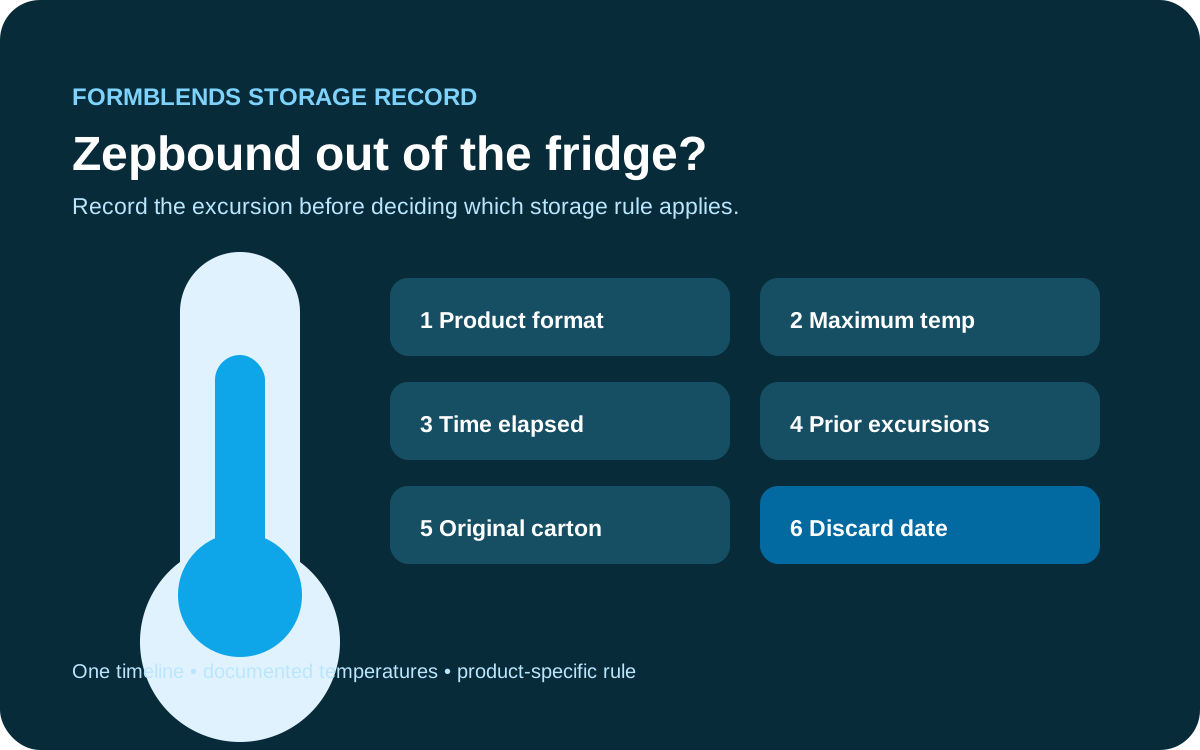
1. Has the pen been frozen, even briefly? If yes or uncertain, discard. If no, continue.
2. Has the pen exceeded 86 degrees Fahrenheit? If yes for more than a brief excursion, discard. If only briefly and mildly, use judgment. If no, continue.
3. Has the pen been at room temperature for more than 21 days cumulatively? If yes, discard. If no, continue.
4. Has the printed expiration date passed? If yes, discard. If no, continue.
5. Does the medication look clear and colorless? If no (cloudy, particulate, color shift), discard. If yes, use.
The clean habit for Zepbound users is to refrigerate pens until the day of use, then warm to room temperature briefly before injecting. This pattern uses essentially none of the 21-day room-temperature allowance, keeping all of it in reserve for travel or unexpected storage issues.
FAQ
How long can Zepbound be out of the fridge?
Up to 21 days at room temperature below 86 degrees Fahrenheit per Eli Lilly labeling.
Why is Zepbound's room-temperature window shorter than Ozempic's?
Different active ingredient, different formulation, different stability data.
What is the maximum room temperature for Zepbound?
86 degrees Fahrenheit (30 degrees Celsius).
Can I refrigerate Zepbound after it has been at room temperature?
Yes, but it does not reset the 21-day cumulative clock.
What about freezing? Can I use frozen Zepbound?
No. The label says discard.
Is Zepbound the same as Mounjaro for storage?
Yes. Both are tirzepatide from Lilly with identical storage rules.
How does Zepbound's pen design affect storage?
Single-dose pens simplify tracking. The 21-day window applies per pen.
What if I have an unopened Zepbound pen that was at room temperature for several weeks?
Use if under 21 days. Discard if over.
Related guides
- How Long Can Ozempic Be Out of the Fridge? The 56-Day Rule, Explained
- How Long Can Mounjaro Be Out of the Fridge? The 21-Day Rule for Type 2 Diabetes
- How Long Can Wegovy Be Out of the Fridge? The 28-Day Window
- How Long Can Compounded Semaglutide Be Out of the Fridge? Beyond-Use Dating Explained
- How Long Does Zepbound Stay in Your System? The 5-Day Half-Life and What It Means
- How Long Does Zepbound Last in the Fridge? Single-Dose Pen Storage Profile
Sources
- Eli Lilly and Company. Zepbound (tirzepatide) injection prescribing information, revised 2024.
- Eli Lilly and Company. Mounjaro (tirzepatide) injection prescribing information, revised 2024.
- U.S. Food and Drug Administration. Zepbound approval documentation, 2023.
- Jastreboff AM, Aronne LJ, Ahmad NN, et al. Tirzepatide Once Weekly for the Treatment of Obesity. New England Journal of Medicine 2022;387:205-216.
- International Conference on Harmonisation. ICH Q1A(R2): Stability Testing of New Drug Substances and Products, 2003.
- Manning MC, Patel K, Borchardt RT. Stability of Protein Pharmaceuticals. Pharmaceutical Research 2010;27(4):544-575.
- Aronne LJ, Sattar N, Horn DB, et al. Continued Treatment With Tirzepatide for Maintenance of Weight Reduction (SURMOUNT-4). JAMA 2024;331(1):38-48.
- U.S. National Library of Medicine. DailyMed entry for Zepbound, accessed 2026.
- Coskun T, Sloop KW, Loghin C, et al. LY3298176, a Novel Dual GIP and GLP-1 Receptor Agonist for the Treatment of Type 2 Diabetes Mellitus. Molecular Metabolism 2018;18:3-14.
- American Society of Health-System Pharmacists. Drug stability data: tirzepatide handling, 2024.
- U.S. Food and Drug Administration. Drug labeling and stability requirements for biologics, 2023 guidance.
Footer disclaimers
Platform Disclaimer. FormBlends provides telehealth access and educational content. Storage decisions should be informed by your prescriber and the pharmacy that dispensed your medication. This article does not replace the package insert.
Compounded Medication Notice. Compounded tirzepatide is not FDA-approved. Storage rules in this article apply to Eli Lilly brand Zepbound. Compounded products dispensed by 503A pharmacies have their own beyond-use dates set under USP 797 standards.
Results Disclaimer. Medication stored outside the labeled range may have reduced potency, which can affect weight loss, appetite control, or other treatment outcomes. The specific clinical effect of any individual storage incident is difficult to predict.
Trademark Notice. Zepbound and Mounjaro are registered trademarks of Eli Lilly and Company. Ozempic and Wegovy are registered trademarks of Novo Nordisk A/S. FormBlends has no commercial affiliation with these companies.
See your options in about 2 minutes
Take the free quiz and see what fits you. Quick, private, and no commitment to continue.
See my options →