About
About Cagrilintide
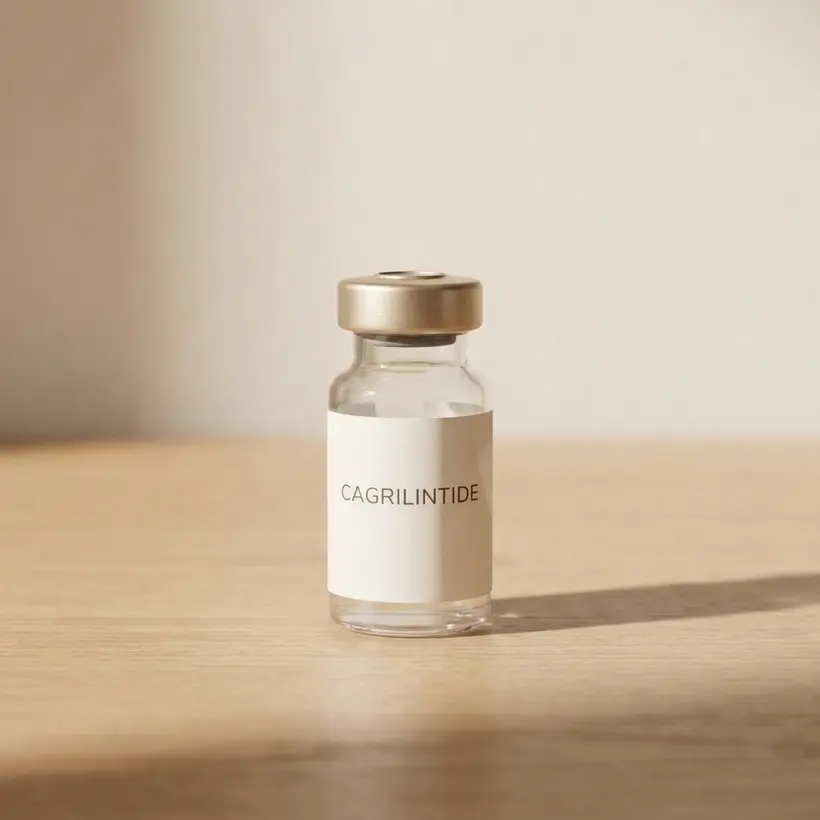
Cagrilintide (NN9838) is a long-acting acylated analog of human amylin (islet amyloid polypeptide, IAPP), a 37-amino-acid peptide hormone co-secreted with insulin from pancreatic beta cells in response to nutrient intake. Cagrilintide is engineered with amino acid substitutions to prevent the amyloid fibril aggregation that limits native amylin's therapeutic use, combined with a C18 fatty diacid modification at Lys residue for albumin binding and extended half-life. CAS number: 2375328-89-5. It was developed by Novo Nordisk as both a standalone obesity treatment and as the amylin component of the CagriSema combination (cagrilintide + semaglutide).
Cagrilintide activates the amylin receptor complex, which consists of the calcitonin receptor (CTR) heterodimerized with receptor activity-modifying proteins (RAMPs), primarily RAMP1, RAMP2, and RAMP3. These receptors are densely expressed in the area postrema (AP) and nucleus tractus solitarius (NTS) of the brainstem -- regions outside the blood-brain barrier that sense circulating hormones. Activation produces three primary effects: (1) potent satiety signaling through AP/NTS neuronal activation that reduces meal size, (2) slowing of gastric emptying via vagal efferent modulation, and (3) suppression of post-prandial glucagon secretion from pancreatic alpha cells. The amylin receptor pathway is neuroanatomically and pharmacologically distinct from the GLP-1 receptor pathway, which is why co-activation of both systems produces additive appetite suppression that exceeds either alone.
As a monotherapy, a Phase 2 dose-finding trial (N=92) evaluated cagrilintide at doses from 0.3mg to 4.5mg weekly over 26 weeks. The highest dose achieved 10.8% mean body weight loss versus 3.0% placebo. The CagriSema combination (cagrilintide + semaglutide 2.4mg) has produced the most compelling data: a Phase 1b proof-of-concept study showed 15.6% mean weight loss at 20 weeks with moderate doses of both components. The Phase 3 REDEFINE program is evaluating CagriSema across multiple populations. REDEFINE 1 results showed 22.7% weight loss with CagriSema versus 15.8% with semaglutide alone and 8.4% with cagrilintide alone over 68 weeks, confirming the additive benefit of dual amylin/GLP-1 pathway activation.
Cagrilintide has a plasma half-life of approximately 7 days (160-170 hours), enabled by its C18 fatty diacid albumin-binding modification. This supports once-weekly subcutaneous dosing. Peak plasma concentration is reached 1-3 days post-injection. Steady state is achieved after approximately 5 weeks of weekly dosing. The long half-life is comparable to semaglutide and driven by the same albumin-binding pharmacokinetic principle. Metabolism occurs via proteolytic degradation; no significant CYP450 involvement has been identified.
Lyophilized cagrilintide should be stored at -20C before reconstitution. Reconstitute with bacteriostatic water (0.9% benzyl alcohol) by gently directing water along the vial wall and swirling slowly. Do not shake or vortex. Reconstituted solution should be stored at 2-8C and used within 28 days. The peptide is engineered for aqueous stability through amino acid substitutions that prevent the beta-sheet aggregation and fibril formation characteristic of native amylin, so it maintains solution stability better than pramlintide (the first-generation amylin analog).
Cagrilintide is studied in research on amylin receptor pharmacology, brainstem appetite circuits, dual-hormone satiety signaling, beta-cell biology, and combination incretin therapy design. The CagriSema combination is particularly studied for its implications in multi-pathway obesity pharmacotherapy and whether non-overlapping receptor mechanisms can achieve weight loss exceeding 25%. Research also explores amylin's role in glucose counterregulation and bone metabolism.
In clinical trials, cagrilintide's adverse event profile differs from GLP-1 agonists. Gastrointestinal side effects occur but at generally lower rates than with GLP-1 agonists alone: nausea was reported in 20-25% of cagrilintide monotherapy participants versus 10% placebo. Injection site reactions were more common than with semaglutide, occurring in approximately 5-10% of participants. No pancreatitis cases were reported. In the CagriSema combination, GI tolerability was comparable to semaglutide alone despite greater weight loss, suggesting the amylin component does not meaningfully add to GLP-1-driven nausea.