


Deep research
About Dihexa
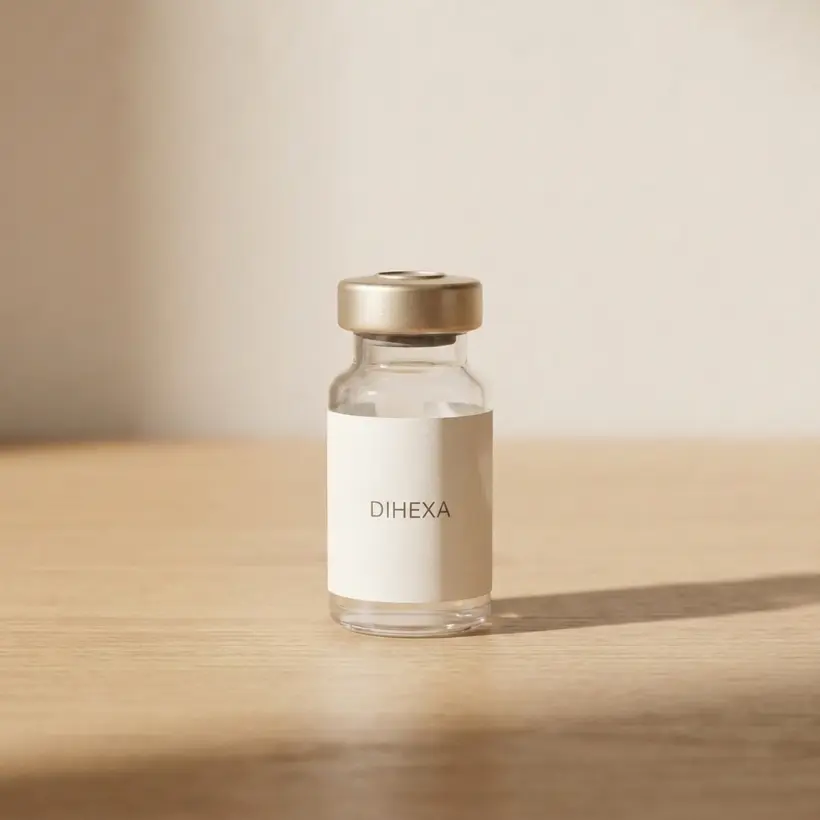
Dihexa (N-hexanoic-Tyr-Ile-(6) aminohexanoic amide) is a modified dipeptide analog with a molecular weight of approximately 507.63 Da. It was developed by Dr. Joseph Harding and Dr. John Wright at Washington State University as part of a systematic investigation into the cognitive-enhancing properties of the angiotensin IV/AT4 receptor system. Unlike traditional peptides, Dihexa is a peptidomimetic, meaning it was designed with non-natural structural elements (hexanoic acid caps on both termini) that confer resistance to enzymatic degradation and enable oral bioavailability.
The mechanism of action centers on the hepatocyte growth factor (HGF) / c-Met receptor signaling pathway. HGF/c-Met signaling is critical for neuronal survival, neurite outgrowth, and synaptogenesis in the developing and adult brain. Dihexa acts as a potent HGF/c-Met agonist by binding to the HGF kringle domain and facilitating HGF dimerization, which is required for c-Met receptor activation. This mechanism was elucidated by McCoy et al. and published in the Journal of Pharmacology and Experimental Therapeutics (2013).
The extraordinary potency of Dihexa was demonstrated in scopolamine-induced cognitive deficit models in rats (Benoist et al., published in the Journal of Pharmacology and Experimental Therapeutics, 2011). Dihexa reversed learning and memory deficits at concentrations as low as 10^-13 M (picomolar range), approximately 10 million times more potent than BDNF on a molar basis for promoting synaptogenesis. It increased dendritic spine density in hippocampal CA1 neurons and strengthened existing synaptic connections as measured by electrophysiological recordings.
Dihexa crosses the blood-brain barrier and demonstrates oral bioavailability, properties that are rare among cognitive-enhancing peptides. The compound's peptidomimetic structure resists degradation by gastrointestinal and serum proteases, allowing oral dosing to achieve effective CNS concentrations. Subcutaneous and intraperitoneal routes have also been used in clinical protocols. Due to its extreme potency, effective doses are in the low microgram range. Research protocols have typically studied doses of 0.5-2 mg/day in animal models.
The angiotensin IV receptor (AT4R), identified as IRAP (insulin-regulated aminopeptidase), was initially thought to be Dihexa's primary target. Subsequent research clarified that while Dihexa interacts with the angiotensin IV system, its cognitive effects are primarily mediated through the HGF/c-Met pathway. C-Met receptor activation triggers PI3K/Akt and Ras/MAPK cascades in neurons, promoting dendritic spine formation, long-term potentiation (LTP), and neuronal survival under stress conditions.
For storage and handling, Dihexa should be stored as a lyophilized powder at -20C, where it is stable for 24+ months. Reconstituted solutions should be refrigerated at 2-8C and used within 28 days. The compound is soluble in DMSO and aqueous solutions at working concentrations. Given the picomolar effective concentration range, accurate weighing and serial dilution are important for reconstitution and storage.
Dihexa is a relatively new compound compared to established nootropic peptides, and its safety profile is less extensively characterized. Preclinical toxicology studies have not identified acute toxicity at doses far exceeding the effective range. However, because HGF/c-Met signaling also plays roles in cell proliferation and is implicated in certain cancers, the long-term safety implications of chronic c-Met activation require careful evaluation. Published research to date has focused on short-term cognitive enhancement protocols.