Deep research
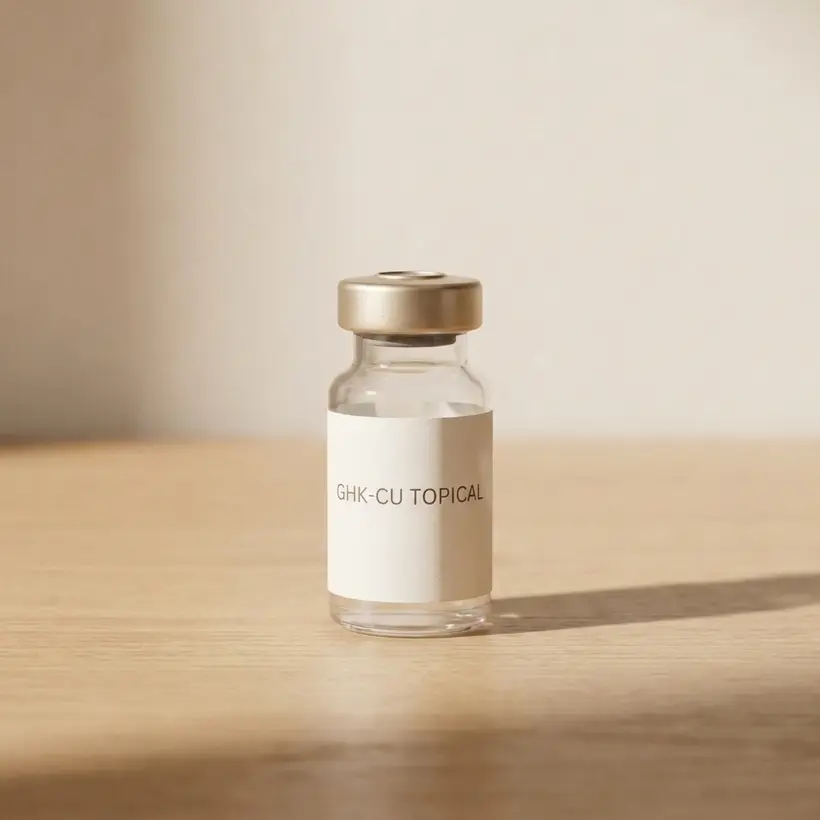
About GHK-Cu Topical Serum
GHK-Cu (glycyl-L-histidyl-L-lysine copper(II)) is a naturally occurring copper-binding tripeptide with the amino acid sequence Gly-His-Lys bound to a Cu2+ ion. It has a molecular weight of approximately 403.9 Da in its free peptide form (or ~340.4 Da without the copper ion). First identified in human plasma by Dr. Loren Pickart in 1973, GHK-Cu was discovered when Pickart observed that albumin from young donors (age 20-25) could stimulate aged liver tissue to synthesize proteins at a youthful rate, and the active factor was traced to this small copper peptide. Our topical serum delivers GHK-Cu at a 3% concentration, the same level used in the clinical studies that demonstrated the most pronounced dermal benefits.
The mechanism of action of GHK-Cu is versatile and remarkably broad. At the molecular level, it modulates the expression of over 4,000 human genes, roughly 6% of the genome, according to a 2012 Broad Institute Connectivity Map analysis published by Pickart, Campbell, and colleagues. It upregulates genes involved in collagen synthesis (COL1A1, COL3A1, COL5A1), extracellular matrix remodeling (decorin, fibromodulin), and antioxidant defense (superoxide dismutase, glutathione peroxidase) while simultaneously suppressing genes associated with inflammation (IL-6, TNF-alpha), fibrinogen production, and tissue destruction (several MMPs). The copper ion itself serves as a cofactor for lysyl oxidase, the enzyme responsible for collagen and elastin cross-linking, meaning GHK-Cu both stimulates production of new structural proteins and ensures they are properly stabilized.
The clinical evidence for topical GHK-Cu is anchored by Pickart's landmark studies. In double-blind, placebo-controlled trials, daily application of GHK-Cu cream at 3% concentration for 12 weeks produced a 70% increase in skin collagen thickness as measured by ultrasound imaging, a 40% increase in skin elasticity, and visible reduction in fine lines and wrinkles. In a separate head-to-head comparison, GHK-Cu outperformed both retinol (vitamin A) and vitamin C in improving skin firmness and elasticity, and it did so without the irritation, photosensitivity, or adjustment period associated with retinoid use. Glycosaminoglycan synthesis also increased by approximately 70%, contributing to improved skin hydration and volume.
From a pharmacokinetic perspective, topical GHK-Cu has a distinct advantage: it acts locally rather than systemically. The peptide is small enough (three amino acids plus a copper ion) to penetrate the stratum corneum, particularly when formulated with phospholipid-based delivery systems that enhance dermal absorption. Once in the dermis, GHK-Cu interacts directly with fibroblasts and keratinocytes. The copper ion is released gradually as the peptide is metabolized, providing sustained signaling. Because the peptide occurs naturally in human plasma (at roughly 200 ng/mL in young adults, declining to approximately 80 ng/mL by age 60), topical supplementation essentially restores youthful local concentrations in treated skin.
Our 3% formulation uses a phospholipid-based delivery system designed to protect the GHK-Cu complex during transit through the lipid-rich outer skin layers and release it at the dermal-epidermal junction. The product should be stored at room temperature (20-25 degrees C) away from direct sunlight. No refrigeration is required for the topical serum, though it should be used within 90 days of opening to ensure peptide stability. The copper peptide is inherently stable in aqueous solution at physiological pH (6.5-7.4), which matches normal skin surface conditions.
Beyond its cosmetic effects, GHK-Cu has demonstrated wound-healing properties in multiple animal models, accelerating closure of surgical wounds and reducing scar tissue formation. Pickart's group showed it attracted immune cells and endothelial cells to wound sites, stimulated nerve outgrowth, and increased the production of vascular endothelial growth factor (VEGF), which promotes new blood vessel formation. These regenerative properties are what make GHK-Cu effective not just for anti-aging skincare but also for post-procedure recovery.
The safety profile of topical GHK-Cu is well-established across decades of use and multiple clinical trials. No adverse effects, allergic reactions, or irritation have been reported at concentrations up to 3%. Because GHK is a naturally occurring peptide already present in human plasma, serum, saliva, and urine, the body recognizes it as endogenous rather than foreign. It does not cause photosensitivity (unlike retinoids), does not thin the skin (unlike corticosteroids), and does not require a tolerance-building period. The Cosmetic Ingredient Review panel has assessed copper peptides as safe for cosmetic use. GHK-Cu is compatible with other active ingredients including hyaluronic acid, niacinamide, and peptide serums.