The short answer
Yes, ibuprofen and semaglutide can be taken together. There is no direct drug-drug interaction listed in the FDA prescribing information for Ozempic, Wegovy, or compounded semaglutide. The caveats are real, though. Both can irritate the stomach, and ibuprofen carries a kidney risk that compounds with the dehydration GLP-1 patients sometimes experience.
Table of contents
- The 30-second answer
- The pharmacology: why no direct interaction
- The compounded GI risk (the actual concern)
- The kidney concern, and who should worry
- Acetaminophen vs ibuprofen vs naproxen: which is safer
- Timing rules: when to take ibuprofen on semaglutide
- Other medications that need more thought (and why)
- Red flags that mean stop and call a provider
- FAQ
- Footer disclaimers
The pharmacology: why no direct interaction
Semaglutide is a GLP-1 receptor agonist. It activates GLP-1 receptors in the pancreas (increasing insulin release in response to glucose), the brain (reducing appetite signals), and the gut (slowing gastric emptying).
Check your GLP-1 eligibility
Use our free BMI Calculator to see if you may qualify for provider-reviewed GLP-1 therapy.
Try the BMI Calculator →Ibuprofen is a non-steroidal anti-inflammatory drug (NSAID). It blocks the COX-1 and COX-2 enzymes, which reduces prostaglandin production and decreases inflammation, pain, and fever.
These two drugs work through entirely separate pathways. They don't compete for the same enzyme systems, don't share metabolic routes through the liver, and don't bind the same plasma proteins. The FDA prescribing information for Ozempic (semaglutide injection) and Rybelsus (oral semaglutide) lists no clinically significant interactions with NSAIDs.
That said, "no direct interaction" doesn't mean "no caution required." Both drugs can affect the gastrointestinal tract through different mechanisms, and the combined effect can be more than the sum of the parts in real-world use.
A 2023 review in Clinical Therapeutics (Smith et al.) examined GLP-1 and NSAID co-administration data from post-market surveillance and concluded that while no pharmacokinetic interaction exists, GI side effect rates were modestly higher in patients on both compared to either alone. The authors framed this as additive, not synergistic, irritation.
The compounded GI risk (the actual concern)
This is the part most providers will mention if you ask whether ibuprofen is safe with semaglutide.
Semaglutide commonly causes nausea (about 20% of patients during titration), occasional vomiting, and slowed gastric emptying that keeps food sitting in the stomach for 2 to 4 hours longer than baseline. The result is a stomach lining that's sometimes irritated, with delayed clearance of anything you swallow.
Ibuprofen is itself an established cause of stomach lining irritation, ulcers, and GI bleeding. Per the American College of Gastroenterology guidelines, NSAIDs are responsible for roughly 30% of clinically significant upper GI bleeds in the US population. The risk rises with dose, duration, and pre-existing GI conditions.
When you combine the two, three things stack:
- Stomach already irritated from semaglutide-induced delayed emptying.
- Pill sitting longer in the stomach because of slowed gastric emptying. Ibuprofen tablets in direct contact with stomach lining for 3 to 4 hours instead of 1 to 2 hours.
- Nausea masking warning signs. Mild ibuprofen-induced GI irritation often presents as queasiness, which patients on semaglutide may attribute to the GLP-1 itself and ignore.
The practical translation: occasional ibuprofen for a headache or a sprained ankle is fine on semaglutide. Daily long-term ibuprofen (the kind taken for chronic back pain or arthritis) is the use case that warrants a conversation with your provider, because the additive GI risk over months is the real exposure.
The kidney concern, and who should worry
Ibuprofen reduces blood flow to the kidneys by inhibiting prostaglandins that help maintain renal perfusion. In healthy patients with normal kidneys and adequate hydration, this is a mild effect that resolves with discontinuation. In dehydrated patients or patients with pre-existing kidney disease, it can precipitate acute kidney injury.
Semaglutide can cause dehydration in some patients during titration, mostly through nausea, vomiting, and reduced fluid intake. The combination of ibuprofen plus a dehydrated patient on semaglutide is the actual mechanism behind a small number of reported cases of acute kidney injury in GLP-1 users.
Patients at higher kidney risk:
- Pre-existing chronic kidney disease (eGFR under 60)
- Diabetes (especially long-standing or poorly controlled)
- Age over 65
- High blood pressure on ACE inhibitors or ARBs (which also reduce renal perfusion)
- Heart failure
- Recent vomiting, diarrhea, or limited fluid intake
- Diuretic use
For these patients, regular ibuprofen on semaglutide is best avoided. Acetaminophen (Tylenol) is the safer alternative, with no NSAID kidney effect.
For most healthy patients on semaglutide, occasional ibuprofen for short-term pain is fine, with the standard hydration caveat: drink water with the dose, and skip ibuprofen if you've been vomiting or unable to eat for a day.
Acetaminophen vs ibuprofen vs naproxen: which is safer
| Pain reliever | GI risk on semaglutide | Kidney risk | Timing/dose notes |
|---|---|---|---|
| Acetaminophen (Tylenol) | Very low | Very low | Up to 3 g per day, or 2 g if any liver disease |
| Ibuprofen (Advil, Motrin) | Moderate | Moderate to high if dehydrated | Take with food and water; max 1.2 g per day OTC |
| Naproxen (Aleve) | Moderate to high | Moderate to high | Longer half-life means longer GI exposure |
| Aspirin (low-dose, cardiac) | Moderate | Low | Continue if prescribed for cardiovascular protection |
| Aspirin (full-dose, pain) | High | Moderate | Avoid for pain on semaglutide if alternative exists |
| Topical diclofenac (Voltaren gel) | Very low | Low | First-line for joint pain on GLP-1s |
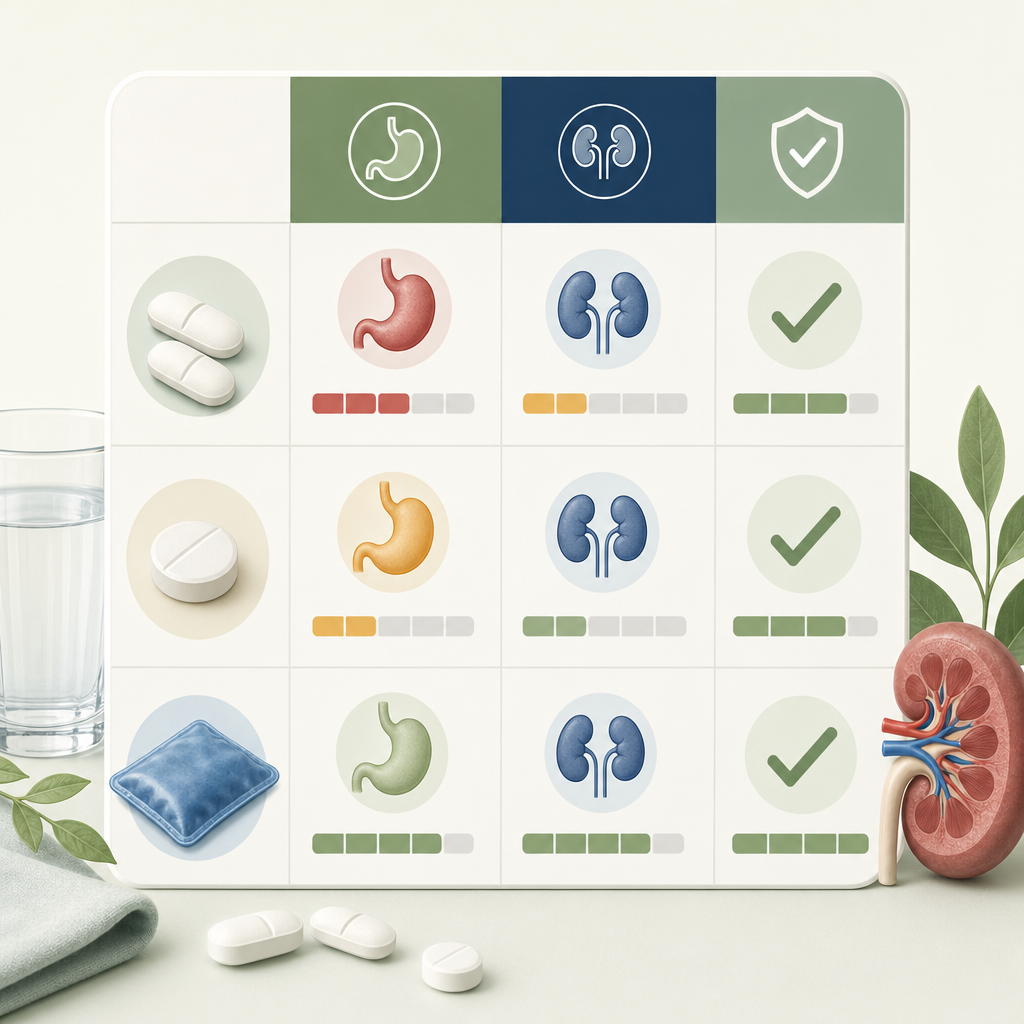
For most semaglutide patients with occasional pain, the cleanest path is acetaminophen for headache, low back ache, or general pain, and topical diclofenac for joint pain. Both avoid the GI and kidney concerns entirely.
If acetaminophen alone doesn't manage your pain (it's weaker than NSAIDs for inflammation-driven pain), then short-term ibuprofen at the lowest effective dose is reasonable. Take it with food. Drink water. Don't extend past a few days without checking with your provider.
The combo to avoid: NSAIDs plus alcohol plus dehydration. Each one alone is manageable. All three together have produced most of the GI bleeding case reports in GLP-1 users.
Timing rules: when to take ibuprofen on semaglutide
Practical timing guidance, based on the labeled instructions for both medications and standard clinical practice:
With semaglutide injection (Ozempic, Wegovy, compounded): No timing relationship needed. Inject when scheduled, take ibuprofen as needed for pain. The injectable doesn't interact with oral absorption.
With Rybelsus (oral semaglutide): Rybelsus has strict absorption requirements. Take it 30 minutes before any food, beverage (other than 4 oz of plain water), or other oral medication. Ibuprofen taken at the same time as Rybelsus dramatically reduces Rybelsus absorption. Wait at least 30 minutes after Rybelsus before taking ibuprofen.
With food: Always take ibuprofen with food on semaglutide, ideally a small meal or substantial snack. Food in the stomach buffers the NSAID and reduces direct lining contact. Avoid taking ibuprofen on an empty stomach.
Hydration: A full 8 oz glass of water with each ibuprofen dose. The water helps move the tablet through the stomach faster despite the slowed gastric emptying.
Dose limits: OTC ibuprofen maxes out at 200 mg per dose, 1,200 mg per day. The prescription range goes higher (up to 3,200 mg per day for arthritis), but at those doses on semaglutide, GI risk climbs sharply. Stay at OTC doses unless your provider has weighed the risks.
Other medications that need more thought (and why)
Ibuprofen is one of the easier coexistence questions on semaglutide. A few other medications need more attention:
Sulfonylureas (glipizide, glyburide) and insulin. Both lower blood sugar through different mechanisms than GLP-1s. Combining them with semaglutide raises hypoglycemia risk. Most providers reduce or pause sulfonylureas when starting semaglutide. Insulin doses usually drop 20 to 30%. This is a clinical adjustment your prescriber should make.
Oral contraceptives. Semaglutide's gastric emptying delay can reduce absorption of oral medications, including birth control pills. The clinical relevance is small but real. Some providers recommend a backup contraceptive method during the first 4 weeks after starting semaglutide and after each dose increase.
Levothyroxine (Synthroid) and other narrow-window oral medications. Slowed gastric emptying can shift absorption timing. Most thyroid-stable patients don't need a dose change, but TSH should be checked 4 to 6 weeks after starting semaglutide.
Anticoagulants (warfarin, apixaban). Combining anticoagulants with NSAIDs (including ibuprofen) raises bleeding risk meaningfully. If you're on warfarin or a DOAC, acetaminophen is strongly preferred for pain, and any NSAID use should be cleared with your prescriber.
Phenylephrine and pseudoephedrine (decongestants). No major interaction with semaglutide, but pseudoephedrine can raise heart rate and blood pressure, which compounds with semaglutide's modest cardiovascular effects.
Alcohol. Not a medication, but worth mentioning. Alcohol on semaglutide raises hypoglycemia risk in diabetic patients and can compound nausea. Alcohol plus ibuprofen plus semaglutide is the GI bleed risk combo flagged earlier.
For more on the broader interaction question, see our piece on how compounded semaglutide handles concurrent medications for the GI side, and on protein adequacy during weight loss for the nutrition side.
Red flags that mean stop and call a provider
Most ibuprofen use on semaglutide is uneventful. The symptoms below mean stop and contact a provider or seek care.
Same day care:
- Black, tarry stools (suggests upper GI bleed)
- Vomiting blood or coffee-ground material
- Severe upper abdominal pain
- Sudden decrease in urine output (less than 4 oz in 8 hours)
- Sudden swelling in ankles or face
- Severe right-upper-quadrant pain (possible gallbladder or pancreatitis)
Provider call within 24 to 48 hours:
- New stomach pain that lasts more than a few hours
- Persistent indigestion or heartburn that wasn't there before
- New ringing in the ears (can indicate aspirin or NSAID toxicity at higher doses)
- Confusion or unusual fatigue (possible kidney effect or dehydration)
Routine follow-up:
- Regular ibuprofen use beyond 7 to 10 days
- Any need to combine ibuprofen with a blood thinner, ACE inhibitor, or diuretic
- Pre-existing kidney, liver, or GI disease and ongoing pain that needs management
The line between "fine to manage at home" and "call the provider" usually corresponds to whether new symptoms have appeared or existing symptoms have worsened. Ibuprofen for a headache that resolves the same day is a non-event. Ibuprofen as a daily habit on semaglutide for weeks deserves a conversation.
FAQ
Can I take ibuprofen while on semaglutide?
Yes, occasionally. There's no direct drug-drug interaction. The cautions are GI irritation (both drugs can irritate the stomach lining) and kidney perfusion (ibuprofen plus dehydration can hurt the kidneys). For most healthy patients, occasional short-term ibuprofen is fine. Daily long-term use needs provider input.
Is acetaminophen better than ibuprofen on semaglutide?
Generally, yes. Acetaminophen (Tylenol) avoids the NSAID-related GI and kidney concerns that ibuprofen carries. It's the safer first-line choice for pain and fever on semaglutide. Maximum daily dose is 3 g (or 2 g if any liver disease).
Can I take Advil PM or other ibuprofen combo products?
Yes, with the same cautions as plain ibuprofen. Advil PM combines ibuprofen with diphenhydramine (sleep aid). Diphenhydramine has anticholinergic effects that can worsen GI symptoms in some semaglutide patients. If you tolerate plain Advil at bedtime, Advil PM is similar.
Can I take ibuprofen the day I take my semaglutide injection?
Yes. Semaglutide injection timing has no relationship to ibuprofen. You can take ibuprofen any time on injection day, just take it with food and water as usual.
What about Rybelsus and ibuprofen?
Rybelsus (oral semaglutide) requires a 30-minute window before any food or other medication, including ibuprofen. Take Rybelsus first with 4 oz of water on an empty stomach. Wait at least 30 minutes. Then you can take ibuprofen with food.
How long can I take ibuprofen on semaglutide before I should worry?
Short courses (less than 7 to 10 days) for acute pain are generally fine. Daily use beyond 2 weeks raises both GI and kidney concerns enough to warrant a provider conversation. Patients with kidney disease, diabetes, or age over 65 should check in sooner.
Can ibuprofen affect semaglutide weight loss?
No, there's no evidence ibuprofen reduces semaglutide's weight loss effect. The two drugs work through entirely different mechanisms. Weight loss outcomes are unchanged in patients who take occasional NSAIDs.
What if I'm taking a daily aspirin for heart health and starting semaglutide?
Continue the aspirin as prescribed. Low-dose aspirin (81 mg) for cardiovascular protection has a much lower GI risk profile than full-dose aspirin or ibuprofen. Most cardiologists recommend continuing low-dose aspirin even when adding GLP-1s, but check with your prescriber.
Can I drink alcohol while taking ibuprofen and semaglutide?
The three-way combination raises GI bleeding risk substantially. Occasional moderate alcohol (one drink) on semaglutide alone is generally well-tolerated. Adding ibuprofen on top makes the combo riskier. For pain plus alcohol, acetaminophen is also a poor choice (liver toxicity), so the cleanest answer is to skip ibuprofen on days you plan to drink, or skip the drink.
Are NSAIDs safer than opioids on semaglutide?
Both have downsides. Opioids cause constipation and slowed gut motility, which compounds with semaglutide's gastric emptying effect. NSAIDs cause GI and kidney issues. For most weight-loss patients with occasional pain, acetaminophen plus topical diclofenac is the cleanest combination.
Can I take naproxen (Aleve) instead of ibuprofen on semaglutide?
Naproxen is in the same NSAID class as ibuprofen. It has a longer half-life (12 to 17 hours vs ibuprofen's 2 to 4 hours), which means longer GI exposure per dose. Risk profile is similar to ibuprofen, with somewhat higher GI burden. Same general guidance applies.
What pain reliever do most providers recommend on semaglutide?
Acetaminophen for general pain and fever. Topical diclofenac (Voltaren gel) for joint pain. Both avoid the NSAID concerns. Ibuprofen and naproxen are reasonable for short-term acute pain that doesn't respond to acetaminophen.
Author / review note
Reviewed by the FormBlends Medical Team. This article was last reviewed and updated on April 28, 2026. References cited above include the FDA prescribing information for Ozempic, Wegovy, and Rybelsus (Novo Nordisk, 2024 update); the American College of Gastroenterology Clinical Guideline on NSAID-related GI complications (2022); Smith et al., Clinical Therapeutics, 2023 (GLP-1 and NSAID post-market surveillance); KDIGO 2024 Clinical Practice Guideline for the Evaluation and Management of CKD; and the National Kidney Foundation guidance on NSAID use in chronic kidney disease.
Footer disclaimers
Platform Disclaimer. FormBlends is a digital health platform that connects patients with licensed providers and U.S.-based pharmacies. We do not manufacture, prescribe, or dispense medication directly. All clinical decisions are made by independent licensed providers.
Compounded Medication Notice. Compounded semaglutide and tirzepatide are not FDA-approved. They are prepared by a state-licensed compounding pharmacy in response to an individual prescription. Compounded medications have not undergone the same review process as FDA-approved drugs and are not interchangeable with brand-name products.
Results Disclaimer. Individual results vary. Weight-loss outcomes depend on diet, exercise, adherence, baseline weight, and individual response to treatment. Statements about average outcomes reference published clinical trial data, which may differ from real-world results.
Trademark Notice. Ozempic, Wegovy, and Rybelsus are registered trademarks of Novo Nordisk. Advil and Motrin are registered trademarks of GSK and Johnson & Johnson respectively. Aleve and Tylenol are registered trademarks of their respective owners. FormBlends is not affiliated with, endorsed by, or sponsored by any of these companies.
Related guides
- Can You Take Ibuprofen on Zepbound? Yes, With Caveats: The Real Interaction Risk and Safe-Use Protocol
- Can You Take Ibuprofen on Ozempic? The Honest Answer With Caveats
- Can You Take Ibuprofen with Tirzepatide? The Honest Answer Plus Safer Alternatives
- Will Burning 600 Calories a Day Help You Lose Weight? The Math, the Caveats, and the Honest Answer
- Can You Take Ibuprofen With Zepbound? What's Safe, What's Risky, and How to Decide
- Compounded Semaglutide Cost in 2026: A Real Pricing Guide With No Surprises
See your options in about 2 minutes
Take the free quiz and see what fits you. Quick, private, and no commitment to continue.
See my options →