The short answer
Yes. High protein intake helps weight loss by suppressing hunger, preserving lean muscle, and burning extra calories through the thermic effect of food. Target 0.7 to 1.0 g per pound of goal body weight, or roughly 25 to 35% of total calories. The biggest gains come from getting protein into every meal.
Table of contents
- The 30-second answer
- Three ways protein helps with weight loss
- How much protein you actually need (and the per-pound calculator)
- Why "high protein" wins on satiety per calorie
- Best protein sources by completeness, cost, and convenience
- The thermic effect of protein, in real numbers
- Distributing protein across the day
- Protein on GLP-1 medications
- A sample 1700-calorie, 130 g protein day
- The kidney concern, the gout concern, the bone concern
- FAQ
- Footer disclaimers
Three ways protein helps with weight loss
The evidence base for protein in weight loss is one of the strongest in nutrition science. Three mechanisms drive the effect, and they stack.
Check your GLP-1 eligibility
Use our free BMI Calculator to see if you may qualify for provider-reviewed GLP-1 therapy.
Try the BMI Calculator →1. Hunger suppression. Protein triggers the release of GLP-1, peptide YY (PYY), and cholecystokinin (CCK), three gut hormones that signal fullness to the brain. Protein also reduces ghrelin, the hormone that drives hunger. Net effect: a higher-protein meal keeps you full longer than the same calorie load from carbs or fats. A 2008 study (Weigle et al., American Journal of Clinical Nutrition) found that increasing protein from 15% to 30% of calories led to a spontaneous reduction of 441 calories per day, with no other dietary changes.
2. Lean tissue preservation during a calorie deficit. When you eat below maintenance, the body has a choice about where to pull energy from. With low protein and no resistance training, around 25 to 30% of the lost weight will come from lean tissue. With adequate protein and 2 weekly resistance sessions, that drops to under 10%. Less muscle lost means a higher resting metabolic rate after the diet, which makes the loss durable.
3. Higher thermic effect of food (TEF). Digesting protein burns about 20 to 30% of its calories as heat. Carbs burn 5 to 10%. Fats burn 0 to 3%. So 100 calories of protein nets you 70 to 80 calories of usable energy. 100 calories of olive oil nets you 97 to 100. Across a day, this gap is meaningful.
How much protein you actually need (and the per-pound calculator)
The U.S. Recommended Dietary Allowance (RDA) of 0.36 g per pound (0.8 g per kg) is set to prevent deficiency in a sedentary population. It's not optimal for weight loss, body composition, or active people.
The current evidence-based target for weight loss is 0.7 to 1.0 g per pound of goal body weight per day, or 1.5 to 2.2 g per kg.
A few clarifications:
- Use goal weight, not current weight. If you're at 220 lbs and your goal is 170, target 119 to 170 g of protein, not 154 to 220 g.
- The upper end (1.0 g/lb) is appropriate for actively training individuals during a calorie deficit, where lean tissue protection is at its highest priority.
- The lower end (0.7 g/lb) is appropriate for moderately active people in a smaller deficit.
- Going above 1.2 g per pound shows diminishing returns. The body has an upper limit on what it can use for muscle protein synthesis.
| Goal weight | Lower target (0.7 g/lb) | Upper target (1.0 g/lb) |
|---|---|---|
| 130 lbs | 91 g | 130 g |
| 150 lbs | 105 g | 150 g |
| 170 lbs | 119 g | 170 g |
| 190 lbs | 133 g | 190 g |
| 210 lbs | 147 g | 210 g |
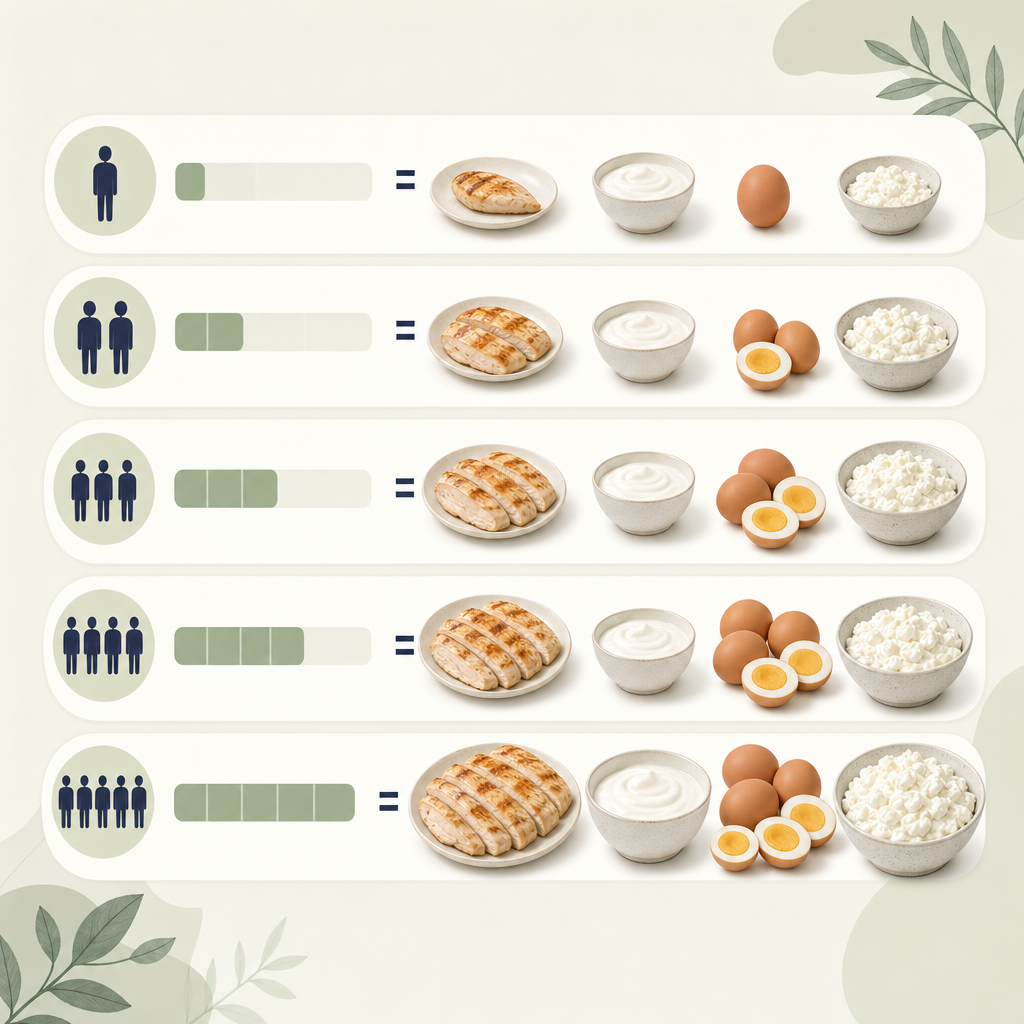
The classic per-kg formulation (1.6 to 2.2 g/kg) was popularized in research papers like Phillips & Van Loon, Journal of Sports Sciences, 2011, and reinforced by Helms et al., Journal of the International Society of Sports Nutrition, 2014. Both numbers (per pound and per kg) reflect the same range; choose whichever is easier to remember.
Why "high protein" wins on satiety per calorie
The Holt Satiety Index (originally Holt et al., European Journal of Clinical Nutrition, 1995, updated 2024) ranks foods by how full they make you per calorie. The top of the list is dominated by protein-heavy options.
| Food | Satiety index (white bread = 100) |
|---|---|
| Boiled potatoes | 323 |
| Fish | 225 |
| Steak (lean) | 176 |
| Beans | 168 |
| Eggs | 150 |
| Cheese | 146 |
| White rice | 138 |
| Lentils | 133 |
| Brown rice | 132 |
| Apples | 197 |
| Greek yogurt | 142 |
| White bread | 100 |
| Croissant | 47 |
| Cake | 65 |
| Doughnut | 68 |
What jumps out: protein-dense foods (fish, steak, eggs, Greek yogurt) consistently land high. Refined carbohydrate desserts (croissants, cake, doughnuts) consistently land low. Per-calorie satiety differences of 3 to 4x exist between the two ends.
The practical translation: replacing 200 calories of croissant with 200 calories of Greek yogurt and berries leaves you significantly more full for the same caloric cost. Multiply across a week, and total intake naturally drops without willpower.
Best protein sources by completeness, cost, and convenience
Not all protein is equal. The two factors that matter most are completeness (does it have all 9 essential amino acids?) and leucine content (the amino acid that triggers muscle protein synthesis).
Top-tier protein sources:
| Source | Protein per 100 calories | Leucine | Notes |
|---|---|---|---|
| Egg whites | 21 g | High | Fat-free, cheap, versatile |
| Chicken breast (boneless skinless) | 18 g | High | Lean, easy to batch |
| Greek yogurt (plain, 2%) | 14 g | High | Probiotic, convenient |
| Cottage cheese (low-fat) | 14 g | High | Slow-digesting casein |
| Salmon | 14 g | High | Omega-3s, vitamin D |
| Whey protein isolate | 22 g | Very high | Fast-digesting, post-workout |
| Lean beef (93/7) | 13 g | High | Iron, B12 |
| Tofu (firm) | 11 g | Moderate | Plant-based, soy |
| Tempeh | 12 g | Moderate | Fermented soy, more bioavailable |
| Lentils | 8 g | Lower | Plant protein with fiber |
| Beans (black, kidney) | 6 g | Lower | Plant protein with carb |
| Quinoa | 4 g | Moderate | Complete plant protein |
For omnivores, the easy stack is chicken, eggs, Greek yogurt, and a whey shake. That covers 4 to 5 of your daily eating events with high-leucine, high-completeness protein.
For vegetarians, eggs, Greek yogurt, cottage cheese, and tofu cover the bases. Add whey protein if dairy works for you, or a pea-rice blend if it doesn't.
For vegans, the protein lift requires more deliberate planning. Tofu, tempeh, lentils, and a complete plant-based protein powder (pea + rice or pea + soy) are the foundation. Plant proteins generally need to be eaten in larger volumes to hit equivalent gram targets, and leucine content per serving runs lower than animal sources.
The thermic effect of protein, in real numbers
The thermic effect of food (TEF) is the energy your body spends digesting and processing what you eat. The numbers most often quoted:
- Protein: 20 to 30% of consumed calories
- Carbohydrates: 5 to 10% of consumed calories
- Fats: 0 to 3% of consumed calories
- Mixed meals: typically 8 to 15%
Worked example. A 1700-calorie day with 30% protein burns about (510 cal x 0.25) + (680 cal x 0.075) + (510 cal x 0.02) = 128 + 51 + 10 = 189 calories on TEF.
A 1700-calorie day with 15% protein burns about (255 x 0.25) + (850 x 0.075) + (595 x 0.02) = 64 + 64 + 12 = 140 calories.
The high-protein day burns 49 extra calories per day on TEF alone. Over a year, that's 17,885 calories or about 5 lbs of fat. Small, but free.
This is why protein is sometimes called the "free deficit" food. You spend more calories digesting it than you do digesting the same caloric mass of other macronutrients.
Distributing protein across the day
Total daily protein matters most. But how you distribute it across meals affects how much is actually used for muscle protein synthesis.
The current evidence-based guidance: 20 to 40 g of protein per meal, distributed across 3 to 5 meals. This pattern stimulates muscle protein synthesis 3 to 5 times per day, which adds up to more total protein synthesis than getting all your protein in one or two meals.
Studies (Mamerow et al., Journal of Nutrition, 2014; Areta et al., Journal of Physiology, 2013) have shown that an even distribution outperforms a skewed distribution at equivalent total intake.
Practical pattern for a 130 g target across 4 eating events:
- Breakfast: 30 g
- Lunch: 35 g
- Snack: 25 g
- Dinner: 40 g
Skipping breakfast often costs you 25 to 35 g of protein you have to make up later, and most patients can't make up that gap by dinner. The single highest-impact change for most weight-loss patients is adding a real protein-anchored breakfast: 3 eggs and 1 cup of Greek yogurt, or a 30 g whey shake plus 1 cup of cottage cheese.
Protein on GLP-1 medications
If you're on compounded semaglutide or tirzepatide, the protein conversation gets more important, not less.
Two reasons. First, GLP-1 medications suppress appetite, often dramatically. Patients commonly drift to 1,200 to 1,500 calories without trying. At those intakes, hitting 130 g of protein takes structure. If you eat by feel, protein is what gets cut first because it requires chewing and effort. Carbs and fats slip in more easily through smoothies, snacks, and sauces.
Second, GLP-1-driven weight loss can be 1.5 to 3% of body weight per month, which is faster than typical diet-driven loss. The faster you lose, the more important muscle preservation becomes. The lean tissue loss rate is dose-dependent, and high-protein patients on GLP-1 retain markedly more lean mass than low-protein patients.
Practical guidance for GLP-1 patients:
- Hit your protein number first, then add carbs and fats to fill calories.
- Consider a daily protein shake to hit numbers when food intake is low.
- Don't worry as much about hitting "high calorie" targets if appetite is suppressed. Worry about hitting protein, fluids, fiber, and key micronutrients.
For full dosing math on compounded medications, see our units to mg of tirzepatide guide.
A sample 1700-calorie, 130 g protein day
| Meal | Items | Calories | Protein |
|---|---|---|---|
| Breakfast | 3 whole eggs + 2 egg whites, 1/4 avocado, 1 slice sourdough | 380 | 30 g |
| Snack | 1 cup 2% Greek yogurt + 1 cup berries + 1 tsp honey | 210 | 22 g |
| Lunch | 5 oz grilled chicken, 1 cup quinoa, mixed greens, 1 tbsp olive oil + lemon | 480 | 42 g |
| Snack | 1 oz almonds + 1 medium apple | 245 | 7 g |
| Dinner | 4 oz salmon, 1 cup roasted veg, 1/2 cup white rice | 385 | 32 g |
| Total | 1,700 | 133 g |
That hits 31% protein, 38% carbs, 31% fat. Fiber lands around 30 g. It's a sustainable real-food day for someone who cooks at home. If your week is busier, swap a protein shake at the second snack and a pre-cooked grain bowl at lunch.
The kidney concern, the gout concern, the bone concern
Three concerns about high-protein diets get repeated in the lay press. Each has been studied.
Kidneys. The fear is that high protein damages kidney function. The evidence: in healthy kidneys, high protein does not cause damage. A 2018 systematic review (Devries et al., Journal of Nutrition) of 28 randomized controlled trials found no adverse effect of high protein on kidney function in healthy adults. The exception is patients with pre-existing chronic kidney disease (CKD), where protein restriction is sometimes part of treatment. If you have CKD or any history of kidney disease, do not increase protein without your nephrologist's input.
Gout. The concern is that high meat intake elevates uric acid, which precipitates gout attacks. The evidence is more nuanced. Animal protein, especially red meat and seafood, can elevate uric acid in susceptible patients. Dairy protein (Greek yogurt, cottage cheese, whey) actually reduces gout risk. Plant proteins are neutral. If you have gout history, prioritize dairy and plant protein.
Bones. The old "high protein leaches calcium from bones" claim has been retired. The evidence (Shams-White et al., American Journal of Clinical Nutrition, 2017 meta-analysis) shows higher protein intake is actually associated with better bone density and lower fracture risk in older adults, especially when paired with adequate calcium intake.
FAQ
How much protein should I eat to lose weight?
0.7 to 1.0 g per pound of goal body weight per day. For most adults, this lands between 100 and 180 g daily. Use goal weight, not current weight.
Can I lose weight on a high-protein diet without exercising?
Yes, but the lean tissue preservation effect requires resistance training to capture fully. Without exercise, high protein still helps with satiety and the thermic effect, but you'll lose more lean mass than you would with both protein and training.
What's the highest-protein food I can eat?
Per calorie, whey protein isolate (22 g per 100 cal). Per gram, plain egg whites (close to 100% protein). For real-food meals, plain Greek yogurt and chicken breast lead the pack.
Can I get enough protein from plants?
Yes, but it requires more deliberate planning. Tofu, tempeh, lentils, and a complete plant-based protein powder are the foundation. Plant proteins generally need to be eaten in larger total volumes to hit gram targets, and leucine per serving is lower than animal sources.
Is too much protein bad for you?
For healthy adults, the evidence shows no safety issues at intakes up to 1.6 g per pound (3.5 g per kg) studied for up to 6 months. The practical upper limit is whatever your stomach can handle without bloating.
Does protein cause weight gain?
Only if total calories exceed maintenance. Protein is calorie-dense (4 cal per gram) but produces strong satiety per calorie, which usually leads to spontaneous calorie reduction. Eating high protein in addition to (rather than instead of) other foods can produce weight gain.
Should I eat protein before or after a workout?
The "anabolic window" is wider than originally thought. As long as you hit your daily protein target and have a meal within 2 to 3 hours of training, the timing is mostly cosmetic. Post-workout protein is convenient because most people are around food by then anyway.
Are protein shakes as good as whole-food protein?
For meeting daily targets, yes. Whey protein isolate matches or exceeds whole foods on muscle protein synthesis. Whole foods provide additional micronutrients and satiety, but a daily shake is a useful tool for hitting numbers.
How much protein do I need on a GLP-1 medication?
Same per-pound target (0.7 to 1.0 g/lb of goal weight), but harder to hit because appetite is suppressed. Plan protein first and fill remaining calories with carbs and fats. A daily shake helps when total intake drops.
Does eating protein at every meal matter?
Yes. Distributing protein across 3 to 5 meals stimulates muscle protein synthesis multiple times per day. Skewed distribution (one big protein meal) underperforms even at equivalent total intake.
What's the highest leucine food?
Whey protein isolate, followed by eggs, chicken, and fish. Leucine is the amino acid that flips the muscle protein synthesis switch. Animal proteins generally hit the leucine threshold (about 2.5 g) at smaller serving sizes than plant proteins.
How fast should I increase my protein intake?
Gradually. Going from 60 g to 150 g overnight often causes GI distress (constipation, bloating). Increase by 20 to 30 g per week, drink more water, and add fiber to keep digestion moving.
Author / review note
Reviewed by the FormBlends Medical Team. References include Weigle DS et al., American Journal of Clinical Nutrition, 2008; Phillips SM, Van Loon LJ, Journal of Sports Sciences, 2011; Helms ER et al., Journal of the International Society of Sports Nutrition, 2014; Mamerow MM et al., Journal of Nutrition, 2014; Areta JL et al., Journal of Physiology, 2013; Devries MC et al., Journal of Nutrition, 2018 (kidney safety meta-analysis); Shams-White MM et al., American Journal of Clinical Nutrition, 2017 (bone density meta-analysis); and the Holt Satiety Index (Holt et al., European Journal of Clinical Nutrition, 1995, with 2024 update).
Footer disclaimers
Platform Disclaimer. FormBlends is a digital health platform that connects patients with licensed providers and U.S.-based pharmacies. We do not manufacture, prescribe, or dispense medication directly. All clinical decisions are made by independent licensed providers.
Compounded Medication Notice. Compounded semaglutide and tirzepatide are not FDA-approved. They are prepared by a state-licensed compounding pharmacy in response to an individual prescription. Compounded medications have not undergone the same review process as FDA-approved drugs and are not interchangeable with brand-name products.
Results Disclaimer. Individual results vary. Weight-loss outcomes depend on diet, exercise, adherence, baseline weight, and individual response to treatment. Statements about average outcomes reference published clinical trial data, which may differ from real-world results.
Trademark Notice. Brand names referenced in this article are the property of their respective owners. FormBlends is not affiliated with, endorsed by, or sponsored by any brand-name pharmaceutical manufacturer.
Related guides
- When to Eat Yogurt for Weight Loss: Timing, Protein, and Real-World Plans
- What Does Gum and Water Do for Weight Loss? An Honest Look at the Science
- Does Nello Super Calm Help With Weight Loss? What the Ingredients Actually Do
- Does Dr. Biocare Help With Weight Loss? An Honest Review of the Program
- How Much Water to Drink on Zepbound: A Body-Weight Formula, Electrolytes, and the Symptom Map
- Does Pooping Help You Lose Weight? The Real Answer From a Bathroom Scale
- Tool: dosage calculator
See your options in about 2 minutes
Take the free quiz and see what fits you. Quick, private, and no commitment to continue.
See my options →