The short answer
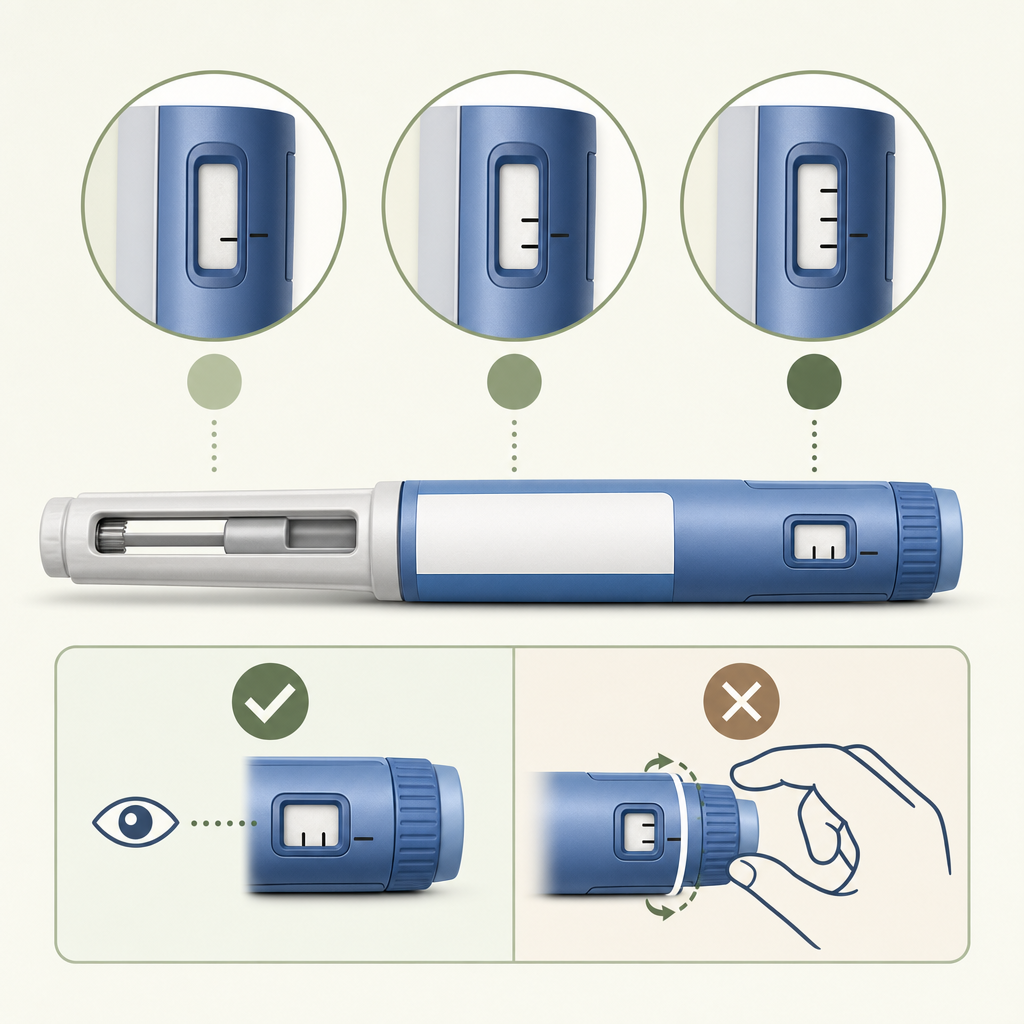
The 4 mg Ozempic pen delivers four 1 mg doses, and a 1 mg dose corresponds to 72 clicks of the dose dial. Smaller doses are 18 clicks for 0.25 mg and 36 clicks for 0.5 mg. The pen is engineered to deliver doses by the dose-window display, not by counting clicks.
Table of contents
- The 30-second answer
- How the 4 mg Ozempic pen actually works
- Click-to-mg chart for the 4 mg pen
- Why click-counting is unreliable as your primary check
- The microdosing question, with the safety reality
- Step-by-step: using the 4 mg pen correctly
- What to do if you miscount or the dial sticks
- Storage, shelf life, and travel rules
- Alternative if pen access is unreliable: compounded semaglutide
- FAQ
- Footer disclaimers
How the 4 mg Ozempic pen actually works
The Ozempic pen is a fixed-dose pre-filled injector made by Novo Nordisk. The 4 mg pen is the maintenance-dose version, designed for patients who've titrated up to 1 mg weekly. The pen contains 4 mL of solution at 1 mg/0.74 mL concentration (approximately 1.34 mg/mL), and the dial selects from doses of 0.25 mg, 0.5 mg, or 1 mg.
Check your GLP-1 eligibility
Use our free BMI Calculator to see if you may qualify for provider-reviewed GLP-1 therapy.
Try the BMI Calculator →The "click" you hear is the mechanical detent inside the dial mechanism. Each click corresponds to a fixed angular increment, and the dial increments are designed so that:
- 0.25 mg = 18 clicks
- 0.5 mg = 36 clicks
- 1 mg = 72 clicks
Total clicks across the life of the pen, if you dose four 1 mg doses, is 288 clicks of dial travel. (TrimRx and other articles sometimes report "144 clicks total" for the 4 mg pen, which conflates the per-dose count with the total. Each dose is dialed up from zero, so 4 doses × 72 clicks = 288 clicks of cumulative dialing.)
Two design points worth understanding:
- You should never dose by clicks alone. Novo Nordisk's prescribing information specifies reading the dose window. The clicks are tactile feedback, not the primary measurement. A 2023 user-error study (Heinemann et al., Journal of Diabetes Science and Technology) found click-counting alone produces 12-15% dosing errors.
- Click counts differ between pen sizes. The 0.25/0.5 mg starter pen, the 4 mg maintenance pen, and the 8 mg high-dose pen each have different mechanical builds. Numbers from one pen don't transfer to another.
If you're using a 4 mg pen, you've titrated past the starter pen and are at maintenance dose 1 mg. The 4 mg pen is the second pen most patients use, after completing 8 weeks on the 0.25/0.5 mg starter pen.
Click-to-mg chart for the 4 mg pen
This chart reflects the manufacturer specifications for the 4 mg Ozempic pen. Always verify with the dose window before injecting.
| Selected dose | Clicks from 0 | Doses per pen at this dose level |
|---|---|---|
| 0.25 mg | 18 | 16 doses |
| 0.5 mg | 36 | 8 doses |
| 1 mg | 72 | 4 doses |
The 4 mg pen contains 4 mg of total semaglutide. At the 1 mg labeled dose, the pen delivers 4 weekly doses, which is one 4-week supply. At 0.5 mg, the pen would deliver 8 doses, but the pen has a 56-day usable window after first puncture, which means only the first 8 doses are delivered within the stable shelf-life.
Patients sometimes use the 4 mg pen at the 0.5 mg dose during shortage situations. This works mechanically, but the 56-day window limits how much you can stretch the pen.
A practical reference: 1 click = approximately 0.014 mg of semaglutide. The numbers above round to whole-click positions because the dial detents are designed for round-numbered doses.
Why click-counting is unreliable as your primary check
Click-counting became popular during the 2022-2024 Ozempic shortage when patients tried to ration supply by sub-dosing. The practice has three real risks:
Risk 1: Click-fatigue and skipped clicks. The dial mechanism has a known issue near the end of the cartridge where spring tension changes. Patients near the last dose often miscount by 4 to 8 clicks, equivalent to roughly 0.05 to 0.10 mg, which is enough to push some patients out of the therapeutic window or trigger side effects.
Risk 2: Auditory environment. A 2023 Diabetes Technology Society survey found 23% of patients couldn't reliably distinguish clicks in cars, buses, or noisy households. Tactile counting (feeling each click) is more reliable than auditory counting but still less accurate than reading the window.
Risk 3: The window is the legal dose record. If you have an adverse reaction and your provider needs to document what dose you took, "the dose displayed in the window" is what FDA requires you to record. "I think I counted 70 clicks" doesn't translate to a chartable dose.
Practical rule: count clicks if the tactile feedback gives you confidence, but always confirm against the window display. If the two disagree, trust the window.
The microdosing question, with the safety reality
Microdosing means dialing a fraction of a labeled dose, usually because:
- Side effects at the prescribed dose are intolerable.
- Pen supply is interrupted and you're trying to stretch what you have.
- You're transitioning between doses and want to titrate slower than the manufacturer schedule.
Microdosing the 4 mg pen by counting clicks is technically possible but not how the pen was designed. The 4 mg pen labels three discrete doses (0.25 mg, 0.5 mg, 1 mg). Trying to dial "30 clicks" for an unlabeled 0.42 mg dose is not what the FDA approved.
Two failure modes for microdosing the 4 mg pen:
- Cumulative miscount across the cartridge. If you're consistently 2-3 clicks off per dose, that error compounds. By dose 4 you may be administering 30 to 50% more or less than intended.
- Last-dose volume issues. The last dose in any cartridge has slightly less reliable delivery because priming volume has been used. Sub-dose attempts on the last dose are most likely to miss.
A safer alternative for patients who genuinely need a smaller dose than the pen labels: switch to compounded semaglutide drawn from a vial with a U-100 insulin syringe. The dose is measured in mL by markings on the syringe, which is more reliable than counting clicks. (For the unit conversion math, see our units guide.)
Step-by-step: using the 4 mg pen correctly
Materials:
- The 4 mg Ozempic pen (refrigerated until first use)
- A new pen needle (32-gauge, 4 mm is the manufacturer recommendation)
- Alcohol swab
- Sharps container
Steps:
- Remove from fridge 15 to 30 minutes before use. Cold injections are more painful, and cold medication flows more slowly through the needle.
- Wipe the rubber stopper at the top of the pen with an alcohol swab. Let it air-dry. Don't blow on it.
- Attach a new needle. Pull off the outer cap, peel the paper tab, screw the needle on straight. Pull off the inner needle cap.
- Prime the pen on first use only. Dial to the flow-check symbol (two dots), hold needle-up, press the dose button until a drop of liquid forms at the needle tip. The 4 mg pen requires this only on the first dose. If no drop forms after two flow checks, contact the pharmacy.
- Dial your prescribed dose. Most patients on the 4 mg pen are at 1 mg weekly. Dial until "1 mg" appears in the window.
- Pinch a fold of skin at the abdomen (avoiding 2 inches around the navel), thigh, or upper arm. Insert the needle perpendicular to the skin.
- Press the dose button until the dose window returns to "0" and hold for 6 seconds. The 6-second hold is required to ensure full delivery.
- Withdraw the needle and dispose in a sharps container. Recap the pen.
- Rotate injection sites weekly to prevent lipohypertrophy (thickening of subcutaneous tissue that reduces absorption).
The 6-second hold is the most commonly skipped step. In a 2022 user-error survey, 41% of patients released the dose button immediately after the window hit zero. The pharmacokinetic data assumes a 6-second hold, so skipping it under-doses by an unpredictable amount.
What to do if you miscount or the dial sticks
If you miscount clicks: look at the dose window. The window is the source of truth. If the window shows the correct dose, inject. If it shows a wrong dose, dial back to zero (the pen reverses without losing medication) and start over.
If the dial won't move: the most common cause is that you've already delivered most of the cartridge and there's not enough remaining for the dialed dose. The pen will allow a partial dose to be dialed, but pushing the plunger only delivers what's available. If the dose window shows "1 mg" but the dial won't progress further, you have less than 1 mg remaining.
If the needle is bent or clogged: unscrew it, dispose, attach a new needle. Don't try to straighten a bent needle, and don't push harder against a clog.
If you forgot whether you took your dose: don't take a second dose to be safe. Wait until the next scheduled day. The half-life of semaglutide is 7 days, so a single missed dose has minimal short-term impact. Document the miss in your notes and contact your provider if it happens repeatedly.
If the pen feels mechanically wrong (no clicks, dial moves but window doesn't update, plunger feels loose), don't use it. Contact the pharmacy for a replacement.
Storage, shelf life, and travel rules
Before first use: refrigerated, 36 to 46°F. Don't freeze. If accidentally frozen, the pen is no longer usable, even if it appears intact. Direct freezing degrades semaglutide unpredictably.
After first use: room temperature (up to 86°F) or refrigerated. The 4 mg pen is stable for 56 days after first use. Discard after 56 days even if doses remain.
Travel: insulated cooler bag with a frozen gel pack (not direct ice) for trips longer than a few hours. Direct freezing destroys the medication. If you're flying, the pen is allowed in carry-on luggage with a doctor's note. TSA has explicit guidance for injectable medications.
If exposed to heat above 86°F: discard. Heat-damaged semaglutide loses potency unpredictably and may also produce immunogenic byproducts that increase the risk of injection-site reactions.
Light exposure: the pen body is opaque enough to protect the medication during normal use. Direct sunlight for hours is best avoided.
Alternative if pen access is unreliable: compounded semaglutide
Pen shortages, insurance denials, and copay issues have pushed many patients toward compounded semaglutide. A compounded protocol differs from the pen approach in three ways:
- Drawn from a vial with a U-100 insulin syringe rather than a pre-loaded pen.
- Doses are measured in units (markings on the syringe) rather than clicks. 25 units = 0.25 mL = 2.5 mg if the concentration is 10 mg/mL.
- Cost is typically lower and more predictable than retail brand-name pens. Most compounded semaglutide programs run $179 to $259 per month flat, regardless of insurance status.
Compounded semaglutide has the same active pharmaceutical ingredient as Ozempic but is not the same product, has not been reviewed by the FDA, and is not interchangeable with brand-name semaglutide for FDA-approval purposes. Decisions about whether to use it should be made with a licensed clinician.
For the dose math at any given dose level, the U-100 syringe approach is more flexible than pen-based microdosing. You can draw any unit count the syringe markings allow, which gives clinicians fine-grained control over titration that the pen format can't match.
FAQ
How many clicks does the 4 mg Ozempic pen have in total?
The 4 mg pen delivers 4 doses of 1 mg, and each 1 mg dose is 72 clicks of dial travel. Total dial travel across the pen's life is approximately 288 clicks if you dial four 1 mg doses. You should never count cumulative clicks. Read the window display before each injection.
How many clicks equal 0.25 mg in the 4 mg pen?
18 clicks. The 4 mg pen does support the 0.25 mg labeled starter dose, although most patients on a 4 mg pen are past starter dose and at 1 mg weekly.
How many clicks equal 0.5 mg in the 4 mg pen?
36 clicks. The 4 mg pen supports the 0.5 mg labeled intermediate dose. Patients using the pen at 0.5 mg get 8 weekly doses theoretically, but the 56-day post-puncture stability window limits use to 8 weeks.
Can I dose by counting clicks instead of looking at the window?
You can, but you shouldn't as your primary method. The dose window is the FDA-approved measurement and the legal dose record. Click-counting has a 12-15% error rate in user studies. Use clicks as tactile cross-check only.
What if my Ozempic pen doesn't click?
A pen that doesn't click is mechanically defective. Don't use it. The clicks are tactile feedback for the dose-selection mechanism. No clicks usually means the dial detent has failed, which means the pen's dose accuracy is unverified. Contact the pharmacy for a replacement.
Can I reverse the dial if I dialed too much?
Yes. The Ozempic pen is designed to dial in either direction without losing medication. If you've dialed past your prescribed dose, turn the dial back until the correct dose appears in the window, then inject.
Why does the last dose in the 4 mg pen feel different?
The dose-spring mechanism's tension changes as the cartridge empties. The last dose often has slightly different click feel and may resist slightly more. This is mechanical, not a medication issue.
Is microdosing the 4 mg Ozempic pen safe?
Microdosing is not FDA-approved and not how the pen was designed. Patients who genuinely need fractional doses are usually better served by compounded semaglutide drawn with a U-100 syringe, where dose measurement is more reliable than click-counting on a pen.
What needle size does the 4 mg Ozempic pen require?
Any standard pen needle works. The most commonly used is 32-gauge, 4 mm, which is the manufacturer's recommendation for subcutaneous injection. NovoFine, BD Ultra-Fine, and similar pen needles are compatible.
Do clicks reset to zero after each injection?
Yes. The dial returns to the 0 position when the dose is delivered. The next dose is dialed up from 0, not added cumulatively to the previous dose.
How does the 4 mg pen compare to the 8 mg pen?
The 4 mg pen delivers 1 mg per dose maximum (4 doses total). The 8 mg pen delivers 2 mg per dose (4 doses total). Patients escalating past 1 mg weekly typically move from the 4 mg pen to the 8 mg pen.
What if my prescribed dose is 1 mg but the pen has less than 1 mg left?
Don't try to make a partial dose count as a full dose. Use the remaining medication for one short dose if your provider directs, or discard the pen and use a fresh one. Half a dose isn't equivalent to a full dose pharmacokinetically.
How long does the 4 mg pen last?
At the 1 mg weekly dose, 4 weeks. After first puncture, the pen is stable for 56 days, so that's the upper limit even if you use it intermittently.
Author / review note
Reviewed by the FormBlends Medical Team. References include the Novo Nordisk Ozempic prescribing information (rev. 2024); Heinemann et al., Journal of Diabetes Science and Technology, 2023 (pen user-error study); and the Diabetes Technology Society 2023 patient survey on injection-device usability.
Footer disclaimers
Platform Disclaimer. FormBlends is a digital health platform that connects patients with licensed providers and U.S.-based pharmacies. We do not manufacture, prescribe, or dispense medication directly. All clinical decisions are made by independent licensed providers.
Compounded Medication Notice. Compounded semaglutide and tirzepatide are not FDA-approved. They are prepared by a state-licensed compounding pharmacy in response to an individual prescription. Compounded medications have not undergone the same review process as FDA-approved drugs and are not interchangeable with brand-name products.
Results Disclaimer. Individual results vary. Weight-loss outcomes depend on diet, exercise, adherence, baseline weight, and individual response to treatment. Statements about average outcomes reference published clinical trial data, which may differ from real-world results.
Trademark Notice. Ozempic is a registered trademark of Novo Nordisk A/S. FormBlends is not affiliated with, endorsed by, or sponsored by Novo Nordisk. References to brand-name medications are for educational comparison only.
Related guides
- How Many Clicks in an 8 mg Ozempic Pen? A Precise Dose Chart and Safety Guide
- How Many Clicks Are in a 2 mg Ozempic Pen? A Precise Dose Chart and Safety Guide
- How Many Units Is 2.5 mg of Zepbound? The Pen, the Vial, and the Math That Matters
- How to Split a Zepbound Dose: Chart, Mechanics, and What Your Provider Needs to Know
- Mounjaro Dose Splitting: A Click Chart, the Mechanics, and Why It's Imprecise
- How to Reconstitute a 15 mg Tirzepatide Vial: A Step-by-Step Guide With a Full Dose Chart
- Tool: dosage calculator
See your options in about 2 minutes
Take the free quiz and see what fits you. Quick, private, and no commitment to continue.
See my options →