The short answer
Zepbound is sold as a fixed-dose autoinjector pen, so 2.5 mg is one full pen, no unit counting required. If you're using compounded tirzepatide drawn from a vial with a U-100 insulin syringe, 2.5 mg equals 25 units at the standard 10 mg/mL concentration. Other concentrations change the unit count.
Table of contents
- The 30-second answer
- Why this question gets asked two different ways
- Brand Zepbound 2.5 mg: what's actually in the pen
- Compounded tirzepatide 2.5 mg: full unit chart
- How to read your vial label and confirm the concentration
- Step-by-step: drawing 2.5 mg from a 10 mg/mL compounded vial
- The 8-units-versus-25-units myth (and why it's dangerous)
- Common dose conversion errors
- Storage, color, and shelf-life rules
- FAQ
- Footer disclaimers
Why this question gets asked two different ways
"How many units is 2.5 mg of Zepbound" gets typed into search bars by two completely different patient groups, and they need different answers.
Check your GLP-1 eligibility
Use our free BMI Calculator to see if you may qualify for provider-reviewed GLP-1 therapy.
Try the BMI Calculator →Group one is using brand-name Zepbound. Zepbound ships as a single-use prefilled autoinjector. The 2.5 mg pen contains exactly 2.5 mg in 0.5 mL of solution and delivers one fixed dose. There's no dial. There's no unit counting. You press the pen against your skin, hold for the required time, and the dose is delivered. The "unit" question doesn't apply.
Group two is using compounded tirzepatide drawn from a multi-dose vial with a U-100 insulin syringe. Compounded products are prepared by a state-licensed compounding pharmacy in response to an individual prescription. They're not the same product as brand Zepbound, are not FDA-approved, and are not interchangeable with brand Zepbound. Doses are drawn from a vial in milliliters, but the U-100 insulin syringe most patients use is marked in "units," which is where the conversion question shows up.
This article covers both. If you're filling Zepbound at a retail pharmacy, scroll to the brand section. If you're using a compounded vial, the chart you need is in section four.
Brand Zepbound 2.5 mg: what's actually in the pen
The Zepbound starter pen contains 2.5 mg of tirzepatide in 0.5 mL of clear, colorless solution. That's a concentration of 5 mg/mL, but you don't need to do that math because the pen handles the entire dose delivery for you.
A few things to know about the pen specifically:
- The pen is an autoinjector, not a multi-dose pen. It delivers the full 2.5 mg in one push and is then disposed of in a sharps container. You can't dial down or microdose it.
- The pen comes pre-attached to a hidden 27 to 29 gauge needle. You don't change the needle.
- Standard injection sites are the abdomen (avoiding 2 inches around the navel), the front of the thigh, or the back of the upper arm. Rotate sites weekly.
- The pen is stored refrigerated at 36 to 46°F. Once removed from the fridge, it can sit at room temperature for up to 21 days. Do not freeze.
If a clinician switches you from 2.5 mg to 5 mg per week (typical at week five of titration), you receive a new prescription written for the 5 mg pen. The 2.5 mg pen and 5 mg pen are physically distinct products. You can't combine two 2.5 mg pens to make a 5 mg dose without a new prescription.
For broader Zepbound information, see our Zepbound vs compounded tirzepatide overview.
Compounded tirzepatide 2.5 mg: full unit chart
Compounded tirzepatide is sold in vials at varying concentrations. The same 2.5 mg dose draws to a different unit count depending on what concentration the pharmacy used. Here's the full chart for all four common concentrations.
| Vial concentration | Volume for 2.5 mg | Units on U-100 syringe |
|---|---|---|
| 5 mg/mL | 0.50 mL | 50 units |
| 10 mg/mL | 0.25 mL | 25 units |
| 15 mg/mL | 0.167 mL | 17 units |
| 20 mg/mL | 0.125 mL | 12.5 units |
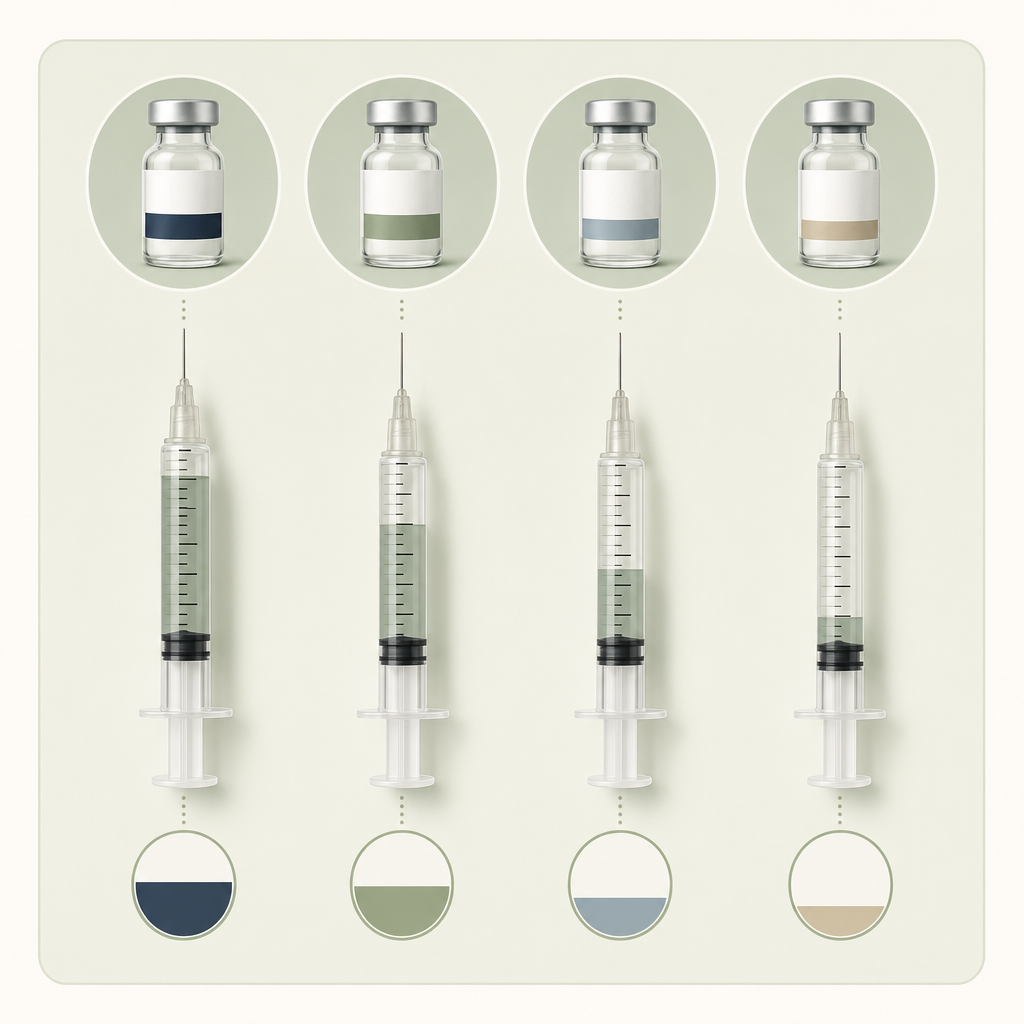
The 10 mg/mL concentration is the most common because the math is clean. Every milligram of tirzepatide corresponds to 10 units on a U-100 syringe, so any prescribed dose comes out to a whole-number unit reading.
If you switch pharmacies and your new vial is at a different concentration, the unit count changes even though the dose hasn't. This is the single most common source of dosing errors in compounded GLP-1 therapy.
How to read your vial label and confirm the concentration
The concentration is printed on the vial label. Three formats you'll see:
Format 1. "Tirzepatide Injection 10 mg/mL." Direct concentration. 2.5 mg = 25 units.
Format 2. "Tirzepatide 100 mg / 10 mL." Total mg over total mL. Divide: 100 ÷ 10 = 10 mg/mL. Same answer.
Format 3. "Tirzepatide for Reconstitution, 30 mg." This is a powder. The pharmacy provides separate bacteriostatic water and reconstitution instructions. The final concentration depends on how much water you add. Reconstituting 30 mg with 1.5 mL of water makes 20 mg/mL. With 3 mL it's 10 mg/mL. Don't guess. Read the printed instructions.
If the vial label only shows total milligrams without a volume, find the concentration in the patient handout that came in the box, the prescription label on the outer packaging, or your patient portal. If you can't find it anywhere, call the pharmacy before drawing a dose. Don't try to back-calculate. Don't compare to internet charts.
Step-by-step: drawing 2.5 mg from a 10 mg/mL compounded vial
This protocol assumes you have a 10 mg/mL pre-mixed vial and a U-100 insulin syringe.
Materials:
- Compounded tirzepatide vial (10 mg/mL)
- U-100 insulin syringe with attached needle (typically 0.3 mL or 0.5 mL barrel, 31-gauge, 5/16-inch)
- Two alcohol swabs
- Sharps container
Steps:
- Wash your hands with soap and water for 20 seconds.
- Inspect the vial. Tirzepatide should be clear and colorless to slightly straw-yellow. If it's cloudy, has visible particles, or has unusually deep color, don't use it. Call the pharmacy.
- Wipe the vial top with an alcohol swab. Let it air-dry. Don't blow on it.
- Pull the syringe plunger to draw 25 units of air into the syringe.
- Push the needle through the rubber stopper. Push the air in.
- Invert the vial. Pull the plunger to draw 25 units of liquid. If you see air bubbles, push the liquid back into the vial and re-draw, or flick the syringe sharply to dislodge bubbles.
- Hold the syringe at eye level and confirm the plunger's leading edge sits exactly on the 25-unit line.
- Withdraw the needle. Don't recap.
- Choose an injection site (abdomen avoiding 2 inches around the navel, thigh, or upper arm). Wipe with the second alcohol swab. Let it air-dry.
- Pinch a fold of skin. Insert at 90 degrees (or 45 degrees if you have minimal subcutaneous fat). Push the plunger steadily until empty.
- Withdraw. Apply gentle pressure with a tissue if there's any bleeding (rare).
- Drop the syringe in a sharps container. Don't throw it in regular trash.
The whole process takes about 90 seconds once you're practiced.
The 8-units-versus-25-units myth (and why it's dangerous)
Several blogs claim that "2.5 mg of Zepbound is 8 to 9 units on an insulin syringe." That number comes from working backward from the brand Zepbound pen's 5 mg/mL concentration, then making an arithmetic error. Don't use it. It's wrong.
Here's where the confusion comes from. Brand Zepbound at 5 mg/mL means 0.5 mL contains 2.5 mg. On a U-100 insulin syringe, 0.5 mL is 50 units, not 8 to 9. Anyone who tries to draw 8 units from a brand-equivalent concentration will under-dose by roughly 6x.
Compounded products at 5 mg/mL also produce a 50-unit draw for 2.5 mg. The 8-9 unit figure does not match any legitimate concentration commonly available.
If you encounter the 8-unit number anywhere, ignore it. Always confirm against your vial's printed concentration and the chart in section four.
Common dose conversion errors
The 2024 FDA Adverse Event Reporting System (FAERS) data on compounded GLP-1 dosing errors flagged five recurring mistakes. The first four overlap with semaglutide. The fifth is specific to tirzepatide.
Error 1: Reading the unit count incorrectly off the syringe. U-100 syringes mark in 1-unit increments on a 1 mL barrel and 0.5-unit increments on a 0.3 mL barrel. If you're used to insulin and counting "10 marks past zero," that may be 5 units, not 10, on a smaller barrel. Read the printed numbers, not your habit.
Error 2: Confusing mL with mg. "0.25 mL" and "2.5 mg" share the digits 25, and patients have drawn 25 units when they should have drawn 2.5 units (or vice versa) at the wrong concentration. The fix: write the unit count on the box in marker once, then refer to that number for every injection.
Error 3: Switching pharmacies without re-checking concentration. Pharmacy A's 10 mg/mL refilled by Pharmacy B at 5 mg/mL means the same "25 units" now delivers half the dose. Read the label every time.
Error 4: Reconstituted vials without confirming post-reconstitution concentration. A 30 mg powder reconstituted with 1.5 mL of bacteriostatic water makes 20 mg/mL. With 3 mL it's 10 mg/mL. Read the reconstitution sheet every time, even on a refill of the same product.
Error 5: Mixing brand and compounded thinking. Brand Zepbound is a fixed-dose pen, so dose math doesn't apply. If a patient transitions from brand to compounded mid-titration, they sometimes assume the compounded product is also fixed-dose and ignore the concentration label. It isn't fixed. The vial concentration determines the unit count.
A 2024 study (Patel et al., Annals of Pharmacotherapy) found that 7.2% of patients self-administering compounded GLP-1 medications reported at least one suspected dosing error in the first 90 days. Most were over-doses, which is why titration-related side effects are higher in compounded patients than pen-using patients.
Storage, color, and shelf-life rules
Refrigeration before first use. 36 to 46°F (2 to 8°C). Don't freeze. A frozen vial is unusable, even if it appears intact.
After first puncture. Most compounding pharmacies stamp 28 days when refrigerated. Some stamp 21 days. Read your vial label.
Travel. Insulated bag with a frozen gel pack (not direct ice). Direct freezing destroys the peptide. The pharmacy can usually provide a travel kit on request. Flying: declared in carry-on with prescription documentation. TSA has explicit guidance for injectable medications.
Color. Clear and colorless to faint straw-yellow is normal. A pink, red, or orange tint usually indicates added vitamin B12 (cyanocobalamin), which some compounding pharmacies include for energy support. If your label doesn't mention B12 and the solution is colored, call the pharmacy. (See our why is my compounded semaglutide red guide for full context.)
Cloudiness or particles. Never use a vial with visible particles, settled material, or significant cloudiness. Tirzepatide is a peptide and can aggregate if temperature-cycled or stored improperly. Aggregated peptide is less effective and can be more immunogenic.
FAQ
How many units is 2.5 mg of Zepbound?
Brand Zepbound is a fixed-dose pen, so the unit question doesn't apply. For compounded tirzepatide at 10 mg/mL (most common), 2.5 mg equals 25 units on a U-100 insulin syringe. At 5 mg/mL it's 50 units, at 15 mg/mL it's 17 units, at 20 mg/mL it's 12.5 units.
Is 2.5 mg of Zepbound the same as 25 units of compounded tirzepatide?
At the most common 10 mg/mL compounded concentration, 25 units equals 2.5 mg. They are not the same product, however. Brand Zepbound is FDA-approved. Compounded tirzepatide is prepared by a state-licensed compounding pharmacy and is not FDA-approved. They are not interchangeable.
Why does my pharmacy's vial say a different unit count than my friend's?
Different compounding pharmacies use different concentrations. If your vial is 10 mg/mL and your friend's is 5 mg/mL, the same 2.5 mg dose is 25 units in your syringe and 50 units in theirs. Always go by the concentration on your specific vial label.
Can I draw 2.5 mg from the brand Zepbound pen?
No. The brand pen is a single-use autoinjector and is not designed to be opened or have its contents extracted. Attempting to access the contents is dangerous and could expose you to needle injury, contamination, and dose error.
What size syringe should I use for 2.5 mg of compounded tirzepatide?
A 0.3 mL or 0.5 mL U-100 insulin syringe with a 31-gauge, 5/16-inch needle. The 0.3 mL barrel has 0.5-unit markings, which makes drawing fractional doses (like 12.5 units at 20 mg/mL) more accurate.
Why does my vial say 30 mg if my dose is 2.5 mg?
Compounded tirzepatide is sold in multi-dose vials. A 30 mg vial at 10 mg/mL is 3 mL of solution, which contains 12 weekly 2.5 mg doses. You draw a small fraction of the vial each week.
What if my dose falls between unit markings?
At small doses (under 25 units), 0.5-unit increments matter more than at larger doses. Use a 0.3 mL syringe with 0.5-unit markings, and don't round more than 1 unit in either direction without provider guidance.
Can I round my 2.5 mg dose up or down by a unit or two?
At small doses, rounding by 0.5 to 1 unit usually has no clinical effect. Don't round by more than 1 unit. Rounding down is safer than up if you're unsure.
Does the type of insulin syringe matter?
Use U-100 syringes only. U-500 syringes have different markings (1 mark = 5 units of insulin) and would deliver 5x the intended tirzepatide dose. Confirm "U-100" is printed on the syringe barrel before drawing.
How accurate are unit markings on insulin syringes?
ISO 8537 specifies a tolerance of plus-or-minus 5% on insulin syringe markings. For a 25-unit draw, that's plus-or-minus 1.25 units, which is clinically irrelevant for tirzepatide.
Should I expect 2.5 mg of tirzepatide to feel different from 2.5 mg of Zepbound?
The active pharmaceutical ingredient is tirzepatide in both cases. Compounded products may have different excipients (preservatives, buffers, vitamin B12 if added), and the FDA has not reviewed compounded products for bioequivalence. Some patients report identical effect, some notice differences. Discuss any concerns with your provider.
What concentration should I ask for if I'm starting tirzepatide?
Most patients are best served by 10 mg/mL because the unit math is clean. If you're at very low doses (2.5 mg), some prefer 5 mg/mL for a more readable 50-unit draw at the cost of larger injection volume. This is a clinical decision worth discussing with your provider.
Author / review note
Reviewed by the FormBlends Medical Team. References include the U.S. Pharmacopeia chapter on insulin syringes (USP <797>, <800>), the Eli Lilly Zepbound prescribing information (rev. 2024), Patel et al., Annals of Pharmacotherapy, 2024 (compounded GLP-1 dosing errors), and the FDA Adverse Event Reporting System dataset accessed Q1 2026.
Footer disclaimers
Platform Disclaimer. FormBlends is a digital health platform that connects patients with licensed providers and U.S.-based pharmacies. We do not manufacture, prescribe, or dispense medication directly. All clinical decisions are made by independent licensed providers.
Compounded Medication Notice. Compounded semaglutide and tirzepatide are not FDA-approved. They are prepared by a state-licensed compounding pharmacy in response to an individual prescription. Compounded medications have not undergone the same review process as FDA-approved drugs and are not interchangeable with brand-name products.
Results Disclaimer. Individual results vary. Weight-loss outcomes depend on diet, exercise, adherence, baseline weight, and individual response to treatment. Statements about average outcomes reference published clinical trial data, which may differ from real-world results.
Trademark Notice. Zepbound and Mounjaro are registered trademarks of Eli Lilly and Company. FormBlends is not affiliated with, endorsed by, or sponsored by Eli Lilly. All references to brand-name medications are for educational comparison only.
Related guides
- How Many Mg Is 40 Units of Tirzepatide? A Clear Conversion by Vial Concentration
- How Many Mg Is 60 Units of Tirzepatide? The Conversion That Depends on Your Vial
- How Many Clicks in an 8 mg Ozempic Pen? A Precise Dose Chart and Safety Guide
- How Many Clicks Are in a 2 mg Ozempic Pen? A Precise Dose Chart and Safety Guide
- How Many Clicks in a 4 mg Ozempic Pen? A Precise Dose Chart and Safety Guide
- Why Zepbound Raises Your Heart Rate: The Mechanism, the Numbers, and When It Actually Matters
- Tool: dosage calculator
See your options in about 2 minutes
Take the free quiz and see what fits you. Quick, private, and no commitment to continue.
See my options →