The short answer
For a 10 mg tirzepatide vial, add 1 mL of bacteriostatic water for a 10 mg/mL solution. This is the standard concentration most U.S. compounding pharmacies use because the unit math is clean: every milligram corresponds to 10 units on a U-100 insulin syringe. Always confirm with your pharmacy's specific instructions.
Table of contents
- The 30-second answer
- Why 1 mL is the standard answer (and when 2 mL makes sense)
- The dose chart for 10 mg tirzepatide reconstituted at 10 mg/mL
- The dose chart for 10 mg tirzepatide reconstituted at 5 mg/mL
- Bacteriostatic water vs sterile water (and why the difference matters)
- The mixing procedure for a 10 mg vial
- What to expect during the first dose
- Storage timeline for the reconstituted 10 mg vial
- FAQ
- Footer disclaimers
Why 1 mL is the standard answer (and when 2 mL makes sense)
Most compounding pharmacies recommend 1 mL of bacteriostatic water per 10 mg vial of tirzepatide for one reason: clean math.
Check your GLP-1 eligibility
Use our free BMI Calculator to see if you may qualify for provider-reviewed GLP-1 therapy.
Try the BMI Calculator →At 10 mg/mL concentration:
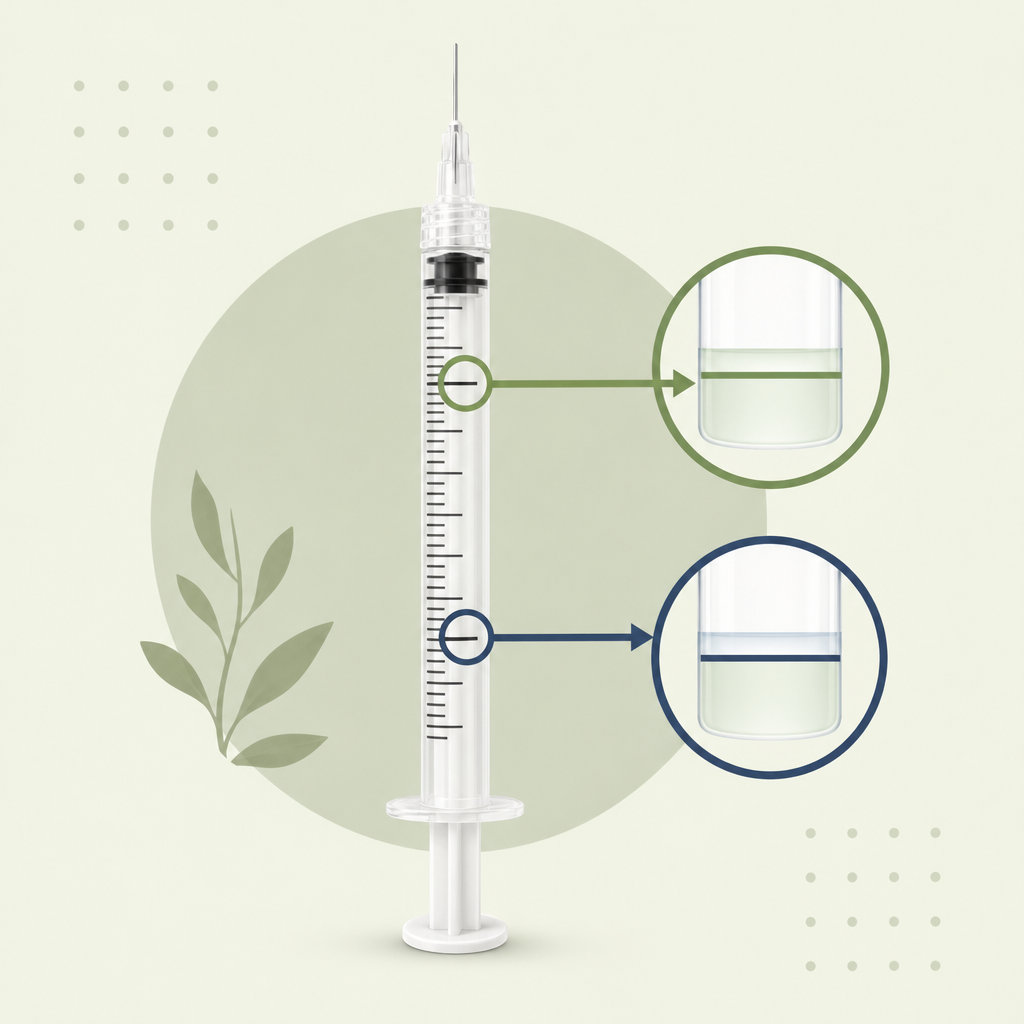
- 1 mg = 10 units on a U-100 insulin syringe
- 2.5 mg = 25 units
- 5 mg = 50 units
- 7.5 mg = 75 units
- 10 mg = 100 units
These are all whole-number unit reads, easy to draw without squinting at fractional markings. Patients make fewer dosing errors at 10 mg/mL than at any other common concentration.
When 2 mL (= 5 mg/mL) makes sense:
Some pharmacies and patients prefer 5 mg/mL specifically for low-dose titration. The reasons:
- Easier-to-read draws at low doses. A 2.5 mg dose at 5 mg/mL = 50 units (a clear, easy-to-see mark). At 10 mg/mL it's 25 units, which is fine but smaller.
- Larger injection volume helps with absorption. Some patients report better tolerability with 0.5 mL injections than 0.25 mL. The clinical evidence is mixed.
- Slightly slower titration feel. Doubling the volume can produce slightly slower local absorption, which some patients perceive as smoother titration.
When 1 mL (= 10 mg/mL) is the right call:
Most patients, most of the time. The math is clean, the injection volume is small enough to be barely felt, and unit conversion across all doses is simple.
The 10 mg vial reconstituted with 1 mL gives you 4 weekly doses at 2.5 mg each, or 2 weekly doses at 5 mg each. That's roughly one month of titration.
The dose chart for 10 mg tirzepatide reconstituted at 10 mg/mL
This is the most common configuration for the 10 mg vial.
| Prescribed dose | Volume | U-100 units | Doses per 10 mg vial |
|---|---|---|---|
| 2.5 mg | 0.25 mL | 25 units | 4 |
| 5 mg | 0.50 mL | 50 units | 2 |
| 7.5 mg | 0.75 mL | 75 units | ~1 (with 0.25 mL waste) |
| 10 mg | 1.00 mL | 100 units | 1 |
A standard titration cycle on the 10 mg vial:
- Week 1-4: 2.5 mg weekly (4 doses, one full vial)
- Week 5-8: 5 mg weekly (start a new 10 mg vial; 2 doses, then move to the next 10 mg vial)
If you're going past the 5 mg dose, most pharmacies switch you to a 30 mg or 40 mg vial for cost efficiency.
The dose chart for 10 mg tirzepatide reconstituted at 5 mg/mL
Less common but useful for low-dose titration.
| Prescribed dose | Volume | U-100 units | Doses per 10 mg vial |
|---|---|---|---|
| 2.5 mg | 0.50 mL | 50 units | 4 |
| 5 mg | 1.00 mL | 100 units | 2 |
| 7.5 mg | 1.50 mL | 150 units (use 1 mL barrel) | ~1 |
| 10 mg | 2.00 mL | 200 units (use 1 mL barrel) | 1 |
The total available doses per vial don't change with concentration. You're still injecting the same total milligrams. The volume per injection just doubles.
If you choose 5 mg/mL for the easier 50-unit read at 2.5 mg, plan to switch to 10 mg/mL once you reach the 5 mg dose, because injection volumes above 0.5 mL start to feel uncomfortable subcutaneously.
Bacteriostatic water vs sterile water (and why the difference matters)
These two products look identical and are both labeled "for injection." They're not interchangeable.
Bacteriostatic water for injection (BWFI):
- Contains 0.9% benzyl alcohol as a preservative
- Approved for multi-dose use (you can puncture the vial repeatedly without bacterial growth between punctures)
- Standard for compounded peptide reconstitution
- Stable for 28 days after first puncture
Sterile water for injection (SWFI):
- No preservative
- Approved for single-dose use only
- The vial must be discarded after one puncture
- Typically used for IV fluid preparation, not for multi-dose self-administered medications
If your pharmacy ships SWFI for a multi-dose tirzepatide vial, that's an error. Don't reconstitute. Call the pharmacy and request BWFI.
The difference matters because reconstituted multi-dose tirzepatide is meant to be punctured weekly for 4+ doses. Without the bacteriostatic preservative, the second puncture risks bacterial contamination. Injecting contaminated medication causes injection-site infection at minimum and can cause serious systemic infection.
A 2023 case-series from the Journal of Compounding Pharmacy reviewed 17 cases of injection-site cellulitis traced to incorrectly reconstituted compounded GLP-1 medications. In 13 cases, sterile water had been used instead of bacteriostatic water.
The mixing procedure for a 10 mg vial
This is the focused, step-by-step procedure for the 10 mg vial specifically. For a longer guide that covers all vial sizes, see our reconstitution guide.
You'll need:
- 10 mg lyophilized tirzepatide vial
- Bacteriostatic water vial (typically 10 mL or 30 mL multi-dose)
- A 3 mL syringe with a 21 to 25 gauge needle (for drawing and injecting the bacteriostatic water)
- Two alcohol swabs
- Sharps container
Steps:
- Wash hands for 20 seconds with soap and water.
- Let both vials reach room temperature (15 minutes out of fridge).
- Inspect the tirzepatide. White or off-white powder, dry, no discoloration.
- Remove flip-tops and clean stoppers with alcohol swabs. Air-dry.
- Draw 1 mL of bacteriostatic water (or 2 mL if reconstituting at 5 mg/mL) into the syringe. Push 1 mL of air into the bacteriostatic water vial first to balance pressure.
- Inject the water into the tirzepatide vial slowly, aiming the stream against the inside wall of the vial at a 45-degree tilt. This avoids splashing the powder and prevents foaming.
- Roll the vial between your palms for 30 to 60 seconds. Don't shake. The powder typically dissolves within 1 to 5 minutes.
- Inspect. The solution should be clear and uniform. If it includes B12, it will be pink or red. If it's cloudy or has particles, don't use.
- Label the vial with the reconstitution date and "Discard by [+28 days]."
- Refrigerate immediately.
The whole process takes 7 to 10 minutes once familiar.
What to expect during the first dose
The first time you draw from a freshly reconstituted vial:
- The solution moves easily into the syringe with a fresh needle.
- The injection itself is barely noticeable when using a 31-gauge, 5/16-inch needle for a 0.25 to 0.5 mL volume.
- A small droplet of solution may appear at the injection site after withdrawal. Light pressure with a clean tissue resolves it.
- A small bruise can develop within 12 hours, especially with abdominal injection. This is harmless and resolves in 3 to 5 days.
What's unusual but worth noting:
- Stinging during injection can happen with B12-containing formulations because B12 is mildly acidic. Brief stinging that resolves within seconds is normal. Persistent burning that lasts more than a minute should be reported to your pharmacy.
- Slight redness at the injection site is normal for the first 24 hours. Spreading redness, warmth, or pus is not normal and indicates infection. Contact a provider.
Storage timeline for the reconstituted 10 mg vial
| Time after reconstitution | Status |
|---|---|
| 0 to 24 hours | Settling time. Some patients prefer to wait until the next day for the first injection. Optional. |
| 1 to 7 days | Optimal use window. Solution is at peak stability. |
| 8 to 21 days | Continued use. Stability remains within manufacturer specifications. |
| 22 to 28 days | Final use window. Some pharmacies recommend discarding at day 21 instead of 28. |
| 29+ days | Discard. Bacteriostatic preservative effectiveness decreases. |
If your refrigerator runs cold (under 35°F) or warm (over 50°F), use a thermometer to verify. Temperature excursions outside 36 to 46°F can shorten the safe-use window.
If the vial accidentally freezes (e.g., placed too close to the freezer compartment), discard. Freezing damages the peptide structure even if the vial appears intact when thawed.
FAQ
How much bacteriostatic water do I add to a 10 mg tirzepatide vial?
The standard recommendation is 1 mL for a 10 mg/mL final concentration. Some patients use 2 mL for a 5 mg/mL concentration that gives larger, easier-to-read draws at low doses. Always follow your pharmacy's specific instructions.
What's the difference between bacteriostatic water and sterile water?
Bacteriostatic water contains 0.9% benzyl alcohol as a preservative, allowing multi-dose use over 28 days. Sterile water has no preservative and is single-use only. Use bacteriostatic water for multi-dose tirzepatide vials.
Can I use saline solution instead of bacteriostatic water?
No. Saline contains salt that affects the peptide's solubility and may alter its stability. Use bacteriostatic water specifically.
What concentration should I aim for with a 10 mg vial?
10 mg/mL (1 mL of bacteriostatic water added) is the most common because the unit math is clean. 5 mg/mL is a reasonable alternative if you want larger draws for low-dose titration.
How many doses can I get from a 10 mg vial?
At 2.5 mg per dose, four doses. At 5 mg per dose, two doses. The total milligrams available is fixed at 10 mg regardless of concentration.
How long can I use the reconstituted vial?
28 days when stored properly at 36 to 46°F. Some pharmacies stamp 21 days. Discard after the labeled date.
Should I shake the vial after adding water?
No. Roll it gently between your palms for 30 to 60 seconds. Shaking creates foam and can damage the peptide.
What if the powder doesn't dissolve right away?
Set the vial down for 2 to 3 minutes and roll again. Most tirzepatide powder dissolves within 5 minutes. If it's still undissolved after 15 minutes of patient rolling, the vial may have a quality issue. Contact the pharmacy.
Can I draw a dose immediately after reconstitution?
Yes, technically. Some patients prefer to wait 30 minutes to an hour for the solution to fully equilibrate, but immediate use is fine if the powder has fully dissolved and the solution is clear.
What syringe should I use to draw doses after reconstitution?
A U-100 insulin syringe with a 0.3 or 0.5 mL barrel and a 31-gauge, 5/16-inch needle. The reconstitution syringe (1 to 3 mL barrel with longer needle) is for adding the bacteriostatic water, not for the actual injection.
Can I freeze the reconstituted vial to extend shelf life?
No. Freezing destroys the peptide structure. The 28-day refrigerated window is the practical maximum.
What if I added too much bacteriostatic water?
The vial is still usable, but the concentration is now lower than expected. Recalculate your unit count for the actual concentration. For example, 10 mg in 2 mL = 5 mg/mL, so 2.5 mg = 50 units instead of the 25 units you'd use at 10 mg/mL.
Author / review note
Reviewed by the FormBlends Medical Team. References include the U.S. Pharmacopeia chapter on compounded sterile preparations (USP <797>), FDA guidance on bacteriostatic water for injection, and the Journal of Compounding Pharmacy 2023 review of reconstitution-related infection cases.
Footer disclaimers
Platform Disclaimer. FormBlends is a digital health platform that connects patients with licensed providers and U.S.-based pharmacies. We do not manufacture, prescribe, or dispense medication directly. All clinical decisions are made by independent licensed providers.
Compounded Medication Notice. Compounded semaglutide and tirzepatide are not FDA-approved. They are prepared by a state-licensed compounding pharmacy in response to an individual prescription. Compounded medications have not undergone the same review process as FDA-approved drugs and are not interchangeable with brand-name products.
Results Disclaimer. Individual results vary. Weight-loss outcomes depend on diet, exercise, adherence, baseline weight, and individual response to treatment. Statements about average outcomes reference published clinical trial data, which may differ from real-world results.
Trademark Notice. All brand names referenced are the property of their respective owners. FormBlends is not affiliated with, endorsed by, or sponsored by any brand-name pharmaceutical manufacturer.
Related guides
- How Much Water to Drink on Zepbound: A Body-Weight Formula, Electrolytes, and the Symptom Map
- How Much Water Should You Drink on Zepbound? Daily Targets, Signs of Dehydration, and a Schedule That Works
- Can You Split Your Tirzepatide Dose? What the Pharmacology Says and When Splitting Makes Clinical Sense
- What Happens If You Accidentally Take Too Much Tirzepatide? Symptoms, Risks, and a Step-by-Step Action Plan
- How Many Units Is 2.5 mg of Tirzepatide? A Conversion Chart for Every Compounded Concentration
- How Many Units Is 5 mg of Tirzepatide? A Conversion Chart for Every Compounded Concentration
- Tool: dosage calculator
See your options in about 2 minutes
Take the free quiz and see what fits you. Quick, private, and no commitment to continue.
See my options →