The short answer
Reconstituting tirzepatide means adding bacteriostatic water to the powder vial. For a 10 mg vial, add 1 mL of bacteriostatic water for a 10 mg/mL solution. The exact ratio depends on your prescribed concentration. Always follow the pharmacy's specific instructions on the label, not a generic ratio from the internet.
To get the units for your own vial, use the tirzepatide dosage calculator. Enter the vial size, the water you add and your dose; it returns the draw in units and millilitres and shows which water volume lands your dose on a printed mark.
Table of contents
- The 30-second answer
- Why tirzepatide needs to be reconstituted at all
- What you'll need before you start
- Vial-by-vial water-to-powder chart
- The 10-step reconstitution procedure
- The dose math after reconstitution
- Common reconstitution mistakes
- Troubleshooting: foaming, slow dissolution, cloudiness
- Storing and labeling the reconstituted vial
- Travel rules
- FAQ
- Footer disclaimers
Why tirzepatide needs to be reconstituted at all
Tirzepatide is a peptide. Peptides are unstable in water at room temperature for extended periods, which is why most compounded peptides ship as a freeze-dried (lyophilized) powder rather than a pre-mixed solution.
Get pre-measured GLP-1 doses shipped to your door
No mixing, no guesswork. FormBlends medications come ready to inject with clear dosing instructions.
Start Free Assessment →Lyophilization removes water from the peptide while preserving its structure. The dry powder is shelf-stable for 24 to 36 months refrigerated, against 28 to 42 days for the reconstituted solution. The pharmacy ships powder so the medication arrives intact even if shipping is delayed or temperature-cycled.
Reconstitution is the process of adding sterile water back into the vial to dissolve the powder. The water you add is bacteriostatic water for injection (BWFI), which contains 0.9% benzyl alcohol as a bacteriostatic preservative. The preservative is what allows the reconstituted vial to be punctured multiple times for multiple doses without bacterial growth.
Note: some compounding pharmacies ship pre-reconstituted ("ready-to-use") tirzepatide. If your vial is already a clear liquid, skip this entire process. The reconstitution-required form is a white, fluffy or compact powder.
What you'll need before you start
From the pharmacy:
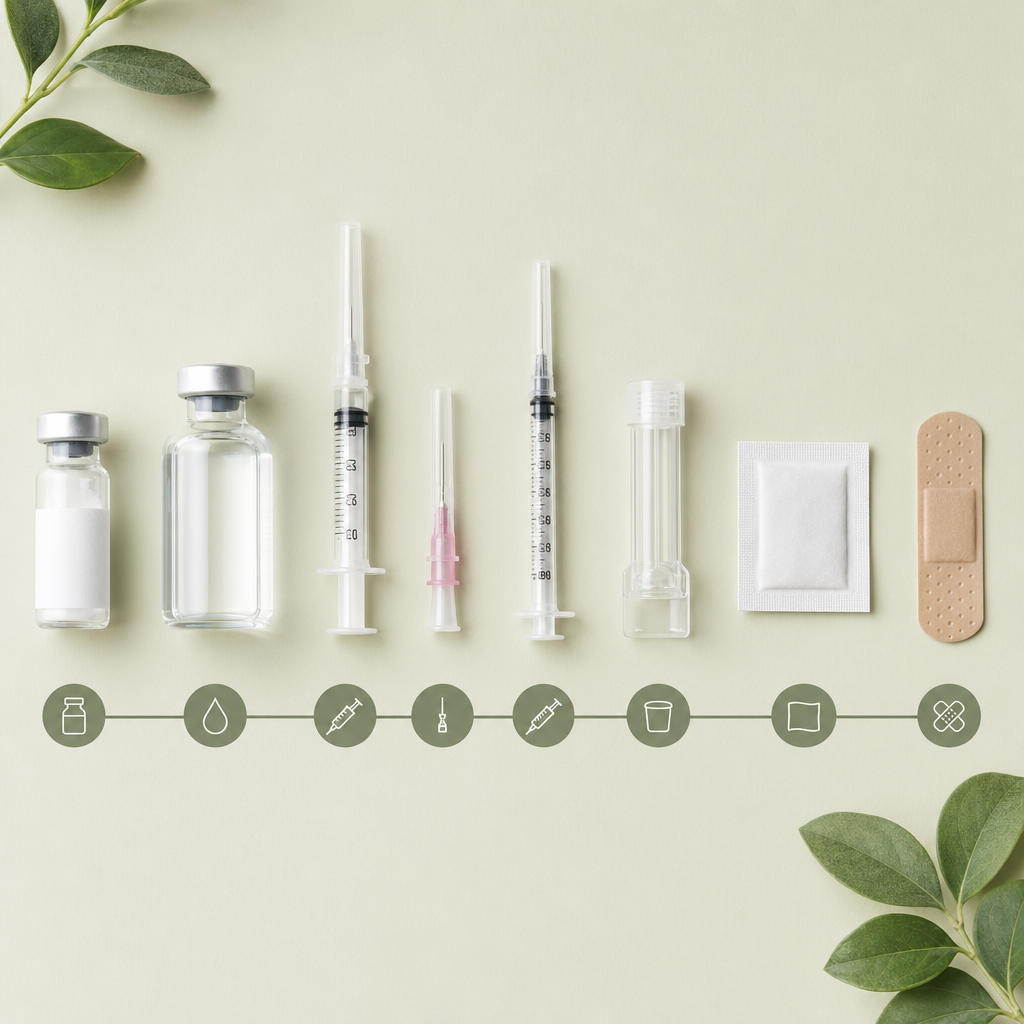
- Tirzepatide vial (lyophilized powder)
- Bacteriostatic water vial (BWFI, 0.9% benzyl alcohol, usually 10 mL or 30 mL multi-dose)
- Reconstitution instructions specific to your vial size
From a pharmacy or online medical supply:
- Sterile syringes for reconstitution: usually a 1 mL or 3 mL syringe with a longer needle (typically 21- to 25-gauge, 1 to 1.5 inch). The reconstitution syringe is different from the injection syringe.
- Sterile syringes for injection: U-100 insulin syringes, 0.3 or 0.5 mL barrel, 31-gauge, 5/16-inch needle.
- Alcohol swabs (70% isopropyl alcohol, individually wrapped)
- Sharps container
Optional but recommended:
- A clean tray or pad to lay supplies on
- A timer (some pharmacies recommend a specific dissolution time)
- A black permanent marker for labeling the vial after reconstitution
Vial-by-vial water-to-powder chart
The exact ratio depends on what concentration your prescription specifies. Below are the most common configurations from U.S. compounding pharmacies. Always confirm with your pharmacy's instructions, not this chart. Pharmacies sometimes use non-standard concentrations.
| Vial size (mg powder) | Bacteriostatic water added | Final concentration | Doses available (at 2.5 mg) | Doses available (at 5 mg) |
|---|---|---|---|---|
| 10 mg | 1 mL | 10 mg/mL | 4 weekly doses | 2 weekly doses |
| 10 mg | 2 mL | 5 mg/mL | 4 weekly doses | 2 weekly doses |
| 20 mg | 2 mL | 10 mg/mL | 8 weekly doses | 4 weekly doses |
| 30 mg | 3 mL | 10 mg/mL | 12 weekly doses | 6 weekly doses |
| 30 mg | 1.5 mL | 20 mg/mL | 12 weekly doses | 6 weekly doses |
| 40 mg | 4 mL | 10 mg/mL | 16 weekly doses | 8 weekly doses |
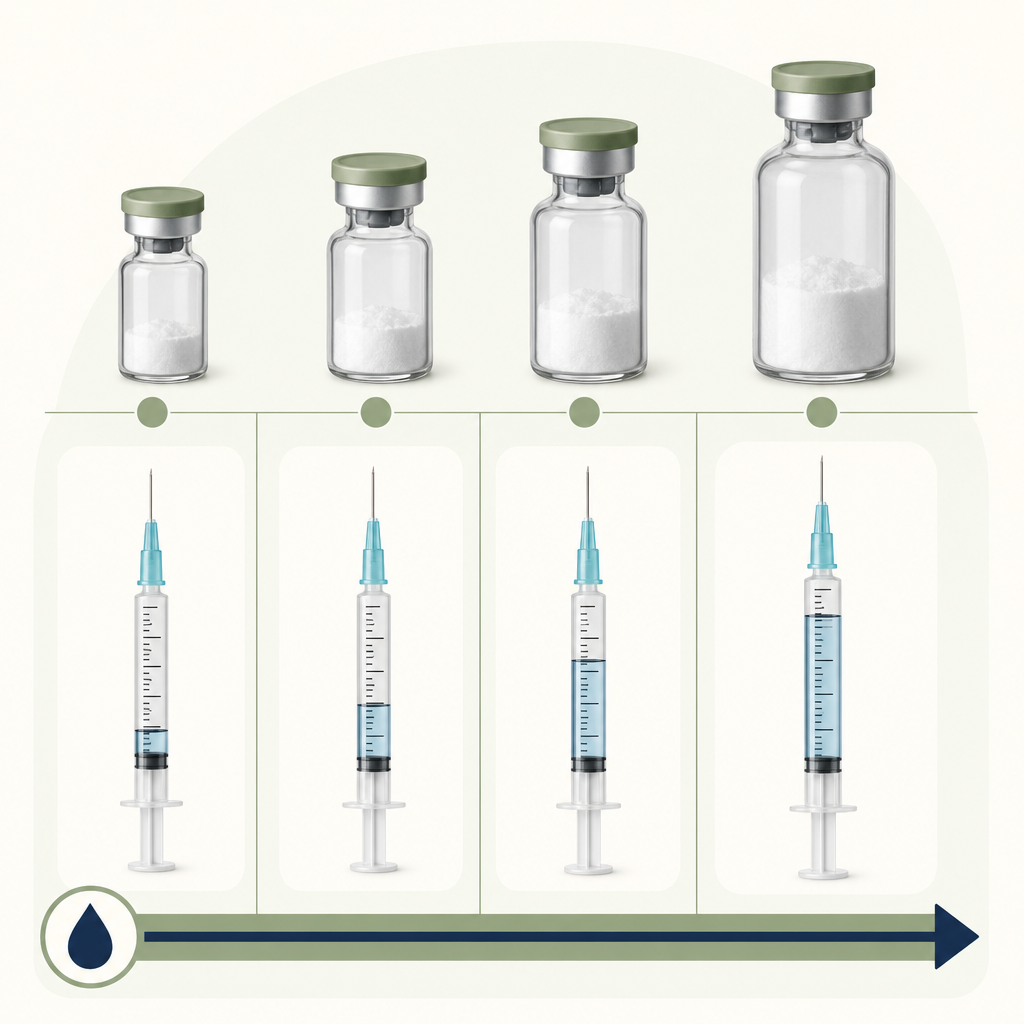
The 10 mg/mL concentration is the most common because the unit math is clean (each milligram corresponds to 10 units on a U-100 syringe).
A 30 mg vial reconstituted with 3 mL is enough for 12 weekly doses at 2.5 mg, which is the typical full titration cycle (4 weeks at 2.5 mg, then escalate). One vial covers a month of titration plus reserve.
The 10-step reconstitution procedure
Step 1: Wash hands and prepare workspace. Wash hands thoroughly with soap and water for 20 seconds. Dry on a clean towel. Set out all supplies on a clean tray. Take both vials out of the refrigerator and let them sit for 15 minutes to reach room temperature. Cold reconstitution causes more foaming and slower dissolution.
Step 2: Inspect both vials. The tirzepatide vial should contain dry, uniform white or off-white powder. The powder may be loose and fluffy or compacted into a "cake" at the bottom of the vial. Both forms are normal. Don't proceed if the powder is yellow, pink, brown, or has visible black specks.
The bacteriostatic water vial should be clear, colorless, and free of particles. Bacteriostatic water that's been opened previously is good for 28 days from first puncture. Discard older vials.
Step 3: Remove the vial caps and clean the stoppers. Remove the plastic flip-top from each vial. Don't remove the rubber stopper underneath. Wipe the rubber stopper of each vial with an alcohol swab using firm pressure for 10 seconds. Let the alcohol air-dry. Don't blow on it.
Step 4: Draw bacteriostatic water into the reconstitution syringe. Refer to the chart above for the correct volume. Pull back the syringe plunger to the desired water volume mark while still capped. Remove the needle cap. Insert the needle through the rubber stopper of the bacteriostatic water vial. Press the plunger to inject the air into the vial (this prevents vacuum buildup). Invert the vial. Pull the plunger back to draw the correct volume of water. Check for air bubbles. If bubbles are present, push them back into the vial and re-draw.
Step 5: Inject the water into the tirzepatide vial. Withdraw the needle from the bacteriostatic water vial. Don't recap. Insert the needle into the tirzepatide vial through the rubber stopper. Tilt the vial at a 45-degree angle and aim the needle so the water runs down the inside wall of the vial, not directly onto the powder. Direct injection onto the powder causes foaming and can damage the peptide.
Slowly press the plunger over 5 to 10 seconds to release the water. Don't rush. Withdraw the needle. Dispose of the syringe in a sharps container.
Step 6: Mix gently. Hold the vial between your palms and roll it slowly for 30 to 60 seconds. Do not shake. Shaking creates foam and shears the peptide bonds, reducing potency.
If the powder dissolves immediately into a clear solution, you're done with this step. If some powder remains undissolved, set the vial down for 2 to 3 minutes, then roll again. Most tirzepatide formulations fully dissolve within 5 minutes of gentle rolling.
Step 7: Inspect the reconstituted solution. The solution should be clear and colorless. Some compounded formulations include B12 and will be pink or red (see our color decoder guide). The solution should not be cloudy, contain visible particles, or have foam on top.
If foam is present, set the vial down for 5 to 10 minutes to let it settle. If cloudiness or particles persist, the reconstitution failed. Don't use the vial. Contact the pharmacy.
Step 8: Label the vial. Use a permanent marker to write on the vial label or a stickered surface:
- Reconstitution date
- Final concentration (e.g., "10 mg/mL")
- "Discard by [date 28 days from now]"
This labeling prevents using an expired vial later.
Step 9: Refrigerate immediately. Reconstituted tirzepatide must be refrigerated at 36 to 46°F. Place the vial in the original box if available, away from the back wall (which can freeze the contents).
Step 10: Discard supplies and clean up. Dispose of the syringe and any used swabs. Wash your hands again.
The full process takes 10 to 15 minutes the first time, 5 to 7 minutes once familiar.
The dose math after reconstitution
Once the vial is reconstituted at, for example, 10 mg/mL, you can draw doses for injection. Use a U-100 insulin syringe (different from the reconstitution syringe).
| Prescribed dose | Volume to draw | Units on U-100 syringe |
|---|---|---|
| 2.5 mg | 0.25 mL | 25 units |
| 5 mg | 0.50 mL | 50 units |
| 7.5 mg | 0.75 mL | 75 units |
| 10 mg | 1.00 mL | 100 units |
| 12.5 mg | 1.25 mL | 125 units (use 1 mL syringe) |
| 15 mg | 1.50 mL | 150 units (use 1 mL syringe) |
For doses above 100 units (1 mL), use a 1 mL barrel syringe instead of a 0.3 or 0.5 mL barrel.
For full unit conversions at every concentration, see our tirzepatide units guide.
Common reconstitution mistakes
Mistake 1: Adding too much water. A 10 mg vial reconstituted with 2 mL instead of 1 mL produces a 5 mg/mL solution. The unit math doubles: 25 units of 10 mg/mL is 2.5 mg, but 25 units of 5 mg/mL is only 1.25 mg. Patients who don't notice the change end up under-dosing.
Mistake 2: Adding too little water. A 10 mg vial reconstituted with 0.5 mL produces a 20 mg/mL solution that's hard to draw accurately at small doses. Drawing "12 units" of 20 mg/mL gives 2.4 mg, with each unit increment representing 0.2 mg.
Mistake 3: Using sterile water for injection (SWFI) instead of bacteriostatic water (BWFI). SWFI lacks the benzyl alcohol preservative. A multi-dose vial reconstituted with SWFI must be discarded after one use, because there's no antimicrobial protection against bacterial growth between punctures. If your pharmacy sent SWFI by mistake, contact them for BWFI before reconstituting.
Mistake 4: Shaking instead of rolling. Vigorous shaking creates foam and can shear the peptide. The injection still works mechanically, but potency may be reduced unpredictably.
Mistake 5: Reconstituting too early. The 28-day post-reconstitution clock starts immediately. Don't reconstitute multiple vials in advance. Reconstitute one vial at a time as needed.
Mistake 6: Failing to label the date. Without a label, it's easy to lose track of how long ago you reconstituted. Patients have used vials 60+ days post-reconstitution without realizing it. Pharmacy labels often print only the dispensing date, not the reconstitution date.
Troubleshooting: foaming, slow dissolution, cloudiness
Persistent foam after rolling: Set the vial down for 10 to 15 minutes. Foam settles on its own. If foam persists, the powder may not have fully dissolved underneath. Roll again gently.
Powder won't fully dissolve: Tirzepatide can sometimes take 5 to 10 minutes to fully dissolve, especially if the powder is compacted. Continue gentle rolling and inspecting. If undissolved powder remains after 15 minutes of rolling, the vial may have a quality issue. Contact the pharmacy.
Solution looks cloudy: Cloudiness usually indicates aggregation, often from temperature shock during shipping or excessive agitation during reconstitution. Don't use a cloudy vial. Document with photos and contact the pharmacy.
Solution has small floating particles: Particles indicate contamination or incomplete dissolution. Don't use. Contact the pharmacy.
Vial pressure is too high or too low after injecting water: This happens when the air-water exchange wasn't balanced. The vial is still usable, but the next time you reconstitute, inject the same volume of air as water you'll draw out, then withdraw the water in two strokes if needed.
Storing and labeling the reconstituted vial
Store the reconstituted vial:
- At 36 to 46°F (2 to 8°C)
- Away from the freezer wall and freezer compartment
- In the original packaging or an opaque container (light protection)
- Upright
Reconstituted tirzepatide is stable for 28 days when stored properly. Some pharmacies stamp 21 days. Use the shorter window if there's any question.
The label should clearly show:
- Drug name and concentration
- Reconstitution date
- Discard date
- Pharmacy and prescription number
A photo of the labeled vial in your phone helps if the marker fades.
Travel rules
For trips of any duration:
Less than 4 hours away from home refrigeration: an insulated lunch bag with a small ice pack is sufficient.
4 to 24 hours: an insulated cooler with a frozen gel pack (not direct ice). Direct ice or freezing temperatures destroy the peptide.
Multi-day travel: bring a small medical-travel cooler (Medactiv or similar) that maintains 36 to 46°F for 24 to 48 hours per gel pack charge. Recharge gel packs in any freezer at the destination.
Air travel: the vial is allowed in carry-on with a doctor's note. TSA has explicit guidance for injectable medications. Don't put medication in checked baggage. Cargo holds can drop below freezing.
Crossing time zones: the weekly dose timing is based on time elapsed, not clock time. If you're 8 hours west of home, take your dose 8 hours later by the new local clock to keep the same interval.
FAQ
How much bacteriostatic water do I add to tirzepatide?
The amount depends on your vial size and target concentration. The most common protocol is 1 mL of bacteriostatic water per 10 mg of tirzepatide, producing a 10 mg/mL solution. Always follow your pharmacy's specific instructions, not a generic ratio.
Can I reconstitute tirzepatide myself at home?
Yes, with proper sterile technique. Most compounding pharmacies provide written instructions and many provide video guides. Don't attempt reconstitution if you're uncomfortable with the process. Ask the pharmacy if they offer pre-reconstituted vials.
How long is reconstituted tirzepatide good for?
28 days when stored refrigerated at 36 to 46°F. Some pharmacies stamp 21 days as a more conservative window. Discard after the labeled date even if doses remain.
Can I use sterile water instead of bacteriostatic water?
No, not for multi-dose vials. Bacteriostatic water contains 0.9% benzyl alcohol as a preservative that prevents bacterial growth between punctures. Sterile water for injection has no preservative and is suitable only for single-dose use.
What if I shake the vial instead of rolling?
The medication will still work but may be less potent. Vigorous shaking creates foam and can shear the peptide structure. Subsequent batches should be rolled, not shaken.
Is it normal for the powder to be a cake at the bottom of the vial?
Yes. Lyophilized tirzepatide can be loose and fluffy or compacted into a cake. Both are normal. Compact cakes take longer to dissolve but reconstitute fully with patient rolling.
What if the solution is cloudy after mixing?
Don't use it. Cloudiness suggests aggregation or contamination. Contact the pharmacy with photos and request a replacement.
Can I mix two different vials together?
No. Each vial is a separate prescription with a separate batch number and reconstitution timeline. Mixing crosses the chain of custody and may invalidate the medication's quality assurance.
What if I lose my reconstitution instructions?
Contact the pharmacy. Most have the dispensing instructions on file and can email or text them to you. Don't guess at the ratio.
Can I freeze reconstituted tirzepatide for longer storage?
No. Freezing damages the peptide structure. The 28-day refrigerated window is the practical maximum. If you have more medication than you can use in 28 days, ask the pharmacy about smaller vials.
What's the difference between U-100 insulin syringes and the reconstitution syringe?
The reconstitution syringe is typically a 1 or 3 mL barrel with a longer 21- to 25-gauge needle, used to draw and inject the bacteriostatic water. The injection syringe is a 0.3 or 0.5 mL U-100 insulin syringe with a fine 31-gauge, 5/16-inch needle, used for the actual subcutaneous injection. They're not interchangeable.
Do I need a sterile environment for reconstitution?
You don't need a clinical-grade sterile space, but a clean, well-lit kitchen counter wiped with disinfectant is the standard recommendation. Wash hands, swab vial tops with alcohol, and don't touch anything between sterile steps.
Author / review note
Reviewed by the FormBlends Medical Team. References include the U.S. Pharmacopeia chapter on compounded sterile preparations (USP <797>), the FDA guidance on bacteriostatic water for injection, and current 503A pharmacy compounding standards.
Footer disclaimers
Platform Disclaimer. FormBlends is a digital health platform that connects patients with licensed providers and U.S.-based pharmacies. We do not manufacture, prescribe, or dispense medication directly. All clinical decisions are made by independent licensed providers.
Compounded Medication Notice. Compounded semaglutide and tirzepatide are not FDA-approved. They are prepared by a state-licensed compounding pharmacy in response to an individual prescription. Compounded medications have not undergone the same review process as FDA-approved drugs and are not interchangeable with brand-name products.
Results Disclaimer. Individual results vary. Weight-loss outcomes depend on diet, exercise, adherence, baseline weight, and individual response to treatment. Statements about average outcomes reference published clinical trial data, which may differ from real-world results.
Trademark Notice. All brand names referenced are the property of their respective owners. FormBlends is not affiliated with, endorsed by, or sponsored by any brand-name pharmaceutical manufacturer.
Related guides
- How to Reconstitute a 15 mg Tirzepatide Vial: A Step-by-Step Guide With a Full Dose Chart
- How to Reconstitute 5 mg Semaglutide: A Step-by-Step Guide With Concentration Math
- What Happens If You Accidentally Take Too Much Tirzepatide? Symptoms, Risks, and a Step-by-Step Action Plan
- Tool: reconstitution calculator
See your options in about 2 minutes
Take the free quiz and see what fits you. Quick, private, and no commitment to continue.
See my options →