The short answer
Red or pink compounded semaglutide is almost always tinted because the pharmacy added vitamin B12 (cyanocobalamin) to the formula. B12 is naturally a deep red liquid. The semaglutide itself is unchanged. If your label doesn't mention B12 or another known additive, call the pharmacy before injecting.
Table of contents
- The 30-second answer
- The color chart: what every tint usually means
- Why B12 is added (and why some pharmacies skip it)
- When red is a warning sign instead of a feature
- Pink vs red vs orange: subtle distinctions
- What to do if your refill looks different than your last vial
- Photo reference for normal appearance
- Storage mistakes that cause color changes
- FAQ
- Footer disclaimers
The color chart: what every tint usually means
| Color | Most likely cause | Safe to use? |
|---|---|---|
| Clear, colorless | Pure semaglutide, no additives | Yes |
| Pale straw yellow | Trace solvent residue or pH-adjusted formulation | Yes (verify with pharmacy) |
| Light pink | Low-dose B12 added (typically 1 mg/mL or less) | Yes if labeled |
| Bright red / cherry | Standard-dose B12 added (typically 1-3 mg/mL) | Yes if labeled |
| Deep ruby red | High-dose B12 + B-complex blend | Yes if labeled |
| Orange-pink | B12 + L-carnitine combination | Yes if labeled |
| Pale yellow with cloudiness | Possible degradation from heat or repeated freeze-thaw | No, contact pharmacy |
| Brown or rust | Significant degradation or contamination | No, do not use |
| Cloudy with floating particles | Aggregated peptide or contamination | No, do not use |
| Layered (clear top, colored bottom) | Inadequate mixing of additive | Roll the vial gently and re-inspect |
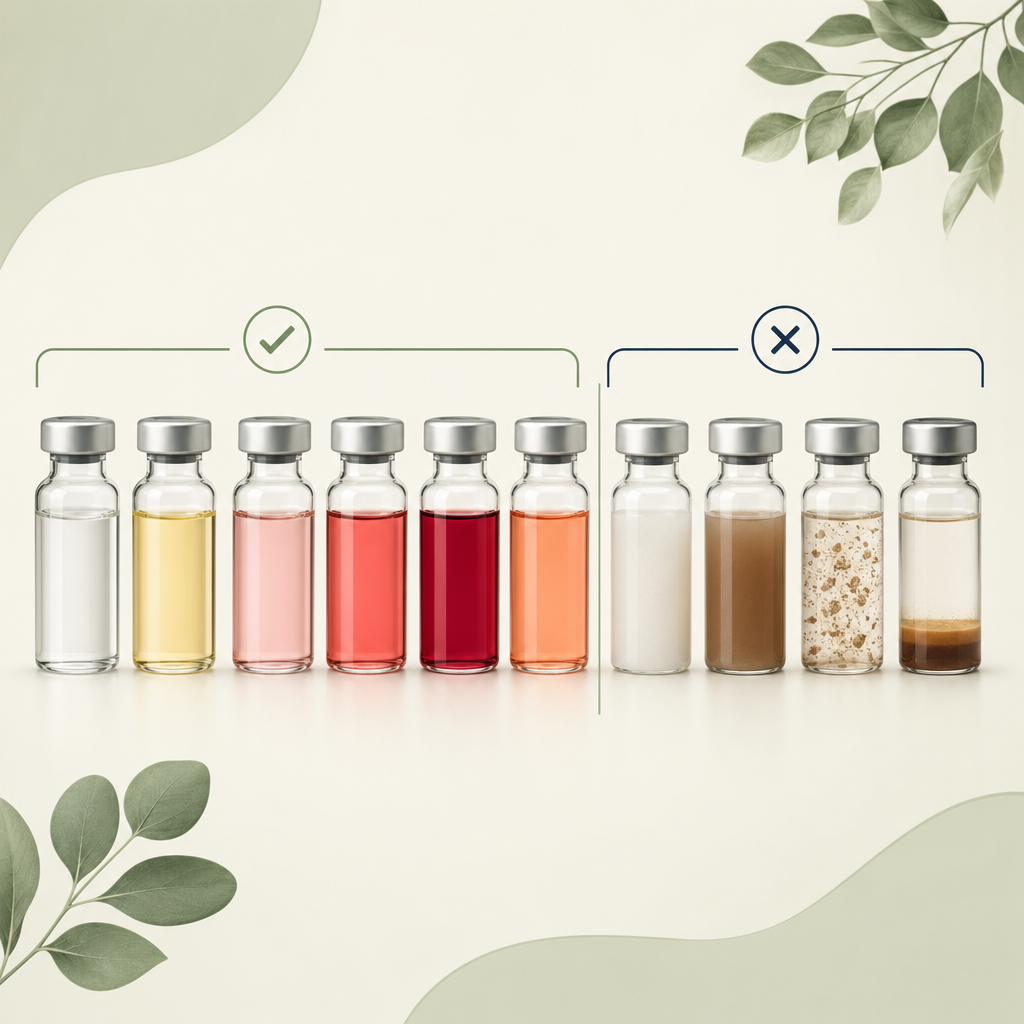
The safest mental model: anything in the red-to-pink-to-yellow range that's clear and uniform is almost certainly fine if your label mentions B12 or B-complex. Anything cloudy, brown, layered, or with visible particles is not.
Get compounded semaglutide, first month $99, then $190 per month, or $165 per month with Subscribe & Save
Free provider review, personalized dosing, and ongoing support included.
Start Free Assessment →Why B12 is added (and why some pharmacies skip it)
Vitamin B12 (cyanocobalamin) shows up in compounded GLP-1 formulations for three real clinical reasons and one historical reason.
Real reason 1: Energy and fatigue support. GLP-1 medications cause some patients to eat less than 1,200 calories per day during titration. That intake level often doesn't supply daily B12 requirements (2.4 mcg per day, per the National Institutes of Health). Adding B12 to the injection sidesteps the absorption issue and ensures adequate intake during the early phase.
Real reason 2: Mood and energy in B12-deficient patients. Roughly 10% of U.S. adults over 30 are B12-deficient or borderline (CDC data, 2018). Compounding pharmacies that include B12 are addressing a baseline deficiency that often shows up as fatigue, brain fog, and low mood.
Real reason 3: Anti-nausea support. This is the weakest of the three. Some clinical case reports suggest B12 supplementation may reduce GLP-1-induced nausea, though the data is small and the mechanism is unclear.
Historical reason: the original 503A and 503B compounding pharmacies that started compounding semaglutide in 2022 used B12 as a "marker" so patients and providers could visually distinguish their compounded product from FDA-approved Ozempic, which is always clear. The color was a quality-control hack as much as a clinical feature.
Why some pharmacies skip B12: a growing number of compounding pharmacies offer "plain" semaglutide because some patients don't want the additive (they may already supplement B12 orally), some prefer not to inject anything they don't strictly need, and the cleaner formula has a longer shelf life since fewer ingredients can degrade.
If your prescription specifically said "semaglutide only" and you got something red, that's worth a phone call to confirm.
When red is a warning sign instead of a feature
Red coloration is fine if it's:
- Clear (no cloudiness or particles)
- Uniform (no separation or layering)
- Disclosed on the label or in the pharmacy paperwork
- Consistent with your previous fills
Red coloration is a warning sign if it's:
- Cloudy or murky
- Has visible particles
- Has separated into a clear top layer and red bottom layer
- Has a brown or rust tint suggesting oxidation
- Is dramatically different from previous fills, with no notification from the pharmacy
The most common scenario where red is concerning: a vial sat in a hot car for several hours during shipping, the peptide partially degraded, and the resulting solution looks slightly different than expected. The B12 itself is heat-stable, but the semaglutide isn't. If your shipping packaging arrived warm or the gel pack was fully thawed, inspect carefully.
A 2023 quality-control survey of compounded GLP-1 products (USP and FDA joint sample) found that 1.3% of vials surveyed had visible signs of degradation, almost all linked to shipping or storage temperature excursions rather than compounding errors.
Pink vs red vs orange: subtle distinctions
The exact shade depends on how much B12 the pharmacy added, what other ingredients are in the formula, and the concentration of the semaglutide itself.
Pink (rose, salmon): typically B12 at 0.5 to 1.0 mg/mL. This is the most common shade for "B12-light" formulations.
Bright red (cherry, ruby): B12 at 2.0 to 3.0 mg/mL. The standard dose used by most U.S. compounding pharmacies.
Deep red (burgundy): B12 at 3.0+ mg/mL or B12 combined with B-complex (B1, B6, B12).
Orange-pink (peach): B12 plus L-carnitine. L-carnitine is sometimes added to compounded GLP-1 formulations for its claimed metabolic effects, though the clinical evidence is limited.
Yellow with hint of pink: B12 plus methionine, lipotropic blend ("MIC-B12" variant).
Yellow only: no B12, but may contain methionine, inositol, choline, or another lipotropic compound. The yellow is usually from riboflavin (B2) or trace solvent.
If you're uncertain which formula you have, the pharmacy's compounding sheet (often included with the medication or available in your patient portal) lists every ingredient by milligram amount.
What to do if your refill looks different than your last vial
Three steps:
- Check the label for any change in formula. Many pharmacies update formulations occasionally, and your refill may legitimately have a different color than your previous vial.
- Check the prescription bottle inserts for ingredient lists. The change may be reflected there.
- Call the pharmacy if you can't account for the difference. A 5-minute call resolves the question without you injecting something you're unsure about.
A real-world case: a patient on FormBlends's program received a refill that was noticeably more yellow than her previous fills. The pharmacy had switched to a B12-free formulation at her provider's request because her B12 levels had been elevated on lab work. The change wasn't communicated to the patient. A phone call resolved it in under 10 minutes.
The lesson: pharmacies don't always explain formulation changes proactively. If something looks different, ask.
Photo reference for normal appearance
Three photos to add as image carousel on this page:
Photo 1: "What clear semaglutide looks like." A standard 5 mL multi-dose vial of B12-free compounded semaglutide held against a white background. The liquid should be clear with a slight pale-yellow tint visible at the meniscus.
Photo 2: "What B12-tinted semaglutide looks like." A 5 mL vial of B12-supplemented compounded semaglutide showing the characteristic ruby-red color. Note: the color is uniform top-to-bottom.
Photo 3: "When to be concerned." A side-by-side comparison: a fresh, properly-stored vial next to a degraded vial showing layering or particulates. The latter should not be used.
Each photo should include the FormBlends label and a caption noting the date the photo was taken (so we can track formulation changes over time).
Storage mistakes that cause color changes
Repeated freeze-thaw cycles are the most damaging. Even a single accidental freeze (e.g., the vial was too close to the back wall of the fridge) can cause aggregation. Visually, this might show up as a slight cloudiness or a haze that wasn't there before.
Heat exposure above 86°F for prolonged periods causes peptide degradation. The solution may yellow or develop a faint brown tint. Once peptide has degraded, the medication is no longer reliable.
Direct light exposure (sitting on a counter near a sunny window for days) can also degrade some peptides. Most compounded vials are amber-tinted glass to mitigate this, but clear vials are still in use.
Vibration during shipping can cause foaming, which sometimes appears as a haze on the surface. Settling for an hour usually resolves this. If foam persists, contact the pharmacy.
Improper reconstitution (for vials that came as powder) can cause cloudiness if too little solvent was added or if the vial was shaken vigorously instead of swirled.
The general rule: store at 36 to 46°F, away from light, in the original packaging, and inspect the vial before every dose. If it looks different than the day you received it, take a photo and contact the pharmacy.
FAQ
Why is my compounded semaglutide red?
The most common reason is added vitamin B12 (cyanocobalamin), which is naturally a deep red liquid. Some compounding pharmacies include B12 to address potential deficiency during the appetite-suppressed phase of GLP-1 treatment. Check your label for B12 or B-complex.
Is red semaglutide safe?
Yes, if the red color is from a disclosed additive like B12 and the solution is clear without particles or cloudiness. Red, clear, uniform = generally fine. Cloudy, brown, layered, or unexpected color = call the pharmacy.
Why isn't FDA-approved semaglutide red?
The FDA-approved semaglutide products (Ozempic, Wegovy, Rybelsus) are formulated as the pure active ingredient with minimal additives. They're clear and colorless. Compounded versions are made by individual pharmacies that may include other ingredients to address specific patient needs.
My semaglutide is more pink than red. Is that normal?
Yes. The exact shade depends on how much B12 the pharmacy added. Pink (lighter B12 dose) and red (standard B12 dose) are both within normal range.
My semaglutide is yellow, not red. Is that normal?
Pale yellow can be normal. It may indicate trace solvent, riboflavin (B2), or a lipotropic blend without B12. Check the label and ingredient list to confirm what's expected.
Can the color change between vials from the same pharmacy?
Slight variation is normal. Significant changes (red one fill, yellow the next) usually mean a formulation update. Confirm with the pharmacy before injecting.
What if my semaglutide is cloudy?
Don't use it. Cloudiness suggests aggregation, contamination, or degradation. Contact the pharmacy for a replacement and document the issue with photos.
What if there's particles floating in the vial?
Don't use it. Visible particles in an injectable solution indicate a quality issue. The vial should be replaced.
What if my vial has separated into two layers?
Roll the vial gently between your palms for 15 to 20 seconds, then inspect again. If the layers re-form, contact the pharmacy. Don't shake vigorously, which can damage the peptide.
Does B12 in compounded semaglutide actually do anything?
There's modest evidence B12 may support energy, mood, and reduced fatigue in B12-deficient patients. The effect is real but small. Patients who already supplement B12 orally are unlikely to benefit further from injectable B12.
Can I request a B12-free version?
Yes. Most compounding pharmacies offer plain semaglutide as an option. Discuss with your provider before switching, especially if you've been tolerating the B12 version well.
Does adding B12 reduce the effectiveness of semaglutide?
No. B12 doesn't interfere with semaglutide's mechanism of action. The two molecules work on different pathways and don't compete for the same receptors.
Author / review note
Reviewed by the FormBlends Medical Team. References include the National Institutes of Health Office of Dietary Supplements B12 fact sheet, CDC NHANES B12 deficiency data 2018, and the joint USP/FDA 2023 quality survey on compounded GLP-1 products.
Footer disclaimers
Platform Disclaimer. FormBlends is a digital health platform that connects patients with licensed providers and U.S.-based pharmacies. We do not manufacture, prescribe, or dispense medication directly. All clinical decisions are made by independent licensed providers.
Compounded Medication Notice. Compounded semaglutide and tirzepatide are not FDA-approved. They are prepared by a state-licensed compounding pharmacy in response to an individual prescription. Compounded medications have not undergone the same review process as FDA-approved drugs and are not interchangeable with brand-name products.
Results Disclaimer. Individual results vary. Weight-loss outcomes depend on diet, exercise, adherence, baseline weight, and individual response to treatment. Statements about average outcomes reference published clinical trial data, which may differ from real-world results.
Trademark Notice. Ozempic, Wegovy, and Rybelsus are registered trademarks of Novo Nordisk A/S. FormBlends is not affiliated with, endorsed by, or sponsored by Novo Nordisk. Brand names are referenced for educational comparison only.
Related guides
- What Color Is Tirzepatide? A Visual Decoder Guide and What Each Tint Tells You
- What Color Is Tirzepatide Injection? A Visual Guide to Clear, Yellow, Pink, and Red Vials
- How Many Units Is 0.25 mg of Semaglutide? A Conversion Chart for Every Compounded Concentration
- How Many mg Is 50 Units of Semaglutide? The Conversion Chart for Every Compounded Concentration
- How Many Units Is 1.7 mg of Semaglutide? A Conversion Chart for Every Compounded Concentration
- How Many Units Is 1.5 mg of Semaglutide? A Conversion Chart for Every Concentration
See your options in about 2 minutes
Take the free quiz and see what fits you. Quick, private, and no commitment to continue.
See my options →