The short answer
Pure compounded tirzepatide is clear and colorless or has a faint straw-yellow tint. A pink, red, or ruby color almost always means the pharmacy added vitamin B12 (cyanocobalamin), which is naturally a deep red liquid. Cloudiness, brown tint, or visible particles are warning signs and mean discard.
Table of contents
- The 30-second answer
- Color chart: every tint and what it likely means
- Why some compounding pharmacies add B12
- When color is a feature vs a warning sign
- Pink vs red vs orange: the subtle distinctions
- What to do if your refill looks different than your last vial
- Storage mistakes that cause color changes
- Brand-name vs compounded: why the colors differ
- FAQ
- Footer disclaimers
Color chart: every tint and what it likely means
| Color | Most likely cause | Safe to use? |
|---|---|---|
| Clear, colorless | Pure tirzepatide, no additives | Yes |
| Faint straw yellow | Trace solvent, pH-adjusted formulation | Yes (verify with pharmacy) |
| Light pink | Low-dose B12 added (typically 1 mg/mL or less) | Yes if disclosed on label |
| Bright red, cherry | Standard B12 (typically 1-3 mg/mL) | Yes if disclosed on label |
| Deep ruby red | High-dose B12 or B-complex blend | Yes if disclosed on label |
| Orange-pink | B12 plus L-carnitine combination | Yes if disclosed on label |
| Pale yellow with cloudiness | Possible heat or freeze-thaw degradation | No, contact pharmacy |
| Brown or rust | Significant degradation or contamination | No, do not use |
| Cloudy with floating particles | Aggregated peptide or contamination | No, do not use |
| Layered (clear top, colored bottom) | Inadequate mixing of additive | Roll vial gently and re-inspect |
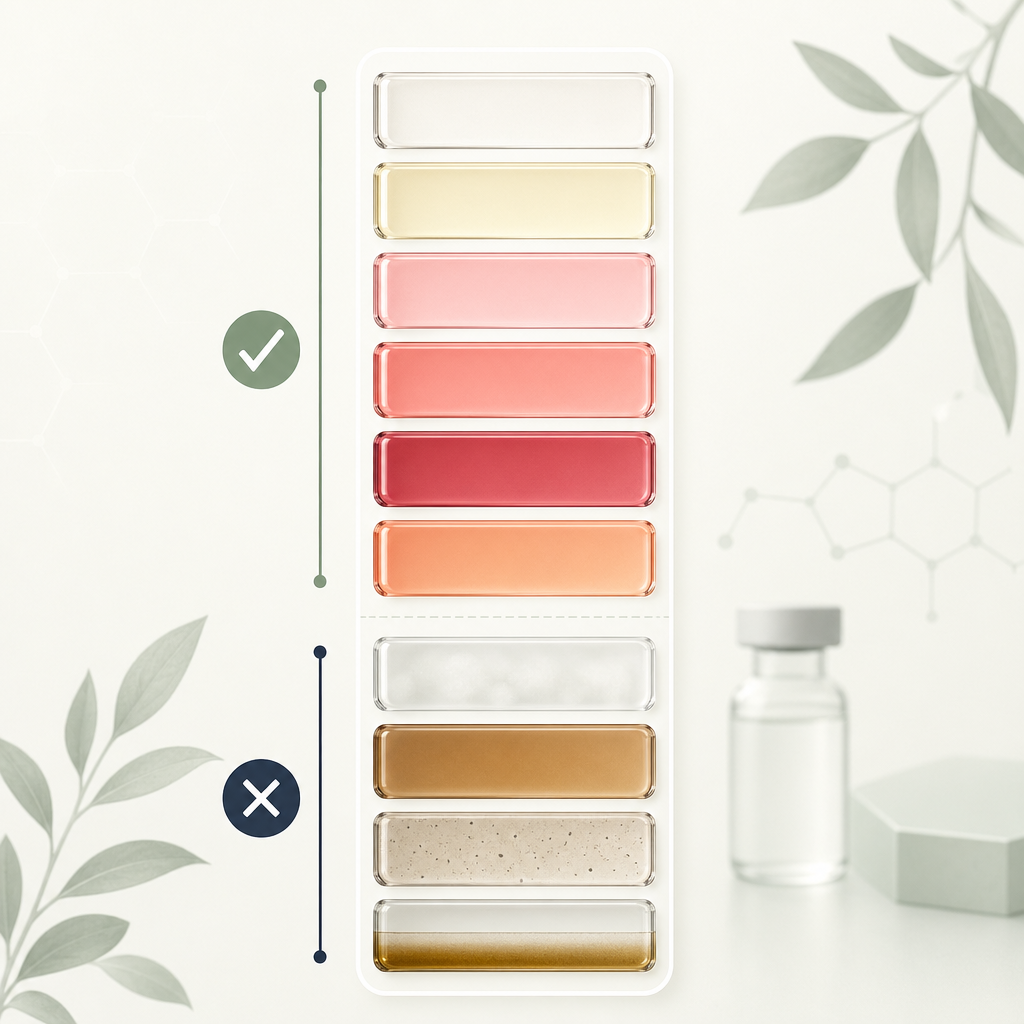
The simple rule: anything in the clear-to-pink-to-red range that is uniform and free of particles is generally fine, provided your label discloses the additive responsible for the color. Anything cloudy, brown, layered, or with visible particles should not be used.
Check your GLP-1 eligibility
Use our free BMI Calculator to see if you may qualify for provider-reviewed GLP-1 therapy.
Try the BMI Calculator →Why some compounding pharmacies add B12
Vitamin B12 (cyanocobalamin) shows up in compounded tirzepatide formulations for three real clinical reasons and one historical reason.
Reason 1: Energy and fatigue support during titration. Tirzepatide can drop appetite to the point that some patients consume under 1,200 calories per day in early weeks. That intake often falls short of the daily B12 requirement (2.4 mcg per day, per the National Institutes of Health). Adding B12 to the injection sidesteps the absorption pathway and ensures adequate intake during the appetite-suppressed phase.
Reason 2: Underlying B12 deficiency. CDC NHANES data from 2018 estimated that roughly 10% of U.S. adults over 30 are B12-deficient or borderline. Compounding pharmacies that include B12 are addressing a baseline deficiency that often presents as fatigue, brain fog, or low mood. Patients with these symptoms sometimes feel better on B12-supplemented compounded tirzepatide than on plain.
Reason 3: Anti-nausea support. Modest evidence from case series suggests B12 may reduce GLP-1-induced nausea in some patients. The mechanism is unclear and the data is limited, but pharmacies sometimes include it on these grounds.
Historical reason: when the first 503A and 503B compounding pharmacies began compounding tirzepatide in 2023, B12 was used as a visual marker so patients and providers could distinguish the compounded product from FDA-approved Mounjaro and Zepbound, which are always clear. The color was as much a quality-control signal as a clinical feature.
A growing number of compounding pharmacies offer plain tirzepatide because some patients prefer not to inject anything they don't strictly need, some already supplement B12 orally, and the simpler formula tends to have a longer shelf life.
If your prescription specifically said "tirzepatide only" and you got something pink or red, call the pharmacy to confirm what's in the vial.
When color is a feature vs a warning sign
Color is a feature if it is:
- Clear (no cloudiness or visible particles)
- Uniform top to bottom
- Disclosed on the label, the patient handout, or in the pharmacy's compounding sheet
- Consistent with previous fills, or a change you were notified about
Color is a warning sign if it is:
- Cloudy or murky
- Has visible particles or threads
- Has separated into a clear top layer and a colored bottom layer that won't recombine with gentle inversion
- Has a brown or rust tint suggesting oxidation
- Is dramatically different from previous fills, with no explanation
The most common warning scenario: a vial sat in a hot car or warm shipping box for several hours, the peptide partially degraded, and the resulting solution looks slightly different than expected. B12 itself is heat-stable, but tirzepatide isn't. If your shipment arrived warm or the gel pack was fully thawed, inspect carefully. (See our tirzepatide storage and heat guide for the full thermal stability picture.)
A 2023 quality survey of compounded GLP-1 products jointly conducted by USP and FDA found that 1.3% of vials surveyed had visible signs of degradation, almost all linked to shipping or storage temperature problems rather than compounding errors.
Pink vs red vs orange: the subtle distinctions
The exact shade depends on how much B12 the pharmacy added, what other ingredients are in the formula, and the concentration of the tirzepatide itself.
Pink (rose, salmon): typically B12 at 0.5 to 1.0 mg/mL. The most common shade for B12-light formulations.
Bright red (cherry): B12 at 1.0 to 3.0 mg/mL. The standard dose used by most U.S. compounding pharmacies that include B12.
Deep ruby (burgundy): B12 at 3.0+ mg/mL or B12 combined with B-complex (B1, B6, B12).
Orange-pink (peach): B12 plus L-carnitine. L-carnitine is sometimes added to compounded GLP-1 formulations for its claimed metabolic effects, though clinical evidence in humans is limited.
Yellow with hint of pink: B12 plus methionine, sometimes called a MIC-B12 variant.
Yellow only: no B12, but may contain methionine, inositol, choline, or another lipotropic compound. The yellow may come from riboflavin (B2) or trace solvent.
If you're not sure which formula you have, the pharmacy's compounding sheet (often included with the medication or available in your patient portal) lists every ingredient by milligram amount.
What to do if your refill looks different than your last vial
A three-step process:
- Check the label for any change in formula. Many pharmacies update formulations from time to time, and your refill may legitimately have a different color than your previous vial.
- Check the patient handout and prescription paperwork for ingredient lists. The change may be reflected there.
- Call the pharmacy if you can't account for the difference. A 5-minute phone call resolves the question without you injecting something you're unsure about.
Real-world example: a patient on a FormBlends-affiliated program received a refill noticeably more yellow than her prior fills. The pharmacy had switched to a B12-free formulation at her provider's request because her B12 levels were elevated on lab work. The change wasn't communicated to the patient. A phone call resolved it in under 10 minutes.
The lesson: pharmacies don't always proactively explain formulation changes. If something looks different, ask before drawing a dose.
Storage mistakes that cause color changes
Color can shift from improper storage even before any pharmacy-side issue. The four main culprits:
Repeated freeze-thaw cycles. Even a single accidental freeze, for example a vial that sat too close to the back wall of the refrigerator, can cause peptide aggregation. Visually, this often shows up as cloudiness or a faint haze that wasn't there originally.
Heat exposure above 86°F (30°C). Prolonged warmth causes peptide degradation. The solution may yellow, develop a faint brown tint, or, in B12-supplemented formulations, lose color clarity.
Direct light exposure. Sitting on a counter near a sunny window for days can degrade some peptides. Most compounded vials use amber-tinted glass to mitigate this, but clear vials are still in use, and they are more vulnerable.
Vibration during shipping. Can cause foaming, which sometimes appears as a haze on the surface. Letting the vial settle for an hour usually resolves this. If foam persists or the haze stays, contact the pharmacy.
The general rule: store at 36 to 46°F, away from light, in the original packaging, and inspect the vial before every dose. If it looks different than the day you received it, take a photo and contact the pharmacy.
Brand-name vs compounded: why the colors differ
FDA-approved tirzepatide products (Mounjaro, Zepbound) are always clear and colorless. Their formulations contain only tirzepatide, water for injection, sodium chloride, sodium phosphate buffer, and a small amount of stabilizer. No B12, no L-carnitine, no lipotropic compounds. The pure peptide does not impart color.
Compounded tirzepatide is made by individual state-licensed compounding pharmacies, and the formulations vary. Some pharmacies replicate the brand-name formulation closely, producing a clear product. Others add B12, B-complex, L-carnitine, or other ingredients depending on prescriber preference and patient request. The color reflects those formulation choices.
Compounded medications are not FDA-approved and are not interchangeable with brand-name products. Color is one visible expression of the difference between formulations. (See our tirzepatide units conversion guide for additional differences in concentration and dosing.)
FAQ
What color is tirzepatide?
Pure tirzepatide is clear and colorless or has a very faint straw-yellow tint. Brand-name Mounjaro and Zepbound are always clear. Compounded tirzepatide can be clear or tinted (pink, red, ruby, orange-pink, or pale yellow) depending on whether the pharmacy added B12, B-complex, or other ingredients.
Why is my compounded tirzepatide red or pink?
The most common reason is added vitamin B12 (cyanocobalamin), which is naturally a deep red liquid. Some compounding pharmacies include B12 to address possible deficiency during the appetite-suppressed phase of treatment. Check your label or pharmacy paperwork for B12 or B-complex.
Is red tirzepatide safe to inject?
Yes, if the red color comes from a disclosed additive like B12 and the solution is clear without particles or cloudiness. Red, clear, and uniform usually indicates a B12-supplemented formula. Cloudy, brown, layered, or unexpectedly colored solution should be examined further before use.
Why is brand-name tirzepatide clear but compounded is sometimes red?
Brand-name Mounjaro and Zepbound contain only tirzepatide and a few standard excipients, with no color-imparting ingredients. Compounded tirzepatide may include B12 or other additives at the prescriber's or pharmacy's discretion, which can produce pink or red coloration.
My tirzepatide is more pink than red. Is that normal?
Yes. The exact shade depends on how much B12 the pharmacy added. Pink usually indicates a lower B12 dose; red indicates a standard dose. Both are within normal range for B12-supplemented formulations.
My tirzepatide is yellow, not pink or red. Is that normal?
Pale yellow can be normal. It may indicate trace solvent, riboflavin (B2), or a lipotropic blend like methionine-inositol-choline (MIC) without B12. Check the pharmacy paperwork to confirm what's expected. Bright yellow or murky yellow may suggest a problem; call the pharmacy.
Can the color change between vials from the same pharmacy?
Slight variation is normal. Significant changes (red one fill, yellow the next) usually mean a formulation update. Confirm with the pharmacy before injecting.
What if my tirzepatide is cloudy?
Don't use it. Cloudiness suggests aggregation, contamination, or degradation. Contact the pharmacy for a replacement and document the issue with photos.
What if there are visible particles in the vial?
Don't use it. Visible particles in an injectable solution indicate a quality issue. The vial should be replaced.
What if my vial has separated into two layers?
Roll the vial gently between your palms for 15 to 20 seconds, then inspect again. If the layers re-form, contact the pharmacy. Don't shake vigorously, which can damage the peptide.
Does B12 in compounded tirzepatide actually help anything?
There is modest evidence that B12 may support energy, mood, and reduced fatigue in patients with B12 deficiency. The effect is real but small. Patients who already supplement B12 orally are unlikely to benefit further from injectable B12.
Can I request a B12-free version?
Yes. Most compounding pharmacies offer plain tirzepatide as an option. Discuss with your provider before switching, especially if you've been tolerating the B12 version well.
Does the color affect how well tirzepatide works?
The color itself doesn't affect efficacy. The active ingredient is tirzepatide; the additives that produce color (B12, B-complex) work on different pathways. A clear formula and a B12-tinted formula deliver the same tirzepatide dose if both are formulated at the same concentration.
Is there a way to tell if the color comes from B12 or from degradation?
B12-tinted tirzepatide is uniform, transparent (you can see through it), and bright pink to ruby red. Degraded tirzepatide tends to be cloudy, brown-tinged, or shows visible particles. The clarity of the solution is usually the giveaway.
Should I ask the pharmacy to take a photo of my vial before shipping?
Most pharmacies don't routinely do this, but you can request a photo of the lot or batch you'll receive. More practically, take a photo of your own vial when it arrives so you have a baseline for comparing future fills.
Author / review note
Reviewed by the FormBlends Medical Team. References include the National Institutes of Health Office of Dietary Supplements B12 fact sheet, CDC NHANES B12 deficiency data 2018, the joint USP/FDA 2023 quality survey on compounded GLP-1 products, and the FDA-approved labeling for Mounjaro and Zepbound (Eli Lilly), accessed Q1 2026.
Footer disclaimers
Platform Disclaimer. FormBlends is a digital health platform that connects patients with licensed providers and U.S.-based pharmacies. We do not manufacture, prescribe, or dispense medication directly. All clinical decisions are made by independent licensed providers.
Compounded Medication Notice. Compounded semaglutide and tirzepatide are not FDA-approved. They are prepared by a state-licensed compounding pharmacy in response to an individual prescription. Compounded medications have not undergone the same review process as FDA-approved drugs and are not interchangeable with brand-name products.
Results Disclaimer. Individual results vary. Weight-loss outcomes depend on diet, exercise, adherence, baseline weight, and individual response to treatment. Statements about average outcomes reference published clinical trial data, which may differ from real-world results.
Trademark Notice. Mounjaro and Zepbound are registered trademarks of Eli Lilly and Company. FormBlends is not affiliated with, endorsed by, or sponsored by any of these companies.
Related guides
- Why Is My Compounded Semaglutide Red? A Visual Decoder for Every Color You Might See
- What Color Is Tirzepatide Injection? A Visual Guide to Clear, Yellow, Pink, and Red Vials
- What Color Is Tirzepatide with B12? The Complete Visual Identification Guide for Compounded Formulations
- What Color Should Tirzepatide Be? A Visual Safety Guide to Identifying Contamination, Degradation, and Safe Medication
- What Color Is Tirzepatide? The Visual Identification Guide for Brand and Compounded Formulations
- What Color Is Semaglutide? The Visual Safety Check Every Patient Should Know Before Injection
See your options in about 2 minutes
Take the free quiz and see what fits you. Quick, private, and no commitment to continue.
See my options →