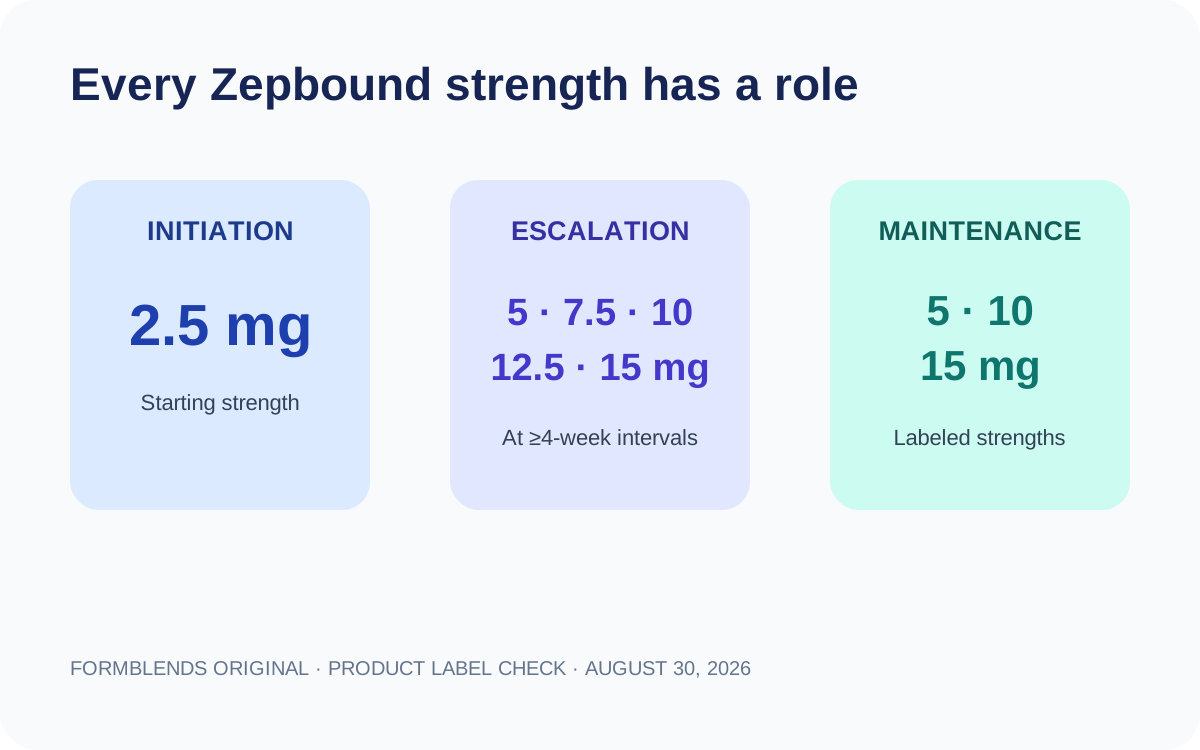
Zepbound comes in six once-weekly doses: 2.5, 5, 7.5, 10, 12.5 and 15 mg. Everyone starts at 2.5 mg for four weeks, then moves up in 2.5 mg steps with at least four weeks on each. The maintenance doses are 5, 10 and 15 mg. In the SURMOUNT-1 trial, average weight loss at 72 weeks was 15.0% at 5 mg, 19.5% at 10 mg and 20.9% at 15 mg. If you are new to the drug, our tirzepatide guide covers the basics first.
Key takeaways
- Zepbound and Mounjaro are both tirzepatide, made by Eli Lilly, in the same six strengths. Zepbound is approved for chronic weight management and obstructive sleep apnea in adults with obesity; Mounjaro is approved for type 2 diabetes.
- The label says 2.5 mg is a starting dose, not a maintenance dose. The maximum dose is 15 mg once weekly.
- Higher doses produced more weight loss in SURMOUNT-1, but more nausea and more discontinuation for side effects.
- Lilly's self-pay vial prices run from $299 a month for 2.5 mg to $699 a month for 10, 12.5 and 15 mg.
- Compounded tirzepatide is not FDA approved and is not interchangeable with Zepbound; the mg schedule carries over, the delivery does not.
All six Zepbound doses
Each Zepbound strength is a fixed weekly dose in a single-use pen or a single-dose vial. You do not measure anything. The table lists each strength, its role in the label, and Lilly's published self-pay vial price through LillyDirect.
| Dose | Role per the Zepbound label | LillyDirect self-pay vial price |
|---|---|---|
| 2.5 mg | Starting dose, first 4 weeks | $299 a month |
| 5 mg | Maintenance dose | $399 a month |
| 7.5 mg | Step between 5 and 10 mg | $499 a month |
| 10 mg | Maintenance dose | $699 a month |
| 12.5 mg | Step between 10 and 15 mg | $699 a month |
| 15 mg | Maximum maintenance dose | $699 a month |
Source: Zepbound prescribing information (DailyMed); Eli Lilly LillyDirect self-pay pricing, accessed September 4, 2026.
People with commercial insurance that covers Zepbound may pay as little as $25 a month with Lilly's savings card. Coverage rules vary by plan, and the tirzepatide cost guide walks through the options.
Zepbound titration schedule
The label sets a floor of four weeks per step. It does not set a ceiling. Your prescriber can keep you at any dose longer, or hold at a maintenance dose without going higher.
Check your GLP-1 eligibility
Use our free BMI Calculator to see if you may qualify for provider-reviewed GLP-1 therapy.
Try the BMI Calculator →| Weeks | Dose | Notes |
|---|---|---|
| 1 to 4 | 2.5 mg | Starting dose only |
| 5 to 8 | 5 mg | Earliest maintenance dose |
| 9 to 12 | 7.5 mg | Increase only after at least 4 weeks at 5 mg |
| 13 to 16 | 10 mg | Maintenance dose |
| 17 to 20 | 12.5 mg | Increase only after at least 4 weeks at 10 mg |
| 21 onward | 15 mg | Maximum; do not exceed |
Source: Zepbound prescribing information, Dosage and Administration.
Timing rules also come from the label: a missed dose can be taken within 4 days (96 hours), otherwise skip it; never take two doses within 3 days of each other. The full schedule in units for compounded vials is on the tirzepatide dosage chart.
Zepbound weight loss chart by dose
The approval of Zepbound for weight management rested on SURMOUNT-1, a 72-week trial of 2,539 adults with obesity or overweight and no diabetes. Participants were randomized to 5, 10 or 15 mg of tirzepatide or placebo. All received diet and activity counseling. These are the average results, not guarantees for any one person.
| Group | Mean weight change at 72 weeks | Lost at least 5% | Lost at least 20% |
|---|---|---|---|
| Placebo | -3.1% | 35% | 3% |
| 5 mg | -15.0% | 85% | Not reported in the summary used here |
| 10 mg | -19.5% | 89% | 50% |
| 15 mg | -20.9% | 91% | 57% |
Source: SURMOUNT-1, Jastreboff et al., NEJM 2022 (treatment-regimen estimand).
In adults who also have type 2 diabetes, the numbers were lower. SURMOUNT-2 reported -12.8% at 10 mg and -14.7% at 15 mg over 72 weeks, versus -3.2% on placebo. If you want the full trial picture, read how much weight can you lose on tirzepatide.
Side effects by Zepbound dose
Gastrointestinal effects were the most common adverse events in SURMOUNT-1. They were mostly mild to moderate and mostly happened while the dose was going up.
| Adverse event | Placebo | 5 mg | 10 mg | 15 mg |
|---|---|---|---|---|
| Nausea | 9.5% | 24.6% | 33.3% | 31.0% |
| Diarrhea | 7.3% | 18.7% | 21.2% | 23.0% |
| Vomiting | 1.7% | 8.3% | 10.7% | 12.2% |
| Constipation | 5.8% | 16.8% | 17.1% | 11.7% |
| Stopped for adverse events | 2.6% | 4.3% | 7.1% | 6.2% |
Source: SURMOUNT-1, Jastreboff et al., NEJM 2022.
The Zepbound label also lists a boxed warning for thyroid C-cell tumors (seen in rats, unknown in humans) and warnings for severe gut reactions, pancreatitis, gallbladder disease, kidney injury from dehydration, low blood sugar with insulin or sulfonylureas, allergic reactions, diabetic eye disease in type 2 diabetes, aspiration under deep sedation, and never sharing a pen. Report new or worsening symptoms to your prescriber at any dose.
Which Zepbound dose is the maintenance dose?
The label names 5, 10 and 15 mg as maintenance doses. There is no requirement to reach 15 mg. Many people settle at 5 or 10 mg because the weight loss is steady and the side effects are manageable. The 7.5 and 12.5 mg strengths are steps, though a prescriber can hold you at either. Once you reach a dose that works, the question becomes how long to stay there. Our page on the tirzepatide maintenance dose after goal weight covers what the SURMOUNT-4 trial found about continuing versus stopping.
Mounjaro conversion chart
There is no conversion to do. Mounjaro and Zepbound are the same molecule at the same six strengths, so 5 mg of one is 5 mg of the other. What differs is the approved use: Mounjaro for type 2 diabetes, Zepbound for chronic weight management and obstructive sleep apnea. Insurance often covers one and not the other. If you switch brands, your prescriber decides the dose; the label does not describe restarting at 2.5 mg when the mg amount stays the same, but it also does not address brand switches directly, so ask.
What this means for compounded tirzepatide
Compounded tirzepatide is not FDA approved and is not interchangeable with Zepbound or Mounjaro. Prescribers commonly use the same mg schedule, but a compounded multi-dose vial has no fixed-dose pen. You draw each dose in units based on the vial's concentration. At 10 mg/mL, the six doses are 25, 50, 75, 100, 125 and 150 units.
At FormBlends, compounded tirzepatide costs $149 for the first month and then $239 a month, or $214 a month with Subscribe & Save. The price is the same at every dose, shipping and injection supplies are included, and lab work is not. Prescriptions come from independent, state-licensed clinicians of Recess MD LLC, and medication is compounded by state-licensed 503A compounding pharmacies. See pricing or begin the assessment at start.
Frequently Asked Questions
What are the Zepbound doses?
Zepbound is made in 2.5, 5, 7.5, 10, 12.5 and 15 mg once-weekly strengths. The 2.5 mg dose is only a starting dose. Maintenance doses are 5, 10 and 15 mg, and 15 mg is the maximum.
Is there a Zepbound weight loss chart by dose?
The best data come from SURMOUNT-1: an average loss of 15.0% at 5 mg, 19.5% at 10 mg and 20.9% at 15 mg over 72 weeks, versus 3.1% on placebo. Those are group averages. Individual results vary widely in both directions.
Is there a Mounjaro conversion chart for Zepbound?
No conversion is needed because both products are tirzepatide at the same six strengths. A 7.5 mg Mounjaro pen delivers the same tirzepatide dose as a 7.5 mg Zepbound pen. Ask your prescriber before switching products, since the approved uses and insurance coverage differ.
What does a tirzepatide niacinamide dosing chart have to do with Zepbound?
Nothing on the Zepbound side. Zepbound contains only tirzepatide, and its label does not include niacinamide. Some compounded vials add niacinamide, which does not change the tirzepatide mg math; see our separate page on tirzepatide with niacinamide.
Can I stay on 2.5 mg of Zepbound?
The label describes 2.5 mg as a starting dose for treatment initiation, not a maintenance dose. Some prescribers keep people there longer for side-effect reasons. That is a prescriber decision, so ask rather than deciding alone.
Sources
- Zepbound (tirzepatide) prescribing information, Eli Lilly via DailyMed, revised 08/2026.
- Mounjaro (tirzepatide) prescribing information, Eli Lilly via DailyMed, revised 08/2026.
- Tirzepatide Once Weekly for the Treatment of Obesity (SURMOUNT-1), Jastreboff et al., New England Journal of Medicine, 2022.
- Tirzepatide once weekly for the treatment of obesity in people with type 2 diabetes (SURMOUNT-2), Garvey et al., The Lancet, 2023.
- FDA Approves New Medication for Chronic Weight Management, U.S. Food and Drug Administration, November 8, 2023.
- FormBlends pricing, Form Blends LLC, verified September 5, 2026.
Next steps
See the tirzepatide dosage chart for units at every concentration, and the tirzepatide cost guide for brand versus compounded pricing. Browse the tirzepatide hub for every other tirzepatide question. Talk to a clinician before changing any dose. Compounded tirzepatide is not FDA approved and is not interchangeable with Zepbound or Mounjaro; a licensed provider decides whether it is appropriate for you.
See your options in about 2 minutes
Take the free quiz and see what fits you. Quick, private, and no commitment to continue.
See my options →