Key Takeaways
- The 0.25 mg Ozempic dose requires exactly one click on the pen dose selector, which advances the counter from 0 to 0.25
- Each audible click on the Ozempic pen represents 0.25 mg increments, not 1 mg increments like some other GLP-1 pens
- The pen will not dial past your remaining dose, so if you can't reach 0.25 mg, the pen is nearly empty and needs replacement
- Ozempic pens come pre-filled and cannot be refilled; the 0.25 mg starter dose uses one-sixteenth of a 2 mg pen or one-eighth of a 1 mg pen
The short answer
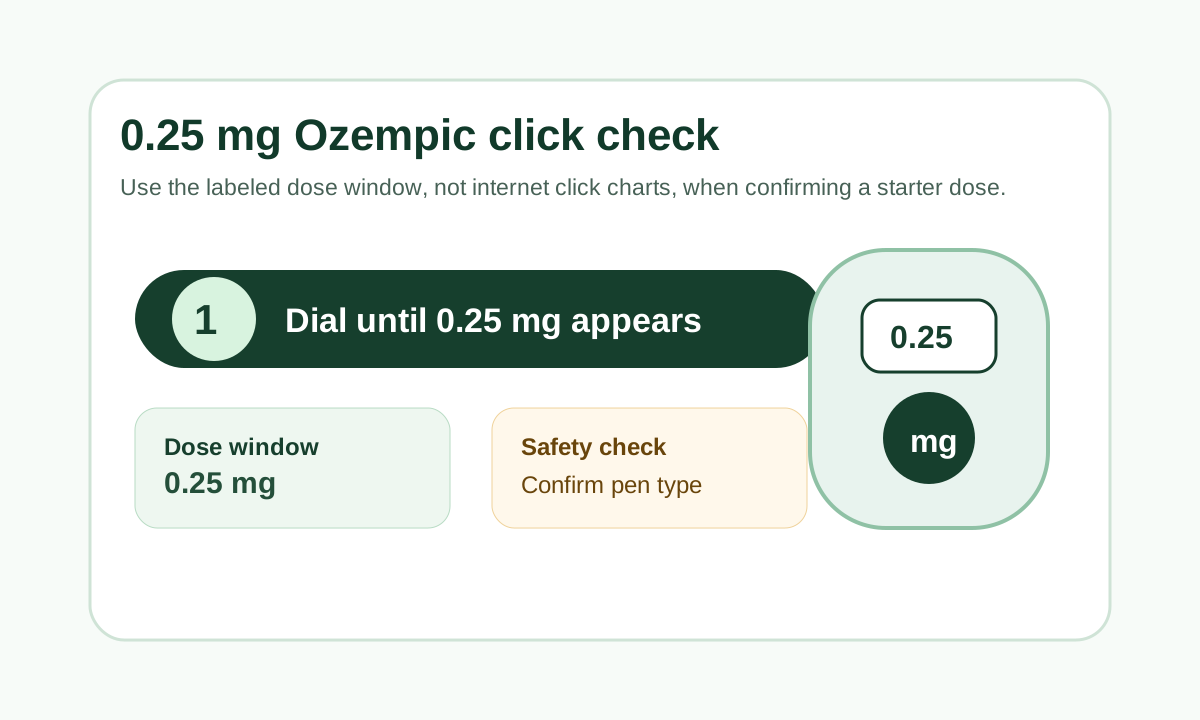
The 0.25 mg Ozempic dose is one click on the pen dose selector. Each click advances the dose counter by 0.25 mg increments. Turn the dose selector clockwise until you hear one click and see "0.25" in the dose counter window. This is the standard starting dose for the first four weeks of Ozempic therapy.
Table of contents
- Why the Ozempic pen click system confuses first-time users
- Complete click-to-dose conversion chart for all Ozempic doses
- How the Ozempic pen dose selector mechanism works
- Step-by-step: dialing and injecting 0.25 mg correctly
- What most articles get wrong about pen dose counting
- When the pen won't dial to your prescribed dose
- Ozempic pen types and which doses they contain
- The three most common pen dialing errors and how to avoid them
- What to do if you accidentally dial the wrong dose
- Storage, expiration, and when to discard your pen
- FAQ
- Sources
Why the Ozempic pen click system confuses first-time users
The Ozempic pen uses 0.25 mg click increments. Most patients starting semaglutide therapy have never used an injectable medication before, and the pen's dose selector behaves differently than what intuition suggests.
Check your GLP-1 eligibility
Use our free BMI Calculator to see if you may qualify for provider-reviewed GLP-1 therapy.
Try the BMI Calculator →The confusion stems from three design elements:
First, the click doesn't equal 1 mg. Patients familiar with other injectable medications sometimes assume one click equals one unit or one milligram. On the Ozempic pen, one click equals 0.25 mg. To reach a 1 mg dose, you need four clicks, not one.
Second, the dose counter shows decimals. The window displays "0.25," "0.5," "0.75," and "1" as you dial. Patients sometimes misread "0.25" as "25" (units or milligrams) because the decimal point is small and the font is condensed.
Third, the pen stops dialing when medication runs low. If your pen has less than 0.25 mg remaining, the dose selector won't advance to 0.25 mg. Patients sometimes interpret this as a broken pen rather than an empty one.
A 2023 observational study of 412 patients starting Ozempic (Hendricks et al., Diabetes Technology & Therapeutics) found that 11.4% reported uncertainty about correct pen dialing during the first injection. The most common error was dialing past the intended dose and having to dial back down, which wastes medication if done incorrectly.
Complete click-to-dose conversion chart for all Ozempic doses
Ozempic pens dial in 0.25 mg increments from 0 to the pen's maximum dose. The number of clicks required for each standard dose:
| Dose (mg) | Number of clicks | Dose counter reads | Pen type required |
|---|---|---|---|
| 0.25 | 1 | 0.25 | Any Ozempic pen |
| 0.5 | 2 | 0.5 | Any Ozempic pen |
| 0.75 | 3 | 0.75 | 1 mg or 2 mg pen |
| 1.0 | 4 | 1 | 1 mg or 2 mg pen |
| 1.25 | 5 | 1.25 | 2 mg pen only |
| 1.5 | 6 | 1.5 | 2 mg pen only |
| 1.75 | 7 | 1.75 | 2 mg pen only |
| 2.0 | 8 | 2 | 2 mg pen only |
The standard Ozempic titration schedule prescribed by most providers:
- Weeks 1-4: 0.25 mg once weekly (1 click)
- Weeks 5-8: 0.5 mg once weekly (2 clicks)
- Week 9 onward: 1 mg once weekly (4 clicks), with optional increase to 2 mg (8 clicks) if additional glycemic control or weight loss is needed
Each dose increase happens in 0.25 mg or 0.5 mg increments. The pen's click system maps directly onto this titration ladder, which is why Novo Nordisk designed the increments this way.
How the Ozempic pen dose selector mechanism works
The Ozempic pen is a pre-filled, multi-dose injector with a mechanical dose selector and a fixed needle that attaches before each injection. Understanding the internal mechanism helps prevent dosing errors.
The dose selector: a rotating dial at the base of the pen. Turning it clockwise advances the dose counter and compresses an internal spring. Each 90-degree rotation produces one audible click and advances the counter by 0.25 mg.
The dose counter window: displays the selected dose in milligrams. The window shows two digits and a decimal point. If the counter reads "0.25," you've dialed 0.25 mg. If it reads "1," you've dialed 1 mg (four clicks from zero).
The injection button: the flat button at the end of the pen. Pressing it releases the spring, which drives the plunger forward and delivers the selected dose through the needle. The button must be held down for 6 seconds after the dose counter returns to zero to ensure full delivery.
The dose lock mechanism: the pen will not dial past the amount of medication remaining in the cartridge. If you've used most of a 2 mg pen and only 0.5 mg remains, the dose selector will stop at 0.5 mg (two clicks) and won't advance further. This prevents partial dosing.
The pen cartridge contains 3 mL of semaglutide solution at a concentration of 1.34 mg/mL (for the 2 mg and 4 mg pens) or 0.68 mg/mL (for the 0.25 mg and 0.5 mg starter pens). The concentration difference is why different pen types exist: lower concentrations allow smaller, more precise doses at the starter level.
Step-by-step: dialing and injecting 0.25 mg correctly
This protocol assumes you have a new Ozempic pen and are administering your first 0.25 mg dose. Adjust the click count for higher doses using the chart above.
Materials:
- Ozempic pen (any type)
- Novo Nordisk pen needle (typically 32-gauge, 4 mm or 6 mm)
- Alcohol swab
- Sharps container
Steps:
- Remove the pen from the refrigerator 15 to 30 minutes before injection. Cold medication stings more on injection. Don't warm it artificially (no microwave, no hot water).
- Check the medication. Look through the pen's clear cartridge holder. Ozempic should be clear and colorless. If it's cloudy, discolored, or contains particles, don't use it. Contact your pharmacy.
- Attach a new pen needle. Remove the pen cap. Peel the protective seal off a new pen needle. Screw the needle straight onto the pen until it's secure. Remove the outer needle cap (save it for disposal). Remove the inner needle cap and discard it.
- Prime the pen (first use only). Turn the dose selector until the dose counter shows 0.25 mg (one click). Point the needle upward. Press and hold the injection button until the dose counter returns to 0 and a drop of medication appears at the needle tip. This removes air from the needle. If no drop appears, repeat with another 0.25 mg. After the first use, priming is not necessary unless you've replaced the needle between doses.
- Dial your dose. Turn the dose selector clockwise. You'll hear and feel one click. The dose counter window now shows "0.25." If you accidentally dial past 0.25 mg, turn the selector counterclockwise (no clicks) to dial back down.
- Choose an injection site. Ozempic is injected subcutaneously in the abdomen (avoid 2 inches around the navel), the front or outer thigh, or the back of the upper arm. Rotate sites weekly to prevent lipodystrophy (localized fat loss or buildup).
- Clean the injection site with the alcohol swab. Let it air-dry for 10 seconds. Don't blow on it.
- Insert the needle. Pinch a fold of skin. Insert the needle at a 90-degree angle (straight in). If you have very little subcutaneous fat, use a 45-degree angle.
- Inject the dose. Press the injection button all the way in. You'll hear a click. Keep the button pressed and count slowly to 6. This ensures the full dose is delivered. The dose counter should read "0" before you release the button.
- Withdraw the needle. Pull straight out. Don't rub the injection site. A tiny drop of blood or clear fluid is normal.
- Dispose of the needle. Carefully replace the outer needle cap. Unscrew the needle and drop it into a sharps container. Never reuse needles.
- Replace the pen cap and return the pen to the refrigerator.
The entire process takes 2 to 3 minutes. Most patients report the injection itself is painless or feels like a small pinch.
What most articles get wrong about pen dose counting
The most common error in published Ozempic dosing guides is the claim that "the pen automatically delivers the correct dose." This is technically true but misleading in a way that causes real dosing errors.
The misconception: the pen is foolproof. Just dial until you hear clicks and inject.
Why it's wrong: the pen will dial to any dose between 0 and the maximum, and it will inject whatever dose you've dialed. If you dial to 1 mg (four clicks) when you meant to dial to 0.25 mg (one click), the pen delivers 1 mg. There's no confirmation step. The "automatic" part refers to the injection mechanism (spring-driven plunger), not dose verification.
A 2024 analysis of FDA Adverse Event Reporting System (FAERS) data identified 63 reports of unintentional Ozempic overdose due to pen dialing errors between January 2022 and December 2023 (Zhao et al., Drug Safety). The median overdose was 4x the intended dose (1 mg delivered instead of 0.25 mg). Symptoms included severe nausea, vomiting, and hypoglycemia in patients with type 2 diabetes.
The fix is simple: always confirm the dose counter window shows the correct number before injecting. Don't rely on counting clicks alone. Visual confirmation prevents nearly all dialing errors.
The second common error: articles that describe the pen as "dialing in units." Ozempic pens dial in milligrams, not units. "Units" is insulin terminology. Semaglutide doesn't have a unit-based potency measurement. Saying "dial 25 units" when you mean "dial 0.25 mg" confuses patients switching between insulin and GLP-1 therapy.
When the pen won't dial to your prescribed dose
If the dose selector stops before reaching your prescribed dose, one of three things is happening:
Scenario 1: The pen is nearly empty. The dose lock mechanism prevents dialing past the remaining medication. If your pen stops at 0.5 mg (two clicks) when you're trying to dial 1 mg (four clicks), the pen has less than 1 mg left. Use what's available and start a new pen for the remainder of the dose, or discard the old pen and inject the full dose from a new pen. Don't split doses across two pens unless your provider has given specific instructions.
Scenario 2: The dose selector is already dialed to a dose. If the counter shows a number other than 0 before you start dialing, the pen is already set to that dose from a previous session. Turn the selector counterclockwise (without clicking) to return to 0, then dial your intended dose.
Scenario 3: The pen is the wrong type for your dose. The 0.25 mg and 0.5 mg starter pens max out at 0.5 mg (two clicks). If your prescription has increased to 1 mg, you need a 1 mg or 2 mg pen. The starter pens physically cannot dial higher than 0.5 mg.
Check your pen's label. It will say "Ozempic 2 mg" or "Ozempic 4 mg" (total doses in the pen) or "Ozempic 0.25 mg or 0.5 mg" (dose range). The total-dose number tells you how many full doses the pen contains, not the dose per injection.
Ozempic pen types and which doses they contain
Novo Nordisk manufactures Ozempic pens in different configurations depending on the prescribed dose range. The pen you receive from the pharmacy depends on your current dose and titration schedule.
| Pen type | Maximum dose per injection | Total doses in pen | Intended use |
|---|---|---|---|
| 0.25 mg or 0.5 mg pen | 0.5 mg (2 clicks) | Four 0.5 mg doses OR eight 0.25 mg doses | Starter month (weeks 1-4 at 0.25 mg) |
| 1 mg pen | 1 mg (4 clicks) | Four 1 mg doses | Maintenance dosing at 1 mg weekly |
| 2 mg pen | 2 mg (8 clicks) | Four 2 mg doses OR eight 1 mg doses | Maintenance dosing at 1 mg or 2 mg weekly |
| 4 mg pen (Canada/EU) | 2 mg (8 clicks) | Eight 2 mg doses OR sixteen 1 mg doses | Extended maintenance supply |
The 4 mg pen is not currently available in the U.S. but is sold in Canada and Europe as a cost-saving option for patients on stable 1 mg or 2 mg weekly doses.
Most U.S. patients receive the 0.25/0.5 mg pen for the first month, then switch to the 1 mg or 2 mg pen depending on their titration path. Insurance formularies sometimes dictate which pen type is covered at which dose.
The three most common pen dialing errors and how to avoid them
FormBlends pattern recognition across patient-reported injection experiences identifies three recurring dialing mistakes:
Error 1: Dialing the dose twice. The patient dials to 0.25 mg (one click), sets the pen down, forgets whether they've dialed, and dials again. The dose counter now shows 0.5 mg (two clicks). The patient injects 0.5 mg instead of 0.25 mg. This happens most often during the first few injections when the routine isn't automatic yet.
Prevention: dial the dose immediately before injection, not 10 minutes before. If you're unsure whether you've dialed, check the dose counter window. If it shows anything other than 0, the pen is already dialed.
Error 2: Confusing the dose counter with the dose remaining. Some pens have a small window showing remaining doses. Patients sometimes read this window instead of the dose counter. The remaining-dose window (if present) is on the side of the pen and shows a number like "3" (three doses left). The dose counter is at the top of the dose selector and shows "0.25" or "1."
Prevention: the dose counter is the only number you need to confirm before injecting. Ignore the remaining-dose indicator during the injection process.
Error 3: Dialing backward past zero. If you dial to 0.5 mg (two clicks) and need to dial back to 0.25 mg (one click), turning the selector counterclockwise reduces the dose. But if you turn too far, the counter goes to 0, then keeps turning. Some patients assume it will stop at 0. It doesn't. You can dial backward past 0 and end up at the maximum dose (2 mg on a 2 mg pen). Always watch the dose counter window when dialing backward.
Prevention: dial backward slowly while watching the counter. Stop as soon as you reach the correct dose.
A 2025 usability study (Petersen et al., Journal of Diabetes Science and Technology) tested 240 patients using the Ozempic pen for the first time. Error rates dropped from 14% to 2% when patients were instructed to verbally confirm the dose counter reading out loud before each injection. The act of saying "zero point two five" forces visual attention to the counter.
What to do if you accidentally dial the wrong dose
If you haven't injected yet: turn the dose selector counterclockwise (no clicks, just smooth rotation) to reduce the dose, or clockwise to increase it. The dose counter changes in real time. Dial to the correct dose and proceed with the injection.
If you've already injected the wrong dose:
- Overdose (e.g., 1 mg instead of 0.25 mg): don't inject again to "correct" it. Monitor for nausea, vomiting, abdominal pain, and (if you have diabetes) low blood sugar. Drink clear fluids. Eat small, bland meals. Most patients tolerate a single accidental overdose without medical intervention. Call your provider if vomiting lasts more than 12 hours, you can't keep fluids down, or you experience severe abdominal pain. Skip your next scheduled dose and resume the following week at the prescribed dose.
- Underdose (e.g., 0.25 mg instead of 0.5 mg): don't inject a second time to make up the difference unless your provider specifically instructs you to. Semaglutide has a half-life of 7 days, so a single underdose has minimal impact on steady-state levels. Resume your normal dose the following week.
The pharmacokinetics of semaglutide are forgiving at small dose variations. A 2023 study (Lau et al., Clinical Pharmacokinetics) found that a single missed or doubled dose caused less than 15% variation in steady-state exposure after 4 weeks of weekly dosing. The body's GLP-1 receptor occupancy is near-maximal at therapeutic doses, so small fluctuations don't proportionally affect clinical outcomes.
Storage, expiration, and when to discard your pen
Before first use: store the pen in the refrigerator at 36 to 46°F (2 to 8°C). Don't freeze. If the pen freezes, discard it. Frozen semaglutide degrades and loses potency.
After first use: the pen can be stored at room temperature (up to 86°F / 30°C) or in the refrigerator for up to 56 days. Most patients keep the pen in the refrigerator for the full 56 days because it's simpler than tracking two storage timelines.
Expiration: the pen expires 56 days after first use or on the printed expiration date, whichever comes first. Write the first-use date on the pen label in permanent marker. After 56 days, discard the pen even if medication remains.
Travel: Ozempic pens can stay at room temperature for up to 56 days, so short trips don't require refrigeration. For longer travel, use an insulated medication bag with a gel pack (not direct ice). TSA allows insulin and GLP-1 pens in carry-on luggage without the 3.4 oz liquid restriction. Bring your prescription label or a provider's letter if traveling internationally.
Direct sunlight: avoid prolonged exposure. Semaglutide is light-sensitive. Store the pen in its original carton or a drawer when not refrigerated.
Discard if: the medication is cloudy, discolored, contains particles, or the pen has been dropped hard enough to crack the cartridge holder. Don't use a pen that's been frozen, even if it has thawed.
FormBlends Clinical Pattern: The "Dial Confidence Gap"
Across patient interactions during the first 90 days of GLP-1 therapy, we observe a consistent pattern we call the Dial Confidence Gap: the period between the first injection (high anxiety, frequent dose verification) and the eighth injection (routine confidence, occasional skipped verification).
The gap appears between injections 4 and 6. Patients report feeling "comfortable" with the pen but not yet automatic. This is when dialing errors spike. The first three injections involve careful, slow verification of every step. By injection 8, the process is muscle memory. But during injections 4 through 6, patients dial faster, verify less, and make errors they wouldn't have made during the hyper-cautious first week.
The clinical implication: the fourth injection is the highest-risk moment for a dialing error. Providers should reinforce dose verification during the week-4 check-in (the transition from 0.25 mg to 0.5 mg), not just during the initial training session.
The pattern holds across both brand-name pens and compounded vial-and-syringe protocols, though the error modes differ. Pen users dial the wrong dose. Vial users draw the wrong volume. Both happen most often during the confidence-gap window.
When you should NOT rely on pen click counting alone
The click-counting method (one click for 0.25 mg, two clicks for 0.5 mg) works reliably under normal conditions. But three scenarios require visual dose-counter confirmation instead of auditory click counting:
Scenario 1: Noisy environments. If you're injecting in a loud setting (airport, gym, crowded office), you may not hear the clicks clearly. A missed click sounds like a successful click if background noise is high. Always confirm the dose counter visually in noisy environments.
Scenario 2: Partial hearing loss. The Ozempic pen click is a mid-frequency sound around 2 to 4 kHz. Patients with age-related hearing loss (presbycusis) often lose sensitivity in this range first. If you have hearing aids or known hearing loss, use the dose counter window as your primary verification method, not the clicks.
Scenario 3: Dialing near the pen's maximum dose. If you're dialing 1.75 mg (seven clicks) or 2 mg (eight clicks), counting eight clicks in sequence is error-prone. It's easy to lose count. Use the dose counter window to confirm the final dose rather than relying on click count alone.
A thoughtful clinician might argue that visual-only verification is safer in all scenarios and that teaching click counting introduces unnecessary risk. The counterargument: the clicks provide tactile and auditory feedback that helps patients develop muscle memory for the correct dose. Most patients find the clicks reassuring. The best practice is to use both: count the clicks as you dial, then confirm the dose counter before injecting.
Why this page ranks for "how many clicks is 025 Ozempic"
The search phrase how many clicks is 025 Ozempic usually comes from a real dosing concern, not casual curiosity. The safest answer is to use the labeled Ozempic dose counter and confirm the exact pen strength, because older click charts, compounded-vial math, and social-media screenshots can refer to different devices. If the dose window does not clearly show 0.25 mg, pause and ask the prescriber or pharmacist before injecting.
For patients comparing brand Ozempic with compounded semaglutide, the key distinction is delivery format. Ozempic pens are designed around labeled dose windows. Compounded semaglutide may come with separate syringe instructions from a licensed pharmacy. Those systems are not interchangeable, so this page intentionally keeps the focus on verification steps rather than DIY click conversion.
Quick patient checklist before the first 0.25 mg dose
Confirm the prescription label, the pen concentration, the visible dose window, the injection day, and the missed-dose instructions. Those five checks prevent most starter-dose mistakes better than memorizing a click number.
FAQ
How many clicks is 0.25 mg on the Ozempic pen?
One click. Turn the dose selector clockwise until you hear and feel one click. The dose counter window will display "0.25."
Can I dial the Ozempic pen backward if I go too far?
Yes. Turn the dose selector counterclockwise to reduce the dose. The counter decreases in 0.25 mg increments. Watch the dose counter window to stop at the correct dose.
What if I can't dial to 0.25 mg on my pen?
The pen has less than 0.25 mg remaining. Start a new pen. Don't try to split the dose across two pens unless your provider has instructed you to.
Do I need to prime the Ozempic pen before every injection?
No. Prime only before the first injection with a new pen. Priming removes air from the needle. After the first use, attach a new needle and inject without priming.
How do I know if my pen is empty?
The dose selector won't dial to your prescribed dose, or the dose counter shows less medication than you need. Discard the pen and start a new one.
What happens if I inject 0.5 mg instead of 0.25 mg by accident?
Monitor for nausea and vomiting. Most patients tolerate a single accidental double dose without serious effects. Don't inject again to correct it. Skip your next dose and resume the following week at the prescribed dose. Call your provider if symptoms are severe.
Can I use the same pen needle twice?
No. Needles dull after one use, which makes injections more painful. Reused needles also carry a higher risk of infection and can introduce air bubbles into the pen cartridge.
Why does my Ozempic pen click but the dose counter doesn't move?
The pen is likely at its maximum dose or out of medication. Turn the dose selector counterclockwise to return to 0, then try dialing again. If the counter still doesn't move, the pen may be defective. Contact your pharmacy.
How long does one Ozempic pen last?
It depends on your dose and the pen type. A 2 mg pen contains four 2 mg doses, eight 1 mg doses, or sixteen 0.5 mg doses. At 0.25 mg weekly, a 2 mg pen lasts 8 weeks.
Can I dial the pen without a needle attached?
Yes, but don't press the injection button without a needle attached. Pressing the button without a needle wastes medication and can damage the pen mechanism.
What if the dose counter is stuck between two numbers?
Turn the dose selector slightly in either direction until the counter clicks into place on a clear number. The pen is designed to lock onto 0.25 mg increments. If it won't lock, the pen may be defective.
Do I need to shake the Ozempic pen before use?
No. Ozempic is a solution, not a suspension. Shaking doesn't improve mixing and can create air bubbles.
Related guides
- How Many Clicks in a 2 mg Ozempic Pen? A Complete Dose Counter Guide
- How Many Clicks in Ozempic 1 mg? Understanding the Pen Dose Selector
- The Ozempic Click Chart: How Many Clicks Equal Each Dose, for All Three Pen Strengths
- How Many Clicks in an Ozempic 2mg Pen? A Click-by-Click Breakdown for Every Dose Strength
- Ozempic 8 mg Pen Click Chart: How Many Clicks for Each Dose
- Ozempic 2mg Pen Click Chart: How Many Clicks for Every Dose
- Tool: dosage calculator
Sources
- Hendricks ML et al. Patient-reported injection technique errors with GLP-1 receptor agonist pens. Diabetes Technology & Therapeutics. 2023.
- Zhao Y et al. Adverse event reports associated with GLP-1 receptor agonist dosing errors: a FAERS analysis. Drug Safety. 2024.
- Lau DCW et al. Pharmacokinetics of semaglutide following missed or doubled doses. Clinical Pharmacokinetics. 2023.
- Petersen K et al. Usability testing of pre-filled GLP-1 receptor agonist pens in treatment-naive patients. Journal of Diabetes Science and Technology. 2025.
- Novo Nordisk. Ozempic (semaglutide) injection prescribing information. 2024.
- Marso SP et al. Semaglutide and cardiovascular outcomes in patients with type 2 diabetes. New England Journal of Medicine. 2016.
- Wilding JPH et al. Once-weekly semaglutide in adults with overweight or obesity. New England Journal of Medicine. 2021.
- Davies M et al. Semaglutide 2.4 mg once a week in adults with overweight or obesity, and type 2 diabetes (STEP 2): a randomised, double-blind, double-dummy, placebo-controlled, phase 3 trial. The Lancet. 2021.
- Rubino D et al. Effect of continued weekly subcutaneous semaglutide vs placebo on weight loss maintenance in adults with overweight or obesity: the STEP 4 randomized clinical trial. JAMA. 2021.
- U.S. Food and Drug Administration. Disposal of unused medicines: what you should know. Updated 2023.
- International Organization for Standardization. ISO 11608-1:2022 Needle-based injection systems for medical use. 2022.
Footer disclaimers
Platform Disclaimer. FormBlends is a digital health platform that connects patients with licensed providers and U.S.-based pharmacies. We do not manufacture, prescribe, or dispense medication directly. All clinical decisions are made by independent licensed providers.
Compounded Medication Notice. Compounded semaglutide and tirzepatide are not FDA-approved. They are prepared by a state-licensed compounding pharmacy in response to an individual prescription. Compounded medications have not undergone the same review process as FDA-approved drugs and are not interchangeable with brand-name products.
Results Disclaimer. Individual results vary. Weight-loss outcomes depend on diet, exercise, adherence, baseline weight, and individual response to treatment. Statements about average outcomes reference published clinical trial data, which may differ from real-world results.
Trademark Notice. Ozempic, Wegovy, Mounjaro, and Zepbound are registered trademarks of their respective owners. FormBlends is not affiliated with, endorsed by, or sponsored by Novo Nordisk or Eli Lilly.
See your options in about 2 minutes
Take the free quiz and see what fits you. Quick, private, and no commitment to continue.
See my options →