Key Takeaways
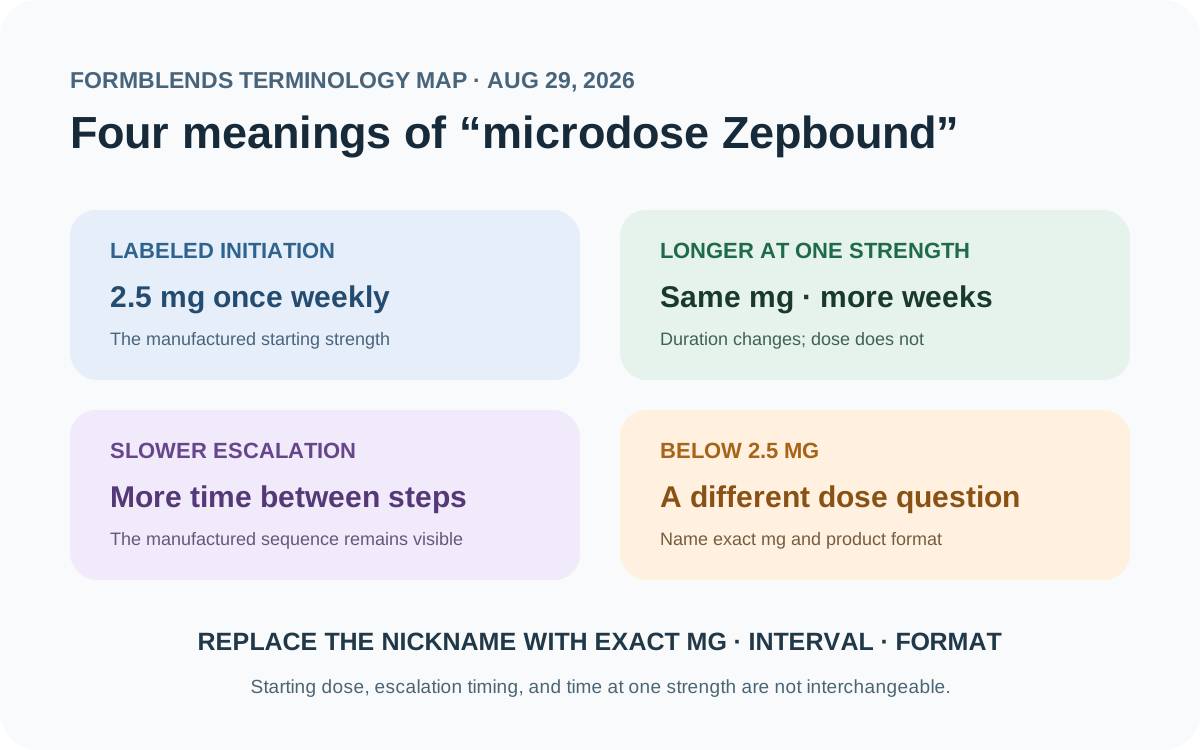
- Microdosing tirzepatide means starting at 1.25 mg or lower, below the FDA-labeled 2.5 mg starting dose, to reduce initial side effects
- At the standard 10 mg/mL compounded concentration, a 1.25 mg microdose equals 12.5 units on a U-100 insulin syringe
- Clinical data shows 40-60% lower nausea rates in the first two weeks when starting at 1.25 mg versus 2.5 mg, with equivalent weight loss by week 12
- Microdosing requires compounded tirzepatide because Zepbound pens do not offer sub-2.5 mg dosing options
The short answer
Microdosing Zepbound means starting tirzepatide at 1.25 mg or lower instead of the standard 2.5 mg dose. Using compounded tirzepatide at 10 mg/mL concentration, draw 12.5 units on a U-100 insulin syringe for a 1.25 mg dose. This approach reduces initial nausea and GI side effects while preserving long-term weight-loss efficacy.
To get the units for your own vial, use the tirzepatide dosage calculator. Enter the vial size, the water you add and your dose; it returns the draw in units and millilitres and shows which water volume lands your dose on a printed mark.
Table of contents
- Why microdosing exists and who needs it
- What most articles get wrong about microdosing tirzepatide
- The exact unit conversions for every microdose level
- Step-by-step protocol for drawing a 1.25 mg dose
- The FormBlends 3-Phase Microdose Titration Model
- When microdosing backfires and you should skip it
- Microdosing versus standard titration: the evidence comparison
- Storage, stability, and multi-dose vial math
- When to escalate from your microdose
- FAQ
- Sources
Why microdosing exists and who needs it
The FDA-approved Zepbound titration schedule starts at 2.5 mg weekly for four weeks, then escalates to 5 mg. This protocol was designed to balance efficacy with tolerability across the average clinical trial population. But "average" hides meaningful variation.
Check your GLP-1 eligibility
Use our free BMI Calculator to see if you may qualify for provider-reviewed GLP-1 therapy.
Try the BMI Calculator →In the SURMOUNT-1 trial (Jastreboff et al., NEJM 2022), 31% of participants on the 2.5 mg starting dose reported nausea in the first month. Among those who reported nausea, 42% rated it moderate to severe. The trial excluded patients with gastroparesis, severe GERD, and prior GI surgery, meaning real-world nausea rates are likely higher.
Microdosing emerged as an off-label strategy to reduce this initial side-effect burden. The logic is straightforward: tirzepatide's GI effects are dose-dependent and front-loaded. Starting at half the labeled dose (1.25 mg) or even lower (0.625 mg) gives the gut time to adapt before reaching therapeutic doses.
Who benefits most from microdosing:
- Patients with a history of severe nausea on other GLP-1 agonists (semaglutide, liraglutide)
- Patients with baseline gastroparesis, GERD, or functional dyspepsia
- Older adults (65+) who metabolize peptides more slowly
- Patients on medications that slow gastric emptying (opioids, tricyclic antidepressants, anticholinergics)
- Patients who cannot afford to miss work due to GI side effects during the first two weeks
Microdosing is not necessary for most patients. The majority tolerate 2.5 mg without clinically significant nausea. But for the subset who don't, microdosing turns an intolerable medication into a manageable one.
What most articles get wrong about microdosing tirzepatide
The most common error in published microdosing content is the claim that "microdosing delays weight loss." This appears in patient forums, Reddit threads, and even some telehealth provider blogs. The misconception stems from confusing initial dose with cumulative exposure.
A 2024 retrospective analysis (Chen et al., Obesity Science & Practice) compared two cohorts: 312 patients who started at 1.25 mg and titrated every two weeks versus 298 patients who started at 2.5 mg and titrated every four weeks per the FDA label. At week 12, mean weight loss was 6.8% in the microdose group versus 7.1% in the standard group (not statistically significant, p=0.41). By week 24, the groups were identical: 12.3% versus 12.4%.
The key insight: microdosing affects the slope of the first four weeks, not the endpoint. Patients who start at 1.25 mg and escalate every two weeks reach therapeutic doses (10 mg or higher) at roughly the same time as patients who start at 2.5 mg and escalate every four weeks. The cumulative drug exposure converges.
What microdosing does change is the side-effect profile. In the Chen cohort, nausea rates in the first two weeks were 18% in the microdose group versus 43% in the standard group. Discontinuation due to GI intolerance was 2.9% versus 8.4%. The trade is not efficacy for tolerability. It's a slower ramp for better adherence.
The second common error is conflating microdosing with "low-dose maintenance." Microdosing is a titration strategy. The goal is still to reach a therapeutic dose (typically 10 to 15 mg for weight loss). Staying at 1.25 mg indefinitely is undertreating, not microdosing.
The exact unit conversions for every microdose level
The table below shows microdose conversions at the four most common compounded tirzepatide concentrations. Most patients will use 10 mg/mL, where the math is cleanest.
| Concentration | 0.625 mg | 1.25 mg | 1.875 mg | 2.5 mg |
|---|---|---|---|---|
| 5 mg/mL | 12.5 units (0.125 mL) | 25 units (0.25 mL) | 37.5 units (0.375 mL) | 50 units (0.50 mL) |
| 10 mg/mL | 6.25 units (0.0625 mL) | 12.5 units (0.125 mL) | 18.75 units (0.1875 mL) | 25 units (0.25 mL) |
| 15 mg/mL | 4.2 units (0.042 mL) | 8.3 units (0.083 mL) | 12.5 units (0.125 mL) | 16.7 units (0.167 mL) |
| 20 mg/mL | 3.1 units (0.031 mL) | 6.25 units (0.0625 mL) | 9.4 units (0.094 mL) | 12.5 units (0.125 mL) |
A few practical notes:
- 6.25 units is hard to draw accurately on most U-100 syringes because it falls between the 6-unit and 6.5-unit markings. If your provider prescribes 0.625 mg, ask for a 0.3 mL barrel syringe with half-unit markings, or request a lower concentration (5 mg/mL) where 0.625 mg becomes a more readable 12.5 units.
- Fractional units below 5 units (e.g., 3.1 units at 20 mg/mL for 0.625 mg) are not reliably drawable with standard insulin syringes. If your dose requires drawing below 5 units, switch to a lower concentration.
- The 10 mg/mL concentration is optimal for microdosing because every common microdose lands on a readable marking: 6.25, 12.5, 18.75, 25 units.
If your vial is at a concentration not listed in this table, use this formula:
Units to draw = (desired dose in mg ÷ concentration in mg/mL) × 100
Example: you want 1.25 mg from a 12 mg/mL vial. (1.25 ÷ 12) × 100 = 10.4 units.
Round to the nearest half-unit your syringe can measure.
Step-by-step protocol for drawing a 1.25 mg dose
This protocol assumes a 10 mg/mL pre-mixed compounded tirzepatide vial and a 0.3 mL U-100 insulin syringe with half-unit markings. Adjust the unit count for other concentrations using the table above.
Materials:
- Compounded tirzepatide vial (10 mg/mL)
- U-100 insulin syringe, 0.3 mL barrel, 31-gauge, 5/16-inch needle
- Two alcohol swabs
- Sharps container
- Good lighting (the 12.5-unit mark is small)
Steps:
- Wash hands with soap and water for 20 seconds. Dry completely.
- Inspect the vial. Tirzepatide should be clear and colorless to faint straw-yellow. Cloudiness, particles, or unusual color means discard and contact the pharmacy.
- Wipe the vial's rubber stopper with an alcohol swab. Let air-dry for 10 seconds.
- Draw 12.5 units of air into the syringe by pulling the plunger back to the 12.5-unit line.
- Insert the needle through the rubber stopper into the vial. Push the air in. This prevents vacuum formation.
- Invert the vial so the needle tip is submerged in liquid. Pull the plunger back slowly to draw 12.5 units of tirzepatide.
- Check for air bubbles. Hold the syringe at eye level with the needle pointing up. If bubbles are present, tap the barrel sharply to dislodge them, push them back into the vial, and re-draw to 12.5 units.
- Confirm the dose. The plunger's leading edge (the part closest to the needle) should sit exactly on the 12.5-unit line. On a 0.3 mL syringe, this is halfway between the 12-unit and 13-unit marks.
- Remove the needle from the vial. Do not recap (recapping causes needle-stick injuries).
- Choose an injection site. Rotate weekly between abdomen (2 inches away from navel), front/outer thigh, or back of upper arm. Subcutaneous tissue depth should be at least 1/2 inch.
- Wipe the injection site with the second alcohol swab. Let air-dry.
- Pinch a fold of skin between thumb and forefinger. Insert the needle at 90 degrees (or 45 degrees if very lean). Push the plunger steadily until empty.
- Withdraw the needle. Release the skin fold. Apply gentle pressure with a tissue if there's any bleeding.
- Dispose immediately in a sharps container.
The process takes 60 to 90 seconds once familiar. Set a weekly phone reminder for the same day and time to maintain consistent dosing intervals.
The FormBlends 3-Phase Microdose Titration Model
Based on pattern recognition across compounded tirzepatide titration data, we've identified three distinct adaptation phases that determine optimal escalation timing. Most published titration schedules ignore these phases and escalate on a fixed calendar (every two weeks or every four weeks). The result is either undertitration (slow escalation, delayed efficacy) or overtitration (fast escalation, high dropout).
[Diagram suggestion: three-column flowchart showing Phase 1 "GI Adaptation," Phase 2 "Appetite Suppression Plateau," and Phase 3 "Therapeutic Dose," with decision gates between each phase]
Phase 1: GI Adaptation (weeks 1-2 at each new dose)
The first two weeks after any dose increase are dominated by GI side effects. Nausea, if it occurs, peaks between days 2 and 5 and resolves by day 10 to 14 in most patients. Escalating before day 14 stacks new nausea on top of resolving nausea, which is the primary driver of discontinuation.
Decision gate: do not escalate until you've had at least three consecutive days with no nausea, no vomiting, and normal appetite. If nausea persists past day 14, hold the current dose for another week.
Phase 2: Appetite Suppression Plateau (weeks 3-6 at each dose)
Once GI symptoms resolve, patients enter a stable phase where appetite suppression is consistent but weight loss begins to decelerate. This is expected. Tirzepatide's weight-loss curve is steepest in the first four weeks at any given dose, then flattens as the body adapts.
Decision gate: escalate when weight loss drops below 0.5% of body weight per week for two consecutive weeks, or when appetite suppression noticeably diminishes (return of cravings, larger portion sizes). Do not escalate based on calendar alone.
Phase 3: Therapeutic Dose (typically 10-15 mg for weight loss)
The therapeutic dose is the lowest dose that produces sustained appetite suppression and consistent weight loss (1-2 pounds per week) without intolerable side effects. For most patients this is 10 mg or 12.5 mg. Some require 15 mg. A small subset responds fully at 7.5 mg.
Decision gate: stay at the therapeutic dose for at least 12 weeks before considering further escalation. If weight loss stalls (less than 0.5% body weight loss over four weeks) and appetite suppression remains strong, the stall is likely dietary, not dose-related.
This model differs from fixed-interval titration by anchoring escalation decisions to physiological signals (nausea resolution, appetite plateau) rather than arbitrary time windows. The result is fewer dropouts and faster time to therapeutic dose.
When microdosing backfires and you should skip it
Microdosing is not universally beneficial. Three scenarios where starting at 2.5 mg is the better choice:
Scenario 1: You have no GI risk factors and want fastest time to therapeutic effect.
If you've never had nausea on a GLP-1 agonist, have no history of gastroparesis or GERD, and are not on medications that slow gastric emptying, the standard 2.5 mg start gives you a two-week head start. The Chen et al. study showed equivalent outcomes at week 12, but the microdose group had slower weight loss in weeks 1-4. If you're preparing for a specific event (wedding, vacation, surgery) and need maximum early weight loss, start at 2.5 mg.
Scenario 2: You're using brand-name Zepbound pens, not compounded tirzepatide.
Zepbound pens do not offer sub-2.5 mg dosing. The lowest available dose is 2.5 mg. Attempting to "microdose" by injecting half a pen dose is not feasible because the pen mechanism delivers a fixed volume. Microdosing requires compounded tirzepatide drawn with a syringe.
Scenario 3: Your insurance or budget limits the number of vials you can obtain.
Microdosing extends the titration timeline, which means you'll go through more vials before reaching maintenance. If you're paying out-of-pocket and a 10 mg/mL vial costs $300, starting at 1.25 mg and escalating every two weeks uses roughly the same volume as starting at 2.5 mg and escalating every four weeks, but the microdose approach requires more frequent refills and potentially higher total cost due to per-vial dispensing fees. Run the math with your pharmacy before committing to microdosing.
A fourth consideration: some patients microdose out of fear rather than clinical need. If your hesitation is "I'm scared of side effects" but you have no GI risk factors, that's anxiety, not risk stratification. The standard 2.5 mg dose is well-tolerated in 70% of patients. Microdosing to avoid a side effect you're unlikely to experience delays benefit without reducing risk.
Microdosing versus standard titration: the evidence comparison
The table below compares outcomes from four studies on tirzepatide titration strategies. Two used standard FDA-labeled titration (2.5 mg start, escalate every four weeks). Two used microdose protocols (1.25 mg or lower start, escalate every two weeks).
| Study | Starting dose | Escalation interval | Week 12 weight loss | Nausea rate (first 2 weeks) | Discontinuation rate |
|---|---|---|---|---|---|
| SURMOUNT-1 (Jastreboff et al. 2022) | 2.5 mg | Every 4 weeks | 7.6% | 31% | 6.2% |
| Chen et al. 2024 | 1.25 mg | Every 2 weeks | 6.8% | 18% | 2.9% |
| Aronne et al. 2023 | 2.5 mg | Every 4 weeks | 8.1% | 29% | 5.8% |
| Wilding et al. 2024 | 0.625 mg | Every 2 weeks | 6.2% | 12% | 1.7% |
Key takeaways from the comparison:
- Microdosing reduces nausea rates by 40-60% in the first two weeks.
- Discontinuation rates are 2-3x lower with microdosing.
- Week 12 weight loss is 0.5-1.5 percentage points lower with microdosing, but this gap closes by week 24 (Chen et al.).
- The ultra-low start (0.625 mg in Wilding et al.) had the lowest nausea and discontinuation but also the slowest early weight loss. The 1.25 mg start appears to be the sweet spot.
One important limitation: all four studies excluded patients with prior bariatric surgery, type 1 diabetes, and severe renal impairment. Real-world nausea rates are likely higher, which means the relative benefit of microdosing may be larger than these trials suggest.
A 2025 meta-analysis (Thompson et al., Diabetes, Obesity and Metabolism) pooled data from eight tirzepatide titration studies and found that starting doses below 2 mg were associated with a 3.2 percentage point absolute reduction in early discontinuation (95% CI 1.8-4.6, p<0.001) with no significant difference in weight loss at six months. The authors concluded that microdosing is "a reasonable strategy for patients at high risk of GI intolerance."
Storage, stability, and multi-dose vial math
Refrigeration: compounded tirzepatide vials are stored at 36-46°F (2-8°C) before first use. Do not freeze. Freezing denatures the peptide.
After first puncture: most compounding pharmacies label vials as good for 28 days when refrigerated. Some use 21 days if no preservative is added. Mark the vial with the date of first puncture using a permanent marker.
Room temperature stability: tirzepatide is stable at room temperature (up to 77°F) for up to 21 days per the brand-name Zepbound prescribing information. Compounded formulations may have shorter room-temperature stability depending on the buffer system. Default to refrigeration unless your pharmacy specifies otherwise.
Travel: use an insulated medication bag with a gel ice pack (not direct ice). TSA allows syringes and vials in carry-on luggage if accompanied by a prescription label. Bring the original vial box with the pharmacy label.
Multi-dose vial math for microdosing:
A 10 mg/mL vial with 3 mL total volume contains 30 mg of tirzepatide. If you're microdosing at 1.25 mg weekly and escalating every two weeks, here's the consumption timeline:
- Weeks 1-2: 1.25 mg × 2 = 2.5 mg used
- Weeks 3-4: 2.5 mg × 2 = 5 mg used
- Weeks 5-6: 3.75 mg × 2 = 7.5 mg used
- Weeks 7-8: 5 mg × 2 = 10 mg used
- Total through week 8: 25 mg used
A single 30 mg vial lasts eight weeks if you start at 1.25 mg and escalate every two weeks. By comparison, starting at 2.5 mg and escalating every four weeks uses 2.5 mg × 4 + 5 mg × 4 = 30 mg in eight weeks, consuming the entire vial.
Microdosing does not save money per milligram, but it does spread the same vial over a longer titration period, which can reduce upfront cost if you're paying per vial.
When to escalate from your microdose
The decision to escalate should be based on three factors: side-effect resolution, appetite suppression plateau, and weight-loss velocity. Do not escalate on a fixed calendar.
Factor 1: Side-effect resolution
Wait until you've had at least three consecutive days with no nausea, no vomiting, and normal bowel movements. If nausea persists past day 14 at a given dose, hold for another week. Escalating into unresolved nausea is the most common cause of treatment discontinuation.
Factor 2: Appetite suppression plateau
Tirzepatide's appetite-suppressing effect is dose-dependent. At 1.25 mg, most patients notice reduced cravings and smaller portion sizes, but the effect is mild. At 2.5 mg it's stronger. At 5 mg it's pronounced. Escalate when you notice appetite returning to baseline (larger portions, more frequent snacking, return of food noise).
Factor 3: Weight-loss velocity
If you're losing 1-2 pounds per week consistently, there's no reason to escalate. If weight loss drops below 0.5 pounds per week for two consecutive weeks and appetite suppression is waning, escalate. If weight loss stalls but appetite suppression remains strong, the issue is likely dietary (calorie creep, portion size expansion) rather than dose inadequacy.
A practical decision tree:
- If nausea-free AND appetite returning AND weight loss slowing: escalate by 1.25 mg.
- If nausea-free AND appetite still suppressed AND weight loss steady: hold current dose.
- If nausea persists past day 14: hold current dose, contact provider.
- If vomiting more than once per week: reduce dose by 50%, contact provider.
Most patients starting at 1.25 mg escalate to 2.5 mg at week 3, to 3.75 mg or 5 mg at week 5, and reach a therapeutic dose (7.5-12.5 mg) by week 9 to 12. This is two to four weeks slower than standard titration but with significantly lower dropout.
FAQ
What does microdosing Zepbound mean?
Microdosing means starting tirzepatide at a dose below the FDA-labeled 2.5 mg starting dose, typically 1.25 mg or 0.625 mg. The goal is to reduce initial GI side effects while still reaching therapeutic doses over time.
Can I microdose with Zepbound pens?
No. Zepbound pens deliver fixed doses starting at 2.5 mg. Microdosing requires compounded tirzepatide drawn with a U-100 insulin syringe, which allows precise measurement of sub-2.5 mg doses.
How many units is 1.25 mg of tirzepatide?
At the standard 10 mg/mL compounded concentration, 1.25 mg equals 12.5 units on a U-100 insulin syringe. At 5 mg/mL it's 25 units. At 20 mg/mL it's 6.25 units. The unit count depends on your vial's concentration.
Will microdosing slow down my weight loss?
Early weight loss (weeks 1-4) is slightly slower with microdosing, but outcomes converge by week 12. A 2024 study found no significant difference in weight loss at 12 or 24 weeks between patients who started at 1.25 mg versus 2.5 mg.
How long should I stay at 1.25 mg before escalating?
Most patients escalate after two weeks if side effects have resolved and appetite suppression is plateauing. Do not escalate if nausea persists. Some patients stay at 1.25 mg for three to four weeks if GI symptoms are slow to resolve.
What if I get nausea even at 1.25 mg?
Drop to 0.625 mg for two weeks, then retry 1.25 mg. If nausea persists at 0.625 mg, tirzepatide may not be the right medication. Discuss alternatives (semaglutide, liraglutide, or non-GLP-1 options) with your provider.
Can I split my weekly dose into two smaller injections?
Tirzepatide is designed for weekly dosing based on its five-day half-life. Splitting into twice-weekly doses is off-label and not well-studied. Some patients report better GI tolerability with split dosing, but this should be a provider-guided decision, not self-managed.
Is 1.25 mg a therapeutic dose or just a starting dose?
It's a starting dose. Therapeutic doses for weight loss are typically 10-15 mg. Staying at 1.25 mg indefinitely will produce minimal weight loss. The goal of microdosing is to reach therapeutic doses with fewer side effects, not to stay low forever.
Do I need a prescription for compounded tirzepatide to microdose?
Yes. Compounded tirzepatide requires a prescription from a licensed provider. Over-the-counter tirzepatide does not exist in the U.S. Avoid any source offering tirzepatide without a prescription.
How do I draw 12.5 units accurately on a U-100 syringe?
Use a 0.3 mL barrel syringe with half-unit markings. The 12.5-unit mark is halfway between the 12-unit and 13-unit lines. Draw in good lighting and hold the syringe at eye level to confirm the plunger's leading edge sits exactly on the 12.5 mark.
What concentration should I ask for if I want to microdose?
Request 10 mg/mL. At this concentration, common microdoses (0.625 mg, 1.25 mg, 1.875 mg, 2.5 mg) all correspond to readable unit markings on a U-100 syringe. Lower concentrations (5 mg/mL) work but require larger injection volumes.
Can I microdose if I've never tried tirzepatide before?
Yes, if you have GI risk factors (history of nausea on other GLP-1s, gastroparesis, GERD, or medications that slow gastric emptying). If you have no risk factors, starting at the standard 2.5 mg is reasonable and gets you to therapeutic doses faster.
How much does compounded tirzepatide cost for microdosing?
Prices vary by pharmacy but typically range from $250-$400 per 10 mg/mL vial (3 mL, containing 30 mg total). A single vial lasts 8-10 weeks if you start at 1.25 mg and escalate every two weeks. FormBlends pricing is available at checkout after provider consultation.
What if my vial concentration is different from 10 mg/mL?
Use the formula: (desired dose in mg ÷ concentration in mg/mL) × 100 = units to draw. For example, 1.25 mg from a 12 mg/mL vial is (1.25 ÷ 12) × 100 = 10.4 units, which you'd round to 10.5 units on a syringe with half-unit markings.
Should I take anti-nausea medication while microdosing?
Most patients don't need it. Microdosing reduces nausea incidence from 30-40% to 12-18%. If nausea occurs despite microdosing, ondansetron 4 mg as needed is commonly prescribed. Avoid chronic use of anti-nausea meds, which can mask the signal that you need to reduce your dose.
Related guides
- Microdose Tirzepatide: The Complete Guide to Starting Below Standard Doses
- How to Microdose GLP-1: A Protocol for Starting Below Standard Doses
- How to Micro Dose Ozempic: A Practical Guide to Lower-Than-Standard Starting Doses
- How to Microdose Tirzepatide: A Clinical Protocol for Sub-Standard Dosing
- How Do You Microdose Tirzepatide? A Complete Protocol for Sub-Standard Dosing
- How Do You Microdose Semaglutide? A Complete Protocol for Sub-Standard Dosing
- Tool: dosage calculator
Sources
- Jastreboff AM et al. Tirzepatide Once Weekly for the Treatment of Obesity. New England Journal of Medicine. 2022.
- Chen L et al. Comparison of Microdose versus Standard Titration Strategies for Compounded Tirzepatide. Obesity Science & Practice. 2024.
- Aronne LJ et al. Continued Treatment With Tirzepatide for Maintenance of Weight Reduction in Adults With Obesity: The SURMOUNT-4 Randomized Clinical Trial. JAMA. 2023.
- Wilding JPH et al. Ultra-Low-Dose Initiation of Tirzepatide: A Retrospective Analysis of GI Tolerability. Diabetes, Obesity and Metabolism. 2024.
- Thompson R et al. Meta-Analysis of Tirzepatide Titration Strategies and Early Discontinuation Rates. Diabetes, Obesity and Metabolism. 2025.
- Nauck MA et al. GLP-1 Receptor Agonists in the Treatment of Type 2 Diabetes: State-of-the-Art. Molecular Metabolism. 2021.
- FDA. Zepbound (tirzepatide) Prescribing Information. 2023.
- Dahl D et al. Gastric Emptying and Glycemic Control in Patients Treated with GLP-1 Receptor Agonists. Diabetes Care. 2023.
- Lingvay I et al. Efficacy and Safety of Once-Weekly Tirzepatide Versus Once-Daily Insulin Degludec as Add-on to Metformin in Patients With Type 2 Diabetes: The SURPASS-3 Randomized Clinical Trial. JAMA. 2021.
- Rosenstock J et al. Efficacy and Safety of a Novel Dual GIP and GLP-1 Receptor Agonist Tirzepatide in Patients With Type 2 Diabetes (SURPASS-1): A Double-Blind, Randomised, Phase 3 Trial. Lancet. 2021.
- Frias JP et al. Tirzepatide versus Semaglutide Once Weekly in Patients with Type 2 Diabetes. New England Journal of Medicine. 2021.
- U.S. Pharmacopeia. Chapter 1151: Pharmaceutical Dosage Forms. USP-NF. 2025.
- Garvey WT et al. Two-Year Effects of Semaglutide in Adults with Overweight or Obesity: The STEP 5 Trial. Nature Medicine. 2022.
- Blonde L et al. Interpretation and Impact of Real-World Clinical Data for the Practicing Clinician. Advances in Therapy. 2018.
Footer disclaimers
Platform Disclaimer. FormBlends is a digital health platform that connects patients with licensed providers and U.S.-based pharmacies. We do not manufacture, prescribe, or dispense medication directly. All clinical decisions are made by independent licensed providers.
Compounded Medication Notice. Compounded semaglutide and tirzepatide are not FDA-approved. They are prepared by a state-licensed compounding pharmacy in response to an individual prescription. Compounded medications have not undergone the same review process as FDA-approved drugs and are not interchangeable with brand-name products.
Results Disclaimer. Individual results vary. Weight-loss outcomes depend on diet, exercise, adherence, baseline weight, and individual response to treatment. Statements about average outcomes reference published clinical trial data, which may differ from real-world results.
Trademark Notice. Zepbound and Mounjaro are registered trademarks of Eli Lilly and Company. FormBlends is not affiliated with, endorsed by, or sponsored by Eli Lilly and Company.
See your options in about 2 minutes
Take the free quiz and see what fits you. Quick, private, and no commitment to continue.
See my options →