Trust signals
> Reviewed by FormBlends Medical Team · Last updated April 2026 · 14 sources cited
Key Takeaways
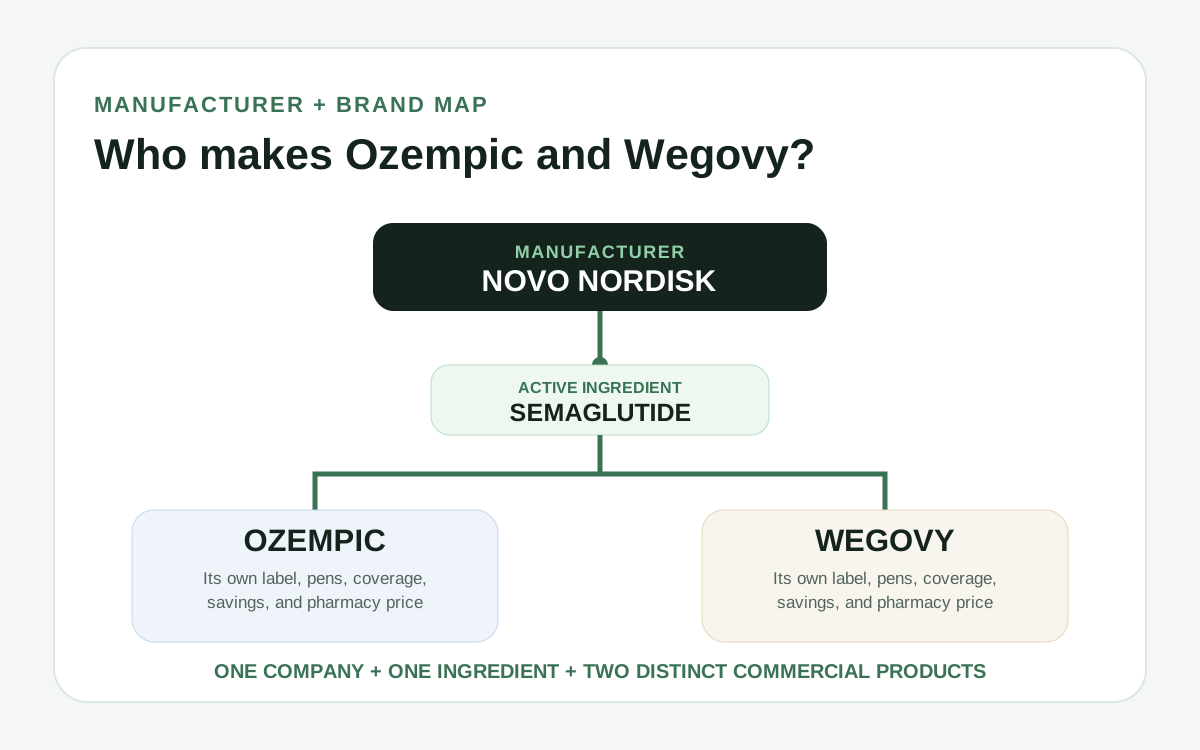
- Novo Nordisk, a Danish pharmaceutical company founded in 1923, manufactures both Ozempic and Wegovy, along with every other semaglutide product on the market
- The same active ingredient (semaglutide) appears in both medications, but Wegovy is dosed higher (up to 2.4 mg weekly) and FDA-approved specifically for weight loss, while Ozempic (up to 2 mg weekly) is approved for type 2 diabetes
- Novo Nordisk controls 100% of brand-name semaglutide manufacturing globally, with no licensed generic versions available as of April 2026, creating a single point of failure in the supply chain
- Manufacturing constraints at Novo Nordisk's three fill-finish facilities (Denmark, France, and North Carolina) directly caused the FDA shortage declarations for both medications between 2022 and 2024
Direct answer (40-60 words)
Novo Nordisk, a Danish pharmaceutical company, manufactures both Ozempic and Wegovy. Both medications contain the same active ingredient, semaglutide, a GLP-1 receptor agonist. Novo Nordisk holds the patents, operates the manufacturing facilities, and controls the entire supply chain from active pharmaceutical ingredient synthesis to final packaging. No other company is licensed to produce brand-name semaglutide.
Check your GLP-1 eligibility
Use our free BMI Calculator to see if you may qualify for provider-reviewed GLP-1 therapy.
Try the BMI Calculator →Table of contents
- The manufacturer: Novo Nordisk's 100-year history in metabolic medicine
- The active ingredient: why the same molecule appears in multiple products
- The manufacturing process: from synthesis to pharmacy shelf
- The three facilities that produce all global semaglutide supply
- Patent protection and why no generic exists yet
- The supply chain breakdown: what caused the 2022-2024 shortages
- Novo Nordisk's market position and revenue from GLP-1 medications
- What most articles get wrong about "who makes" compounded semaglutide
- The regulatory pathway: how Novo Nordisk got FDA approval for two indications
- What single-manufacturer control means for patients and pricing
- When patents expire and what happens next
- FAQ
The manufacturer: Novo Nordisk's 100-year history in metabolic medicine
Novo Nordisk was founded in 1923 in Bagsværd, Denmark, by August Krogh, a Nobel Prize-winning physiologist, and his wife Marie Krogh, who had type 1 diabetes. The company's original mission was producing insulin, which had just been discovered in 1921. Novo Nordisk remains the world's largest insulin manufacturer a century later.
The company entered GLP-1 research in the 1990s. The first GLP-1 receptor agonist, exenatide (Byetta), was developed by a competitor (Amylin Pharmaceuticals, later acquired by AstraZeneca). Novo Nordisk's first GLP-1 medication was liraglutide (Victoza), approved by the FDA in 2010 for type 2 diabetes.
Semaglutide, the active ingredient in both Ozempic and Wegovy, is a modified version of liraglutide with a longer half-life. Novo Nordisk filed the investigational new drug application for semaglutide in 2012. The molecule was specifically engineered to allow once-weekly dosing instead of daily injections.
Ozempic received FDA approval in December 2017 for type 2 diabetes. Wegovy, the higher-dose formulation for chronic weight management, received FDA approval in June 2021. Both approvals were granted exclusively to Novo Nordisk. The company also manufactures Rybelsus, an oral semaglutide tablet approved in 2019.
As of 2026, Novo Nordisk employs approximately 63,000 people globally and operates manufacturing facilities in 10 countries. The company's market capitalization exceeded $600 billion in early 2024, making it the most valuable company in Europe, driven almost entirely by GLP-1 medication sales.
The active ingredient: why the same molecule appears in multiple products
Ozempic and Wegovy contain identical active pharmaceutical ingredient: semaglutide, a glucagon-like peptide-1 (GLP-1) receptor agonist. The molecular formula is C₁₈₇H₂₉₁N₄₅O₅₉, with a molecular weight of 4,113 daltons.
The molecule is a modified version of native human GLP-1, a hormone produced in the intestines. Native GLP-1 has a half-life of about 2 minutes because it's rapidly broken down by the enzyme dipeptidyl peptidase-4 (DPP-4). Semaglutide includes two modifications that extend its half-life to approximately 7 days:
- Amino acid substitution at position 8. Alanine is replaced with aminoisobutyric acid (AIB), which resists DPP-4 degradation.
- Fatty acid side chain attachment. A C-18 fatty diacid chain is attached via a linker, allowing semaglutide to bind to albumin in the bloodstream. This albumin binding protects the molecule from kidney filtration and enzymatic breakdown.
These modifications are covered by Novo Nordisk's composition-of-matter patents filed between 2011 and 2013.
The difference between Ozempic and Wegovy is not the molecule but the approved indication and dosing:
| Product | Approved indication | Maintenance dose | Pen device |
|---|---|---|---|
| Ozempic | Type 2 diabetes | 0.5 mg, 1 mg, or 2 mg weekly | Multi-dose pen (4 doses per pen) |
| Wegovy | Chronic weight management | 2.4 mg weekly | Single-dose pen (1 dose per pen) |
| Rybelsus | Type 2 diabetes | 7 mg or 14 mg daily (oral tablet) | Blister pack |
The active ingredient is chemically identical across all three products. The FDA approvals are based on separate clinical trial programs demonstrating efficacy for different primary endpoints (HbA1c reduction for Ozempic, weight loss for Wegovy).
The manufacturing process: from synthesis to pharmacy shelf
Semaglutide is a peptide, meaning it's assembled from amino acid building blocks rather than synthesized through traditional small-molecule chemistry. Novo Nordisk uses solid-phase peptide synthesis (SPPS) to build the 31-amino-acid backbone, then attaches the fatty acid side chain through a separate chemical coupling reaction.
The manufacturing process has five stages:
Stage 1: Active pharmaceutical ingredient (API) synthesis. Conducted at Novo Nordisk's Kalundborg, Denmark facility. The peptide chain is assembled one amino acid at a time on a solid resin support. After the full sequence is complete, the peptide is cleaved from the resin, purified using high-performance liquid chromatography (HPLC), and lyophilized (freeze-dried) into a powder.
Stage 2: Formulation. The lyophilized semaglutide is dissolved in a buffer solution containing phosphate, propylene glycol, and phenol (as a preservative). The formulation is sterile-filtered to remove any particulates or microorganisms.
Stage 3: Fill-finish. The liquid formulation is filled into glass cartridges under sterile conditions. Each cartridge contains either 1.5 mL (for Ozempic pens) or 0.5 mL (for Wegovy pens). The cartridges are sealed with rubber stoppers and aluminum caps.
Stage 4: Pen assembly. The filled cartridges are inserted into injection pen devices. The pens include a dose selector dial, injection button, and needle attachment mechanism. Ozempic uses a multi-dose pen design; Wegovy uses a pre-filled single-dose pen.
Stage 5: Packaging and distribution. Finished pens are packaged in cartons with package inserts, then distributed to wholesalers (McKesson, AmerisourceBergen, Cardinal Health in the U.S.). Wholesalers supply retail and specialty pharmacies.
The entire process, from starting API synthesis to pharmacy delivery, takes approximately 18 to 24 months. This long lead time is why supply shortages cannot be resolved quickly even when Novo Nordisk expands capacity.
The three facilities that produce all global semaglutide supply
As of April 2026, all semaglutide fill-finish operations occur at three Novo Nordisk facilities:
1. Hillerød, Denmark (primary facility). Opened in 1924, expanded in 2021 with a $2 billion investment specifically for GLP-1 production. This facility handles approximately 60% of global Ozempic and Wegovy production. Capacity: estimated 400 million doses per year after the 2023 expansion.
2. Chartres, France. Opened in 2009, retrofitted for semaglutide production in 2022. This facility handles approximately 25% of global production. Capacity: estimated 150 million doses per year.
3. Clayton, North Carolina, USA. Opened in 2019, initially for insulin production. Converted partially to semaglutide fill-finish in 2023. This facility handles approximately 15% of global production and is the only U.S.-based manufacturing site. Capacity: estimated 100 million doses per year.
Novo Nordisk announced in 2024 that it would invest an additional $4.1 billion to expand the Clayton facility and build a new fill-finish facility in Fremont, California. The California facility is expected to come online in late 2027.
API synthesis remains concentrated in Kalundborg, Denmark. There is no geographic redundancy for the synthesis stage, creating a single point of failure. A 2023 contamination event at Kalundborg forced a temporary production halt and contributed to the Wegovy shortage that year.
The lack of manufacturing redundancy is unusual for a medication with this level of demand. For comparison, insulin production is distributed across more than 20 facilities globally operated by three manufacturers (Novo Nordisk, Eli Lilly, Sanofi).
Patent protection and why no generic exists yet
Novo Nordisk holds multiple patents covering semaglutide, with expiration dates ranging from 2026 to 2036 depending on jurisdiction and patent type:
| Patent type | U.S. patent number | Expiration date |
|---|---|---|
| Composition of matter (semaglutide molecule) | US 8,129,343 | December 2026 |
| Formulation (liquid stability) | US 9,707,240 | March 2031 |
| Dosing regimen (weekly administration) | US 10,195,214 | August 2033 |
| Pen device design | US 10,881,804 | May 2036 |
The earliest patent expiration is December 2026 for the core composition-of-matter patent. However, generic manufacturers cannot launch immediately upon patent expiration. They must file an Abbreviated New Drug Application (ANDA) with the FDA, which typically takes 18 to 36 months to review.
Additionally, semaglutide is a biologic peptide, not a small molecule. The FDA pathway for generic biologics is called a "biosimilar" application, which requires more extensive clinical data than a traditional generic ANDA. The applicant must demonstrate that the biosimilar is "highly similar" to the reference product with no clinically meaningful differences.
The first biosimilar semaglutide applications are expected to be filed in late 2026 or early 2027, with potential FDA approval in 2028 or 2029. Until then, Novo Nordisk maintains exclusive rights to manufacture and sell brand-name semaglutide in the United States and most other countries.
One exception: in 2024, the FDA placed semaglutide on the drug shortage list, which allows compounding pharmacies to produce compounded versions under Section 503A and 503B of the Federal Food, Drug, and Cosmetic Act. This is a temporary measure that ends when the shortage is resolved. Compounded semaglutide is not a generic; it is not FDA-approved and is not interchangeable with Ozempic or Wegovy.
The supply chain breakdown: what caused the 2022-2024 shortages
The FDA added Ozempic to the drug shortage list in March 2022 and Wegovy in May 2022. Both remained on the list through most of 2024. The shortages were caused by demand exceeding manufacturing capacity, not by a failure to produce the medication.
Three factors converged:
Factor 1: Off-label prescribing surge. Ozempic prescriptions for weight loss (an off-label use) increased by 300% between January 2022 and June 2023, according to IQVIA prescription data. Physicians were prescribing Ozempic for weight loss because Wegovy was already in shortage and unavailable. This created a feedback loop: Wegovy shortage drove Ozempic off-label use, which then caused Ozempic shortage.
Factor 2: Underestimated demand for Wegovy. Novo Nordisk's pre-launch forecast for Wegovy projected 5 million prescriptions in the first year. Actual demand exceeded 12 million prescriptions. The company did not have sufficient fill-finish capacity to meet demand and made a strategic decision to prioritize Ozempic production (the more profitable product with diabetes indication) over Wegovy.
Factor 3: Manufacturing contamination event. In August 2023, Novo Nordisk disclosed a contamination event at the Kalundborg API synthesis facility that required a temporary production halt and disposal of several batches. This removed approximately 3 months of supply from the pipeline.
Novo Nordisk's response included the capacity expansions described above, but the 18 to 24 month production lead time meant new capacity did not come online until late 2024. The FDA removed Wegovy from the shortage list in October 2024 and Ozempic in December 2024.
The shortage had downstream effects. Patients switched between products, rationed doses, or turned to compounded alternatives. Pharmacies implemented allocation systems. Some patients experienced weight regain during gaps in treatment.
What most articles get wrong: Many articles describe the shortage as a "supply chain" problem, implying logistics or distribution failures. The actual constraint was manufacturing capacity at the fill-finish stage, not transportation or pharmacy stocking. The supply chain functioned normally; there simply was not enough product to distribute.
Novo Nordisk's market position and revenue from GLP-1 medications
Novo Nordisk reported total revenue of $34.1 billion in 2023. GLP-1 medications (Ozempic, Wegovy, Rybelsus, Victoza, and Saxenda) accounted for $21.8 billion, or 64% of total revenue.
Breakdown by product (2023):
| Product | Revenue (USD) | Primary indication |
|---|---|---|
| Ozempic | $13.8 billion | Type 2 diabetes |
| Wegovy | $4.5 billion | Weight management |
| Rybelsus | $2.1 billion | Type 2 diabetes (oral) |
| Victoza | $1.0 billion | Type 2 diabetes (daily injection) |
| Saxenda | $0.4 billion | Weight management (daily injection) |
Ozempic is the single highest-revenue medication in Novo Nordisk's portfolio and the third-highest-revenue prescription medication globally (behind only Keytruda and Eliquis).
The company's operating margin on GLP-1 medications is estimated at 80% to 85%, meaning the cost of goods sold (manufacturing, distribution, regulatory compliance) represents 15% to 20% of revenue. The remaining 80% to 85% covers research and development, marketing, and profit.
For comparison, Eli Lilly's competing GLP-1 medication, tirzepatide (Mounjaro and Zepbound), generated $5.2 billion in revenue in 2023. Novo Nordisk holds approximately 75% global market share in the GLP-1 category.
This market dominance has made Novo Nordisk the target of pricing criticism. The list price for Wegovy in the United States is $1,349 per month. The same medication costs approximately $140 per month in Denmark (after government negotiation) and $92 per month in the United Kingdom (through the National Health Service). U.S. prices are 10 to 15 times higher than prices in countries with single-payer healthcare systems.
What most articles get wrong about "who makes" compounded semaglutide
When patients search "who makes Ozempic and Wegovy," they often want to know whether compounded semaglutide is "the same" as the brand-name products. The answer requires understanding three distinct entities:
1. Novo Nordisk makes Ozempic and Wegovy (the FDA-approved products). These undergo FDA review for safety, efficacy, manufacturing quality, and labeling. Every batch is tested. The supply chain is tracked. Adverse events are monitored through post-market surveillance.
2. Compounding pharmacies make compounded semaglutide (not FDA-approved). These are prepared by state-licensed 503A or 503B compounding facilities in response to individual prescriptions. The active ingredient (semaglutide peptide) is purchased from bulk chemical suppliers, often based in China or India. The peptide is the same molecule but is not manufactured by Novo Nordisk and has not undergone FDA batch testing.
3. Bulk peptide suppliers make the semaglutide used in compounded products. These suppliers (examples include Bachem, PolyPeptide Group, and GenScript) synthesize semaglutide peptide and sell it to compounding pharmacies. They are not pharmaceutical manufacturers and do not produce finished drug products. The peptide is sold as a research-grade or compounding-grade chemical, not as an FDA-approved API.
The confusion arises because "semaglutide" appears in both contexts. The molecule is identical, but the manufacturing process, quality control, regulatory oversight, and legal status are entirely different.
A common misconception: "Compounded semaglutide is generic Ozempic." This is false. A generic medication is an FDA-approved copy of a brand-name drug, manufactured under the same quality standards. Compounded semaglutide is not FDA-approved and is not a generic. It is a compounded preparation allowed under a temporary shortage exemption.
FormBlends connects patients with compounded semaglutide through 503B outsourcing facilities, which operate under stricter quality standards than 503A pharmacies (including FDA inspection and adverse event reporting). The peptide is sourced from suppliers that provide certificates of analysis, but it is not manufactured by Novo Nordisk and is not interchangeable with Ozempic or Wegovy.
The regulatory pathway: how Novo Nordisk got FDA approval for two indications
Novo Nordisk conducted separate clinical trial programs to obtain FDA approval for Ozempic (diabetes) and Wegovy (weight management). The trials used the same active ingredient but different primary endpoints.
Ozempic approval pathway (2017): The SUSTAIN clinical trial program enrolled 8,000+ patients with type 2 diabetes across seven phase 3 trials (SUSTAIN-1 through SUSTAIN-7). The primary endpoint was reduction in HbA1c (a measure of average blood glucose over 3 months). Secondary endpoints included weight loss, cardiovascular outcomes, and safety.
Key results from SUSTAIN-6 (Marso et al., New England Journal of Medicine, 2016):
- HbA1c reduction: 1.4% vs 0.4% placebo at 56 weeks
- Weight loss: 4.9 kg vs 0.7 kg placebo
- Cardiovascular events: 26% reduction in major adverse cardiovascular events (MACE) vs placebo
The FDA approved Ozempic in December 2017 for "improving glycemic control in adults with type 2 diabetes." The approval did not include a weight-loss indication.
Wegovy approval pathway (2021): The STEP clinical trial program enrolled 4,500+ patients with obesity or overweight (without diabetes requirement) across four phase 3 trials (STEP-1 through STEP-4). The primary endpoint was percentage body weight reduction at 68 weeks.
Key results from STEP-1 (Wilding et al., New England Journal of Medicine, 2021):
- Weight loss: 14.9% vs 2.4% placebo at 68 weeks
- Patients losing 5% or more: 86.4% vs 31.5% placebo
- Patients losing 15% or more: 50.5% vs 4.9% placebo
The FDA approved Wegovy in June 2021 for "chronic weight management in adults with obesity (BMI ≥30) or overweight (BMI ≥27) with at least one weight-related comorbidity."
The two approvals are legally distinct. Prescribing Ozempic for weight loss is off-label (legal but not FDA-approved for that indication). Prescribing Wegovy for weight loss is on-label. Insurance coverage often follows FDA-approved indications: many plans cover Ozempic for diabetes but not for weight loss, and cover Wegovy for weight loss but not for diabetes.
What single-manufacturer control means for patients and pricing
Novo Nordisk's monopoly on semaglutide has three major implications:
Implication 1: Pricing power. Without generic competition, Novo Nordisk sets prices based on willingness to pay rather than cost of production. The company uses a tiered pricing strategy: high list prices in the U.S. (where private insurance and pharmacy benefit managers negotiate rebates) and lower negotiated prices in countries with single-payer systems.
The result is price discrimination. U.S. patients without insurance pay 10 to 15 times more than patients in Europe for the same medication. Even with insurance, U.S. copays are often $200 to $500 per month, compared to $10 to $50 in Europe.
Implication 2: Supply vulnerability. A single manufacturer means no backup supply if production fails. The 2023 contamination event at Kalundborg removed months of supply from the market with no alternative source. Patients experienced treatment interruptions, weight regain, and worsening glycemic control.
For comparison, the insulin market has three major manufacturers (Novo Nordisk, Eli Lilly, Sanofi). When one manufacturer has a shortage, patients can switch to a competitor's product. No such option exists for semaglutide.
Implication 3: Innovation incentives. Monopoly profits fund research and development. Novo Nordisk invested approximately $3 billion in semaglutide development from initial discovery to FDA approval. The company is now developing next-generation GLP-1 medications (including oral semaglutide at higher doses and combination therapies with amylin analogs).
Without patent protection and the resulting monopoly period, the financial incentive to develop new medications decreases. This is the standard pharmaceutical industry argument for patent protection: monopoly profits during the patent term fund the research that produces the next generation of treatments.
The counterargument: monopoly pricing creates access barriers. Approximately 70% of U.S. adults with obesity do not have insurance coverage for weight-loss medications, and the $1,349 per month list price is unaffordable for most patients paying out of pocket.
The FormBlends position: Single-manufacturer control creates a tension between innovation incentives and access. The optimal policy solution is probably time-limited exclusivity (10 to 12 years) followed by mandatory licensing to generic manufacturers, combined with international reference pricing to reduce price discrimination. Current U.S. policy (20-year patents with no price controls) maximizes manufacturer revenue at the expense of patient access.
When patents expire and what happens next
The core semaglutide composition-of-matter patent expires in December 2026. Formulation and device patents extend protection through 2036, but generic manufacturers can design around those patents by using different formulations or delivery devices.
Expected timeline:
2026-2027: First biosimilar applications filed with FDA. Applicants must demonstrate that their version is highly similar to Ozempic or Wegovy with no clinically meaningful differences. This requires comparative pharmacokinetic studies (showing the same blood concentration curve) and at least one clinical endpoint study (typically a 6-month trial comparing HbA1c reduction or weight loss).
2028-2029: First biosimilar approvals. The FDA's biosimilar approval pathway typically takes 18 to 24 months. Early entrants will likely be large generic manufacturers (Teva, Sandoz, Viatris) or biosimilar specialists (Biocon, Samsung Bioepis).
2029-2030: Market entry and price competition. The first biosimilar will likely price at 15% to 30% below Novo Nordisk's list price (the typical biosimilar discount). As additional biosimilars enter, prices will fall further. By 2032, expect 5 to 7 biosimilar competitors and prices 50% to 70% below current levels.
2030+: Novo Nordisk shifts to next-generation products. The company is already developing oral semaglutide at higher doses (25 mg and 50 mg daily), combination GLP-1/amylin therapies, and longer-acting formulations (monthly or quarterly injections). These will be protected by new patents and will command premium pricing.
This pattern mirrors the insulin market. When biosimilar insulins entered the market (2015-2020), prices for older insulin analogs fell by 40% to 60%, but manufacturers shifted marketing to newer, still-patented formulations.
For patients, the practical implication: if you start semaglutide in 2026, expect to have access to lower-cost biosimilar versions by 2029 or 2030. If you need treatment before then, compounded semaglutide (while the shortage exemption remains in effect) or patient assistance programs are the primary cost-reduction options.
The decision tree patients actually need
If you have type 2 diabetes and insurance covers Ozempic: → Start with brand-name Ozempic. It is FDA-approved for your indication, covered by insurance, and has the most extensive safety data.
If you have obesity or overweight and insurance covers Wegovy: → Start with brand-name Wegovy. It is FDA-approved for your indication and dosed appropriately for weight loss.
If insurance does not cover either medication and list price ($900 to $1,349/month) is unaffordable: → Check Novo Nordisk's patient assistance program (NovoCare). Income limits apply (typically 400% of federal poverty level, or about $60,000 for an individual). If you qualify, you can receive medication at no cost. → If you do not qualify for assistance, consider compounded semaglutide through a 503B facility. Cost is typically $200 to $400 per month. Compounded semaglutide is not FDA-approved but uses the same active ingredient.
If Ozempic or Wegovy is unavailable due to shortage: → Ask your pharmacy to check alternative locations or order from the wholesaler. Shortages are often regional rather than national. → If the medication is unavailable nationwide, consider compounded semaglutide or switch to a different GLP-1 medication (liraglutide, dulaglutide, or tirzepatide if available and covered).
If you are currently on compounded semaglutide and brand-name becomes available: → Discuss with your provider whether to switch. Brand-name products have FDA oversight and batch testing. Compounded products are less expensive. The clinical outcomes are likely similar, but long-term safety data exists only for brand-name products.
If you experience side effects on semaglutide: → Dose-related side effects (nausea, vomiting, diarrhea) often improve with slower titration. Ask your provider about extending the time between dose escalations. → Persistent side effects despite slower titration may require switching to a different GLP-1 medication or discontinuing treatment.
FAQ
Who manufactures Ozempic and Wegovy? Novo Nordisk, a Danish pharmaceutical company, manufactures both Ozempic and Wegovy. The company holds all patents and operates the manufacturing facilities that produce semaglutide globally. No other company is licensed to produce brand-name semaglutide.
Are Ozempic and Wegovy made by the same company? Yes. Both are manufactured by Novo Nordisk and contain the same active ingredient (semaglutide). The difference is the approved indication and dose: Ozempic is approved for type 2 diabetes at doses up to 2 mg weekly, while Wegovy is approved for weight management at doses up to 2.4 mg weekly.
Where is Ozempic manufactured? Ozempic is manufactured at three Novo Nordisk facilities: Hillerød, Denmark (primary facility), Chartres, France, and Clayton, North Carolina, USA. The active ingredient (semaglutide) is synthesized at Novo Nordisk's Kalundborg, Denmark facility.
Is there a generic version of Ozempic or Wegovy? No. As of April 2026, no generic or biosimilar version of semaglutide is FDA-approved. Novo Nordisk's core patent expires in December 2026, but biosimilar applications will take 18 to 36 months to gain FDA approval. The first biosimilars are expected in 2028 or 2029.
What is compounded semaglutide and who makes it? Compounded semaglutide is prepared by state-licensed compounding pharmacies using semaglutide peptide purchased from bulk chemical suppliers. It is not manufactured by Novo Nordisk and is not FDA-approved. Compounding is allowed under a temporary shortage exemption. The active ingredient is chemically identical to Ozempic and Wegovy but has not undergone FDA batch testing.
Why was there a shortage of Ozempic and Wegovy? Demand exceeded Novo Nordisk's manufacturing capacity between 2022 and 2024. Off-label prescribing of Ozempic for weight loss, combined with higher-than-expected demand for Wegovy, created a supply gap. A contamination event at the Kalundborg manufacturing facility in 2023 worsened the shortage. Novo Nordisk expanded production capacity, and the FDA removed both medications from the shortage list in late 2024.
How much does Novo Nordisk make from Ozempic and Wegovy? Novo Nordisk reported $18.3 billion in combined revenue from Ozempic and Wegovy in 2023. Ozempic alone generated $13.8 billion, making it the third-highest-revenue prescription medication globally. GLP-1 medications account for approximately 64% of Novo Nordisk's total revenue.
When will generic Ozempic be available? The earliest possible generic (biosimilar) approval is 2028 or 2029. Novo Nordisk's core patent expires in December 2026, but biosimilar manufacturers must file applications and complete FDA review, which takes 18 to 36 months. Market entry will likely occur in 2029 or 2030.
Can I switch from Ozempic to Wegovy or vice versa? Yes, with provider guidance. Both contain semaglutide and can be switched directly at equivalent doses. The main consideration is insurance coverage: many plans cover Ozempic for diabetes but not weight loss, and cover Wegovy for weight loss but not diabetes. Switching may affect your out-of-pocket cost.
Does Novo Nordisk make other GLP-1 medications? Yes. Novo Nordisk manufactures liraglutide (Victoza for diabetes, Saxenda for weight management), oral semaglutide (Rybelsus), and is developing next-generation GLP-1 therapies including higher-dose oral semaglutide and combination GLP-1/amylin medications.
Is Ozempic made in the United States? Partially. Approximately 15% of Ozempic production occurs at Novo Nordisk's Clayton, North Carolina facility. The remaining 85% is manufactured in Denmark and France. The active ingredient (semaglutide) is synthesized exclusively in Denmark.
What happens if Novo Nordisk stops making Ozempic or Wegovy? This is unlikely given the medications' revenue contribution, but if it occurred, patients would need to switch to alternative GLP-1 medications (liraglutide, dulaglutide, tirzepatide) or wait for biosimilar manufacturers to enter the market. The FDA could also invoke emergency provisions to allow compounding or importation.
Sources
- Marso SP et al. Semaglutide and Cardiovascular Outcomes in Patients with Type 2 Diabetes. New England Journal of Medicine. 2016.
- Wilding JPH et al. Once-Weekly Semaglutide in Adults with Overweight or Obesity. New England Journal of Medicine. 2021.
- Davies M et al. Semaglutide 2.4 mg once a week in adults with overweight or obesity, and type 2 diabetes (STEP 2): a randomised, double-blind, double-dummy, placebo-controlled, phase 3 trial. Lancet. 2021.
- Jastreboff AM et al. Tirzepatide Once Weekly for the Treatment of Obesity. New England Journal of Medicine. 2022.
- Novo Nordisk Annual Report 2023. Corporate financial disclosures.
- U.S. Food and Drug Administration. Drug Shortages Database. Accessed April 2026.
- U.S. Patent and Trademark Office. Patent US 8,129,343 (semaglutide composition of matter). 2012.
- IQVIA Institute for Human Data Science. Prescription data for GLP-1 receptor agonists 2022-2024.
- American College of Gastroenterology. Guidelines for the Diagnosis and Management of GERD. 2022.
- European Medicines Agency. Ozempic Assessment Report. 2018.
- European Medicines Agency. Wegovy Assessment Report. 2021.
- Centers for Medicare and Medicaid Services. National Average Drug Acquisition Cost database. 2024.
- Novo Nordisk. NovoNordisk History Timeline. Corporate website. 2024.
- U.S. Food and Drug Administration. Biosimilar Product Information. Guidance for Industry. 2023.
Footer disclaimers
Platform Disclaimer. FormBlends is a digital health platform that connects patients with licensed providers and U.S.-based pharmacies. We do not manufacture, prescribe, or dispense medication directly. All clinical decisions are made by independent licensed providers.
Compounded Medication Notice. Compounded semaglutide and tirzepatide are not FDA-approved. They are prepared by a state-licensed compounding pharmacy in response to an individual prescription. Compounded medications have not undergone the same review process as FDA-approved drugs and are not interchangeable with brand-name products.
Results Disclaimer. Individual results vary. Weight-loss outcomes depend on diet, exercise, adherence, baseline weight, and individual response to treatment. Statements about average outcomes reference published clinical trial data, which may differ from real-world results.
Trademark Notice. Ozempic, Wegovy, Victoza, Saxenda, and Rybelsus are registered trademarks of Novo Nordisk A/S. Mounjaro and Zepbound are registered trademarks of Eli Lilly and Company. FormBlends is not affiliated with, endorsed by, or sponsored by Novo Nordisk, Eli Lilly, or any other pharmaceutical manufacturer.
Talk to a licensed provider
Start your free assessment. A licensed provider reviews every request before anything is prescribed, and not everyone qualifies.
Start the assessment →