Key Takeaway
Learn how CJC-1295 and the GH/IGF-1 axis may support joint health, cartilage repair, and connective tissue maintenance. Evidence-based guide with safety information.
Quick Answer: CJC-1295 may support joint health by improving growth hormone (GH) and IGF-1, both of which play important roles in cartilage maintenance, collagen synthesis, and connective tissue repair. Research on GH and IGF-1 in joint tissue is well-established, though clinical trials on CJC-1295 specifically for joint pain aren't yet available. All peptide therapy requires physician supervision.
What Is CJC-1295?
CJC-1295 is a synthetic growth hormone-releasing hormone (GHRH) analog that stimulates the pituitary gland to produce and release more growth hormone. Available as CJC-1295 with DAC (extended half-life) and without DAC (shorter-acting, pulsatile release), both forms improve GH and its key downstream mediator, insulin-like growth factor 1 (IGF-1).
Interest in CJC-1295 for joint health stems from the well-documented role of the GH/IGF-1 axis in maintaining and repairing the connective tissues that make up joints, including cartilage, tendons, ligaments, and synovial fluid.
Why Joints Need Growth Hormone
Joint health depends on a network of connective tissues that require ongoing maintenance and repair. Cartilage, the smooth tissue that cushions the ends of bones, is particularly important and particularly vulnerable. Unlike most tissues, cartilage has limited blood supply, which restricts its access to nutrients and growth factors and makes repair slow.
The Role of IGF-1 in Cartilage
IGF-1 is one of the most important anabolic signals for cartilage cells (chondrocytes). Research has established that IGF-1:
- Stimulates chondrocyte proliferation and survival
- Promotes the synthesis of proteoglycans and type II collagen, the primary structural components of articular cartilage
- Helps counteract the catabolic (breakdown) signals that contribute to cartilage degradation
- Supports the maintenance of the extracellular matrix that gives cartilage its mechanical properties
Studies published in journals including Arthritis and Rheumatism and the Journal of Orthopaedic Research have demonstrated that IGF-1 signaling is critical for cartilage homeostasis, and that reduced IGF-1 activity is associated with cartilage degeneration.
GH and Collagen Synthesis
Growth hormone stimulates collagen synthesis throughout the body. Collagen is the primary structural protein in tendons, ligaments, joint capsules, and the organic matrix of bone. GH acts both directly on connective tissue cells and indirectly through IGF-1 production in the liver and locally within joint tissues.
A study in the Journal of Clinical Endocrinology and Metabolism found that GH administration increased collagen synthesis markers in healthy adults, supporting the idea that GH improvement could benefit connective tissue health.
What the Research Shows
Animal Studies on GH/IGF-1 and Joint Tissue
- In animal models of osteoarthritis, IGF-1 administration has been shown to slow cartilage degradation and promote chondrocyte survival.
- GH treatment in aging animal models has been associated with improved cartilage thickness and proteoglycan content.
- Local injection of IGF-1 into damaged joints in animal studies has demonstrated enhanced cartilage repair compared to untreated controls.
These findings support the biological plausibility of GH/IGF-1 elevation as a strategy for joint tissue support, though animal results don't always translate directly to human outcomes.
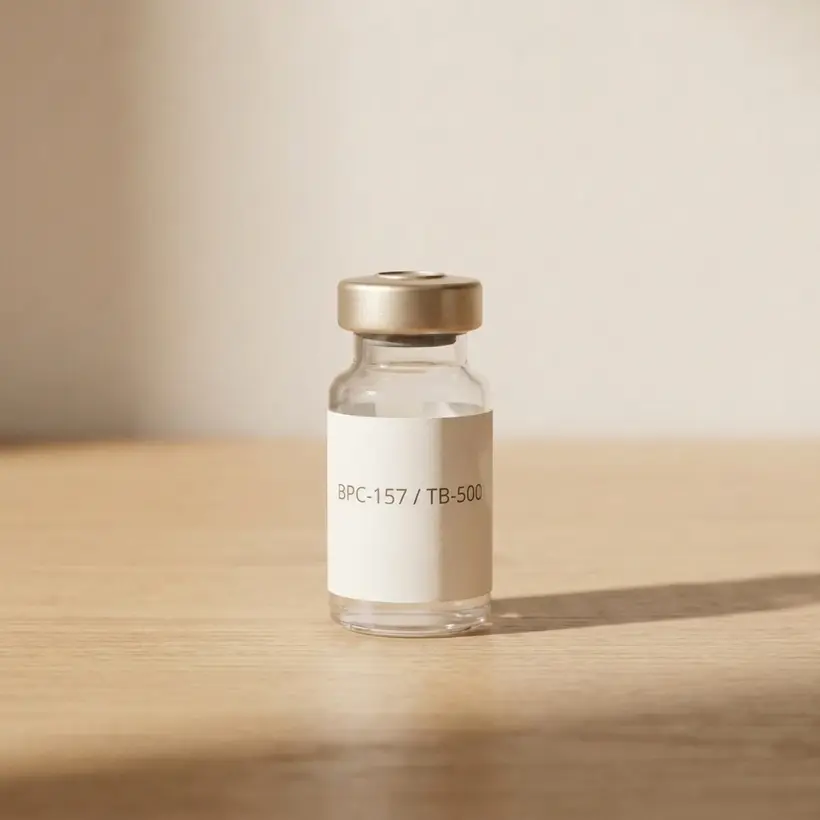
From the FormBlends catalog
BPC-157 / TB-500 Blend
The ultimate recovery stack in one vial · From $249/mo · compounded by a licensed 503A pharmacy, dispensed only after provider review.
View BPC-157 / TB-500 Blend →Human Evidence
Human data on GH and joint health comes primarily from studies on GH deficiency and GH replacement therapy:
- Adults with GH deficiency frequently report joint pain, stiffness, and reduced mobility. GH replacement therapy in these patients has been associated with improvements in musculoskeletal symptoms and physical function.
- A study in GH-deficient adults found that GH replacement increased collagen turnover markers, suggesting enhanced connective tissue remodeling.
- Research on athletes has shown that GH administration increases collagen synthesis in tendons and muscle connective tissue, supporting structural tissue repair.
No published clinical trials have specifically evaluated CJC-1295 for joint pain outcomes in humans. The rationale for its potential joint health benefits is based on its ability to improve the GH and IGF-1 pathways that are directly involved in connective tissue maintenance.
Important Distinction: Human vs. Animal Research
Much of the strongest evidence for GH and IGF-1 in cartilage repair comes from animal models. While the biological pathways are conserved between species, the magnitude of benefit, optimal dosing, and clinical significance in humans remain areas of active research. Claims about CJC-1295 "repairing" or "regenerating" joints should be viewed critically until supported by human clinical trial data.
How CJC-1295 May Help with Joint Pain
Based on the established biology of the GH/IGF-1 axis, CJC-1295 may support joint health through several pathways:
Supporting Cartilage Maintenance
By improving IGF-1, CJC-1295 may help maintain the anabolic signaling that chondrocytes need to produce and maintain the cartilage matrix. This is particularly relevant for individuals experiencing age-related decline in GH and IGF-1, which may contribute to the progressive cartilage thinning seen with aging.
Enhancing Collagen Production
Improved GH levels support collagen synthesis in tendons, ligaments, and joint capsules. For individuals with joint pain related to connective tissue weakness or degeneration, improved collagen turnover could contribute to better joint stability and reduced discomfort.
Reducing Inflammation
Some research suggests that IGF-1 has anti-inflammatory properties in joint tissue. IGF-1 has been shown to counteract certain pro-inflammatory cytokines that contribute to cartilage breakdown. While CJC-1295 isn't an anti-inflammatory drug, its downstream effects on IGF-1 may modulate the inflammatory environment within joints.
Improving Recovery from Joint Injuries
GH and IGF-1 are both involved in tissue repair following injury. For individuals recovering from joint injuries, sprains, or surgical procedures, improved GH levels may support faster and more complete healing of the affected connective tissues.
What CJC-1295 Can't Do
It's important to set realistic expectations:
- CJC-1295 isn't a treatment for osteoarthritis, rheumatoid arthritis, or any other diagnosed joint disease.
- It can't reverse advanced cartilage loss or bone-on-bone joint deterioration.
- It doesn't replace physical therapy, weight management, or other evidence-based interventions for joint health.
- Joint pain has many possible causes, and proper diagnosis by a physician is important before assuming that hormone improvement is the answer.
Complementary Strategies for Joint Health
Patients using CJC-1295 for joint support often benefit from combining it with other evidence-based strategies:
- Resistance training: Strengthening the muscles around a joint reduces load on the joint itself and improves stability.
- Weight management: Excess body weight is one of the strongest modifiable risk factors for joint pain, particularly in the knees and hips.
- Nutrition: Adequate protein intake, omega-3 fatty acids, and micronutrients like vitamin C (important for collagen synthesis) and vitamin D support joint tissue health.
- Physical therapy: Targeted exercises and mobility work can improve joint function and reduce pain.
- Other peptides: Some physicians may consider BPC-157 or other peptides with connective tissue-supporting properties alongside CJC-1295.
Safety Considerations
CJC-1295 has shown a generally favorable safety profile in clinical studies. Common side effects include injection site reactions, flushing, headache, and mild water retention.
Ironically, one potential side effect of improved GH levels is temporary joint stiffness or mild joint discomfort, particularly in the hands and wrists. This is a dose-dependent effect that typically resolves with dose adjustment. It's important to distinguish between this GH-related joint stiffness and the underlying joint pain being addressed.
Your physician will monitor your response to therapy and adjust your protocol to balance benefits and tolerability.
How FormBlends Can Help
FormBlends provides physician-supervised peptide therapy that can be tailored to support joint health as part of a broader wellness strategy. Your physician will evaluate your joint symptoms, review imaging or other diagnostic information if available, order baseline lab work, and determine whether CJC-1295 is appropriate for your situation.
Throughout treatment, your physician monitors your GH and IGF-1 levels, tracks your symptom response, and adjusts your protocol as needed. If combination therapy with other peptides is warranted, your physician can design a thorough approach aligned with your goals.
Frequently Asked Questions
How long does it take for CJC-1295 to help with joint pain?
Connective tissue repair and remodeling is a slow process. While some patients report improvements in joint comfort within 4 to 8 weeks, meaningful changes in cartilage and connective tissue typically require months of consistent GH/IGF-1 elevation. Patience and consistency are important.
Can CJC-1295 replace my current joint pain treatment?
No. CJC-1295 should be considered a complementary approach, not a replacement for established treatments. Continue any treatments recommended by your orthopedist, rheumatologist, or primary care physician unless directed otherwise.
Is CJC-1295 better than direct GH injections for joint health?
CJC-1295 stimulates endogenous GH production through the pituitary, preserving the body's natural feedback mechanisms. Direct GH bypasses these controls. Many clinicians prefer the GHRH analog approach for its more physiological GH release pattern, though the optimal strategy depends on individual factors.
Can CJC-1295 cause joint pain?
Yes, temporary joint stiffness (particularly in the hands) is a recognized side effect of improved GH levels. This is typically dose-dependent and resolves with dose reduction. Your physician can distinguish between this side effect and your underlying joint condition.
Should I combine CJC-1295 with BPC-157 for joint health?
Some physicians use CJC-1295 and BPC-157 together because they work through different mechanisms. CJC-1295 provides systemic GH/IGF-1 elevation, while BPC-157 acts more locally on tissue repair. Any combination protocol should be designed and supervised by your physician.
Explore Peptide Support for Joint Health
Joint health is about more than managing pain. FormBlends can connect you with a physician who understands the role of growth hormone in connective tissue maintenance and can determine whether CJC-1295 therapy is right for you. Start with a consultation.
Disclaimer: This article is for informational purposes only and doesn't constitute medical advice. CJC-1295 isn't FDA-approved and should only be used under the supervision of a licensed healthcare provider. The joint health applications discussed here are based on research into the GH/IGF-1 axis and shouldn't be interpreted as claims that CJC-1295 prevents, treats, or cures any joint disease or condition.
Ready when you are
BPC-157 / TB-500 Blend
The ultimate recovery stack in one vial · From $249/mo · compounded by a licensed 503A pharmacy, dispensed only after provider review.
View BPC-157 / TB-500 Blend →