Last October, a 42-year-old IT project manager named Daniel in Austin texted his prescribing clinician a photo of his insulin syringe next to a freshly reconstituted vial. "I'm getting 250 mcg at 10 units, right? Or is it 25?" His doctor called him back within the hour. "If you have to ask," she told him, "we're starting you at 100 mcg tonight and you're not touching the dose until our follow-up next week." That exchange captures the single most important thing about ipamorelin dosing: the numbers only matter if you understand what you're measuring.
Here's what the published literature actually says, how the math works in practice, and where most people trip up.
Compounded ipamorelin is dispensed by licensed pharmacies for individual patients and is not FDA-approved. The information below summarizes what published peptide research and clinical literature suggest about dosing patterns, reconstitution, and titration. A prescribing clinician should always direct the actual protocol used.
The Reference Range and Where It Comes From
The dose most often cited in research is 200 to 300 mcg per subcutaneous injection, administered one to three times daily. Daily totals across published protocols range from 200 mcg to roughly 900 mcg.
That 200 to 300 mcg window traces back to the original Raun K et al. 1998 study in the European Journal of Endocrinology, where researchers showed ipamorelin triggered selective GH release without the cortisol and prolactin spikes that plagued earlier secretagogues like GHRP-6 and GHRP-2. The dose-response curve was clear across this range. Going higher didn't produce proportionally bigger GH pulses in most published data, which is why clinicians generally cap single doses around 300 mcg.
Think of it like a light dimmer that only turns from 7 to 7.5 when you crank it from 80% to 100%. The extra effort (and cost, and injection volume) buys you very little.
A common starting framework in clinical practice:
- Beginner: 100 to 200 mcg once daily before bed, for the first one to two weeks
- Intermediate: 200 to 300 mcg twice daily (morning fasted and pre-bed)
- Advanced research protocol: 200 to 300 mcg three times daily (post-workout, mid-afternoon, pre-bed)
Many protocols stop at twice daily. The marginal GH pulse from a third injection tends to be noticeably smaller than the first two, based on GH release curves reported in healthy adults.
When to Inject (and Why It Matters)
Timing isn't arbitrary. Each dosing window aligns with a specific physiological rationale.
Pre-bed is the most commonly recommended single-dose timing. The body's largest natural GH surge happens during slow-wave sleep. Adding a secretagogue 15 to 30 minutes before sleep, on an empty stomach (no food in the prior two hours), appears to amplify that existing pulse rather than creating a competing one.
Post-workout takes advantage of the GH burst that follows resistance training. Research shows a meaningful endogenous release in the first hour after a session. Injecting ipamorelin within 15 to 30 minutes of finishing lets the exogenous pulse ride the same wave.
Fasted morning is the third option for people running a three-dose protocol. The catch: carbohydrates and fats blunt secretagogue-driven GH release in published research. If you eat breakfast and then inject, you've largely wasted the dose. This one needs to happen on an empty stomach or not at all.
Reconstitution Math (the Part Most People Get Wrong)
Ipamorelin ships as a lyophilized powder. You reconstitute it with bacteriostatic water before use.
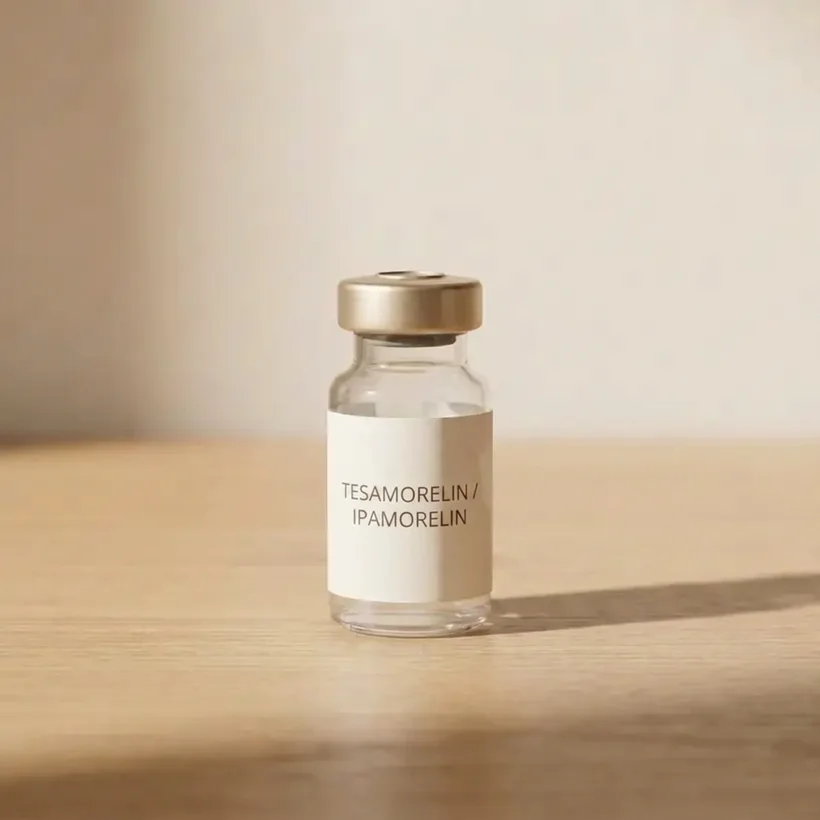
From the FormBlends catalog
Tesamorelin / Ipamorelin Blend
Growth-hormone pathway support in one blend · From $299/mo · compounded by a licensed 503A pharmacy, dispensed only after provider review.
View Tesamorelin / Ipamorelin Blend →Standard reconstitution:
- 5 mg vial + 2 mL bacteriostatic water = 2,500 mcg/mL
- At this concentration, 0.1 mL (10 units on an insulin syringe) = 250 mcg
For finer control:
- 5 mg vial + 5 mL bacteriostatic water = 1,000 mcg/mL
- 0.1 mL = 100 mcg
- 0.2 mL = 200 mcg
- 0.3 mL = 300 mcg
The second ratio is more forgiving for beginners. Measuring 100 mcg with a 2,500 mcg/mL solution means pulling to 4 units on an insulin syringe, and at that tiny volume, even a slight error doubles your dose. With the 1,000 mcg/mL concentration, the same dose is 10 units. Much harder to mess up.
Store reconstituted vials refrigerated (2 to 8°C). Use within 28 to 30 days. Don't freeze them. Don't shake during reconstitution. Swirl gently or roll between your palms.
Syringe Selection and Injection Sites
Most compounded peptide protocols use a 0.3 mL or 0.5 mL insulin syringe, 29 to 31 gauge, 5/16-inch needle. Insulin syringes are marked in units: 100 units equals 1.0 mL, so 10 units equals 0.1 mL. That conversion is the single piece of math you need to internalize.
Ipamorelin goes subcutaneous. Rotate between:
- Abdomen (two inches from the navel)
- Outer thigh
- Love handle area
- Upper outer hip
Rotate. Every time. Repeated injections in the same spot invite bruising and a small risk of localized lipodystrophy over months.
Titration: Why You Don't Start at Full Dose
Most clinicians prefer a ramp-up rather than jumping to the target. A representative titration:
- Week 1: 100 mcg once daily, pre-bed
- Week 2: 200 mcg once daily, pre-bed
- Week 3 onward: 200 to 300 mcg twice daily (post-workout + pre-bed)
The boring truth is that starting low lets you catch tolerability issues (mild water retention, head rush, flushing) before they compound at higher doses. It also helps you figure out your personal response curve. Some people notice obvious improvements in sleep quality at 100 mcg. Others feel nothing until 300 mcg twice daily.
Stacking With CJC-1295
Ipamorelin is frequently paired with CJC-1295, with or without the DAC modification. When stacked:
- No-DAC CJC-1295 is typically dosed at 100 to 300 mcg per injection, drawn into the same syringe as each ipamorelin pulse
- DAC CJC-1295 pairs at 1 to 2 mg total weekly (injected once or twice), while ipamorelin continues daily
Same-syringe combination is standard practice. The pairing is covered in detail in our companion article on ipamorelin with CJC-1295.
Cycling and How Long to Run a Protocol
Most research-based protocols cycle rather than running continuously:
- 8 to 12 weeks on
- 4 weeks off
- Reassess and resume if appropriate under clinical direction
The rationale is limiting potential receptor desensitization, though I'll be honest: the human data on long-term ipamorelin-specific desensitization is thin. Cycling is partly borrowed from the broader GH secretagogue literature and partly a "better safe than stale" approach. It's a reasonable precaution, not an established certainty.
Adjustments and Common Mistakes
When something's not working, clinicians generally adjust frequency before dose. If you're not responding at 200 mcg once daily, adding a second daily dose is the typical next step, not jumping to 400 mcg in a single injection.
Where this falls apart for people:
- Dosing right after eating (especially fats and carbs). GH release tanks.
- Skipping site rotation. You'll learn why the hard way.
- Using plain sterile water instead of bacteriostatic water. Bacteriostatic water contains a preservative (benzyl alcohol) that keeps the vial from becoming a petri dish over 30 days. Regular sterile water doesn't.
- Reusing syringes. Just don't.
- Running 12+ months straight without a break. Even if you feel great.
- Jumping to three daily doses before stabilizing at two. Each step should be boring and uneventful before you add complexity.
If you're experiencing water retention or puffiness, reduce the per-dose amount before cutting frequency. If sleep is disrupted, move the pre-bed dose 30 to 60 minutes earlier. If you hit a plateau after several months, a structured off-period is typically the move.
All adjustments should happen under clinical supervision. Don't exceed the upper bounds of published dosing without explicit guidance from your prescriber.
FAQ
Is more always better with ipamorelin?
No. Published research does not show a linear increase in GH release beyond roughly 300 mcg per dose. Going higher doesn't appear to produce proportionally larger responses in most data and may not justify the additional cost.
Can ipamorelin be dosed once weekly?
No. Ipamorelin has a short half-life (around two hours) and needs daily dosing. If you want a once-weekly option, that's a different molecule entirely: CJC-1295 with DAC has a longer half-life, but it's structurally distinct and works differently.
Does food affect the dose?
Yes. Carbohydrates and fats consumed close to injection time blunt the GH release response. Most protocols specify a fasted state for at least one to two hours before and 30 minutes after injection.
What time of day is best?
Pre-bed is the most common single-dose timing, aligned with the body's natural overnight GH pulse. A second dose is often added post-workout or fasted morning depending on training schedule.
How long until effects are noticed?
Sleep quality and recovery are typically the first changes people report, often within two to four weeks. Body composition shifts, when they occur, tend to emerge in the 8 to 12 week window. Anyone telling you they saw dramatic results in five days is probably experiencing placebo or confirmation bias.
What happens if I miss a dose?
Skip it and resume at your next scheduled injection. Don't double up to compensate. GH pulses are discrete events, not accumulating blood levels, so a missed dose is just a missed pulse.
Can I travel with reconstituted ipamorelin?
You can, but temperature control matters. A small insulated cooler with ice packs keeps the vial viable for a few hours. For longer travel, discuss logistics with your prescribing pharmacy, and carry your prescription documentation.
Related Reading
---
Disclaimer: Ipamorelin is not FDA-approved. It is a compounded research peptide dispensed by licensed pharmacies for individual patients under a valid prescription. This article is for educational purposes and does not constitute medical advice. Individual results vary. Always consult a licensed prescribing clinician before starting any compounded peptide protocol.
Citation: Raun K, Hansen BS, Johansen NL, et al. Ipamorelin, the first selective growth hormone secretagogue. Eur J Endocrinol. 1998;139(5):552-561.
Ready when you are
Tesamorelin / Ipamorelin Blend
Growth-hormone pathway support in one blend · From $299/mo · compounded by a licensed 503A pharmacy, dispensed only after provider review.
View Tesamorelin / Ipamorelin Blend →