By Samuel Okafor, BSN, RN, Registered Nurse, Endocrinology. Medically reviewed by Dr. Robert Yamada, MD, Board-Certified Endocrinology.
Laura, 44, a paralegal in Fort Worth, started Zepbound at 2.5 mg in January. By week three she'd lost six pounds and her A1C was trending down. She also hadn't slept more than four consecutive hours in twelve days. "I'd be exhausted at ten o'clock, fall asleep fine, then just... be awake at two a.m. staring at the ceiling like it owed me money," she told her endocrinologist at a follow-up. Her prescriber adjusted her injection timing from morning to early evening, added magnesium glycinate before bed, and within two weeks she was back to six-plus hours. Not a miracle. Just the right tweak.
Laura's experience is more common than most Zepbound prescribing information suggests. The clinical trials for tirzepatide (Zepbound's active ingredient) focused heavily on GI tolerability, weight loss, and glycemic endpoints. Sleep disruption wasn't a primary outcome measure. But scroll any patient forum, and insomnia ranks right alongside nausea and constipation as a complaint people didn't expect.
This article is part of the FormBlends ultimate guide to compounded tirzepatide and the Drug Comparison (Sema vs Tirz vs Brand) hub.
Key Takeaways
- Sleep disruption on Zepbound is a real and frequently reported complaint, though it wasn't a headline finding in the SURMOUNT trials.
- Most GLP-1 side effects, including insomnia, are dose-dependent and most prominent during the first 4 to 12 weeks at a new dose.
- Non-pharmacologic strategies (injection timing, meal timing, hydration, sleep hygiene) are the first line before reaching for a sleep aid.
- Severe symptoms like persistent vomiting, intense abdominal pain, or signs of allergic reaction are not routine and require urgent care.
- Compounded tirzepatide is not FDA-approved. The FDA does not pre-review compounded medications.
Why Zepbound Messes With Sleep in the First Place
Here's the thing: tirzepatide is a dual GIP/GLP-1 receptor agonist. It doesn't just slow gastric emptying. It affects appetite signaling in the hypothalamus, which sits uncomfortably close (neuroanatomically speaking) to the brain's sleep-wake regulatory centers. GLP-1 receptors are expressed in the brainstem and hypothalamus, areas that modulate arousal. So when you flood those receptors with a new agonist, some degree of sleep architecture disruption isn't surprising. Think of it like moving into an apartment next to a nightclub; the music isn't aimed at you, but you're going to hear it.
There's also a simpler explanation that runs in parallel: GI discomfort. If low-grade nausea, acid reflux, or bloating wakes you at 2 a.m., the problem isn't really "insomnia" in the classical sense. It's discomfort that interrupts sleep. The fix for that is completely different from the fix for true onset or maintenance insomnia.
And then there's the caloric deficit itself. Rapid caloric reduction changes cortisol rhythms, and cortisol is one of the major drivers of early-morning awakening. SURMOUNT-1 reported substantial variance in weight loss even within the same dose arm, which means the metabolic stress on any individual body varies enormously.
Practical Steps That Actually Help
1. Move the injection time. This is the single most underrated adjustment. Many patients inject in the morning because that's when they remember. But if the peak pharmacokinetic activity (roughly 24 to 72 hours post-injection) lands during your sleep window and correlates with worse nights, shifting the injection to late afternoon or early evening sometimes helps. Other patients find the opposite. The only way to know is to try it for two to three weeks and track the results.
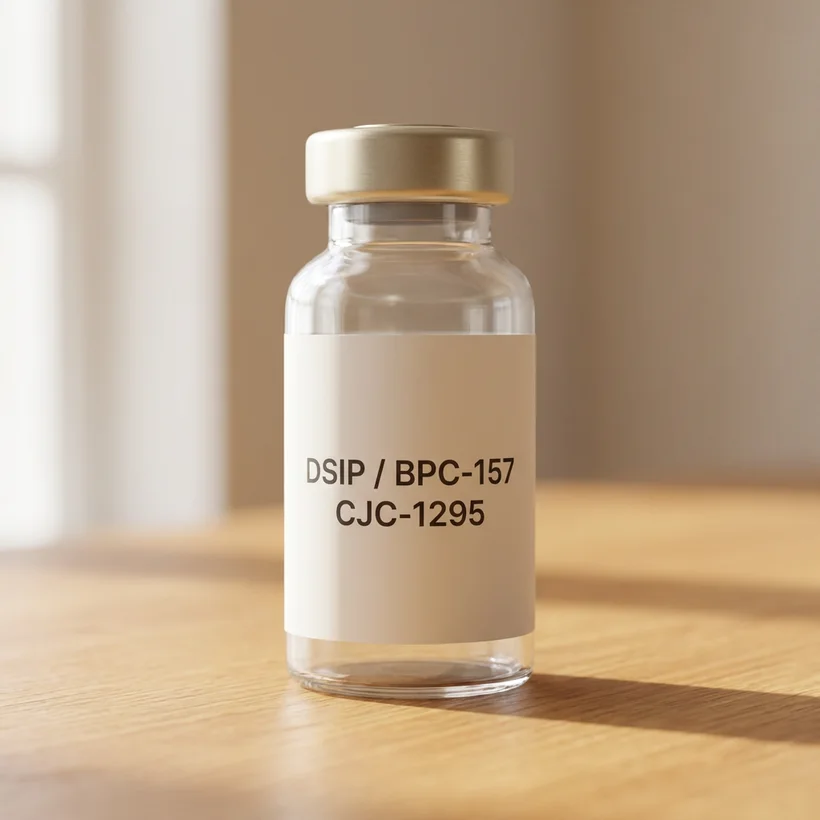
From the FormBlends catalog
Sleep + Recovery Stack
Sleep and repair support with DSIP, BPC-157, and CJC · From $299/mo · compounded by a licensed 503A pharmacy, dispensed only after provider review.
View Sleep + Recovery Stack →2. Fix what you're eating, and when. A high-fat meal within three hours of bedtime on a GLP-1 agonist is a recipe for reflux and disrupted sleep. Smaller, lower-fat meals earlier in the evening work better. If you're eating very little overall (common on tirzepatide, because appetite suppression can be aggressive), make sure you're getting enough total calories that your body isn't running a cortisol alarm at 3 a.m.
3. Standard sleep hygiene, but actually do it. I know this sounds boring. It is boring. Cool room, dark room, no screens for 30 minutes before bed, consistent wake time. The reason clinicians keep repeating this stuff is that it accounts for a surprisingly large chunk of sleep quality variance, and it costs nothing.
4. Magnesium glycinate before bed. Not a prescription. Not a guarantee. But magnesium glycinate (200 to 400 mg) has modest evidence for improving sleep onset latency and is well-tolerated alongside GLP-1 agonists. Confirm with your prescriber or pharmacist, especially if you take other medications.
5. If the insomnia persists past week 6 at a stable dose, talk to your prescriber about a dose hold or step-down. A coordinated dose reduction is a routine clinical tool. An improvised skip is not. Don't freelance your dosing.
The Injection Itself: Getting the Basics Right
Since many readers here are on compounded tirzepatide (which comes in vials rather than pre-filled pens), a few practical notes on safe self-injection that apply regardless of why you're reading this article.
Before you start, gather: your vial with the concentration (mg/mL) clearly printed on the pharmacy label, a U-100 insulin syringe (typically 0.3 mL or 0.5 mL), an alcohol prep pad, a sharps container, and your prescribed dose written down on paper. Not remembered. Written.
The calculation: Prescribed dose in milligrams divided by concentration in mg/mL equals volume in mL. Multiply by 100 to convert to units on a U-100 syringe. Write it down. If the math gives you a fractional unit (say, 12.5 units), do not round without confirming with your prescriber.
The verification step takes thirty seconds. Read the dose back to yourself, or to a family member, or call the pharmacy. This single habit catches roughly half the errors that would otherwise reach the syringe in self-administered protocols. It's the highest-leverage step in the entire process.
The injection: Clean the site with the alcohol pad. Let it dry. Pinch skin if needed (depends on subcutaneous fat depth at the site). Insert at 90 degrees, push the plunger smoothly, count to five with the needle still in, withdraw, dispose in the sharps container immediately. Rotate sites across weeks: abdomen (at least two inches from the navel), front of the thigh, back of the upper arm. Don't inject through clothing.
Document everything. Date, dose in milligrams, units drawn, injection site, symptoms. Review the log monthly with your prescriber. A single data point tells you nothing. A trend line tells you a lot.
Common Mistakes (Especially When You're Tired)
The irony of insomnia is that sleep-deprived people make more dosing errors. Three mistakes show up repeatedly:
Using last month's unit calculation when the pharmacy refill has a different concentration. Always re-read the label. Every time.
Injecting the same site repeatedly because it's comfortable, leading to nodules and lipohypertrophy that affect drug absorption. Rotate.
Leaving the vial out of the recommended temperature range. If you're unsure whether a vial that sat on your nightstand overnight is still viable, call the pharmacy before injecting.
When Insomnia Is a Red Flag, Not a Nuisance
Most Zepbound-related sleep disruption is annoying but not dangerous. It improves as the body acclimates to a given dose. But certain symptoms alongside insomnia warrant a call or a visit:
Seek immediate care for: severe abdominal pain (especially radiating to the back, which may signal pancreatitis), persistent vomiting preventing fluid intake, jaundice or right-upper-quadrant pain, signs of allergic reaction (rash, facial or throat swelling, difficulty breathing), severe dehydration, or thoughts of self-harm.
Call your prescriber within 24 to 48 hours for: nausea that hasn't improved after two weeks at a stable dose, new vision changes, ongoing constipation despite hydration and fiber, or any symptom you can't explain.
For non-urgent questions (timing tweaks, sleep supplement options, routine tolerability), schedule a follow-up rather than self-adjusting. Dose-escalation schedules are protocol-driven for a reason.
Putting the Trial Data in Perspective
SURMOUNT-1 reported significant differences in response even within the same dose arm. That's the normal pattern across GLP-1 trials. Trial averages compress enormous variance into a single number, and reading the published distribution behind the average is more useful than fixating on the average itself.
Real-world cohorts add even more variance, mostly from adherence and lifestyle differences. The strongest predictor of long-term outcome across the GLP-1 class is months on therapy at or near the maintenance dose. Everything else, including the sleep disruption that tempts people to quit early, matters less than staying the course (with appropriate clinical support).
Related Reading
- Zepbound Dry Mouth: Complete Guide
- Why is my semaglutide red?
- Can you take phentermine with Ozempic?
- Ozempic Cost At Walmart With Insurance, Real Numbers
Frequently Asked Questions
Should I talk to my doctor about Zepbound insomnia? Yes. Any symptom that's affecting your daily function or tempting you to change your dosing schedule is worth raising with your prescriber. This article is general education, not individualized clinical advice.
How long does Zepbound insomnia typically last? Most GLP-1 side effects, including sleep disruption, are most prominent during the first 4 to 12 weeks at a new dose and tend to improve as the body adjusts. If insomnia persists or worsens beyond that window, it warrants a prescriber conversation.
Can I take melatonin or an OTC sleep aid with Zepbound? Some non-prescription options are commonly used alongside GLP-1 agonists. Confirm with your prescriber or pharmacist before adding anything, particularly if you take other prescription medications. Magnesium glycinate and melatonin (0.5 to 3 mg) are the most frequently discussed options in clinical practice.
Should I skip a dose if the insomnia is bad? Do not skip or alter doses without talking to your prescriber first. A coordinated dose hold or step-down is a routine clinical tool. An improvised skip can disrupt the titration schedule and make side effects worse when you restart.
Does the insomnia mean the medication isn't right for me? Not necessarily. Sleep disruption is common during dose escalation and often resolves. Persistent, treatment-resistant insomnia after multiple adjustments (timing, dose, sleep hygiene) is a different conversation, and one worth having with your prescriber.
Is compounded tirzepatide FDA-approved? No. Compounded tirzepatide is not an FDA-approved drug. The FDA does not review compounded medications for safety, effectiveness, or quality prior to dispensing. Compounded medications are dispensed under personalized prescriptions through state-licensed pharmacies when a prescriber determines a personalized formulation is clinically appropriate.
Continue the Series
- Hub: Drug Comparison (Sema vs Tirz vs Brand) hub
- Pillar: Compounded tirzepatide ultimate guide
Important Safety Information
This article is for educational purposes only and is not medical advice. Compounded tirzepatide and compounded semaglutide are not FDA-approved drugs. The FDA does not review compounded medications for safety, effectiveness, or quality before they are sold. Compounded medications should only be used when a licensed prescriber determines a personalized formulation is clinically appropriate. Do not start, stop, or modify any prescription medication without speaking with a licensed healthcare provider. If you experience symptoms of a serious reaction, including severe abdominal pain, signs of pancreatitis, vision changes, persistent vomiting, signs of an allergic reaction, or thoughts of self-harm, seek emergency care immediately.
FormBlends sells only compounded semaglutide and compounded tirzepatide through licensed U.S. pharmacies after a telehealth evaluation by an independent prescriber. Eligibility, pricing, and formulation are determined on a case-by-case basis.
About This Article
Ready when you are
Sleep + Recovery Stack
Sleep and repair support with DSIP, BPC-157, and CJC · From $299/mo · compounded by a licensed 503A pharmacy, dispensed only after provider review.
View Sleep + Recovery Stack →