The short answer
To reconstitute a 5 mg semaglutide powder vial, draw the bacteriostatic water amount your pharmacy prescribes (commonly 1 mL or 2 mL) and slowly inject it down the vial wall. The resulting concentration is 5 mg/mL with 1 mL of water, or 2.5 mg/mL with 2 mL. Swirl gently, never shake. Use within 28 days when refrigerated.
Table of contents
- The 30-second answer
- What "reconstitute" means and why it's needed
- Supplies you'll need
- The bacteriostatic water amount sets your concentration
- Reconstitution chart for 5 mg semaglutide
- Step-by-step reconstitution procedure
- After reconstitution: storage, shelf life, and labeling
- How to draw your first dose
- Common reconstitution mistakes
- When to discard and start over
- FAQ
- Footer disclaimers
What "reconstitute" means and why it's needed
Semaglutide is a peptide. In its dry, freeze-dried (lyophilized) form it's stable for months at refrigerated temperatures. Once water is added, the peptide dissolves into solution and starts a much shorter clock (typically 28 days). So compounding pharmacies sometimes ship the active drug as a powder and ask the patient to mix in bacteriostatic water at home. This protects shelf life during shipping and storage.
Get pre-measured GLP-1 doses shipped to your door
No mixing, no guesswork. FormBlends medications come ready to inject with clear dosing instructions.
Start Free Assessment →Reconstitution is just adding water to the powder. The procedure is simple, but two things have to be exact:
- The amount of water you add sets the final concentration. More water = more dilute solution = more units per dose.
- The technique matters because peptides foam and aggregate easily. Forceful mixing damages the molecule.
If you're working with a pre-mixed semaglutide vial, you don't need to reconstitute anything. This guide is only for powder vials. For dose math on pre-mixed vials, see our 25 mg to units semaglutide guide.
Supplies you'll need
- 5 mg semaglutide powder vial (often labeled "Semaglutide 5 mg, lyophilized")
- Bacteriostatic water for injection (the multi-dose vial with 0.9% benzyl alcohol as a preservative, NOT sterile water)
- A 3 mL syringe with an 18- or 22-gauge needle for transferring the water (or whatever your pharmacy supplied)
- A U-100 insulin syringe for drawing your weekly dose afterward
- Two alcohol swabs
- A sharps container
- A flat, clean surface with good light
Some pharmacies ship a complete reconstitution kit. Others assume you have a syringe drawer at home from prior insulin or peptide therapy. If anything's missing, call before you start.
A note on water: it must be bacteriostatic water, not sterile or distilled water. Bacteriostatic water contains 0.9% benzyl alcohol, which keeps the solution stable for the 28-day post-reconstitution window. Sterile water without preservative would limit the vial to 24 hours.
The bacteriostatic water amount sets your concentration
This is the most common source of confusion in compounded semaglutide. The same 5 mg powder vial can become a 5 mg/mL solution, a 2.5 mg/mL solution, or a 1 mg/mL solution depending on how much water you add.
The math is simple division:
Concentration (mg/mL) = Total milligrams in the vial ÷ Volume of water added (mL)
So for a 5 mg powder vial:
- 5 mg ÷ 1 mL water = 5 mg/mL
- 5 mg ÷ 2 mL water = 2.5 mg/mL
- 5 mg ÷ 5 mL water = 1 mg/mL
Your pharmacy's reconstitution instructions specify exactly how much water to add. Follow that instruction. Don't decide on your own to use a different volume, because every unit count math you do afterward depends on this number.
If your prescription is for 0.25 mg per dose and your pharmacy says to reconstitute with 2 mL, you'll end up at 2.5 mg/mL, which means 0.25 mg = 10 units on a U-100 syringe. If you accidentally use 1 mL instead, you'd be at 5 mg/mL, where 10 units delivers 0.5 mg (double the prescription).
Reconstitution chart for 5 mg semaglutide
| Bacteriostatic water added | Resulting concentration | 0.25 mg dose | 0.5 mg dose | 1 mg dose | Total weekly doses (at 0.25 mg) |
|---|---|---|---|---|---|
| 1 mL | 5 mg/mL | 5 units | 10 units | 20 units | 20 doses |
| 1.5 mL | 3.33 mg/mL | 7.5 units | 15 units | 30 units | 20 doses |
| 2 mL | 2.5 mg/mL | 10 units | 20 units | 40 units | 20 doses |
| 2.5 mL | 2 mg/mL | 12.5 units | 25 units | 50 units | 20 doses |
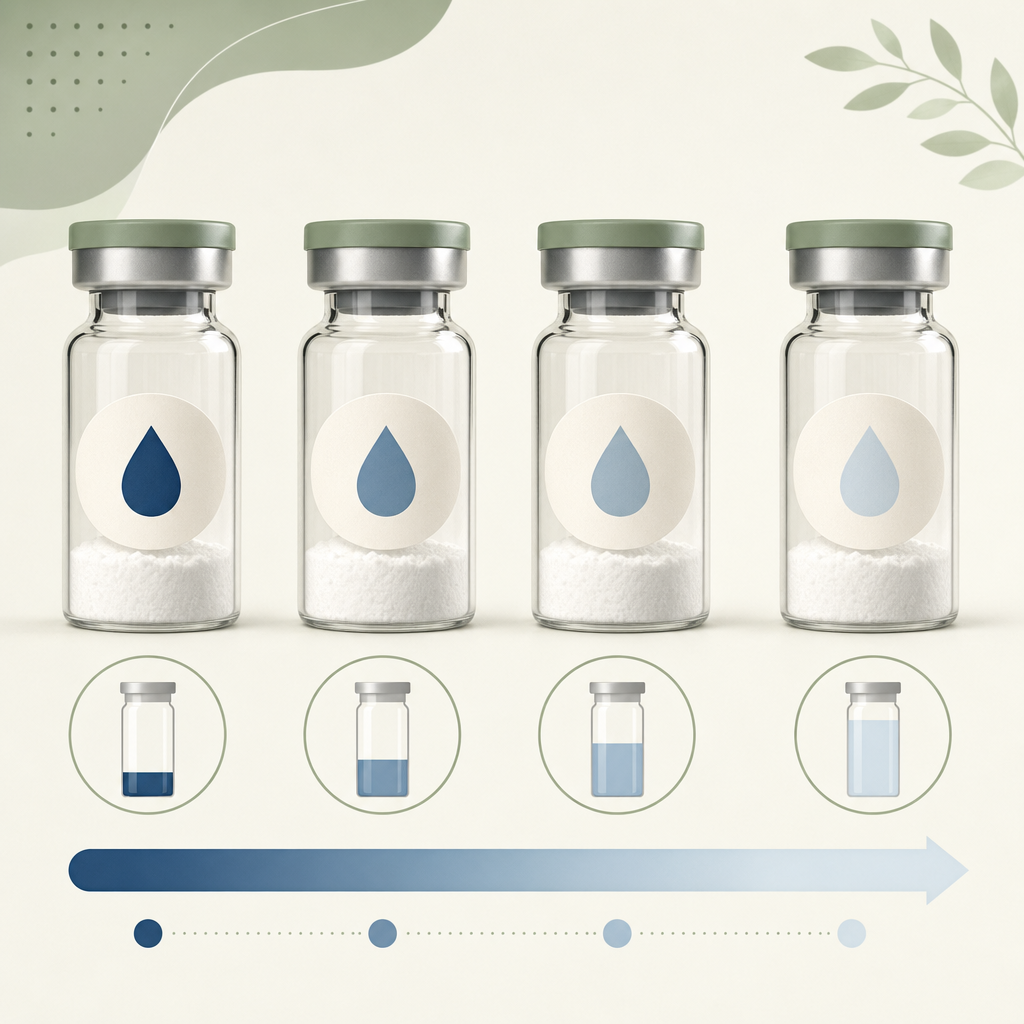
A few things worth pointing out:
- Total milligrams in the vial doesn't change. Whether you add 1 mL or 2.5 mL, you still have 5 mg of semaglutide. The total number of weekly doses you can pull out is the same (20 weekly doses at 0.25 mg).
- The unit count per dose changes inversely with the water volume. Less water = higher concentration = lower unit count per dose.
- The 2 mL → 2.5 mg/mL setup is the most common because the unit math is reasonably clean and the draw volumes are large enough to be readable on a standard 0.5 mL U-100 syringe.
Step-by-step reconstitution procedure
These steps assume your pharmacy specified 2 mL of bacteriostatic water for a 5 mg semaglutide powder vial (the most common compounding protocol). Adjust the water volume as your pharmacy instructs.
1. Set up. Wash your hands with soap and warm water for 20 seconds. Lay out the powder vial, the bacteriostatic water vial, the transfer syringe (3 mL with 18- or 22-gauge needle), the U-100 insulin syringe, two alcohol swabs, and a sharps container on a clean flat surface.
2. Let the powder vial reach room temperature. Take it out of the refrigerator and let it sit for 10 to 15 minutes. Cold peptide doesn't dissolve as cleanly. Don't warm it with hot water or a heat source.
3. Inspect both vials. The semaglutide powder should be a white or off-white cake (a freeze-dried disc at the bottom of the vial). The bacteriostatic water should be clear and colorless. Discard either vial if it looks wrong.
4. Wipe the rubber stoppers. Use a fresh alcohol swab on the bacteriostatic water vial's rubber top, and another on the semaglutide powder vial's top. Let both air-dry. Don't blow on them.
5. Draw 2 mL of bacteriostatic water. Using the 3 mL transfer syringe, pull back the plunger to the 2 mL mark to draw air. Insert the needle into the bacteriostatic water vial through the rubber stopper. Push the air in. Invert the vial. Pull the plunger to the 2 mL mark. Check for air bubbles, flick to dislodge, and confirm the volume at eye level. Withdraw the needle.
6. Inject the water down the side of the powder vial. Insert the transfer syringe into the powder vial through the rubber stopper. Angle the needle so the bacteriostatic water runs down the inner glass wall of the vial, NOT directly onto the powder cake. Push the plunger slowly. Pouring water directly on the cake creates foam, which damages the peptide.
7. Withdraw the syringe and discard. Drop the transfer syringe in the sharps container. You won't reuse it.
8. Swirl, don't shake. Hold the powder vial upright and gently swirl it in small circles for 10 to 15 seconds. The powder should dissolve within a minute or two. If you see floating particles after 5 minutes, swirl again. Never shake the vial. Shaking creates foam and degrades the peptide.
9. Inspect the solution. After dissolution, the solution should be clear and colorless to faint straw-yellow. No floating particles. No persistent foam. If foam appears, set the vial aside for 10 minutes to settle.
10. Label the vial. Write the reconstitution date on the vial label or on a small piece of medical tape. The 28-day clock starts now. Note the resulting concentration too (e.g., "Reconstituted April 29, 2026, 2.5 mg/mL"). Don't rely on memory.
11. Refrigerate. Place the vial in the refrigerator at 36 to 46°F (2 to 8°C). Don't freeze. Don't store on the door (temperature swings).
The whole reconstitution procedure takes about 5 minutes once you've done it once or twice.
After reconstitution: storage, shelf life, and labeling
Refrigeration: 36 to 46°F (2 to 8°C). Keep in the main body of the fridge, not the door, where temperature swings are larger.
Shelf life: 28 days from reconstitution under most compounding pharmacy guidelines. Some pharmacies cut this to 21 days if they used a different preservative system. Always defer to the dispensing label.
Labeling: write the reconstitution date and concentration on the vial. The original label likely shows only the powder weight and lot number, not the post-reconstitution math. Adding your own label prevents confusion later.
Travel: insulated bag with a frozen gel pack (not direct ice) for 6 to 8 hours. Direct freezing destroys the peptide.
Color: clear and colorless to faint straw-yellow is the normal range. A pink or red tint usually means the original powder included vitamin B12 (cyanocobalamin) for energy support or labeling. If the label didn't mention B12 and the solution is colored, call the pharmacy. See our color variations guide for more.
Particle or precipitate after reconstitution: if you see particles or precipitate that won't dissolve after gentle swirling, don't use the vial. Call the pharmacy.
How to draw your first dose
Once the solution is clear and labeled, you can draw your first weekly dose.
Assume you've reconstituted with 2 mL of water (concentration: 2.5 mg/mL) and your prescription is 0.25 mg weekly. The correct unit count is 10 units on a U-100 insulin syringe.
- Wash your hands.
- Wipe the reconstituted vial's rubber stopper with alcohol. Let it air-dry.
- Pull back 10 units of air on a U-100 insulin syringe.
- Insert through the stopper. Push air in.
- Invert the vial, pull the plunger to 10 units.
- Check for bubbles, flick to dislodge.
- Confirm at eye level. Withdraw the needle.
- Inject subcutaneously into the abdomen, thigh, or upper arm.
For more on dose-drawing technique and the conversion math at other concentrations, see our 25 mg to units semaglutide guide.
Common reconstitution mistakes
Mistake 1: Using sterile water instead of bacteriostatic water. Sterile water has no preservative. The reconstituted solution would be stable for only 24 hours, not 28 days. Always confirm "bacteriostatic" on the water vial's label.
Mistake 2: Adding the wrong volume of water. This is the single most common error in compounded semaglutide. If your pharmacy says 2 mL and you add 1 mL, your concentration doubles, and every dose you draw afterward delivers double the prescription. Read the reconstitution instructions every time, even if you've reconstituted before.
Mistake 3: Shaking the vial. Shaking creates foam, denatures the peptide, and reduces effectiveness. Always swirl gently.
Mistake 4: Pouring water directly on the powder cake. This creates more foam than letting the water run down the inner glass wall. Angle the needle.
Mistake 5: Using a vial that has separated, foamed persistently, or developed cloudiness. A failed reconstitution isn't recoverable. Discard and start over with a fresh vial.
Mistake 6: Forgetting to label the reconstitution date. Without the date written down, you can't tell whether the 28-day window has expired. When in doubt, discard.
Mistake 7: Reconstituting and forgetting to refrigerate. Room-temperature semaglutide degrades within hours. After reconstitution, refrigerate immediately.
A 2024 analysis of compounded GLP-1 self-administration (Patel et al., Annals of Pharmacotherapy) found that reconstitution-related concentration errors accounted for a meaningful share of suspected over- and under-doses in the first 90 days of therapy.
When to discard and start over
Throw the vial out and ask the pharmacy for a replacement if:
- The powder didn't dissolve fully after 10 minutes of gentle swirling.
- The solution is cloudy, particulate, or visibly different from the expected color.
- You realized you used sterile water instead of bacteriostatic water.
- You added the wrong volume of water and can't safely back-calculate the dose.
- The reconstitution date is older than 28 days (or 21 days if your pharmacy specified the shorter window).
- The vial was left at room temperature for more than a few hours.
- The vial was accidentally frozen.
Don't try to "rescue" a failed reconstitution by adding more water or filtering particles. Peptide aggregation isn't reversible, and aggregated peptide is less effective and more immunogenic than fresh solution.
FAQ
How much bacteriostatic water do I add to a 5 mg semaglutide vial?
Whatever your pharmacy's reconstitution instructions specify. Common volumes are 1 mL (resulting in 5 mg/mL), 2 mL (2.5 mg/mL), or 2.5 mL (2 mg/mL). The water volume sets your concentration, which determines your unit count per dose.
Can I substitute sterile water for bacteriostatic water?
No. Bacteriostatic water contains 0.9% benzyl alcohol as a preservative. Without it, the reconstituted solution is stable for only 24 hours instead of 28 days.
What if I shake the vial accidentally?
A single accidental shake usually doesn't ruin the vial, but it creates foam and increases the risk of peptide aggregation. Let the vial sit upright for 10 minutes, inspect for clarity, and proceed if it looks normal.
How long does reconstituted semaglutide last?
28 days refrigerated under most compounding pharmacy guidelines. Some pharmacies stamp 21 days. Read your dispensing label.
Why does my reconstituted solution look slightly yellow?
Faint straw-yellow is normal. Strong yellow, pink, or red usually means the powder included vitamin B12. If you didn't expect color, call the pharmacy.
Can I reconstitute multiple vials at once?
Yes, but each vial starts its own 28-day clock from its own reconstitution date. Label each vial individually.
Do I need a special syringe for transferring bacteriostatic water?
A 3 mL syringe with an 18- or 22-gauge needle is standard. The wider gauge handles the more viscous water transfer faster than a 31-gauge insulin syringe.
What if my powder cake doesn't dissolve?
Swirl gently for another minute. If it still doesn't dissolve fully, set the vial aside for 5 minutes and swirl again. Most cakes dissolve within 2 minutes. If it doesn't dissolve after 10 minutes of patient swirling, the vial may be defective. Call the pharmacy.
Can I refrigerate the reconstituted vial in the door of the fridge?
Avoid the door. Door temperature swings are larger because of opening and closing. Store in the main body of the fridge, ideally on the middle shelf.
What if I added 1 mL when my pharmacy said 2 mL?
Your concentration is now 5 mg/mL instead of 2.5 mg/mL. Every unit count you draw delivers double the intended milligram dose. Either re-do the math at the new concentration (and confirm with your provider), or discard and reconstitute a fresh vial correctly.
Is reconstituted semaglutide the same as Wegovy or Ozempic?
No. Compounded semaglutide is not FDA-approved and is not interchangeable with brand-name semaglutide. The active ingredient is the same (semaglutide), but compounded preparations haven't undergone the same regulatory review.
How do I know my reconstitution worked?
Visual inspection. The solution should be clear and colorless to faint straw-yellow, with no floating particles, no persistent foam, and uniform appearance throughout the vial. If any of those checks fail, don't use the vial.
Author / review note
Reviewed by the FormBlends Medical Team. References include Wilding et al., New England Journal of Medicine, 2021 (STEP 1, semaglutide for obesity), the U.S. Pharmacopeia chapter on sterile compounding (USP <797>), the FDA prescribing information for semaglutide (Wegovy and Ozempic), and Patel et al., Annals of Pharmacotherapy, 2024 (compounded GLP-1 dosing errors).
Footer disclaimers
Platform Disclaimer. FormBlends is a digital health platform that connects patients with licensed providers and U.S.-based pharmacies. We do not manufacture, prescribe, or dispense medication directly. All clinical decisions are made by independent licensed providers.
Compounded Medication Notice. Compounded semaglutide and tirzepatide are not FDA-approved. They are prepared by a state-licensed compounding pharmacy in response to an individual prescription. Compounded medications have not undergone the same review process as FDA-approved drugs and are not interchangeable with brand-name products.
Results Disclaimer. Individual results vary. Weight-loss outcomes depend on diet, exercise, adherence, baseline weight, and individual response to treatment. Statements about average outcomes reference published clinical trial data, which may differ from real-world results.
Trademark Notice. Ozempic and Wegovy are registered trademarks of Novo Nordisk. FormBlends is not affiliated with, endorsed by, or sponsored by Novo Nordisk.
See your options in about 2 minutes
Take the free quiz and see what fits you. Quick, private, and no commitment to continue.
See my options →