The short answer
Yogalates (yoga and Pilates fused) burns 150 to 250 calories per hour for most adults, builds slow lean mass gains, and improves mobility. It supports weight loss but won't drive it alone. Best paired with 2 to 3 cardio sessions per week and a moderate calorie deficit. Excellent for sustainability and injury prevention.
Table of contents
- The 30-second answer
- What yogalates actually is
- The calorie burn number, honestly
- The muscle and metabolic case
- Yogalates vs other workouts (table)
- How yogalates fits into a GLP-1 plan
- A simple weekly movement framework
- Better alternatives if pure weight loss is the goal
- FAQ
- Footer disclaimers
What yogalates actually is
Yogalates (sometimes spelled "yogilates" or "yogalata") is a fusion class that blends yoga's flexibility and breathwork with Pilates' core-and-spine-focused strength work. The format was popularized in the late 1990s by instructor Jonathan Urla, who registered the trademark in 2002, and the modern form is now taught in most boutique studios and many gym group-class schedules under various names (Yoga Pilates Fusion, Pilatesyoga, Flow Pilates, Fusion Flow).
Check your GLP-1 eligibility
Use our free BMI Calculator to see if you may qualify for provider-reviewed GLP-1 therapy.
Try the BMI Calculator →A typical 60-minute class includes:
- 5 to 10 minutes of breathwork and floor mobility
- 15 to 20 minutes of Pilates mat work (hundred, roll-up, leg circles, plank variations)
- 20 to 25 minutes of yoga flow sequences (sun salutations, warrior poses, balance work)
- 5 to 10 minutes of cooldown and savasana
Intensity varies dramatically by instructor. A "gentle yogalates" class can be barely more demanding than a slow stretch session. A "power yogalates" class can include continuous flowing movement that produces real cardiovascular load. The calorie burn discussion below assumes a moderate-intensity class, which is the most common format.
The calorie burn number, honestly
The energy cost of moderate-intensity yogalates for a 155-pound adult is roughly 150 to 250 calories per hour. A 200-pound adult is closer to 200 to 320 calories per hour. The wide range reflects how variable the format is.
For context, here's how that compares to other 60-minute workouts (155-pound adult, moderate effort):
| Activity | Calories per hour |
|---|---|
| Walking, 3 mph | 240 |
| Yogalates, moderate | 200 |
| Vinyasa yoga, moderate | 280 |
| Mat Pilates, moderate | 240 |
| Reformer Pilates, vigorous | 350 |
| Cycling, 12 to 14 mph | 560 |
| Running, 6 mph | 600 |
| HIIT (Tabata format) | 700 |
| Swimming, freestyle | 510 |
Yogalates sits near the bottom of structured workouts for raw calorie burn. That's the honest answer. If your only metric for "good for weight loss" is calories burned in the hour, yogalates is mid-pack at best.
But raw calorie burn during the workout is only one of three pathways through which exercise affects weight loss. The other two (muscle gain and stress hormone management) are where yogalates earns its place.
The muscle and metabolic case
The Pilates portion of yogalates produces real strength gains, particularly in the deep core stabilizers (transverse abdominis, multifidus, pelvic floor) and the postural muscles of the back. The yoga portion builds shoulder stability, hip mobility, and isometric strength in the legs through poses like warrior II, chair pose, and plank.
Lean muscle mass matters for weight loss for two reasons. First, every pound of muscle burns roughly 6 to 10 calories per day at rest, compared to 2 calories per day for the same weight in fat. Adding 5 pounds of muscle through 6 to 12 months of consistent training raises resting metabolic rate by about 30 to 50 calories per day. That's not meaningful, but it stacks up over a year.
Second, and this is the bigger effect, muscle preservation during weight loss prevents the metabolic adaptation that often stalls fat loss after 3 to 6 months. The 2018 Lancet Diabetes & Endocrinology analysis of weight-loss intervention trials found that participants who lost weight while preserving lean mass kept off 60 to 80% of the weight at 5 years. Participants who lost mostly weight (with significant lean mass loss) regained the bulk of it within 18 months.
Yogalates won't build muscle as fast as a structured weightlifting program. But it builds muscle faster than no resistance training at all, and the low-impact nature makes it more sustainable for people new to exercise or returning after injury.
The third pathway: stress hormone management. The yoga portion's emphasis on slow breathing and parasympathetic activation reliably lowers cortisol levels in trained populations. The 2023 Psychoneuroendocrinology meta-analysis of 17 yoga trials found average cortisol reductions of 12 to 18% with twice-weekly practice over 12 weeks. Lower chronic cortisol is associated with reduced visceral fat accumulation and lower stress-driven eating.
The honest summary: yogalates won't drive a calorie deficit on its own, but it preserves muscle and lowers stress hormones in ways that make a calorie deficit easier to maintain.
Yogalates vs other workouts (head-to-head)
| Workout | Cal/hr (155 lb) | Strength | Mobility | Cardio | Sustainability | Best for |
|---|---|---|---|---|---|---|
| Yogalates (moderate) | 200 | Medium | High | Low | High | Beginners, sustainability |
| Vinyasa yoga | 280 | Low-Med | High | Low-Med | High | Mobility, mind-body |
| Mat Pilates | 240 | Medium | Med | Low | High | Core strength |
| Walking, 3 mph | 240 | Low | Low | Med | Very High | Daily baseline |
| Cycling, moderate | 380 | Low-Med | Low | High | Med-High | Cardio + low impact |
| Running, 6 mph | 600 | Low | Low | High | Medium | Calorie burn |
| HIIT | 700 | Med | Low | Very High | Low-Med | Time-efficient cal burn |
| Strength training | 280 | Very High | Low-Med | Low | High | Muscle building |
| Swimming | 510 | Med | Med | High | Med-High | Joint-friendly cardio |
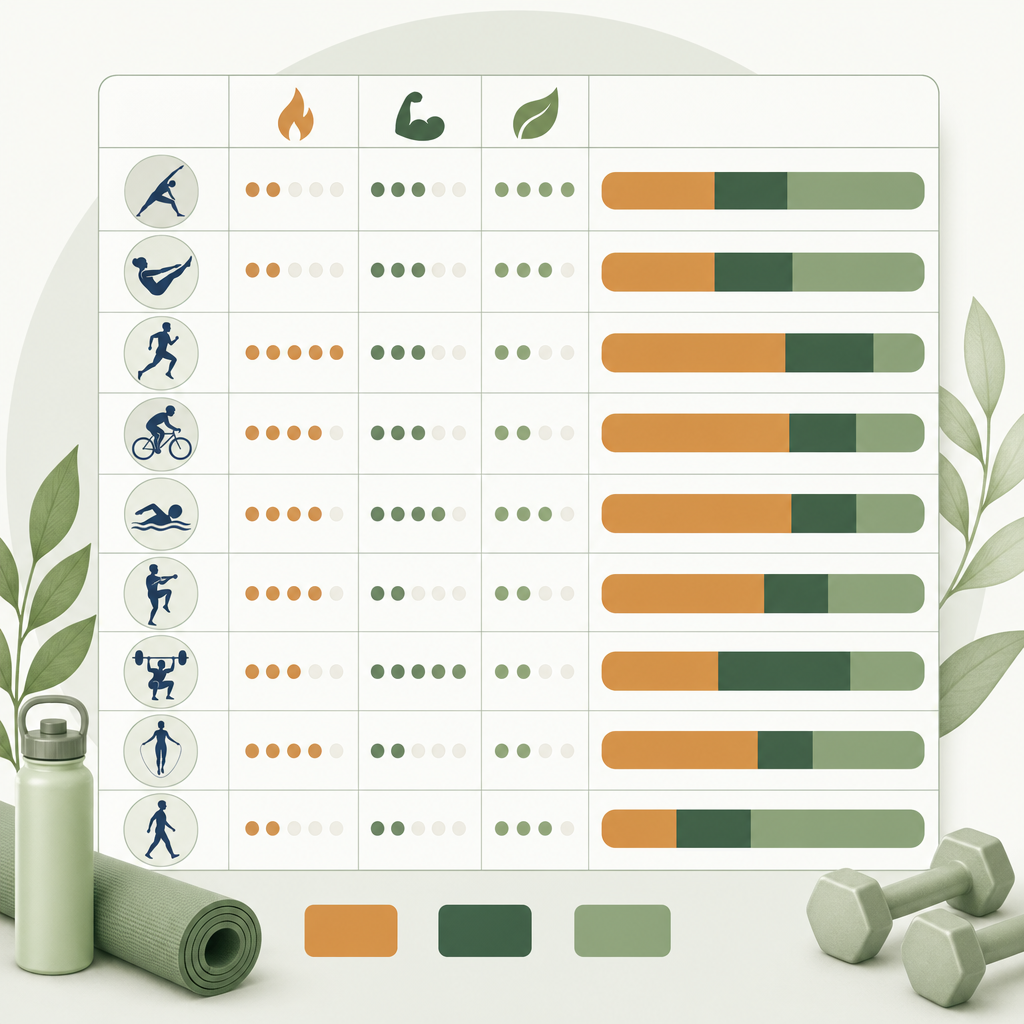
If your single goal is maximum calories burned per hour, HIIT or running wins. If your goal is a workout you can do 4 to 5 times per week for a year without injury or burnout, yogalates is in the top tier. The right choice depends on what you'll actually stick to.
The 2021 British Journal of Sports Medicine analysis of exercise adherence data put it bluntly: the workout that produces the best long-term weight loss outcomes is the one a person continues for at least 18 months. For people who hate running or cardio classes, yogalates often beats more "efficient" workouts on adherence by 3 to 5x.
How yogalates fits into a GLP-1 plan
If you're on compounded semaglutide or tirzepatide, your relationship with exercise typically shifts in the first 8 to 12 weeks. Two patterns show up consistently:
- Lower energy availability. Reduced calorie intake on a GLP-1 means less fuel for high-intensity work. Patients often report that workouts that felt manageable before treatment now feel grinding. The shift is most noticeable for HIIT, hard cardio, and heavy strength training. Lower-intensity work tolerates the energy drop better.
- Higher need for muscle preservation. GLP-1 weight loss has been shown in trials (STEP 1, SURMOUNT-1) to include around 25 to 40% lean mass loss alongside fat loss when no resistance training is added. Adding even modest resistance training (2 to 3 sessions per week) cuts that lean mass loss roughly in half.
Yogalates is one of the better-fit workouts for both patterns. The intensity is moderate enough to be sustainable on reduced calorie intake. The Pilates and yoga components include enough resistance work to preserve some lean mass, even though it's not as effective as dedicated strength training.
The pattern that works best for most patients: yogalates 2 to 3 times per week, plus a structured strength training session once or twice per week, plus daily walking. The total weekly time commitment is roughly 4 to 6 hours of movement, which most people on GLP-1s can sustain.
The catch: don't replace strength training with yogalates entirely. The dedicated lifting session does more for muscle preservation than yogalates does. Yogalates fills the gap on the days you don't want to lift but want to move.
A simple weekly movement framework
The weight-loss research that has the most consistent results uses a movement framework that combines four elements: cardiovascular work, resistance work, mobility work, and daily activity (walking, standing). Yogalates contributes to two of those (resistance and mobility), and arguably the cardiovascular when the class is high-intensity.
Sample one-week framework for a person doing yogalates as their main movement modality:
| Day | Activity | Duration |
|---|---|---|
| Mon | Yogalates (moderate) | 60 min |
| Tue | Strength training (gym or home) | 30 min |
| Wed | Walking, 3 to 4 mph | 30 to 45 min |
| Thu | Yogalates (vigorous if available) | 60 min |
| Fri | Strength training | 30 min |
| Sat | Long walk or hike | 60 to 90 min |
| Sun | Restorative yoga or rest | as needed |
That schedule produces about 250 to 350 minutes of moderate to vigorous movement per week, well above the 150-minute minimum from the U.S. Physical Activity Guidelines and matching the 250-minute weekly threshold associated with meaningful weight loss in the National Weight Control Registry.
For people new to exercise, the first 4 weeks should focus on building consistency rather than hitting full volume. Two yogalates classes plus three 20-minute walks is a reasonable starting point. Add the strength training and longer walks once the base is in place.
Better alternatives if pure weight loss is the goal
If your only metric is fastest possible weight loss in the shortest time, yogalates is probably not the optimal workout choice. Higher-impact options would be more efficient. Specifically:
- Brisk walking, 4 mph, 60 min daily. 320 to 400 calories per session, low injury risk, excellent for sustainability. The 2024 JAMA Internal Medicine analysis of step-count data found 7,000 to 10,000 steps daily is the highest-evidence dose for weight management.
- Interval cycling on a stationary bike. 400 to 500 calories per 30-minute session, low joint stress, sustainable for most fitness levels.
- Strength training (3 to 4 sessions per week of 30 to 45 min). 280 to 350 calories per session plus the resting metabolic rate boost from added muscle. Best long-term return on time invested.
- Swimming (30 to 45 min, 3 times per week). 250 to 380 calories per session, near-zero joint stress, full-body strength and cardio.
- Group strength classes (CrossFit, Orangetheory, F45). 500 to 700 calories per session, builds strength and cardio together, the structured format helps adherence.
The honest framing: yogalates is a good supplement, an excellent baseline workout for people who don't enjoy higher-intensity work, and a reasonable solo modality for people who prioritize mobility and stress reduction alongside weight loss. It's rarely the optimal sole workout for a person who has 6 months and 30 pounds to lose.
FAQ
Is yogalates good for losing weight?
Yogalates supports weight loss. It burns 150 to 250 calories per hour, builds modest lean muscle, and lowers stress hormones that drive overeating. As a sole exercise modality, it's slower than higher-intensity options. Combined with cardio and a calorie deficit, it works well.
How many calories does an hour of yogalates burn?
Most adults burn 150 to 320 calories per hour of yogalates depending on body weight and class intensity. A 155-pound adult averages 200 calories per hour at moderate intensity. A 200-pound adult averages 260.
Is yogalates better than yoga for weight loss?
Slightly, on average. The Pilates component of yogalates adds more strength work than typical yoga, which builds lean mass faster. Vinyasa or power yoga at high intensity can match yogalates on calories burned. Restorative or yin yoga burns far less.
Is yogalates better than Pilates for weight loss?
Roughly equivalent. Mat Pilates and yogalates burn similar calories per hour. Reformer Pilates burns slightly more than either due to the spring resistance. The choice is mainly about preference and access, not weight-loss efficiency.
How often should I do yogalates to lose weight?
3 to 4 sessions per week of 45 to 60 minutes is the sweet spot for most adults. Above that, you hit diminishing returns and increased risk of overuse injuries (wrist, lower back). Below that, the cumulative calorie burn and muscle gains drop off.
Can yogalates alone help me lose weight?
Possibly, if combined with a meaningful calorie deficit. Most clinical weight-loss trials show that exercise alone produces 1 to 3% body weight loss without dietary changes. Adding a 300 to 500 calorie daily deficit to a yogalates routine can drive 0.5 to 1 lb per week of fat loss.
Does yogalates work for someone on a GLP-1 medication like compounded semaglutide or tirzepatide?
Yes, and it's one of the better-tolerated options during titration. The moderate intensity matches the lower energy availability that comes with reduced calorie intake. The Pilates component helps preserve lean mass that would otherwise decline 25 to 40% during GLP-1 weight loss.
Will yogalates build muscle?
Yes, but slowly. The strength gains are mostly in core stabilizers, postural muscles, and small stabilizers in the shoulders and hips. Don't expect visible muscle growth the way you would from heavy lifting. Expect improvements in posture, balance, and functional strength over 8 to 12 weeks.
How long until I see weight loss results from yogalates?
Strength and mobility improvements show up in 4 to 8 weeks. Visible body composition changes typically take 12 to 16 weeks of 3 to 4 sessions per week, combined with a moderate calorie deficit. Faster results require higher-intensity work or larger calorie deficits.
Can beginners do yogalates?
Yes. Yogalates is one of the most beginner-friendly group fitness formats. The pace is slower than vinyasa yoga, the moves are scalable, and most studios offer "level 1" or "fundamentals" classes. People returning to exercise after injury or pregnancy often start here.
Is yogalates safe during pregnancy?
Modified yogalates is generally safe during pregnancy with provider clearance, though specific moves (deep twists, prone positions after the first trimester, intense core work) need adjustment. Look for prenatal yogalates classes, which already incorporate the modifications.
Should I combine yogalates with cardio or strength training?
Yes, for best weight-loss results. The pattern that works for most patients: yogalates 2 to 3 times per week, plus 1 to 2 strength sessions per week, plus daily walking. That covers all four elements (cardio, resistance, mobility, daily activity) the research supports.
Author / review note
Reviewed by the FormBlends Medical Team. This article was last reviewed and updated on April 29, 2026. References cited include the 2021 British Journal of Sports Medicine review on exercise adherence; the 2018 Lancet Diabetes & Endocrinology analysis of lean mass preservation in weight-loss trials; the 2023 Psychoneuroendocrinology meta-analysis on yoga and cortisol; the 2024 JAMA Internal Medicine step-count data; the U.S. Physical Activity Guidelines, 2018; and trial data from STEP 1 (semaglutide) and SURMOUNT-1 (tirzepatide).
Footer disclaimers
Platform Disclaimer. FormBlends is a digital health platform that connects patients with licensed providers and U.S.-based pharmacies. We do not manufacture, prescribe, or dispense medication directly. All clinical decisions are made by independent licensed providers.
Compounded Medication Notice. Compounded semaglutide and tirzepatide are not FDA-approved. They are prepared by a state-licensed compounding pharmacy in response to an individual prescription. Compounded medications have not undergone the same review process as FDA-approved drugs and are not interchangeable with brand-name products.
Results Disclaimer. Individual results vary. Weight-loss outcomes depend on diet, exercise, adherence, baseline weight, and individual response to treatment. Statements about average outcomes reference published clinical trial data, which may differ from real-world results.
Trademark Notice. All brand names referenced are the property of their respective owners. FormBlends is not affiliated with, endorsed by, or sponsored by any brand-name pharmaceutical manufacturer.
Related guides
- Are Peanut Butter and Jelly Sandwiches Good for Weight Loss? An Honest Look
- Is Tajin Good for Weight Loss? An Honest Look at the Calories, Sodium, and Capsaicin Math
- Is Fairlife Milk Good for Weight Loss? An Honest Look at the Numbers
- The Best Time to Eat Grapefruit for Weight Loss: What the Research Actually Says
- Does Nexplanon Cause Weight Loss? What the Research Actually Says (and Why Some Users Gain Instead)
- When to Drink Green Tea for Weight Loss: Timing, Doses, and What the Evidence Actually Shows
See your options in about 2 minutes
Take the free quiz and see what fits you. Quick, private, and no commitment to continue.
See my options →