The short answer
A standard PB&J on white bread runs around 400 to 550 calories with 15 to 30 g of sugar. Built well (whole grain bread, natural peanut butter, low-sugar fruit spread), the same sandwich drops to 300 to 350 calories with 8 to 12 g of sugar and 12 to 16 g of protein. The build determines everything.
Table of contents
- The 30-second answer
- What's actually in a standard PB&J
- Reading the nutrition label like a clinician
- The optimized build (and why it works)
- PB&J vs other lunch sandwiches (table)
- How PB&J fits into a GLP-1 plan
- A simple weekly PB&J framework
- Better alternatives if PB&J isn't satisfying you
- FAQ
- Footer disclaimers
What's actually in a standard PB&J
The classic American PB&J as most people build it: 2 slices of white sandwich bread, 2 tablespoons of commercial peanut butter (usually with added sugar and partially hydrogenated oils in older formulations, palm oil in newer ones), and 1 to 2 tablespoons of grape or strawberry jelly.
Check your GLP-1 eligibility
Use our free BMI Calculator to see if you may qualify for provider-reviewed GLP-1 therapy.
Try the BMI Calculator →Each component is doing something specific:
- White bread is refined wheat flour with the bran and germ stripped out. Two slices weigh about 56 g and run 130 to 160 calories with 1 to 2 g of fiber and roughly 3 to 4 g of protein.
- Commercial peanut butter (Jif, Skippy, Peter Pan) typically contains peanuts, sugar, palm oil, and salt. Two tablespoons (32 g) deliver 190 calories, 8 g of protein, 16 g of fat, and 3 g of added sugar.
- Grape or strawberry jelly is the highest-sugar component. Standard Smucker's grape jelly is 50 calories per tablespoon with 12 g of sugar, almost all added.
Total for the standard build: 370 to 420 calories, 11 to 12 g of protein, 2 to 3 g of fiber, and 18 to 30 g of sugar. The protein content is decent. The fiber is low and the sugar is high, which is the satiety problem.
Reading the nutrition label like a clinician
Standard PB&J (2 slices white bread + 2 tbsp commercial peanut butter + 1 tbsp grape jelly):
| Macro | Amount | % daily value |
|---|---|---|
| Calories | 380 | 19% |
| Total fat | 17 g | 22% |
| Saturated fat | 3.5 g | 18% |
| Sodium | 410 mg | 18% |
| Total carbohydrate | 47 g | 17% |
| Dietary fiber | 2.5 g | 9% |
| Total sugars | 18 g | n/a |
| Added sugars | 14 g | 28% |
| Protein | 11 g | 22% |
A clinician's read: this is a higher-calorie sandwich than most people assume, with a sugar content (18 g, of which 14 g is added) that uses up more than a quarter of the recommended daily added-sugar limit. The protein is reasonable at 11 g, but it's swimming in refined carbs.
The same sandwich built with whole grain bread (3 g fiber per slice), natural peanut butter (peanuts and salt only), and a low-sugar fruit spread:
| Macro | Amount | % daily value |
|---|---|---|
| Calories | 320 | 16% |
| Total fat | 16 g | 21% |
| Saturated fat | 3 g | 15% |
| Sodium | 320 mg | 14% |
| Total carbohydrate | 32 g | 12% |
| Dietary fiber | 7 g | 25% |
| Total sugars | 7 g | n/a |
| Added sugars | 3 g | 6% |
| Protein | 14 g | 28% |
Same sandwich format, different ingredients, completely different metabolic profile. The calorie drop comes from the bread (whole grain is denser per slice, which means a smaller weight does the same job) and the spread switch. The protein gain comes from the natural peanut butter (more peanuts per gram, since the commercial brands cut peanuts with sugar and oil).
The optimized build (and why it works)
Three swaps drive almost all of the improvement:
1. Bread. Pick a 100% whole grain bread with at least 3 g of fiber per slice and ingredient list that starts with "whole wheat flour" (not "wheat flour" or "enriched wheat flour"). Brands that consistently meet this bar include Dave's Killer Bread Powerseed, Ezekiel 4:9 Sprouted, and Trader Joe's Whole Grain Sandwich Bread. The fiber slows gastric emptying, blunts the glucose response, and adds 4 to 5 g of meaningful fiber to the sandwich.
2. Peanut butter. Pick natural peanut butter where the ingredient list reads "peanuts, salt" or just "peanuts." Examples: Smucker's Natural, Trader Joe's No-Stir Creamy, Costco Kirkland Organic. The protein content is the same per tablespoon, but the calorie density is 5 to 10% lower because there's no added sugar or palm oil filler. The flavor is also less sweet, which dampens the dessert-like quality of the sandwich.
3. Spread. This is the swap with the biggest sugar reduction. Options, ranked by quality:
- Mashed fresh berries. 1/4 cup mashed strawberries or blueberries adds 15 calories and 3 g of natural sugar. Best option, though the sandwich gets soggy fast.
- Chia seed jam. Homemade with frozen berries, chia seeds, and a splash of lemon juice. About 20 calories per tablespoon with 4 g sugar.
- All-fruit preserves. Smucker's Simply Fruit, Crofter's, or St. Dalfour run 25 to 35 calories per tablespoon with 5 to 8 g of natural sugar (no added sugar).
- Reduced-sugar jelly. Smucker's Sugar Free or Polaner Sugar Free run 10 calories per tablespoon. Use sucralose or stevia, which works fine if you tolerate those sweeteners.
The optimized PB&J holds you for 3 to 4 hours. The standard PB&J holds you for 90 minutes to 2 hours, and the sugar drop on the back end can trigger a craving for another snack within 2 hours.
PB&J vs other lunch sandwiches (head-to-head)
| Sandwich | Cal | Protein | Fiber | Sugar | Sodium | Best for |
|---|---|---|---|---|---|---|
| Standard PB&J (white bread) | 380 | 11 g | 2.5 g | 18 g | 410 mg | Quick, kid-friendly |
| Optimized PB&J (whole grain) | 320 | 14 g | 7 g | 7 g | 320 mg | Sustained energy |
| Turkey + cheese on whole grain | 380 | 24 g | 4 g | 5 g | 1,100 mg | Highest protein |
| Tuna salad on whole grain | 350 | 22 g | 4 g | 4 g | 700 mg | Omega-3, protein |
| Grilled chicken sandwich | 420 | 30 g | 3 g | 6 g | 950 mg | Lean protein |
| Veggie hummus wrap | 340 | 11 g | 8 g | 6 g | 600 mg | Plant-based, fiber |
| Egg salad on whole grain | 360 | 16 g | 4 g | 4 g | 580 mg | Choline, protein |
| Almond butter + banana | 360 | 10 g | 6 g | 14 g | 280 mg | Pre-workout |
| Avocado toast (2 slices) | 340 | 8 g | 9 g | 3 g | 350 mg | Healthy fat, fiber |
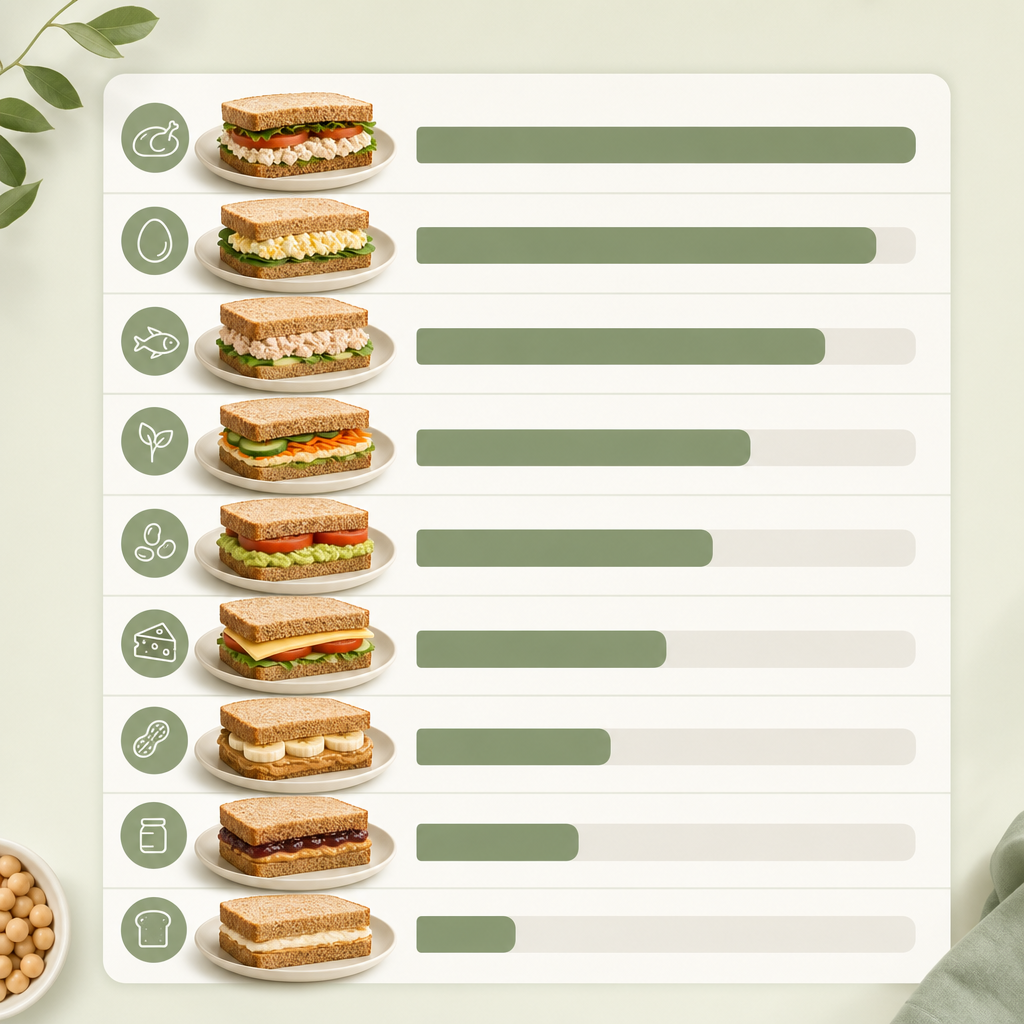
The optimized PB&J holds its own against turkey-and-cheese and grilled chicken on satiety per calorie. It loses to those options on raw protein content but wins on simplicity, shelf-stability, and cost. A whole grain PB&J runs around $1.20 per sandwich. A grilled chicken sandwich at the equivalent ingredient cost is closer to $3.50.
How PB&J fits into a GLP-1 plan
If you're on compounded semaglutide or tirzepatide, your relationship with calorie-dense foods usually shifts within 4 to 8 weeks. The constant low-grade hunger that drove higher portions quiets down. What people often report is that they want familiar comfort meals at smaller portions, and they want foods that don't trigger nausea.
PB&J fits or doesn't fit a GLP-1 plan based on three factors:
- Fat content. Two tablespoons of peanut butter delivers 16 g of fat, which is on the higher end of what some patients tolerate during early titration. If you've had GLP-1-induced nausea, drop to 1 tablespoon or switch to PB2 powdered peanut butter (50 calories, 5 g protein, 1.5 g fat per 2 tablespoons rehydrated). PB2 isn't nutritionally equivalent to natural peanut butter (the fats are mostly removed), but it solves the nausea-during-titration problem.
- Sugar content. The standard PB&J's 14 g of added sugar can produce reflux in some GLP-1 patients, particularly those on tirzepatide. The optimized build (3 g added sugar) doesn't have this issue.
- Portion size. A full PB&J is 320 to 380 calories, which is a meaningful percentage of a 1,200 to 1,500 calorie target. Most GLP-1 patients on titration find that a half-sandwich (160 to 190 calories) is the right portion. Don't force the full sandwich. Save the second half for the next meal.
The pattern that works for most patients: optimized PB&J as a once or twice weekly lunch, paired with a piece of fruit or a side of vegetables. It's familiar, shelf-stable, and provides a workable amount of protein without the meal-prep effort of a hot lunch.
A simple weekly PB&J framework
If you've used PB&J as a default lunch for years and want to keep it without stalling weight loss, the framework that works for most patients is a 3-pattern rotation: optimized PB&J twice a week, a higher-protein sandwich twice a week, and a salad or grain bowl 3 times a week.
Sample one-week framework:
| Day | Lunch | Calories | Protein |
|---|---|---|---|
| Mon | Optimized PB&J + apple | 415 | 14 g |
| Tue | Turkey + cheese on whole grain + side salad | 480 | 27 g |
| Wed | Grain bowl: quinoa, chicken, vegetables | 450 | 30 g |
| Thu | Optimized PB&J + Greek yogurt | 420 | 28 g |
| Fri | Tuna salad on whole grain + carrots | 410 | 24 g |
| Sat | Big salad with grilled salmon | 480 | 32 g |
| Sun | Half optimized PB&J + bowl of soup | 380 | 16 g |
That rotation puts PB&J in twice as a primary lunch and once as a half-portion. The total weekly calorie and protein targets stay in range without making PB&J the cornerstone of your eating plan.
The half-PB&J trick on Sunday is worth flagging. A half-sandwich plus a 200-calorie cup of bean-based or chicken soup gives you the comfort-food feel without the calorie cost of a full sandwich. The protein from the soup compensates for the lower protein in the half-sandwich.
Better alternatives if PB&J isn't satisfying you
If you're eating optimized PB&J and still hungry an hour later, the gap is usually protein. Try one of these instead:
- Almond butter + banana on Ezekiel toast. Slightly higher in protein and significantly higher in potassium. Same calorie count as a PB&J. Better pre-workout fuel.
- Cottage cheese + berries on whole grain toast. 280 calories, 18 g protein, 5 g fiber. Open-faced, eaten with a fork. Wins on satiety per calorie.
- PB&J wrap with added Greek yogurt. Use a low-carb tortilla, 1 tbsp natural peanut butter, 1 tbsp chia jam, and 2 tbsp plain Greek yogurt as a binder. About 240 calories with 16 g protein.
- Peanut butter + banana smoothie. 1 banana, 1 tbsp natural peanut butter, 1 cup unsweetened almond milk, 1 scoop protein powder. About 320 calories with 30 g protein. Drinkable in 5 minutes, holds for 4 hours.
None of these is as fast or as satisfying-feeling as a sandwich. All of them have a better satiety profile per calorie.
FAQ
Are PB&J sandwiches fattening?
A standard PB&J on white bread is calorie-dense (around 380 calories) but not inherently fattening at one sandwich per day. The "fattening" question comes down to total daily calories. The bigger issue is the sugar content (18 g, mostly added) which drives a glucose spike and rebound hunger that can lead to overeating later.
How many calories are in a PB&J sandwich?
A standard PB&J on white bread with commercial peanut butter and grape jelly is 370 to 420 calories. Built with whole grain bread, natural peanut butter, and low-sugar fruit spread, it drops to 300 to 350 calories.
Can you eat PB&J on a diet?
Yes, especially the optimized version. A PB&J built with whole grain bread, natural peanut butter, and low-sugar spread fits comfortably in a 1,500 to 2,000 calorie weight-loss plan. The standard build is harder to fit because the calorie cost-to-satiety ratio is worse.
Is peanut butter and jelly high in protein?
At 11 to 14 g of protein per sandwich, PB&J is moderate-protein. That's higher than most plant-only sandwiches but lower than meat or fish-based options like turkey, tuna, or grilled chicken. Adding a side of Greek yogurt or cottage cheese closes the protein gap.
Is PB&J a good lunch for weight loss?
The optimized build is a reasonable lunch option. The standard build is workable if it fits your daily calories and you pair it with a protein-rich side. As an everyday lunch, the optimized version wins on cost, time, and shelf-stability.
Why is peanut butter so high in calories?
Peanut butter is calorie-dense because it's mostly fat (16 g per 2 tablespoons, contributing 144 of the 190 calories). Fat is the most calorie-dense macro at 9 calories per gram, compared to 4 calories per gram for protein and carbs. The fat content is also why peanut butter is filling.
Does PB&J work as lunch on a GLP-1 medication like compounded semaglutide or tirzepatide?
Yes, with two adjustments. First, drop to 1 tablespoon of peanut butter or use PB2 powdered peanut butter to reduce the fat load and avoid nausea. Second, expect to eat a half-sandwich rather than a full one during titration. Many patients find the optimized PB&J fits well as a small lunch.
What jelly is best for weight loss?
All-fruit preserves (Smucker's Simply Fruit, Crofter's, St. Dalfour) at 25 to 35 calories per tablespoon with 5 to 8 g of natural sugar are the best balance of taste and nutrition. Sugar-free jelly works if you tolerate sucralose or stevia. Mashed fresh berries are the most nutritious option but make the sandwich soggy.
Is natural peanut butter healthier than regular?
For weight loss, yes. Natural peanut butter has roughly the same calories per tablespoon but no added sugar and no added oils. The flavor is slightly less sweet, which makes it less likely to drive overconsumption. The protein content is the same.
Can kids eat PB&J for lunch?
Yes, and PB&J is a reasonable kid-lunch option. The same upgrade advice applies: whole grain bread, natural peanut butter, and lower-sugar fruit spread. For school lunches, PB&J pairs well with a piece of fruit, a small dairy serving, and water.
Is almond butter healthier than peanut butter?
Almond butter has slightly more vitamin E and magnesium per tablespoon, slightly less protein, and slightly more calories. The differences are small. Either works for weight loss when you stick to a 2-tablespoon portion. Pick based on taste preference and price (almond butter is usually 2 to 3 times more expensive).
How do I make PB&J fit a 1,500-calorie plan?
Use the optimized build (320 calories) and pair it with a piece of fruit (100 calories) for a 420-calorie lunch. That leaves 1,080 calories for breakfast, dinner, and snacks. A breakfast of Greek yogurt with berries (200 cal), a 100-calorie afternoon snack, and a 600 to 700-calorie dinner gets you to target with room for a 100-calorie evening snack.
Author / review note
Reviewed by the FormBlends Medical Team. This article was last reviewed and updated on April 29, 2026. References cited include the USDA FoodData Central database; the U.S. Dietary Guidelines for Americans, 2020-2025; and Holt et al., European Journal of Clinical Nutrition, 1995 (satiety index, original).
Footer disclaimers
Platform Disclaimer. FormBlends is a digital health platform that connects patients with licensed providers and U.S.-based pharmacies. We do not manufacture, prescribe, or dispense medication directly. All clinical decisions are made by independent licensed providers.
Compounded Medication Notice. Compounded semaglutide and tirzepatide are not FDA-approved. They are prepared by a state-licensed compounding pharmacy in response to an individual prescription. Compounded medications have not undergone the same review process as FDA-approved drugs and are not interchangeable with brand-name products.
Results Disclaimer. Individual results vary. Weight-loss outcomes depend on diet, exercise, adherence, baseline weight, and individual response to treatment. Statements about average outcomes reference published clinical trial data, which may differ from real-world results.
Trademark Notice. All brand names referenced are the property of their respective owners. FormBlends is not affiliated with, endorsed by, or sponsored by any brand-name pharmaceutical manufacturer.
Related guides
- Is Yogalates Good for Weight Loss? An Honest Look at What the Research Actually Shows
- Is Tajin Good for Weight Loss? An Honest Look at the Calories, Sodium, and Capsaicin Math
- Is Fairlife Milk Good for Weight Loss? An Honest Look at the Numbers
- Is Propel Good for Weight Loss? A Label-First Look at Zero-Cal Electrolyte Water
- Is Jasmine Rice Good for Weight Loss? The Honest Answer Backed by the Numbers
- Is Chai Latte Good for Weight Loss? An Honest Answer Backed by the Sugar Content
See your options in about 2 minutes
Take the free quiz and see what fits you. Quick, private, and no commitment to continue.
See my options →