The short answer
For brand-name Mounjaro, 2.5 mg is delivered in 0.5 mL by the prefilled single-dose pen. For compounded tirzepatide, 2.5 mg in mL depends on concentration: at 10 mg/mL it's 0.25 mL, at 5 mg/mL it's 0.5 mL, at 20 mg/mL it's 0.125 mL. Always read your vial label.
Table of contents
- The 30-second answer
- Brand Mounjaro: 0.5 mL per pen
- Why brand pen volume is fixed
- Compounded tirzepatide: it depends on concentration
- Conversion chart for compounded tirzepatide
- How to find your concentration on the label
- The 2.5 mg starting dose explained
- Drawing 2.5 mg from a compounded vial
- Common mistakes around the 2.5 mg conversion
- Why the math matters more than people realize
- FAQ
- Footer disclaimers
Brand Mounjaro: 0.5 mL per pen
Mounjaro (tirzepatide) from Eli Lilly is supplied in single-dose prefilled pens. Each pen contains one weekly dose. The 2.5 mg pen contains exactly 0.5 mL of solution at a concentration of 5 mg/mL.
Check your GLP-1 eligibility
Use our free BMI Calculator to see if you may qualify for provider-reviewed GLP-1 therapy.
Try the BMI Calculator →When you press the pen against your skin and trigger the injection, the full 0.5 mL is delivered automatically. There's no measuring, no drawing, and no syringe to read. The mechanism takes about 5 to 10 seconds to complete.
The 0.5 mL volume is consistent across most Mounjaro pen strengths (some higher doses are at the same volume, others at slightly different volumes). The 2.5 mg pen specifically is 0.5 mL at 5 mg/mL.
Each pen is a single-use device. You don't reuse Mounjaro pens, and you don't draw additional doses from them. Once injected, the pen goes in a sharps container.
Why brand pen volume is fixed
The Mounjaro pen is engineered around a single dose. The mechanism delivers a predetermined volume regardless of any user input. This is by design: it removes the math, the drawing, and the human error from injection.
The trade-off is that brand pens come in fixed strengths (2.5 mg, 5 mg, 7.5 mg, 10 mg, 12.5 mg, 15 mg). You can't dial in a custom dose. If your provider wants you on 6 mg, you don't get a 6 mg pen. You get either 5 mg or 7.5 mg.
For most patients, the fixed strengths line up with the standard titration ladder, so this isn't a constraint. Patients who want fractional doses (for example, a person who tolerates 5 mg poorly but does fine on 6 mg) typically can't get them through the brand product. That's part of why some patients move to compounded formulations.
The pen's ease-of-use is its main advantage over a vial-and-syringe approach. There's no concentration math, no draw error, and no decision-making at the moment of injection. For a weekly therapy that runs for years, that simplicity matters.
Compounded tirzepatide: it depends on concentration
Compounded tirzepatide arrives in multi-dose vials. The pharmacy fills the vial at one of a few standard concentrations. Common ones in the U.S.:
- 5 mg/mL. A 2.5 mg dose is 0.5 mL (50 units on a U-100 insulin syringe).
- 10 mg/mL. A 2.5 mg dose is 0.25 mL (25 units on a U-100 insulin syringe).
- 15 mg/mL. A 2.5 mg dose is 0.17 mL (17 units on a U-100 insulin syringe).
- 20 mg/mL. A 2.5 mg dose is 0.125 mL (12.5 units on a U-100 insulin syringe).
The 10 mg/mL concentration is the most common because the unit math is clean: 1 mg of tirzepatide equals 10 units, every standard dose comes out to a whole-number unit reading, and the injection volume stays small.
To convert milligrams to milliliters at any concentration, divide the milligram dose by the concentration. For 2.5 mg at 10 mg/mL: 2.5 ÷ 10 = 0.25 mL. To convert milliliters to units on a U-100 syringe, multiply by 100. So 0.25 mL × 100 = 25 units.
Conversion chart for compounded tirzepatide
The full chart for every common compounded concentration and every common dose:
| Concentration | 2.5 mg | 5 mg | 7.5 mg | 10 mg | 12.5 mg | 15 mg |
|---|---|---|---|---|---|---|
| 5 mg/mL | 0.5 mL (50 u) | 1.0 mL (100 u) | 1.5 mL (150 u) | 2.0 mL (200 u) | 2.5 mL (250 u) | 3.0 mL (300 u) |
| 10 mg/mL | 0.25 mL (25 u) | 0.5 mL (50 u) | 0.75 mL (75 u) | 1.0 mL (100 u) | 1.25 mL (125 u) | 1.5 mL (150 u) |
| 15 mg/mL | 0.17 mL (17 u) | 0.33 mL (33 u) | 0.5 mL (50 u) | 0.67 mL (67 u) | 0.83 mL (83 u) | 1.0 mL (100 u) |
| 20 mg/mL | 0.125 mL (12.5 u) | 0.25 mL (25 u) | 0.375 mL (37.5 u) | 0.5 mL (50 u) | 0.625 mL (62.5 u) | 0.75 mL (75 u) |
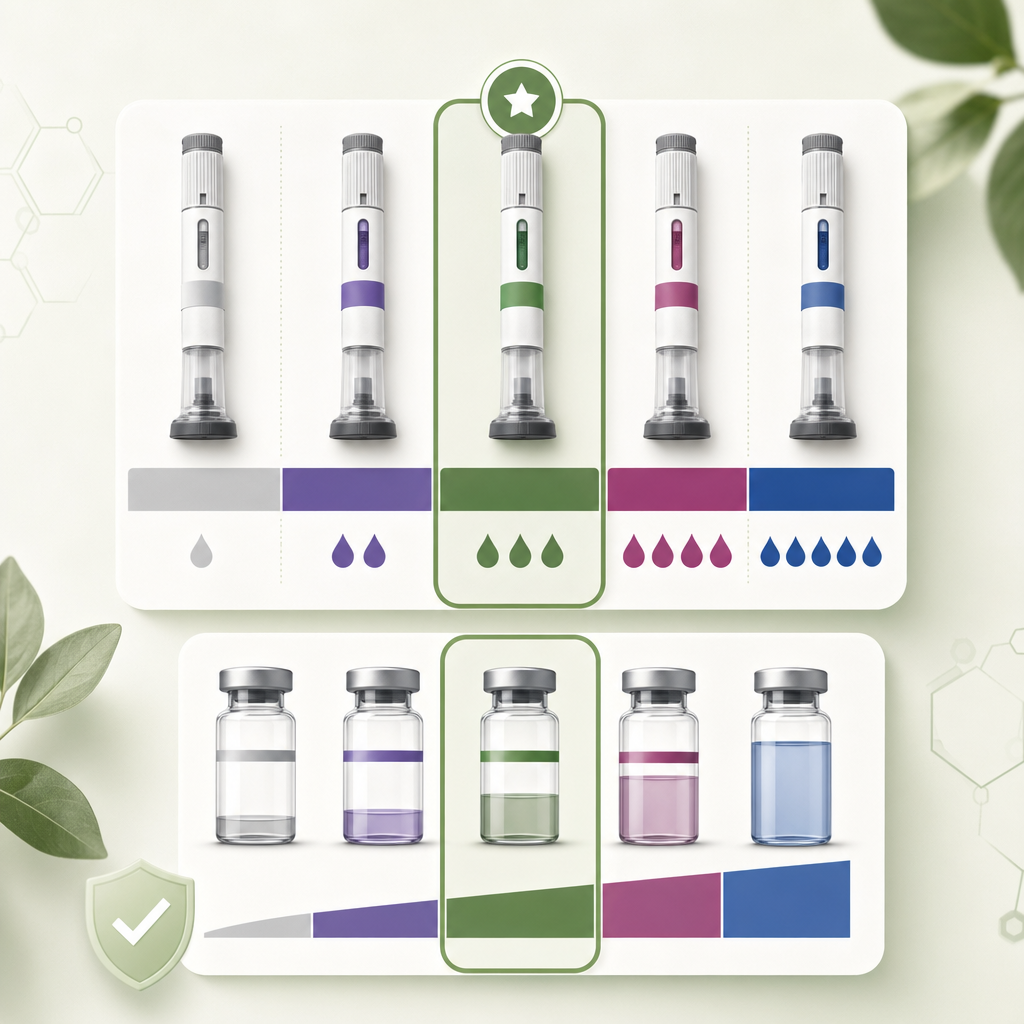
For deeper detail on the unit conversions, see our guide on how many units is 2.5 mg of tirzepatide.
How to find your concentration on the label
Pick up your vial. Read the label. Look for one of these formats:
- "Tirzepatide 10 mg/mL": that's the concentration. 2.5 mg is 0.25 mL.
- "Tirzepatide 100 mg / 10 mL Multi-Dose Vial": divide. 100 ÷ 10 = 10 mg/mL.
- "Tirzepatide 30 mg / 1.5 mL": divide. 30 ÷ 1.5 = 20 mg/mL.
- "Tirzepatide for Reconstitution, 30 mg": this is dry powder. The concentration is set when you reconstitute the vial with bacteriostatic water. The pharmacy's dispensing instructions specify exactly how much water to add. (See our reconstitution guide for the full process.)
If your label only shows total milligrams without a volume, the concentration is in the patient handout, the prescription label on the outer packaging, or the pharmacy's online portal. Don't guess. Two pharmacies dispensing what they call a "30 mg vial" can have very different total volumes, which means very different concentrations.
If you can't find the concentration anywhere, call the pharmacy before drawing a dose. This protects you from a 2x or 4x dosing error.
The 2.5 mg starting dose explained
2.5 mg is the starting dose for tirzepatide and is held for 4 weeks before any titration. The reason has nothing to do with the math and everything to do with tolerability.
Tirzepatide slows gastric emptying and signals satiety to the brain. At full dose, this can cause nausea, vomiting, reflux, constipation, and other GI symptoms. Starting at 2.5 mg lets the gut adapt before the dose increases. Most patients tolerate 2.5 mg well, with side effects that are noticeable but manageable.
After 4 weeks, the dose typically increases to 5 mg. From there, dose escalation continues every 4 weeks in 2.5 mg increments, up to a maximum maintenance dose of 15 mg. Patients who can't tolerate the next step often hold at the previous dose for an extra 4 weeks before retrying.
The 2.5 mg starting dose itself isn't expected to drive significant weight loss. It's a tolerability bridge to the higher maintenance doses where the weight-loss data is strongest. Patients sometimes get discouraged in week 4 because they haven't lost much. That's expected. The dose ladder is designed to ramp into therapeutic territory after the gut has adapted.
For more on starting dose strategy, see our piece on can you start at 5 mg of zepbound.
Drawing 2.5 mg from a compounded vial
If you've been prescribed 2.5 mg of compounded tirzepatide and your vial is at 10 mg/mL (the most common concentration), here's the protocol:
Materials:
- Compounded tirzepatide vial
- U-100 insulin syringe with attached needle, 0.3 mL or 0.5 mL barrel, 31-gauge, 5/16-inch needle
- Two alcohol swabs
- Sharps container
Steps:
- Wash your hands with soap and water for 20 seconds.
- Inspect the vial. Tirzepatide should be clear and colorless to faintly straw-yellow. Cloudy, particulate, or unexpected color means stop and call the pharmacy.
- Wipe the vial top with an alcohol swab. Let it air-dry. Don't blow on it.
- Pull the syringe plunger to draw 25 units of air. (For 2.5 mg at 10 mg/mL, the dose is 25 units.)
- Insert the needle into the vial through the rubber stopper. Push the air in.
- Invert the vial with the needle inserted. Pull the plunger back to draw 25 units of liquid.
- Check for air bubbles. If present, push the liquid back into the vial and re-draw, or flick the syringe to dislodge bubbles.
- Confirm 25 units in the syringe at eye level. The leading edge of the plunger should sit on the 25-unit line.
- Withdraw the needle from the vial. Don't recap.
- Pick an injection site. Subcutaneous sites are the abdomen (avoid 2 inches around the navel), the front or outer thigh, or the back of the upper arm. Rotate sites week to week.
- Wipe the injection site with the second alcohol swab. Let it air-dry.
- Pinch a fold of skin. Insert the needle at 90 degrees. Push the plunger steadily until the syringe is empty. Hold for 5 seconds.
- Withdraw the needle. Apply gentle pressure with a clean tissue if there's any bleeding.
- Drop the syringe into a sharps container.
The whole process takes about 90 seconds once you've done it a few times.
Common mistakes around the 2.5 mg conversion
The 2.5 mg dose is where most conversion errors happen because it's the starting dose and most patients are new to the math.
Confusing the brand pen with a vial. A patient who's seen "Mounjaro 2.5 mg = 0.5 mL" online and then receives a compounded vial at 10 mg/mL may try to draw 0.5 mL. That's actually 5 mg, double the intended dose. The brand pen volume only applies to brand pens.
Reading a "30 mg vial" as a 30 mg dose. A multi-dose vial labeled "30 mg" contains 30 mg total, which is 12 weekly doses of 2.5 mg. Each draw is a fraction of the vial. Patients occasionally try to inject the whole thing, which would be 12x the intended dose.
Drawing 2.5 mL instead of 0.25 mL. Decimal points get missed. Always confirm at eye level that the plunger sits on the right line. A 2.5 mL injection is 100 units of insulin syringe markings, which won't fit in a 0.5 mL barrel anyway, so this error usually self-corrects when the syringe runs out of room. If you're using a 1 mL syringe, the error is harder to catch.
Drawing from a reconstituted vial without confirming concentration. A 30 mg powder reconstituted with 1.5 mL of bacteriostatic water makes 20 mg/mL. With 3 mL it's 10 mg/mL. With 6 mL it's 5 mg/mL. Read the reconstitution instructions every time.
A 2024 review in Annals of Pharmacotherapy (Patel et al.) found that 7 to 10% of patients self-administering compounded GLP-1 medications reported at least one suspected dosing error in the first 90 days of therapy.
Why the math matters more than people realize
A 2x or 4x dose error on tirzepatide isn't usually life-threatening, but it's not minor either. At 2 to 4x the intended dose, side effects scale up sharply. Severe nausea and vomiting can lead to dehydration. Pancreatitis risk goes up. Gallbladder issues become more likely.
The therapeutic window for tirzepatide is wide enough that small variations (5 to 10%) are clinically irrelevant. That's why a unit or two off from the intended draw doesn't matter. What matters is getting the order of magnitude right.
The cleanest way to avoid magnitude errors is to write your unit count on the box of your vial in marker. Read it before every injection. Recheck the concentration any time you receive a new vial, especially from a different pharmacy or after a refill at a new strength.
FAQ
How many mL is 2.5 mg of Mounjaro?
For the brand-name Mounjaro pen, 2.5 mg is 0.5 mL at 5 mg/mL concentration, delivered automatically by the pen. For compounded tirzepatide, the answer depends on concentration: 0.5 mL at 5 mg/mL, 0.25 mL at 10 mg/mL, 0.125 mL at 20 mg/mL.
What is 2.5 mg of Mounjaro in units?
For brand Mounjaro you don't measure in units, the pen delivers automatically. For compounded tirzepatide on a U-100 insulin syringe, 2.5 mg at 10 mg/mL is 25 units. At 5 mg/mL it's 50 units.
Why is the starting dose 2.5 mg?
2.5 mg lets the gut adapt to the medication before higher doses. Most patients tolerate 2.5 mg with manageable GI side effects. The dose typically isn't expected to drive significant weight loss; it's a tolerability bridge to the higher therapeutic doses.
How long do I stay at 2.5 mg?
Standard titration is 4 weeks at 2.5 mg before increasing to 5 mg. If you're not tolerating 5 mg, your provider may extend 2.5 mg or step you up more slowly.
Can I split the brand Mounjaro pen?
The brand pen is engineered as a single-dose device. It's not designed to deliver partial doses. Splitting risks dose inaccuracy and contamination of the pen. For partial-dose flexibility, ask your provider about compounded vials.
Does compounded tirzepatide work the same as Mounjaro?
Compounded tirzepatide uses the same active peptide, but compounded products are not FDA-approved and are not interchangeable with brand-name Mounjaro. The clinical data on weight loss and blood sugar comes from the brand product. Compounded efficacy is assumed to be similar but isn't independently verified by the FDA.
What concentration of compounded tirzepatide should I ask for?
10 mg/mL is the most common because the unit math is clean. 5 mg/mL gives a larger injection volume that's easier to read at low doses. Ask your provider what they prescribe.
Does the injection volume matter?
Smaller volumes (under 0.5 mL) inject faster and feel less uncomfortable. Larger volumes can sting more during the injection. For most patients, the difference is minor.
What if my pen says it has 0.5 mL but mine looks different?
Brand Mounjaro pens are sealed and pre-measured. If your pen looks different from what you expect, check the box and the pen label to confirm strength and brand. Counterfeit GLP-1 pens have appeared in some markets.
Can I save extra solution if I draw too much?
Push the excess back into the vial. Don't store it in the syringe. Bacteria can grow in syringes left at room temperature.
Why does my dose card say 2.5 mg but the pharmacy gave me a different volume?
The volume depends on the formulation. Brand pens, vials at different concentrations, and reconstituted powders all deliver 2.5 mg in different volumes. Always go by the milligram dose, not the volume.
Are there 2.5 mg increments above the starting dose?
Yes. Brand Mounjaro is available in 2.5, 5, 7.5, 10, 12.5, and 15 mg pens. Compounded tirzepatide can be prescribed in any milligram dose your provider specifies, including non-standard increments.
Author / review note
Reviewed by the FormBlends Medical Team. References include the FDA-approved prescribing information for tirzepatide, the U.S. Pharmacopeia chapter on insulin syringes, and Patel et al. in Annals of Pharmacotherapy (2024) on compounded GLP-1 dosing accuracy.
Footer disclaimers
Platform Disclaimer. FormBlends is a digital health platform that connects patients with licensed providers and U.S.-based pharmacies. We do not manufacture, prescribe, or dispense medication directly. All clinical decisions are made by independent licensed providers.
Compounded Medication Notice. Compounded semaglutide and tirzepatide are not FDA-approved. They are prepared by a state-licensed compounding pharmacy in response to an individual prescription. Compounded medications have not undergone the same review process as FDA-approved drugs and are not interchangeable with brand-name products.
Results Disclaimer. Individual results vary. Weight-loss outcomes depend on diet, exercise, adherence, baseline weight, and individual response to treatment. Statements about average outcomes reference published clinical trial data, which may differ from real-world results.
Trademark Notice. Mounjaro and Zepbound are registered trademarks of Eli Lilly and Company. FormBlends is not affiliated with, endorsed by, or sponsored by Eli Lilly.
See your options in about 2 minutes
Take the free quiz and see what fits you. Quick, private, and no commitment to continue.
See my options →