The short answer
For compounded tirzepatide at the most common concentration of 10 mg/mL, 15 mg equals 150 units on a U-100 insulin syringe. At 5 mg/mL it's 300 units (which exceeds a single 1 mL syringe). At 20 mg/mL it's 75 units. The exact number depends on the concentration printed on your specific vial.
Table of contents
- The 30-second answer
- Why "units" works for tirzepatide even though it's not insulin
- Unit conversion chart for 15 mg at every common concentration
- Why 15 mg is the maximum tirzepatide dose
- How to find your vial's concentration
- Step-by-step: drawing 15 mg accurately
- Common errors at the 15 mg dose level
- Storage, shelf life, and color warnings
- When to call your provider
- FAQ
- Footer disclaimers
Why "units" works for tirzepatide even though it's not insulin
A "unit" is technically a measurement of insulin biological activity. Tirzepatide isn't insulin and doesn't have a unit-based potency. When patients and pharmacies say "150 units of tirzepatide," what they mean is "150 markings on a U-100 insulin syringe," which corresponds to 150 hundredths of a milliliter (1.50 mL).
Check your GLP-1 eligibility
Use our free BMI Calculator to see if you may qualify for provider-reviewed GLP-1 therapy.
Try the BMI Calculator →The U-100 insulin syringe is the standard tool because it's cheap, widely available, and has the fine markings needed for small subcutaneous doses. Compounding pharmacies write dosing instructions in units to map prescribed milligrams onto the syringe most patients already have at home.
What this means for the 15 mg question: the answer depends entirely on the concentration of your vial. The same 15 mg dose can be 75 units, 100 units, or 150 units depending on what the pharmacy dispensed. Reading the concentration label is the first step every time.
Unit conversion chart for 15 mg at every common concentration
The four concentrations most U.S. compounding pharmacies use:
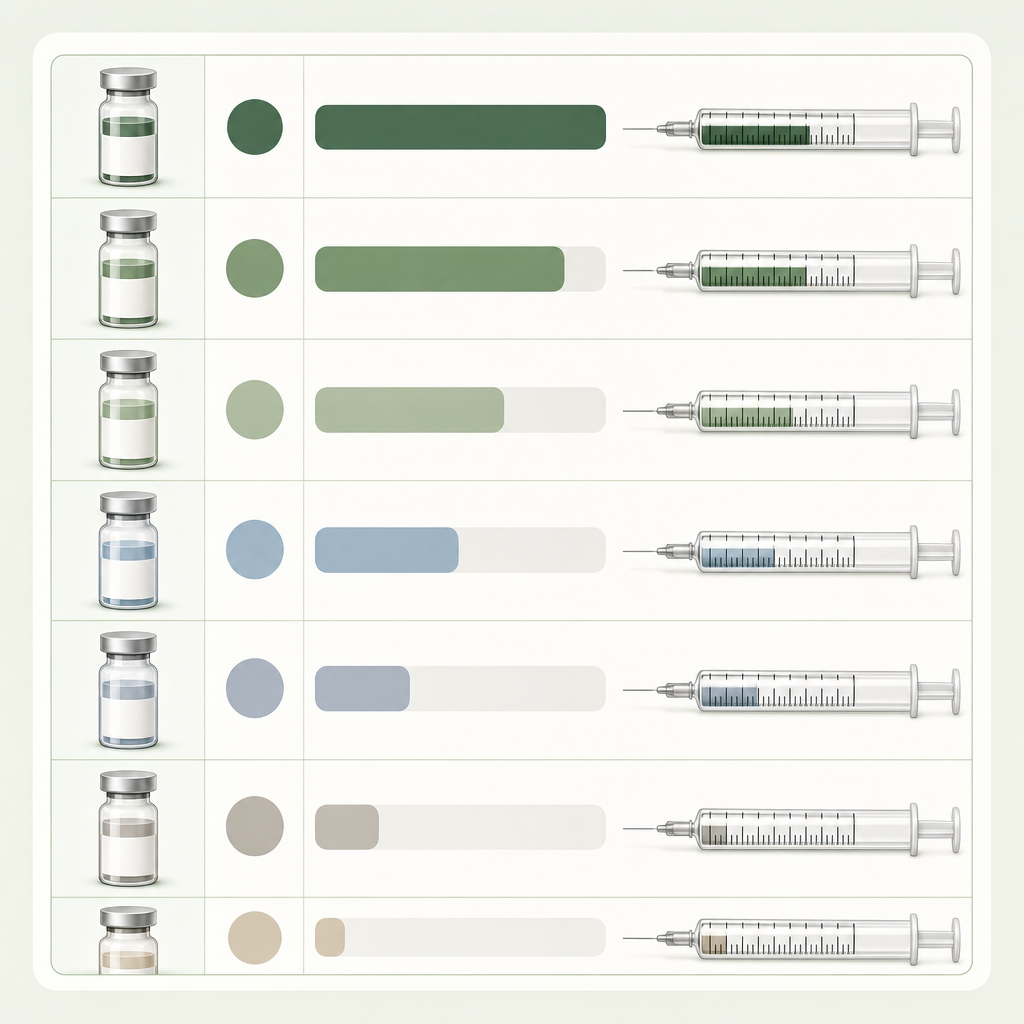
| Concentration | 15 mg dose volume | 15 mg dose units (U-100 syringe) |
|---|---|---|
| 5 mg/mL | 3.00 mL | 300 units (requires 3 mL syringe or split injection) |
| 10 mg/mL | 1.50 mL | 150 units |
| 15 mg/mL | 1.00 mL | 100 units |
| 20 mg/mL | 0.75 mL | 75 units |
A 1 mL U-100 insulin syringe maxes out at 100 units. The 5 mg/mL concentration at the full 15 mg dose exceeds this and either requires a 3 mL syringe (uncommon) or two split injections of 150 units each. Most compounding pharmacies that dispense for 15 mg patients move to a more concentrated formulation specifically to keep the volume injectable in a single syringe.
The 10 mg/mL formulation is the most common at the 15 mg dose level because the math works out cleanly: 15 mg ÷ 10 mg/mL × 100 units/mL = 150 units. Patients can use a 1.5 mL syringe (the largest U-100 size widely available) or split into two injections of 75 units each.
The 20 mg/mL concentration is increasingly common at higher dose levels because it keeps the injection volume small (75 units = 0.75 mL) and fits a 4-week supply in a smaller vial.
The general formula:
- Volume (mL) = Dose (mg) ÷ Concentration (mg/mL)
- Units = Volume (mL) × 100
For 15 mg specifically: 15 mg ÷ X mg/mL × 100 = your unit count.
Why 15 mg is the maximum tirzepatide dose
The 15 mg dose is the FDA-labeled maximum for tirzepatide (sold as Mounjaro for type 2 diabetes and Zepbound for chronic weight management). The titration schedule recommended by Eli Lilly's prescribing information looks like this:
| Week | Dose |
|---|---|
| 1-4 | 2.5 mg weekly |
| 5-8 | 5 mg weekly |
| 9-12 | 7.5 mg weekly (optional intermediate step) |
| 13-16 | 10 mg weekly |
| 17-20 | 12.5 mg weekly (optional) |
| 21+ | 15 mg weekly (maximum) |
The 15 mg dose is reached after roughly 5 to 6 months of progressive titration in patients who tolerate the medication and need additional weight-loss or glucose-lowering effect. Many patients respond well at 10 mg or 12.5 mg and never need to escalate to 15 mg.
The clinical trials behind 15 mg approval (SURMOUNT-1, SURPASS-2) showed an average weight loss of about 22.5% of baseline body weight at 72 weeks at the 15 mg dose, compared to roughly 19.5% at 10 mg. The marginal benefit of going from 10 to 15 mg is real but smaller than the jumps earlier in titration.
Side effect rates rise with dose. In SURMOUNT-1, GI side effects were 6 to 8 percentage points higher in the 15 mg arm compared to 10 mg. Patients sometimes choose to stay at 10 mg or 12.5 mg even if they could tolerate 15 mg, because the trade-off of additional weight loss for additional GI side effects doesn't favor escalation.
How to find your vial's concentration
The concentration is printed on the vial label. Look for a phrase like "10 mg/mL" or a fraction like "120 mg/12 mL." The two formats mean the same thing.
If the label only shows total milligrams (e.g., "120 mg") without a volume, the concentration is in the pharmacy's dispensing instructions, the patient handout, or the prescription label on the outer box.
Common label formats you'll see at the 15 mg dose level:
- "Tirzepatide Injection 10 mg/mL, 12 mL Multi-Dose Vial": 10 mg per mL, 120 mg total, 8 weekly 15 mg doses per vial.
- "Tirzepatide 60 mg / 6 mL": divide 60 by 6 = 10 mg/mL.
- "Tirzepatide for Reconstitution, 90 mg": this is a powder. The concentration depends on how much bacteriostatic water you add per the pharmacy's instructions.
If you can't find the concentration on the vial, the box, the paper insert, or your pharmacy patient portal, call the pharmacy before drawing a dose. At the 15 mg level a concentration mistake produces a meaningfully wrong dose.
Step-by-step: drawing 15 mg accurately
The protocol assumes you have a 10 mg/mL pre-mixed vial of compounded tirzepatide and a U-100 insulin syringe with at least a 1.5 mL barrel. Adjust unit counts using the chart above for other concentrations.
Materials:
- Compounded tirzepatide vial
- U-100 insulin syringe (1.5 mL barrel for 10 mg/mL formulation, or 1 mL for higher concentrations) with attached needle, typically 31-gauge, 5/16-inch
- Two alcohol swabs
- Sharps container
Steps:
- Wash your hands with soap and water for 20 seconds.
- Inspect the vial. Tirzepatide should be clear and colorless to slightly straw-yellow. If cloudy, particulate, or unusually dark, don't use it. Contact the pharmacy.
- Wipe the vial top with an alcohol swab. Let it air-dry. Don't blow on it.
- Pull back the syringe plunger to draw 150 units of air (matching the dose volume).
- Insert the needle into the vial through the rubber stopper. Push the air in. This equalizes pressure inside the vial and makes withdrawal easier.
- Invert the vial with the needle inserted. Pull the plunger back to draw 150 units of liquid. Check for air bubbles. If bubbles are present, push the liquid back into the vial and re-draw.
- Confirm 150 units in the syringe by holding it at eye level. The plunger's leading edge (not the tail) should sit on the 150-unit line.
- Remove the needle from the vial. Don't recap.
- Choose an injection site. Subcutaneous sites are the abdomen (avoiding 2 inches around the navel), the front or outer thigh, or the back of the upper arm. Rotate sites weekly.
- Wipe the injection site with the second alcohol swab. Let it air-dry.
- Pinch a fold of skin. Insert the needle at a 90-degree angle. Push the plunger steadily until the syringe is empty.
- Withdraw the needle. Apply gentle pressure with a clean tissue if there's any bleeding (rare).
- Dispose of the syringe in a sharps container.
The 150-unit injection volume at the 15 mg dose is larger than what most patients are used to from earlier titration. Some patients report mild stinging at injection due to the larger volume. Cold injections sting more than room-temperature ones, so removing the vial from the fridge 15 to 20 minutes before drawing helps.
Common errors at the 15 mg dose level
Higher doses introduce error patterns that don't show up at lower doses. Drawing from FDA Adverse Event Reporting System data and patient-reported issues:
Error 1: Using the wrong syringe size. A 0.5 mL or 1 mL syringe can't hold the 150-unit volume needed at 10 mg/mL. Patients sometimes split into two injections to make it work, which is fine if intentional but confusing if not. Order 1.5 mL or larger U-100 syringes specifically for 15 mg dosing.
Error 2: Reading at 15 vs 150. "15 mg" and "150 units" share the digit pattern. Patients in a hurry occasionally draw 15 units (which would be 1.5 mg, an under-dose by 90%). Writing "150 UNITS" on the vial box in marker prevents this. The fix is the same for any number: confirm by reading the printed numerals on the syringe before injecting.
Error 3: Switching pharmacies without re-checking concentration. Pharmacy A's 10 mg/mL becomes Pharmacy B's 20 mg/mL on a refill. The same "150 units" now delivers 30 mg, which is double the maximum dose. Always read the concentration on every new vial.
Error 4: Splitting doses incorrectly. Some patients split 150 units into two 75-unit injections. This works pharmacokinetically (the medication is the same regardless of one or two injection sites). The error is splitting unevenly, e.g., 100 + 50 instead of 75 + 75. Use a marker to mark the 75-unit fill level on the syringe before drawing if you split routinely.
Error 5: Reconstituted vial concentration confusion. A 90 mg lyophilized powder reconstituted with 4.5 mL bacteriostatic water makes a 20 mg/mL solution. Reconstituted with 9 mL it's 10 mg/mL. Read the reconstitution instructions every time.
A 2024 study (Patel et al., Annals of Pharmacotherapy) found that 7.2% of patients self-administering compounded tirzepatide reported at least one suspected dosing error in the first 90 days. Error rates were highest at dose escalations, including the move from 12.5 to 15 mg.
Storage, shelf life, and color warnings
Refrigeration: unopened compounded tirzepatide vials are stored at 36 to 46°F (2 to 8°C). Don't freeze. Direct freezing degrades the peptide and renders the vial unusable.
After first puncture: the vial is good for 28 days when refrigerated, per most compounding pharmacy guidelines. Some pharmacies stamp 21 days. The shorter window applies to vials without bacteriostatic preservative.
Travel: insulated bag with a frozen gel pack (not direct ice). Direct freezing destroys the peptide structure. The pharmacy can supply a travel kit if requested.
Color: clear and colorless to faint straw-yellow is normal. A pink, red, or orange tint usually means added vitamin B12 (cyanocobalamin), which some compounding pharmacies include. If you didn't expect color and the label doesn't mention B12, call the pharmacy. (For more on color variations, see our color guide.)
Cloudiness or particles: never use a vial with cloudy contents, visible particles, or settled material at the bottom. Tirzepatide can aggregate if temperature-cycled. Aggregated peptide is less effective and can be more immunogenic.
When to call your provider
Same week:
- You've drawn or injected a dose meaningfully different from 15 mg (e.g., 30 mg by miscalculating concentration, or 1.5 mg by misreading the syringe).
- New onset of severe nausea, vomiting, or abdominal pain after escalating to 15 mg.
- Persistent injection site reactions beyond local irritation that resolves in a few days.
Same day:
- Severe upper abdominal pain (rule out pancreatitis).
- Right-upper-quadrant pain after fatty meals (rule out gallbladder disease, more common at higher tirzepatide doses).
- Persistent vomiting beyond 12 hours.
- Signs of dehydration.
Emergency care:
- Allergic reaction signs (hives, facial swelling, difficulty breathing).
- Vomiting blood or coffee-ground material.
- Severe chest pain.
The therapeutic window for tirzepatide is wide enough that small draw errors (5 to 10% off intended dose) rarely cause clinical issues. Large errors (50% or more in either direction) warrant a provider call.
FAQ
How many units is 15 mg of tirzepatide on a U-100 syringe?
At 10 mg/mL (the most common concentration), 15 mg equals 150 units. At 5 mg/mL it's 300 units (split injection or larger syringe needed). At 15 mg/mL it's 100 units. At 20 mg/mL it's 75 units.
What size syringe do I need for 15 mg?
A 1.5 mL U-100 syringe holds the volume for 10 mg/mL formulations. For higher concentrations (15 mg/mL or 20 mg/mL), a 1 mL syringe works. Standard 0.3 mL or 0.5 mL syringes don't hold enough volume for the full 15 mg dose at 10 mg/mL.
Do I have to take 15 mg, or can I stay at a lower dose?
The 15 mg dose is the maximum. Many patients achieve their target weight loss or glucose control at 10 mg or 12.5 mg and don't need to escalate. The decision is between you and your prescriber based on response, side effects, and goals.
Why does the unit count differ between pharmacies?
Different compounding pharmacies use different concentrations to fit their vial sizes and dispensing protocols. The same 15 mg dose can be 75 units at one pharmacy and 150 units at another. Re-check concentration on every refill and every pharmacy switch.
Can I round my 15 mg dose if it falls between unit markings?
At 10 mg/mL the dose is exactly 150 units (no rounding needed). At odd concentrations (15 mg/mL gives 100 units, also clean). The 5 mg/mL concentration produces awkward fractional results that may require slight rounding. A 1 to 2 unit rounding error has no clinical impact.
What if I draw too much at the 15 mg dose level?
Push the excess back into the vial. Don't inject more than prescribed. If you've already injected an over-dose (e.g., 200 units instead of 150), monitor for severe nausea, vomiting, and abdominal pain. Call your provider if symptoms last beyond 12 hours.
Can I split the 15 mg into two injections?
Yes, two 75-unit injections at separate sites are pharmacokinetically equivalent to a single 150-unit injection. Some patients split for comfort because the larger volume can sting more. Splitting also uses more syringes and increases handling, which slightly raises error risk.
Why is my 15 mg dose 0.75 mL but my friend's is 1.5 mL?
You're using different concentrations. 0.75 mL of 20 mg/mL = 15 mg. 1.5 mL of 10 mg/mL = 15 mg. The dose is the same; the volume isn't. (See our companion guide on 2.5 mg unit conversions for the full chart at lower doses.)
Does 15 mg compounded tirzepatide work the same as 15 mg Mounjaro or Zepbound?
Both contain tirzepatide as the active ingredient. The pharmacology is the same. Compounded products are not FDA-approved and not interchangeable with brand-name Mounjaro or Zepbound from a regulatory standpoint, even when the active ingredient is identical.
Can I switch from a brand-name 15 mg pen to compounded 15 mg vial without re-titrating?
Generally yes, if you've been stable on the 15 mg pen and your provider agrees. The active ingredient and dose are equivalent. The injection technique differs (vial-and-syringe vs auto-injector pen).
How often do I inject the 15 mg dose?
Once weekly, on the same day each week. Tirzepatide's half-life is approximately 5 days, so weekly dosing maintains stable blood levels. Don't double up if you miss a dose.
What's the largest U-100 syringe I can buy for 15 mg dosing?
1.5 mL (150 units) is the largest U-100 insulin syringe commonly available at retail pharmacies. 3 mL syringes exist but are usually U-40 or unmarked, which complicates dose math. Stick with the 1.5 mL U-100 size for 10 mg/mL formulations.
Author / review note
Reviewed by the FormBlends Medical Team. References include the SURMOUNT-1 trial publication (Jastreboff et al., New England Journal of Medicine, 2022); the Eli Lilly Mounjaro and Zepbound prescribing information (rev. 2024); the U.S. Pharmacopeia chapter on insulin syringes (USP <>); and Patel et al., Annals of Pharmacotherapy, 2024 (compounded GLP-1 dosing errors).
Footer disclaimers
Platform Disclaimer. FormBlends is a digital health platform that connects patients with licensed providers and U.S.-based pharmacies. We do not manufacture, prescribe, or dispense medication directly. All clinical decisions are made by independent licensed providers.
Compounded Medication Notice. Compounded semaglutide and tirzepatide are not FDA-approved. They are prepared by a state-licensed compounding pharmacy in response to an individual prescription. Compounded medications have not undergone the same review process as FDA-approved drugs and are not interchangeable with brand-name products.
Results Disclaimer. Individual results vary. Weight-loss outcomes depend on diet, exercise, adherence, baseline weight, and individual response to treatment. Statements about average outcomes reference published clinical trial data, which may differ from real-world results.
Trademark Notice. Mounjaro and Zepbound are registered trademarks of Eli Lilly and Company. FormBlends is not affiliated with, endorsed by, or sponsored by Eli Lilly. References to brand-name medications are for educational comparison only.
Related guides
- How Many Units Is 2.5 mg of Tirzepatide? A Conversion Chart for Every Compounded Concentration
- How Many Units Is 5 mg of Tirzepatide? A Conversion Chart for Every Compounded Concentration
- How Many Units Is 0.25 mg of Semaglutide? A Conversion Chart for Every Compounded Concentration
- How Many mg Is 50 Units of Semaglutide? The Conversion Chart for Every Compounded Concentration
- How Many Units Is 1.7 mg of Semaglutide? A Conversion Chart for Every Compounded Concentration
- How Many Units Is 1.5 mg of Semaglutide? A Conversion Chart for Every Concentration
- Tool: dosage calculator
See your options in about 2 minutes
Take the free quiz and see what fits you. Quick, private, and no commitment to continue.
See my options →