Key Takeaway
Complete guide to NAD+ longevity science. How NAD+ supplementation supports cellular energy, DNA repair, and healthy aging through physician-supervised protocols.
This NAD+ longevity science complete guide explains how nicotinamide adenine dinucleotide (NAD+) functions as a critical coenzyme in every cell of your body, why its levels decline with age, and how restoring those levels through targeted supplementation can support DNA repair, mitochondrial function, and healthy aging. At FormBlends, we offer physician-supervised NAD+ protocols that use the most effective delivery methods and precursor strategies available.
NAD+ has become one of the most studied molecules in longevity science. Here is everything you need to know about what it does, why it matters, and how to use it.
The Science Behind NAD+ and Longevity
NAD+ is a coenzyme found in every living cell. It participates in over 500 enzymatic reactions in your body, making it one of the most important molecules for sustaining life. Its two primary roles are energy metabolism and cellular maintenance.
Energy Production
NAD+ is important for converting the food you eat into cellular energy (ATP). It acts as an electron carrier in the mitochondria, shuttling electrons through the electron transport chain to generate the ATP that powers every cellular process. Without adequate NAD+, your mitochondria can't produce energy efficiently, which manifests as fatigue, brain fog, and reduced physical capacity.
DNA Repair
Your DNA sustains thousands of damaging events every day from normal metabolic processes, UV radiation, and environmental toxins. Enzymes called PARPs (poly ADP-ribose polymerases) repair this damage, and they require NAD+ as a substrate. When NAD+ levels drop, PARP activity decreases, and DNA damage accumulates. This accumulated damage is a primary driver of aging and age-related disease.
Sirtuin Activation
Sirtuins are a family of seven proteins (SIRT1-7) that regulate cellular health, inflammation, stress resistance, and metabolic function. They're often called "longevity genes" because their activity is strongly correlated with lifespan in animal models. All seven sirtuins require NAD+ as a cofactor to function. When NAD+ declines, sirtuin activity declines, and the protective processes they regulate slow down.
The Age-Related NAD+ Decline
Here is the problem: NAD+ levels drop significantly as you age. By middle age, your NAD+ levels may be half what they were in your twenties. This decline is driven by two factors: decreased NAD+ production and increased NAD+ consumption. An enzyme called CD38 becomes more active with age and consumes large quantities of NAD+. Chronic inflammation further drives CD38 expression, creating a vicious cycle.
This decline in NAD+ is now considered one of the hallmarks of aging, not just a consequence of getting older but an active contributor to the aging process itself.
How It Works
Restoring NAD+ levels can be approached through several methods, each with different advantages:
View data table
| Category | Evidence and Efficacy Score | Detail |
|---|---|---|
| Cold Exposure | 72 | Metabolic activation |
| Red Light | 65 | Mitochondrial support |
| CGM Tracking | 82 | Glucose optimization |
| Peptide Stacks | 70 | Targeted protocols |
| Nootropics | 55 | Cognitive enhancement |

NAD+ Precursor Supplementation
NMN (Nicotinamide Mononucleotide): NMN is a direct precursor to NAD+. Your body converts NMN to NAD+ in a single enzymatic step. Oral NMN supplementation has been shown to increase blood NAD+ levels in human trials.
NR (Nicotinamide Riboside): NR is another NAD+ precursor that takes a slightly different metabolic pathway. It has more extensive human clinical trial data than NMN. Both appear effective, and the choice often comes down to individual response and physician preference.
Direct NAD+ Administration
IV NAD+ infusions: Intravenous delivery provides the highest bioavailability and most immediate effect. NAD+ goes directly into the bloodstream, bypassing digestive metabolism. Sessions typically last 2 to 4 hours and can produce noticeable improvements in energy and mental clarity within hours.
Subcutaneous NAD+ injections: A newer approach that offers better bioavailability than oral supplementation without the time commitment of IV infusions. Injections can be self-administered at home after proper training.
CD38 Inhibition
Since CD38 is a major consumer of NAD+, reducing its activity can help preserve existing NAD+ levels. Compounds like apigenin (a flavonoid found in parsley and chamomile) and quercetin have shown CD38-inhibiting properties. These are often included in thorough NAD+ protocols as supportive agents.
Getting Started
- Consultation. Schedule a telehealth appointment with a FormBlends physician. We will assess your health status, energy levels, and longevity goals to determine the best NAD+ approach for you.
- Baseline assessment. We may recommend baseline blood work to evaluate your metabolic health, inflammatory markers, and other relevant parameters.
- Protocol design. Your physician will recommend a specific NAD+ strategy: oral precursors, subcutaneous injections, IV infusions, or a combination. The protocol includes dosing, frequency, and supportive supplements. Starting at $199/mo
- Implementation. For oral or injectable protocols, everything ships to your home. For IV infusions, we coordinate with partner clinics in your area.
- Monitoring. Regular check-ins track your response and allow for protocol adjustments.
Expected Benefits and Timeline
- Days 1-7 (IV/injection): Many patients report an immediate boost in energy and mental clarity following IV NAD+ infusions. This reflects the rapid restoration of mitochondrial function. Oral precursors take longer to show effects.
- Weeks 2-4: Consistent oral supplementation begins to raise NAD+ levels. Energy improvements, better sleep quality, and reduced brain fog are commonly reported.
- Months 1-3: Deeper cellular benefits emerge. Skin quality may improve. Exercise recovery gets faster. Metabolic markers (fasting glucose, insulin sensitivity) often improve. These reflect enhanced sirtuin activity and improved DNA repair capacity.
- Months 3-12: Long-term benefits accumulate. Many patients report feeling and looking younger. Biomarkers of aging (when tracked) often show favorable trends. The compounding effects of restored cellular maintenance become increasingly apparent.
Safety Considerations
- NMN and NR have demonstrated strong safety profiles in human clinical trials at standard doses. Side effects are uncommon and typically mild (flushing, mild GI discomfort).
- IV NAD+ infusions can cause flushing, chest tightness, and nausea during the infusion, particularly at higher infusion rates. Experienced practitioners manage this by adjusting the infusion speed.
- Cancer considerations: There's ongoing scientific discussion about whether boosting NAD+ could theoretically fuel existing cancer cell growth, since cancer cells also need NAD+ for energy. Current evidence doesn't show that NAD+ supplementation increases cancer risk, but patients with active cancer should discuss this with their oncologist.
- Drug interactions: NAD+ precursors are generally well-tolerated alongside most medications, but inform your physician about everything you're taking.
- Quality matters: NMN and NR supplements vary widely in purity and actual content. Physician-supervised protocols use verified, high-quality sources.
Frequently Asked Questions
What is the difference between NMN and NR?
Both are NAD+ precursors that your body converts into NAD+. NMN is one step closer to NAD+ in the biosynthetic pathway. NR has more published human clinical trial data. In practice, both effectively raise NAD+ levels. Your physician may recommend one over the other based on your specific situation and response.
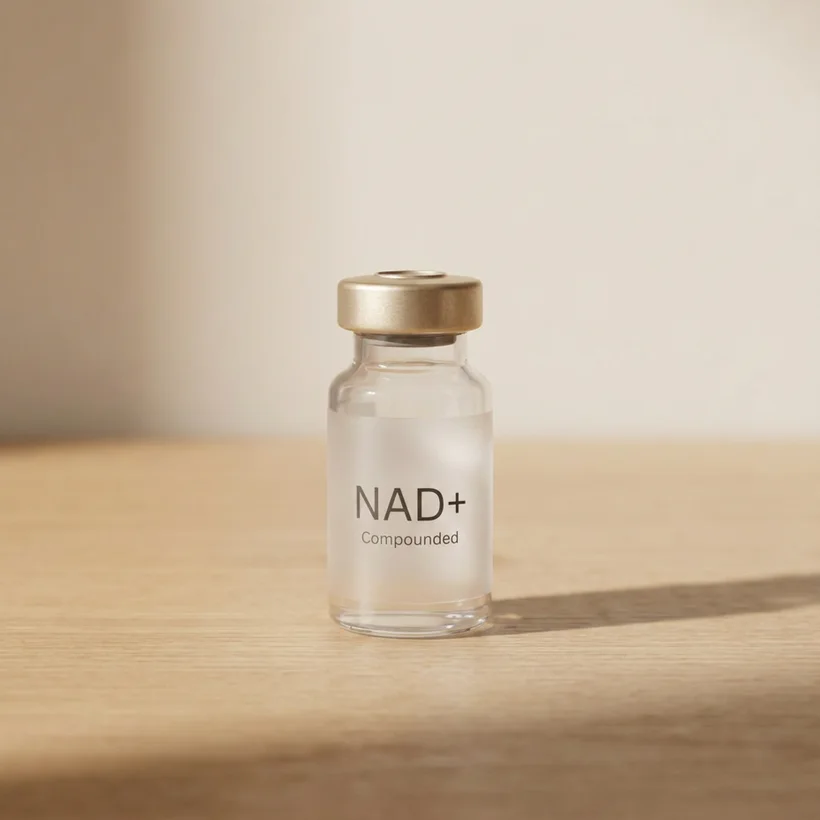
From the FormBlends catalog
NAD+ Peptide Complex
Restore cellular energy and DNA repair capacity · From $179/mo · compounded by a licensed 503A pharmacy, dispensed only after provider review.
View NAD+ Peptide Complex →Can I just take niacin (vitamin B3) instead?
Niacin is technically an NAD+ precursor, but it works through a different pathway and causes uncomfortable flushing at the doses needed to significantly impact NAD+ levels. Nicotinamide (another form of B3) can raise NAD+ but may inhibit sirtuins at high doses, which counteracts some of the longevity benefits. NMN and NR are more targeted and effective approaches. NAD+ precursor comparison
How long do I need to take NAD+ precursors?
Because NAD+ decline is ongoing (driven by aging and CD38 activity), most longevity-focused protocols are designed for long-term use. Think of it like exercise: the benefits continue as long as you maintain the practice. Some patients incorporate periodic IV infusions alongside daily oral supplementation for a thorough approach.
Is NAD+ therapy compatible with GLP-1 weight loss medication?
Yes. NAD+ therapy and GLP-1 medications work through entirely different pathways and are commonly used together. In fact, the metabolic improvements from NAD+ supplementation can complement the weight loss and metabolic benefits of GLP-1 therapy.
Invest in Your Cellular Health
NAD+ isn't a magic pill, but it's one of the most scientifically supported interventions for healthy aging available today. If you want to restore this important molecule to youthful levels under physician guidance, FormBlends is here to help. Schedule your consultation and start building a longevity protocol that works.
Ready when you are
NAD+ Peptide Complex
Restore cellular energy and DNA repair capacity · From $179/mo · compounded by a licensed 503A pharmacy, dispensed only after provider review.
View NAD+ Peptide Complex →