Key Takeaway
NAD+ longevity science explained. Learn how nicotinamide adenine dinucleotide powers cellular repair, slows aging, and supports metabolic health backed by research.
NAD+ (nicotinamide adenine dinucleotide) is a coenzyme found in every living cell that drives energy production, DNA repair, and cellular defense mechanisms linked to longevity. As we age, NAD+ levels decline by up to 50% between ages 40 and 60, contributing to metabolic dysfunction, cognitive decline, and accelerated aging . Understanding the science behind NAD+ is the first step toward using it strategically for a longer, healthier life.
What Is NAD+ and Why Does It Matter for Aging?
NAD+ isn't a vitamin, supplement, or drug. It's a molecule your body already produces, one that sits at the center of hundreds of metabolic reactions. Without adequate NAD+, cells can't convert food into energy efficiently, repair damaged DNA, or activate key longevity pathways.
Think of NAD+ as a biological currency. Every time your cells perform critical maintenance tasks, they spend NAD+. The problem is that production slows with age while demand stays the same or increases. This imbalance is now considered a hallmark of aging by many researchers in the longevity field.
The Two Forms: NAD+ and NADH
NAD+ exists in two forms. The oxidized form (NAD+) accepts electrons during metabolic reactions. The reduced form (NADH) donates electrons. The ratio between these two forms determines how efficiently your mitochondria produce ATP, your body's primary energy molecule. A healthy NAD+/NADH ratio supports strong energy output and cellular resilience.
The Key Longevity Pathways NAD+ Activates
NAD+ doesn't work in isolation. It fuels several interconnected pathways that regulate aging, inflammation, and cellular repair. Here are the most important ones.
View data table
| Category | Evidence and Efficacy Score | Detail |
|---|---|---|
| Cold Exposure | 72 | Metabolic activation |
| Red Light | 65 | Mitochondrial support |
| CGM Tracking | 82 | Glucose optimization |
| Peptide Stacks | 70 | Targeted protocols |
| Nootropics | 55 | Cognitive enhancement |

Sirtuins: The Longevity Regulators
Sirtuins are a family of seven proteins (SIRT1 through SIRT7) that depend entirely on NAD+ to function. They regulate gene expression, reduce inflammation, protect against oxidative stress, and coordinate DNA repair. SIRT1 and SIRT3 are the most studied in the context of aging.
- SIRT1 promotes fat metabolism, insulin sensitivity, and stress resistance. It's sometimes called the "longevity gene" because caloric restriction activates it.
- SIRT3 operates inside mitochondria, protecting them from oxidative damage and supporting efficient energy production.
- SIRT6 repairs double-strand DNA breaks and maintains telomere integrity, both critical for slowing biological aging.
When NAD+ levels drop, sirtuin activity drops with them. This creates a cascade: more inflammation, less DNA repair, faster telomere shortening, and accelerated aging at the cellular level.
PARPs: The DNA Repair Crew
Poly(ADP-ribose) polymerases, or PARPs, are enzymes that detect and repair DNA damage. They consume large amounts of NAD+ to do their work. In fact, PARP1 alone accounts for a significant portion of NAD+ consumption in cells under stress.
As we age, DNA damage accumulates from UV exposure, environmental toxins, and normal metabolic byproducts. PARPs work harder, consuming more NAD+, which leaves less available for sirtuins. This competition between PARPs and sirtuins is one reason aging accelerates once NAD+ levels fall below a critical threshold.
CD38: The NAD+ Consumer
CD38 is an enzyme that increases with age and chronic inflammation. It degrades NAD+ at an alarming rate. Research suggests that rising CD38 activity is one of the primary drivers of age-related NAD+ decline . Some longevity scientists now focus on inhibiting CD38 as a strategy to preserve NAD+ levels naturally.
How NAD+ Levels Decline With Age
The decline in NAD+ isn't sudden. It's a gradual process influenced by multiple factors.
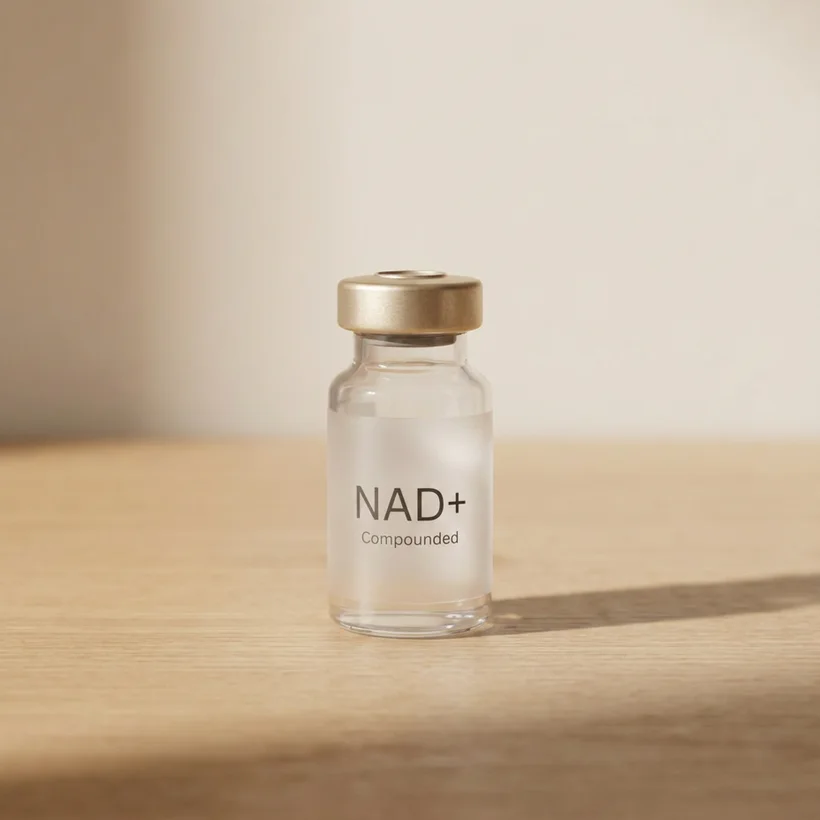
From the FormBlends catalog
NAD+ Peptide Complex
Restore cellular energy and DNA repair capacity · From $179/mo · compounded by a licensed 503A pharmacy, dispensed only after provider review.
View NAD+ Peptide Complex →- Reduced biosynthesis: The enzymes responsible for producing NAD+ (particularly NAMPT) become less active with age.
- Increased consumption: Rising levels of CD38, PARP activity, and chronic inflammation all drain NAD+ faster than the body can replenish it.
- Lifestyle factors: Poor sleep, excessive alcohol, sedentary behavior, and overeating accelerate NAD+ depletion.
- Circadian disruption: NAD+ levels follow a circadian rhythm. Irregular sleep patterns interfere with the natural cycling of NAD+ production and consumption.
By the time most people reach their 50s, NAD+ levels have dropped enough to measurably impair mitochondrial function, DNA repair capacity, and metabolic flexibility.
NAD+ Precursors: NMN vs. NR
Because NAD+ itself is difficult to absorb orally, most supplementation strategies use precursors, molecules the body converts into NAD+. The two most researched precursors are NMN (nicotinamide mononucleotide) and NR (nicotinamide riboside).
| Factor | NMN | NR |
|---|---|---|
| Molecular size | Larger molecule | Smaller molecule |
| Conversion steps to NAD+ | One step | Two steps |
| Bioavailability | Good. uses Slc12a8 transporter | Good. well-absorbed orally |
| Human clinical trials | Growing body of evidence | More published trials to date |
| Typical dose | 250-1000 mg/day | 300-1000 mg/day |
Both precursors have demonstrated the ability to raise NAD+ levels in human studies. The choice between them often comes down to personal response, cost, and quality of the specific product Contact provider for current pricing Contact provider for current pricing.
What the Research Shows
Animal studies have produced compelling results. Mice given NMN showed improved insulin sensitivity, better endurance, enhanced blood vessel growth, and markers of reversed aging in muscle tissue . Studies on NR have shown similar benefits, including protection against neurodegeneration and metabolic disease.
Human trials are catching up. A 2021 clinical trial found that NMN supplementation improved muscle insulin sensitivity in prediabetic women . Multiple NR studies have confirmed safe, sustained increases in blood NAD+ levels in healthy adults.
We're still in the early stages of understanding optimal dosing, timing, and long-term effects. But the direction of the evidence is clear: maintaining NAD+ levels supports healthier aging across multiple organ systems.
Natural Ways to Support NAD+ Levels
Supplementation isn't the only approach. Several lifestyle strategies naturally support NAD+ production and conservation.
- Exercise: Both aerobic and resistance training upregulate NAMPT, the rate-limiting enzyme in NAD+ biosynthesis.
- Caloric restriction and fasting: Fasting activates AMPK and sirtuins, both of which interact with NAD+ pathways.
- Quality sleep: NAD+ production follows circadian rhythms. Consistent sleep supports natural NAD+ cycling.
- Heat and cold exposure: Sauna use and cold plunges activate stress response pathways that may preserve NAD+ levels.
- Limiting alcohol: Alcohol metabolism consumes NAD+ directly, converting it to NADH and depleting the available pool.
How NAD+ Science Connects to Peptide Therapy
At FormBlends, we see NAD+ improvement as one piece of a broader longevity strategy. Our physician-supervised programs integrate peptide therapies that complement NAD+ pathways. For example, certain peptides support mitochondrial function and metabolic health, working alongside NAD+ to promote cellular resilience peptide therapy.
GLP-1 receptor agonists, which we offer for medically supervised weight management, also intersect with NAD+ science. Weight loss reduces chronic inflammation, which lowers CD38 activity and helps preserve NAD+ levels naturally GLP-1 weight loss.
Frequently Asked Questions
Is NAD+ supplementation safe?
Human trials on NMN and NR have shown favorable safety profiles at typical doses (up to 1,200 mg/day for NR and 1,250 mg/day for NMN) over periods of several weeks to months. But long-term safety data beyond one year is still limited. We always recommend physician oversight before starting any supplementation protocol.
At what age should I start thinking about NAD+ levels?
NAD+ decline begins in your 30s and accelerates through your 40s and 50s. Lifestyle strategies like exercise and quality sleep should start as early as possible. Supplementation decisions are best made with a healthcare provider who can assess your individual needs.
Can I measure my NAD+ levels?
Yes. Several commercial labs now offer intracellular NAD+ testing through blood samples. These tests can provide a baseline and help track the effectiveness of interventions over time.
Does NAD+ help with weight loss?
NAD+ supports metabolic flexibility, which is your body's ability to switch between burning carbohydrates and fats for fuel. While NAD+ alone isn't a weight loss intervention, improving NAD+ levels may enhance the effectiveness of structured weight management programs weight loss programs.
What is the difference between IV NAD+ and oral precursors?
IV NAD+ delivers the molecule directly into the bloodstream, bypassing digestion. It can produce rapid effects but requires clinical administration and is more expensive. Oral precursors (NMN, NR) are convenient and well-studied but rely on the body's conversion pathways. Both approaches have merit depending on individual goals and medical context Contact provider for current pricing.
Can NAD+ reverse aging?
NAD+ supplementation has reversed certain markers of aging in animal models, including improved mitochondrial function, muscle performance, and vascular health. In humans, the evidence supports healthier aging rather than true reversal. The science is promising, but we encourage realistic expectations grounded in current data.
Ready when you are
NAD+ Peptide Complex
Restore cellular energy and DNA repair capacity · From $179/mo · compounded by a licensed 503A pharmacy, dispensed only after provider review.
View NAD+ Peptide Complex →