Key Takeaway
Delta sleep-inducing peptide (DSIP) for sleep improvement. Mechanism of action, research on sleep architecture, safety, and how it compares to pharmaceutical sleep aids.
What delta sleep-inducing peptide does, what the research shows, and whether it belongs in your sleep improvement stack.
The Deep Sleep Problem
Sleep is the foundation of everything. Cognitive function, physical recovery, immune health, emotional regulation, and metabolic function all depend on adequate sleep. And within sleep, deep sleep (slow-wave sleep or stage N3) is the most restorative phase. It's when growth hormone peaks, when memory consolidation occurs, when cellular repair ramps up, and when the glymphatic system clears metabolic waste from the brain.
The problem is that deep sleep declines with age. By your 30s, you're already getting significantly less deep sleep than you did as a teenager. By your 50s and 60s, deep sleep may be reduced by 60 to 70 percent compared to young adulthood. This decline isn't just a nuisance. It's increasingly linked to accelerated aging, cognitive decline, and increased disease risk.
Standard pharmaceutical sleep aids don't solve this problem. Most of them increase total sleep time but actually suppress or fail to enhance deep sleep architecture. This is a critical distinction that gets lost in most conversations about sleep medication.
Delta sleep-inducing peptide, or DSIP, is a naturally occurring neuropeptide that has been studied for decades specifically for its effects on sleep architecture. For biohackers focused on improving deep sleep rather than just falling asleep, DSIP represents a fundamentally different approach.
What Is DSIP?
DSIP is a nine-amino-acid peptide (Trp-Ala-Gly-Gly-Asp-Ala-Ser-Gly-Glu) first isolated in 1977 from the blood of rabbits during electrically induced sleep. The researchers, led by Swiss pharmacologist Guido Schoenenberger, found that injecting this peptide fraction into recipient rabbits induced a sleep state characterized by increased delta wave activity on EEG, the hallmark of deep sleep.
View data table
| Category | Evidence and Efficacy Score | Detail |
|---|---|---|
| Cold Exposure | 72 | Metabolic activation |
| Red Light | 65 | Mitochondrial support |
| CGM Tracking | 82 | Glucose optimization |
| Peptide Stacks | 70 | Targeted protocols |
| Nootropics | 55 | Cognitive enhancement |
The peptide is found naturally in human blood and cerebrospinal fluid. Its concentration shows circadian variation, with levels peaking during the night. It has been detected in multiple brain regions, including the hypothalamus, limbic system, and pituitary gland, all areas involved in sleep regulation.
DSIP isn't classified as a neurotransmitter in the traditional sense. It appears to function as a neuromodulator, influencing the activity of multiple neurotransmitter systems rather than acting on a single receptor. This modulatory role is important for understanding both its mechanism and its safety profile.
Mechanism of Action
Despite decades of research, the precise mechanism by which DSIP promotes sleep isn't fully understood. This is partly because DSIP interacts with multiple systems simultaneously, making it difficult to isolate a single pathway.
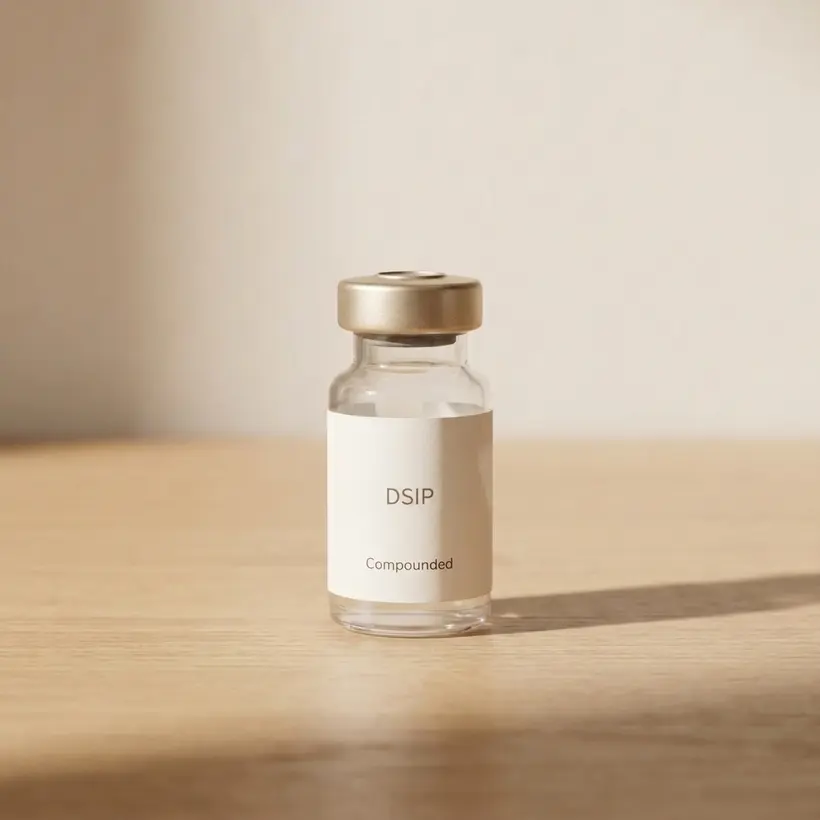
From the FormBlends catalog
DSIP (Delta Sleep-Inducing Peptide)
Restore deep, restorative delta wave sleep · From $179/mo · compounded by a licensed 503A pharmacy, dispensed only after provider review.
View DSIP (Delta Sleep-Inducing Peptide) →Effects on Sleep-Regulating Neurotransmitters
GABA system modulation. Some evidence suggests DSIP enhances GABAergic transmission, the brain's primary inhibitory system and a key driver of sleep onset. Unlike benzodiazepines or Z-drugs, which forcefully activate GABA-A receptors, DSIP appears to modulate GABA activity more gently, potentially explaining why it doesn't produce the same sedative "hangover" or the suppression of deep sleep architecture that those drugs can cause.
Serotonin pathway involvement. DSIP has been shown to influence serotonin metabolism. Serotonin is a precursor to melatonin and plays roles in sleep-wake regulation. Changes in serotonergic tone could affect both sleep onset and sleep architecture.
Glutamate modulation. There's some evidence that DSIP reduces excitatory glutamatergic activity. Since excessive glutamate signaling is associated with wakefulness and, in extreme cases, excitotoxicity, this dampening effect could contribute to both sleep promotion and neuroprotection.
Endocrine Effects
Cortisol regulation. Several studies have found that DSIP reduces cortisol levels, particularly in individuals with improved cortisol. Since cortisol is a wake-promoting hormone and improved evening cortisol is a common cause of insomnia, this cortisol-lowering effect could be a significant pathway through which DSIP improves sleep. DSIP doesn't appear to suppress cortisol below normal levels, suggesting a normalizing rather than suppressive effect.
Growth hormone relationship. Deep sleep is the primary time window for growth hormone secretion. By promoting deep sleep, DSIP indirectly supports growth hormone release. Some studies have also suggested a direct effect of DSIP on GH secretion, though this is less well-established.
LH and endorphin effects. DSIP has been shown to influence luteinizing hormone (LH) and endorphin levels, both of which have downstream effects on sleep quality, mood, and recovery.
Stress Response Modulation
One of DSIP's most consistently demonstrated effects is its ability to normalize stress responses. In animal models and limited human studies, DSIP administration has been associated with reduced physiological stress markers and improved resilience to stress. For people whose sleep is disrupted by stress and anxiety, this mechanism could be particularly relevant. The peptide doesn't appear to block stress responses entirely but rather helps the body return to baseline more efficiently after stress exposure.
Delta Wave Promotion
The most distinctive and name-worthy effect of DSIP is its association with increased delta wave activity during sleep. Delta waves (0.5 to 4 Hz) are the defining feature of deep sleep. EEG studies in both animals and humans have shown that DSIP administration increases the time spent in delta-wave-dominant sleep stages. This is the core of DSIP's appeal: it targets the specific phase of sleep that declines most dramatically with age and that's most critical for recovery and health.
Research on DSIP and Sleep
DSIP has been studied since the late 1970s, producing a moderate body of literature with mixed but generally positive results.
Animal Studies
The original rabbit studies demonstrated clear sleep-promoting effects with increased delta wave activity. Subsequent animal research confirmed that DSIP administration increases slow-wave sleep duration in multiple species. Studies in rats showed that DSIP reduced sleep latency (time to fall asleep) and increased the proportion of deep sleep relative to lighter sleep stages.
Human Studies
Several small human studies have been conducted:
Insomnia patients. A study of chronic insomnia patients found that DSIP improved subjective sleep quality and increased slow-wave sleep as measured by polysomnography. Patients reported easier sleep onset and fewer nighttime awakenings. The effects were more pronounced in patients with stress-related insomnia than in those with other insomnia subtypes.
Narcolepsy. In patients with narcolepsy, DSIP administration improved nighttime sleep consolidation and reduced daytime sleepiness, suggesting effects on overall sleep-wake regulation rather than just sleep promotion.
Pain and withdrawal. Studies in patients with chronic pain and in individuals undergoing alcohol or opioid withdrawal found that DSIP improved sleep quality, reduced anxiety, and in some cases reduced pain perception. The withdrawal studies are particularly interesting because sleep disruption is a major feature of withdrawal syndromes, and DSIP appeared to normalize sleep architecture without producing its own dependence.
Healthy volunteers. Studies in healthy subjects have shown more variable results. Some found increased deep sleep and improved sleep quality. Others found minimal effects. The variability may relate to dosing, timing, individual differences in baseline sleep quality, and the relatively small sample sizes of most studies.
Limitations of the Research
The DSIP literature has significant limitations:
- Most studies are small (fewer than 30 participants)
- Many were conducted in the 1980s and 1990s with methodologies that wouldn't meet current standards
- Several key studies lack placebo controls or blinding
- The peptide's instability in blood (it's rapidly degraded by enzymes) complicates dosing and makes pharmacokinetic studies difficult
- No large-scale randomized controlled trials have been published
- Publication bias likely inflates the apparent effect size
This doesn't mean DSIP is ineffective. It means the evidence base is early-stage and incomplete. The consistent finding across studies is a trend toward improved deep sleep, but the magnitude and reliability of this effect in different populations remains uncertain.
DSIP vs. Pharmaceutical Sleep Aids
Knowing how DSIP compares to conventional sleep medications clarifies its potential niche.
Benzodiazepines (Temazepam, Triazolam)
Benzodiazepines increase total sleep time and reduce sleep latency. But they suppress deep sleep and REM sleep. They produce tolerance (requiring increasing doses), physical dependence, and withdrawal symptoms. Cognitive impairment and next-day drowsiness are common. They're effective hypnotics but actively worsen sleep quality for architecture.
Z-Drugs (Zolpidem, Zaleplon, Eszopiclone)
Z-drugs are more selective GABA-A agonists than benzodiazepines. They produce less suppression of deep sleep than benzodiazepines but still don't enhance it. They carry risks of complex sleep behaviors (sleepwalking, sleep-eating), tolerance, and rebound insomnia. They're better than benzodiazepines for sleep architecture but still far from ideal.
Orexin Receptor Antagonists (Suvorexant, Lemborexant)
These newer medications block the wakefulness-promoting orexin system. They allow natural sleep processes to proceed rather than forcing sedation. They appear to preserve sleep architecture better than benzodiazepines or Z-drugs. But they can cause next-day drowsiness and are relatively expensive. They represent a meaningful step forward in sleep pharmacology.
Melatonin
Melatonin is a hormone that signals darkness and helps regulate circadian timing. It's most useful for circadian misalignment (jet lag, shift work) and modest for general insomnia. It doesn't significantly enhance deep sleep. It's very safe but produces modest effects for most people seeking better sleep quality.
Where DSIP Fits
DSIP's theoretical advantage is that it specifically promotes deep sleep architecture rather than just inducing unconsciousness. If the research findings hold up at scale, this would make it fundamentally different from most sleep medications. You wouldn't just sleep longer. You would sleep more restoratively.
DSIP doesn't appear to produce tolerance, dependence, or withdrawal in the available research. It doesn't cause next-day cognitive impairment. And its natural presence in the human body suggests a lower inherent risk profile than synthetic hypnotics. These are significant potential advantages, but they need validation through larger, more rigorous studies.
Practical Considerations
Administration
DSIP is typically administered via subcutaneous or intramuscular injection. It isn't orally bioavailable because, like most peptides, it would be degraded in the gastrointestinal tract before reaching systemic circulation. Intranasal administration has been explored but produces variable absorption. Injection is the most reliable delivery method.
Dosing
Research studies have used doses ranging from 25 micrograms per kilogram to 250 micrograms total. In the biohacking community, doses of 100 to 300 micrograms subcutaneously before bed are commonly discussed. The optimal dose isn't established, and individual responses appear to vary significantly. Starting at the lower end and titrating based on response is a reasonable approach.
Timing
Most protocols call for DSIP administration 30 to 60 minutes before intended sleep. This aligns with the peptide's natural circadian peak and allows time for absorption and distribution. Some users report that taking DSIP too early in the evening (more than two hours before bed) produces drowsiness at inconvenient times, while taking it too close to bedtime reduces effectiveness.
Stability
DSIP is relatively unstable in solution. It degrades faster than many other peptides when reconstituted. Proper storage (refrigeration, protection from light) and prompt use after reconstitution calculator are important. Some suppliers offer modified DSIP analogs with improved stability, but these are even less studied than the native peptide.
Frequency of Use
There's no established protocol for DSIP frequency. Some users take it nightly for defined periods (two to four weeks). Others use it several times per week. Still others reserve it for nights when deep sleep is particularly important (after hard training days, during stressful periods). The lack of observed tolerance or dependence in the available research suggests that regular use may be feasible, but this hasn't been validated in long-term studies.
Safety Profile
DSIP's safety profile appears favorable based on the available evidence, but the evidence is limited.
Reported Side Effects
Side effects in published studies and anecdotal reports are generally mild:
- Occasional headache
- Mild nausea in some users
- Vivid dreams (reported frequently but not universally)
- Transient flushing at the injection site
- Rare reports of next-morning grogginess, typically at higher doses
What We Do Not Know
- Long-term safety of chronic DSIP use (no studies beyond several weeks)
- Effects on hormonal axes with prolonged use (DSIP affects cortisol, LH, and other hormones)
- Interactions with other sleep aids, medications, or peptides
- Safety in pregnant or nursing women (no data)
- Effects in individuals with seizure disorders (delta wave modulation raises theoretical questions)
Absence of Dependence
Perhaps the most clinically significant safety observation is the consistent absence of tolerance and dependence in DSIP studies. Unlike benzodiazepines, Z-drugs, and even melatonin (which can suppress endogenous production with chronic use), DSIP doesn't appear to create a need for escalating doses or produce rebound insomnia upon discontinuation. If this holds true in larger studies, it would represent a meaningful safety advantage over most existing sleep pharmacology.
Stacking DSIP With Sleep Hygiene
No peptide replaces the fundamentals. DSIP, if it works as the research suggests, enhances deep sleep. But your total sleep quality depends on a broader set of factors that no peptide can override.
Non-Negotiable Foundations
Light exposure management. Bright light in the morning sets your circadian clock. Dim light in the evening allows melatonin to rise naturally. Blue-light-blocking glasses, dimming screens, and avoiding bright overhead lights in the two hours before bed are among the highest-impact sleep interventions available, and they cost almost nothing.
Temperature. Your core body temperature needs to drop by approximately 1 to 2 degrees Fahrenheit to initiate and maintain sleep. A cool bedroom (65 to 68 degrees), cooling mattress pads, or even a warm shower before bed (which paradoxically cools the core through vasodilation) can significantly improve sleep onset and deep sleep duration.
Consistency. Going to bed and waking up at the same time, even on weekends, is one of the most powerful sleep improvement strategies. Your circadian system thrives on regularity. A consistent schedule strengthens the amplitude of your circadian rhythms, making every phase of sleep deeper and more restorative.
Caffeine timing. Caffeine has a half-life of five to six hours and a quarter-life of 10 to 12 hours. That afternoon coffee at 2 PM still has 25 percent of its stimulant effect at midnight. For most people, a caffeine cutoff of 10 AM to noon produces noticeably better sleep. This is a simple intervention with outsized impact.
Alcohol avoidance. Alcohol is a potent deep sleep suppressant. Even moderate consumption in the evening significantly reduces slow-wave sleep and fragments sleep architecture. If you're investing in DSIP to enhance deep sleep while drinking alcohol in the evening, you're working against yourself.
Complementary Supplements
Several supplements have evidence for sleep support and could theoretically complement DSIP:
- Magnesium glycinate or threonate: Magnesium supports GABA activity and muscle relaxation. Threonate may cross the blood-brain barrier more effectively. Doses of 200 to 400 mg of elemental magnesium before bed are commonly used.
- L-theanine: An amino acid from tea that promotes relaxation without sedation. It increases alpha brain wave activity and may ease the transition to sleep. Typical doses are 100 to 400 mg.
- Glycine: The amino acid glycine lowers core body temperature and improves subjective sleep quality. Three grams before bed is the studied dose.
- Apigenin: A flavonoid found in chamomile that modulates GABA receptors. Andrew Huberman has popularized its use at 50 mg before bed. Evidence is limited but the safety profile is clean.
None of these have been studied in combination with DSIP. Use common sense and introduce one variable at a time so you can evaluate the contribution of each.
Tracking Your Results
If you're going to experiment with DSIP, measure the results. Subjective impressions of sleep quality are notoriously unreliable.
Wearable sleep trackers. Devices like the Oura Ring, WHOOP, and Apple Watch provide estimates of sleep stages, including deep sleep duration. These aren't polysomnography-grade measurements, but they're consistent enough to detect trends over time. If DSIP genuinely increases your deep sleep, a wearable should show a measurable increase in estimated deep sleep minutes over baseline.
Subjective metrics. Track morning alertness, energy levels throughout the day, and perceived recovery from exercise. Rate these on a simple 1 to 10 scale daily. After two to four weeks, compare your DSIP period to your baseline.
HRV (Heart Rate Variability). Heart rate variability during sleep is a useful proxy for autonomic nervous system recovery. Higher HRV during sleep generally indicates better recovery. If DSIP enhances deep sleep, you would expect to see improved overnight HRV.
Who Should Consider DSIP
DSIP is most commonly explored by:
- People with age-related deep sleep decline who aren't getting the restorative sleep they need despite good sleep hygiene
- Athletes and high-performers whose recovery depends on deep sleep quality and who want to maximize the growth hormone window
- Individuals with stress-related insomnia whose improved cortisol disrupts sleep architecture
- People seeking alternatives to pharmaceutical sleep aids who want to avoid the tolerance, dependence, and sleep architecture disruption those drugs produce
DSIP is probably not the right starting point if you haven't addressed the fundamentals. If your sleep hygiene is poor, your bedroom is too warm, you're drinking coffee at 4 PM, and you're on screens until midnight, fixing those issues will produce far larger improvements than any peptide. DSIP is for people who have improved the basics and are looking for the next level of sleep quality.
Working With a Physician
DSIP is a research peptide, not an FDA-approved sleep medication. Self-administering injectable peptides without medical guidance carries real risks, from sourcing quality issues to inappropriate dosing to missing underlying sleep disorders that require different treatment.
Sleep apnea, for example, is extraordinarily common (affecting an estimated 20 to 30 percent of adults) and is a far more important intervention target than any peptide. If you haven't been evaluated for sleep apnea and you're experiencing poor sleep quality, that should happen before you explore DSIP.
At FormBlends, our physician network can evaluate your sleep concerns, order appropriate diagnostics, and if DSIP or other peptides are appropriate for your situation, guide your protocol with proper medical oversight. Sleep is too important to your health to improve by guesswork.
Key Points
DSIP occupies a unique position in the sleep improvement space. It's the only widely discussed peptide specifically associated with deep sleep enhancement. Its mechanism of action is fundamentally different from pharmaceutical sleep aids. And its safety profile, while incompletely characterized, appears favorable compared to conventional hypnotics.
The research is real but limited. The animal data consistently shows increased delta wave sleep. The human data trends positive but comes from small studies with methodological limitations. No large-scale clinical trials have been conducted.
For biohackers who have maximized their sleep hygiene, addressed potential sleep disorders, and are looking for an additional tool to enhance deep sleep quality, DSIP is a reasonable compound to explore under physician guidance. It isn't a magic bullet. It's a targeted intervention that, combined with a solid foundation of sleep practices, may help you access the deep, restorative sleep that your body needs and that becomes harder to get with every passing year.
Sleep is the ultimate performance enhancer. Anything that genuinely improves its quality deserves serious, honest attention. DSIP has earned that attention. What it still needs is better evidence. Until that evidence arrives, approach it with informed optimism and appropriate caution.
Related guides
- Sleep Optimization Biohacking Dsip Protocol
- Sleep Biohacking Protocol 2026: Deep Sleep, REM, and Recovery
- Sleep Optimization Biohacking: Complete Guide
- Sleep Optimization Biohacking: How To Start
- Sleep Optimization Biohacking: Science Explained
- Biohacking Evening Routine Sleep Optimization
Ready when you are
DSIP (Delta Sleep-Inducing Peptide)
Restore deep, restorative delta wave sleep · From $179/mo · compounded by a licensed 503A pharmacy, dispensed only after provider review.
View DSIP (Delta Sleep-Inducing Peptide) →