Key Takeaway
MEDVi publishes an active telehealth program. Compare its provider process, exact prescription, full recurring cost, support and refund terms; the dated findings below explain the company record.
Quick Verdict: MEDVi appears to be a real telehealth company, not a fake checkout page, but that is only the first screen. Two dated facts belong in any 2026 verdict: FDA sent MEDVi, LLC a warning letter on February 20, 2026 over misbranded marketing of its compounded semaglutide and tirzepatide, with no close-out letter posted as of September 5, 2026, and MEDVi's refund policy (published September 3, 2026) allows a full refund only within the first 72 hours if no services have been received. A smart MEDVi review should separate clinical legitimacy from business friction: licensed-provider access, pharmacy sourcing, refill reliability, refund terms, cancellation rules, and complaint patterns. The strongest buyer move is to verify those details before paying, especially if you are comparing compounded GLP-1 programs.
Is MEDVi a real telehealth service?
MEDVi publishes an active telehealth weight-loss program with an online patient portal and a stated independent-provider review process. Those public program details help establish what it offers; they do not by themselves prove the quality of an individual consultation or prescription. The useful next question is whether the particular medication, recurring charge, and support package fit your needs.
What does MEDVi say its program includes?
| Feature | What the company publishes | What to compare before enrolling |
|---|---|---|
| Provider review | Prescriptions follow an online consultation with an independent licensed provider. | How questions and follow-up visits are handled for the selected program. |
| Patient portal | A portal for progress, provider check-ins, and care management. | Which functions are included in the chosen plan. |
| Support | 24/7 support is advertised. | Available channels and expected response time for prescription or refill questions. |
| Dietician visits and coaching | Advertised with an insurance/copay eligibility qualification. | Whether a visit has a separate charge for you. |
Source: MEDVi's program homepage. These are attributed company descriptions, not results of a hands-on treatment test.
How should I compare MEDVi's price with another GLP-1 program?
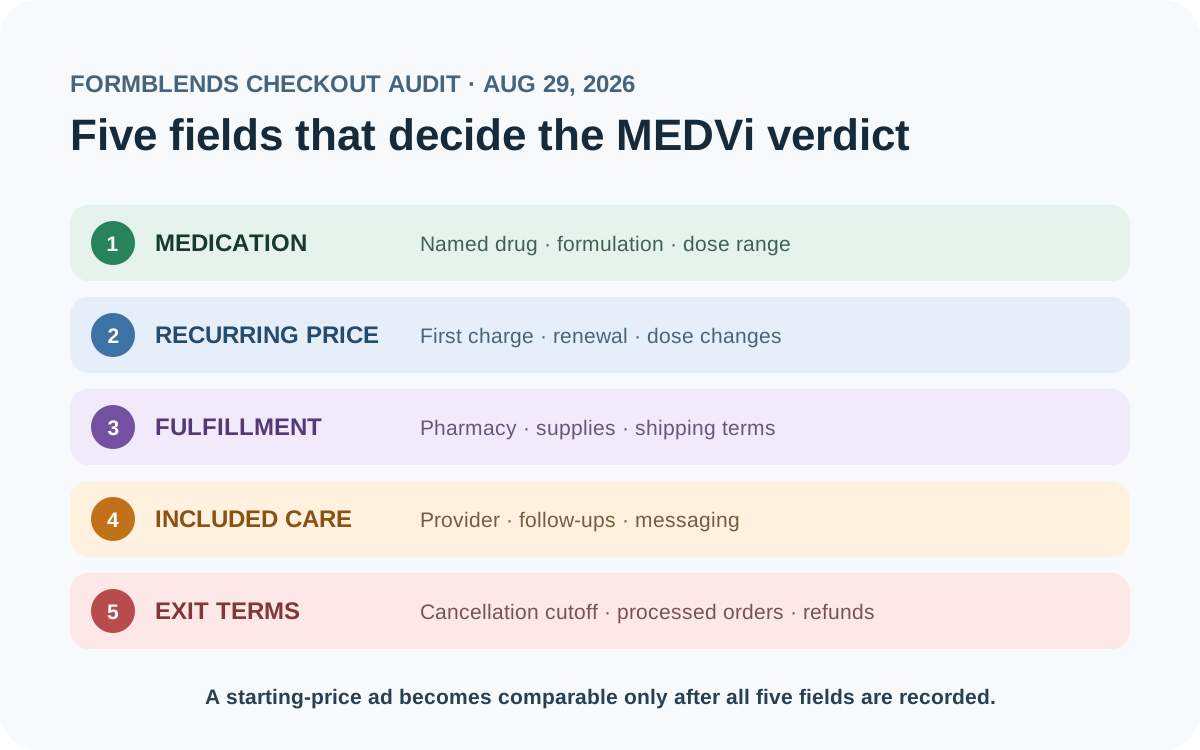
Use the same supply period and medication path for both quotes. Record the first payment, renewal payment, number of shipments, and any separate service or shipping charges. Keep a monthly equivalent separate from the amount charged upfront.
Comparison formula: first-period total = introductory payment + subsequent payments + separately billed services. Divide by the number of covered months only after calculating the complete total.
For an illustrative three-month offer, $200 initially plus two $300 renewals totals $800, or $266.67 per month on average. A different offer billed at $750 upfront averages $250 per month but requires the larger first payment. These are examples of the method, not current MEDVi or FormBlends prices.
Which details should I save from the offer?
- Exact medication, formulation, supply duration, and provider-review requirement.
- First charge, renewal charge, and the date each payment is due.
- Included visits, supplies, shipping, and any separate fees.
- How to request a refill, contact support, and end a subscription.
Use the FormBlends cost calculator to work through the numbers, or browse other provider comparisons. FormBlends publishes this comparison and also offers a competing care pathway.
Overview
| Legitimacy Factor | Status |
|---|---|
| Registered business | Yes, MEDVi, LLC, 131 Continental Drive, Suite 305, Newark, Delaware 19713 (terms updated March 31, 2026) |
| Licensed providers | U.S.-licensed providers through the OpenLoop Health network and CareGLP Affiliated P.C.s (terms); MEDVi does not assert board certification |
| Pharmacy partnerships | Terms name Triad Rx (Daphne, Alabama), RedRock Pharmacy (St. George, Utah) and Beaker Pharmacy and Compounding (McKinney, Texas); confirm which one fills your prescription |
| Trustpilot rating | 4.3 TrustScore from about 14,700 reviews (79 percent 5-star, 12 percent 1-star), viewed September 5, 2026; paid Trustpilot subscription |
| BBB profile | Exists; rating and complaint count not verified by us on September 5, 2026 (site blocks automated access) |
| FDA-approved medications | No. Offers compounded (not FDA-approved) semaglutide and tirzepatide; FDA warning letter dated February 20, 2026 over marketing claims |
| Accepts insurance | Primarily cash-pay; MEDVi's site says insurance and copay eligibility is determined at the time of the visit |
| Contract required | Month to month (reported); cancellation must be requested at least 72 hours before the next billing date (policy published September 3, 2026) |
Why People Ask "Is MEDVi Legit?"
The GLP-1 telehealth market has exploded over the past two years, and with that growth has come a flood of new providers, some reputable and some not. When a company you have never heard of offers to prescribe weight loss medications online for a monthly fee, skepticism is appropriate.
Not sure which GLP-1 is right for you?
Take a 2-minute assessment and get a personalized recommendation after licensed provider review.
Take the Assessment →| MEDVi product (28-day supply, cash, new patient) | Month 1 | Month 4 onward | Required fee | Commitment | How observed |
|---|---|---|---|---|---|
| Compounded semaglutide, vial | $179 | $299 | $0 | Month to month (reported) | Secondary: prices appear only after an intake quiz; figures from Woman's World and PlexusDx, July 2026 |
| Compounded tirzepatide, vial | $279 | $499 | $0 | Month to month (reported) | Secondary: Woman's World; PlexusDx (July 2026) reports about $399 ongoing; glpchart.com (verified August 31, 2026) lists $299 flat |
Rows from the Compounded GLP-1 Price Index, as of September 3, 2026. Because MEDVi's prices are quiz-gated, third-party reports disagree on tirzepatide; treat the figures as a range until you see your own quote. Correction, September 2026: a chart titled Top Telehealth GLP-1 Providers Compared, scoring FormBlends above Hims and Hers, Ro and Calibrate on an Overall Value Score, previously appeared here. It was a self-scored comparison with no external basis and has been removed.
MEDVi also deals with a naming confusion problem. A separate company called MEDvidi (with a "di" at the end) provides online mental health services. The similar names lead to crossed reviews and mixed search results. These are two entirely different companies. This review covers MEDVi, the weight loss telehealth clinic.
Evidence That MEDVi Is Legitimate
Registered Business Entity
MEDVi, LLC is a Delaware company at 131 Continental Drive, Suite 305, Newark, Delaware 19713, the address that appears in its terms and conditions (updated March 31, 2026), on its Trustpilot profile and on FDA's February 20, 2026 warning letter. It publishes terms, a privacy policy and a cancellation and refund policy, all standard indicators of a real operation.
Licensed Physicians
MEDVi's terms (updated March 31, 2026) say consultations are delivered by licensed providers through the OpenLoop Health clinician network and CareGLP Affiliated P.C.s. Depending on state law those providers may be physicians, nurse practitioners or physician assistants; MEDVi does not claim board certification, and we found no mention of lab work on its site. Ask for your prescriber's name and verify the license in your state's board lookup. Correction, September 2026: an earlier version described board-certified MDs and metabolic lab work; neither is asserted by MEDVi.
Regulated Pharmacy Partnerships
MEDVi's terms name three dispensing pharmacies: Triad Rx in Daphne, Alabama; RedRock Pharmacy in St. George, Utah; and Beaker Pharmacy and Compounding in McKinney, Texas. These are state-licensed 503A pharmacies, which are regulated primarily by state boards of pharmacy; their compounded products are not FDA approved, and FDA notes such pharmacies are not required to report adverse events. FDA had received 990 adverse-event reports for compounded semaglutide and more than 730 for compounded tirzepatide as of May 31, 2026 (FDA, content current as of September 1, 2026). Confirm which pharmacy fills your prescription and check its license with that state's board.
Verified Patient Reviews
As of September 5, 2026 MEDVi's Trustpilot profile showed a TrustScore of 4.3 from about 14,700 reviews: 79 percent 5-star, 5 percent 4-star, 2 percent 3-star, 2 percent 2-star and 12 percent 1-star. The profile is claimed, MEDVi holds a paid Trustpilot subscription, and it had replied to 98 percent of negative reviews. Positive reviews describe effective medication and straightforward onboarding; the 1-star reviews cluster around billing and refunds. A paid subscription does not change scores, but it does mean the company can invite reviews, so read the 1-star column as well as the average.
Red Flags and Concerns
BBB Complaints
MEDVi has a Better Business Bureau profile. We could not verify its rating or complaint count on September 5, 2026 because the BBB site blocks automated access, so this page no longer repeats figures or individual complaint narratives; open the profile yourself and check the date on what you read. Billing and refund disputes are the recurring theme in MEDVi's 1-star Trustpilot reviews, which is consistent with a subscription business.
BBB complaints don't necessarily indicate a scam. Even well-established companies accumulate BBB complaints, especially subscription-based businesses. But the pattern of billing-related complaints is worth noting and suggests that MEDVi's billing systems or processes have gaps.
Refund Policy Concerns
Correction, September 2026: an earlier version of this section described a results-based guarantee with a five-month adherence requirement and a 25 percent consultation deduction. MEDVi's current Cancellation and Refund Policy (published September 3, 2026) contains no results guarantee and states there is no guarantee of results or effectiveness. A full refund is available only within the first 72 hours of a subscription term if no services have been received, or if a provider disqualifies you. Otherwise the policy states, in capitals, that no refund is issued for the month in which cancellation occurs or for any prior month; for multi-month prepayments, months with no medication shipped are refunded.
MEDVi's terms (updated March 31, 2026) add that consultations are non-refundable and medication sales are final, and that disputes go to binding arbitration with a class-action waiver and a 30-day opt-out. The site's MEDVi guarantee refers to expedited delivery, doctor-led plans and coaching, not to money back. Read the refund policy before paying, not after.
Compounded Medications Are Not FDA-Approved
This isn't specific to MEDVi; it applies to every telehealth company prescribing compounded GLP-1s. Compounded medications are prepared by state-licensed pharmacies but have not gone through FDA's approval process, and FDA says they may vary in concentration and quality. FDA declared the tirzepatide shortage resolved on December 19, 2024 and the semaglutide shortage on February 21, 2025, which narrows the legal basis for mass compounding, and it had logged 990 semaglutide and 730-plus tirzepatide compounded-product adverse-event reports by May 31, 2026. Patients should understand this trade-off before choosing any compounded medication provider.
How MEDVi Compares to Other GLP-1 Telehealth Platforms
MEDVi is one of dozens of telehealth companies offering compounded GLP-1 medications. Its reported pricing (semaglutide $179 the first month and $299 from month four; tirzepatide $279 then $499, with third-party reports ranging down to $299 flat) sits in the middle of the 31 providers tracked in the Compounded GLP-1 Price Index as of September 3, 2026. Hims, often cited as the low-price alternative, now describes its compounded offering as limited and sells the brand Wegovy pen from $199 plus a $149 membership, per the same index. Compare dated rows rather than reputations.
The key question isn't whether MEDVi is a real company (it is), but whether its terms fit you. The clinical model is a standard licensed-provider telehealth arrangement. The friction points are the ones FDA and reviewers have documented: marketing claims that drew a warning letter, and billing and refund rules that many customers did not read before enrolling.
Pros
- Registered business with verifiable credentials
- Licensed providers through the OpenLoop Health network (terms, March 31, 2026)
- Dispensing pharmacies are named in the terms (Triad Rx, RedRock Pharmacy, Beaker Pharmacy and Compounding)
- 4.3 TrustScore from about 14,700 Trustpilot reviews, viewed September 5, 2026
- Month-to-month pricing with no contract
- Replies to 98 percent of negative Trustpilot reviews
Cons
- 12 percent of Trustpilot reviews are 1-star, mostly billing and refund disputes; BBB profile not verified by us
- No refunds after services begin, and none for the month of cancellation or prior months (policy published September 3, 2026)
- FDA warning letter dated February 20, 2026 over misbranded marketing; no close-out letter posted as of September 5, 2026
- Compounded medications aren't FDA-approved
- Confirm insurance and copay eligibility for each service; the published support offer does not establish prescription coverage
- Naming confusion with MEDvidi (a separate mental health company)
Who Is MEDVi Best For?
MEDVi is a reasonable option for patients who want licensed-provider telehealth for compounded GLP-1s, have read the 72-hour refund window and 72-hour cancellation notice, and are comfortable with reported ongoing prices of $299 (semaglutide) to $499 (tirzepatide) a month as of September 3, 2026. It is less suitable for patients who want brand-name medication, need insurance billing, or have had bad experiences with subscription billing.
The FDA warning letter to MEDVi (February 20, 2026): what it said and what it did not
On February 20, 2026 FDA's Center for Drug Evaluation and Research issued warning letter MARCS-CMS 721455 to MEDVi, LLC dba MEDVi at 131 Continental Drive, Suite 305, Newark, Delaware, covering the website medvi.io. FDA's findings were about marketing, not about a product-quality inspection. It said product labels displaying the MEDVi name falsely suggested that MEDVi itself compounds the semaglutide and tirzepatide it sells, and that claims such as same active ingredient as Wegovy and Ozempic, or as Mounjaro and Zepbound, implied the compounded products were FDA approved when they are not. FDA cited misbranding under sections 502(a) and 502(bb) of the Food, Drug and Cosmetic Act and a prohibited act under section 301(a), and gave MEDVi 15 working days to respond.
What the letter did not do: it did not allege contamination, wrong potency or patient harm, and it did not order MEDVi to stop operating. As of September 5, 2026 FDA had posted no close-out letter for MEDVi, which means the public record does not yet show the matter resolved. For a would-be customer the practical reading is that MEDVi's marketing has been found misleading by FDA at least once, so verify claims about approval, sourcing and results against the documents rather than the ads.
Source: FDA warning letter to MEDVi, LLC, February 20, 2026.
MEDVi's current refund and cancellation rules (policy published September 3, 2026)
MEDVi's Cancellation and Refund Policy, published September 3, 2026, is short and worth reading in full before you enter a card number. Its main terms: a full refund is available if you cancel within the first 72 hours of your subscription term and have not received any subscription services, or if a provider determines you are not eligible; once services have started, no refund is issued for the month in which cancellation occurs or for any prior months; for multi-month prepayments, months with no medication shipped are refunded; and there is no guarantee of results or effectiveness. To cancel, email hello@medvi.org or use the patient-portal chat at least 72 hours before the next billing date. MEDVi's terms and conditions (updated March 31, 2026) add that consultations are non-refundable, medication sales are final, and disputes go to binding arbitration under Delaware law with a 30-day opt-out.
Correction, September 2026: an earlier version of this page described a results-based guarantee requiring five months of adherence and deducting a 25 percent consultation fee. That description does not match the current policy and has been removed.
Sources: MEDVi Cancellation and Refund Policy; MEDVi Terms and Conditions.
Who actually prescribes and dispenses
Two names matter more than the MEDVi brand. Prescribing runs through the OpenLoop Health clinician network and CareGLP Affiliated P.C.s, professional corporations that employ or contract the licensed providers who evaluate you (terms, March 31, 2026); ask for your prescriber's full name and state license number and check it in the state board lookup. Dispensing is by three pharmacies named in the terms: Triad Rx (Daphne, Alabama), RedRock Pharmacy (St. George, Utah) and Beaker Pharmacy and Compounding (McKinney, Texas). A third-party tracker (glpchart.com, verified August 31, 2026) names a different pharmacy, Belmar Pharma Solutions, so ask MEDVi which pharmacy will fill your prescription and confirm that pharmacy's license with its state board. MEDVi-affiliated pages describe LegitScript certification; we could not confirm that status through LegitScript's checker on September 5, 2026, so we neither assert nor deny it.
Sources: MEDVi Terms and Conditions; glpchart.com MEDVi program page; home.medvi.org.
Frequently Asked Questions
Is MEDVi FDA-approved?
MEDVi itself is a telehealth service, not a drug, and it has drawn FDA attention: a warning letter dated February 20, 2026 said MEDVi's product labels falsely suggested it compounds the drugs and that its same-active-ingredient claims implied FDA approval. The medications it prescribes are compounded semaglutide and tirzepatide, which are not FDA approved. The dispensing pharmacies named in its terms are state-licensed 503A pharmacies regulated mainly by state boards.
Is MEDVi a scam?
No. MEDVi, LLC is a registered Delaware company with licensed providers through OpenLoop Health and named state-licensed pharmacies. It holds a 4.3 Trustpilot TrustScore from about 14,700 reviews (September 5, 2026). It received an FDA warning letter on February 20, 2026 over marketing claims, and it draws billing and refund complaints; those are compliance and operational problems, not evidence of a fake business.
Is MEDVi the same as MEDvidi?
No. MEDVi is a weight loss telehealth clinic. MEDvidi is a separate company that provides online mental health services. The similar names cause confusion, but they're unrelated businesses.
Can I trust the medications from MEDVi?
MEDVi's medications come from state-licensed 503A compounding pharmacies named in its terms. Compounded medications are legal when prescribed for an individual patient, but they are not FDA approved, and FDA had received 990 semaglutide and 730-plus tirzepatide compounded-product adverse-event reports as of May 31, 2026. If you require FDA-approved medication, you will need brand-name Wegovy or Zepbound through a prescriber, insurance or a manufacturer self-pay program.
Comparing providers? the Compounded GLP-1 Price Index lists dated cash prices for 31 U.S. telehealth providers, including FormBlends, so you can compare terms before you pay anyone.
How do I cancel MEDVi?
Email hello@medvi.org or use the chat in the patient portal at least 72 hours before your next billing date, per MEDVi's Cancellation and Refund Policy published September 3, 2026. A full refund applies only if you cancel within the first 72 hours of the subscription term and have received no services. After that, no refund is issued for the current or prior months; prepaid months with no medication shipped are refunded.
Did MEDVi get an FDA warning letter?
Yes. FDA issued warning letter MARCS-CMS 721455 to MEDVi, LLC on February 20, 2026. It alleged misbranding: labels bearing the MEDVi name suggested MEDVi compounds the drugs, and same-active-ingredient comparisons to Wegovy, Ozempic, Mounjaro and Zepbound implied FDA approval of compounded products. The letter concerned marketing, not product testing, and gave 15 working days to respond. No close-out letter was posted as of September 5, 2026.
What does MEDVi cost in 2026?
MEDVi shows prices only after an intake quiz, so the figures are third-party reports. The FormBlends Compounded GLP-1 Price Index (as of September 3, 2026) records compounded semaglutide at $179 for the first month and $299 from month four, and compounded tirzepatide at $279 then $499, with no membership fee; other trackers report tirzepatide at about $399 or $299 flat. Treat these as a range until you see your own quote.
Sources
- U.S. Food and Drug Administration. Warning letter to MEDVi, LLC dba MEDVi (MARCS-CMS 721455), February 20, 2026. https://www.fda.gov/inspections-compliance-enforcement-and-criminal-investigations/warning-letters/medvi-llc-dba-medvi-721455-02202026
- MEDVi. Cancellation and Refund Policy, published September 3, 2026. https://home.medvi.org/cancellation-and-refund-policy
- MEDVi. Terms and Conditions, last updated March 31, 2026 (OpenLoop Health, CareGLP Affiliated P.C.s, dispensing pharmacies, arbitration). https://home.medvi.org/terms-and-conditions
- MEDVi. Homepage, viewed September 5, 2026 (quiz-gated pricing; MEDVi guarantee wording; insurance eligibility statement). https://home.medvi.org/
- Trustpilot. MEDVi (medvi.org) profile, viewed September 5, 2026: TrustScore 4.3, about 14,700 reviews, 79 percent 5-star, 12 percent 1-star, paid subscription (trustpilot.com; page blocks automated access).
- glpchart.com. MEDVi program page, last verified August 31, 2026 (third-party price and pharmacy report). https://glpchart.com/program/medvi/
- FormBlends. Compounded GLP-1 Price Index, data feed as of September 3, 2026 (MEDVi and Hims rows). https://formblends.com/feeds/glp1-prices.json
- U.S. Food and Drug Administration. FDA's Concerns with Unapproved GLP-1 Drugs Used for Weight Loss, content current as of September 1, 2026 (adverse-event counts; shortage resolution dates). https://www.fda.gov/drugs/postmarket-drug-safety-information-patients-and-providers/fdas-concerns-unapproved-glp-1-drugs-used-weight-loss
See your options in about 2 minutes
Take the free quiz and see what fits you. Quick, private, and no commitment to continue.
See my options →