Trust signals
> Reviewed by FormBlends Medical Team · Last updated September 5, 2026 · 24 sources cited · Prices checked September 5, 2026; confirm current pricing directly with Ro or the manufacturer.
Comparing providers? Read our Mochi Health review and whether it's legit.
Key Takeaways
- Correction, September 2026: Ro's weight-loss program sells brand Zepbound (the KwikPen, and vials since December 2024), not compounded tirzepatide; Ro's pricing page listed no compounded medication on September 5, 2026
- Medication through Ro costs exactly what LillyDirect charges: $299 (2.5 mg), $399 (5 mg), $449 (7.5 to 15 mg) per month, provided you complete a check-in and refill within 45 days; miss it and the full refill price is $499 to $699 (ro.co, September 5, 2026)
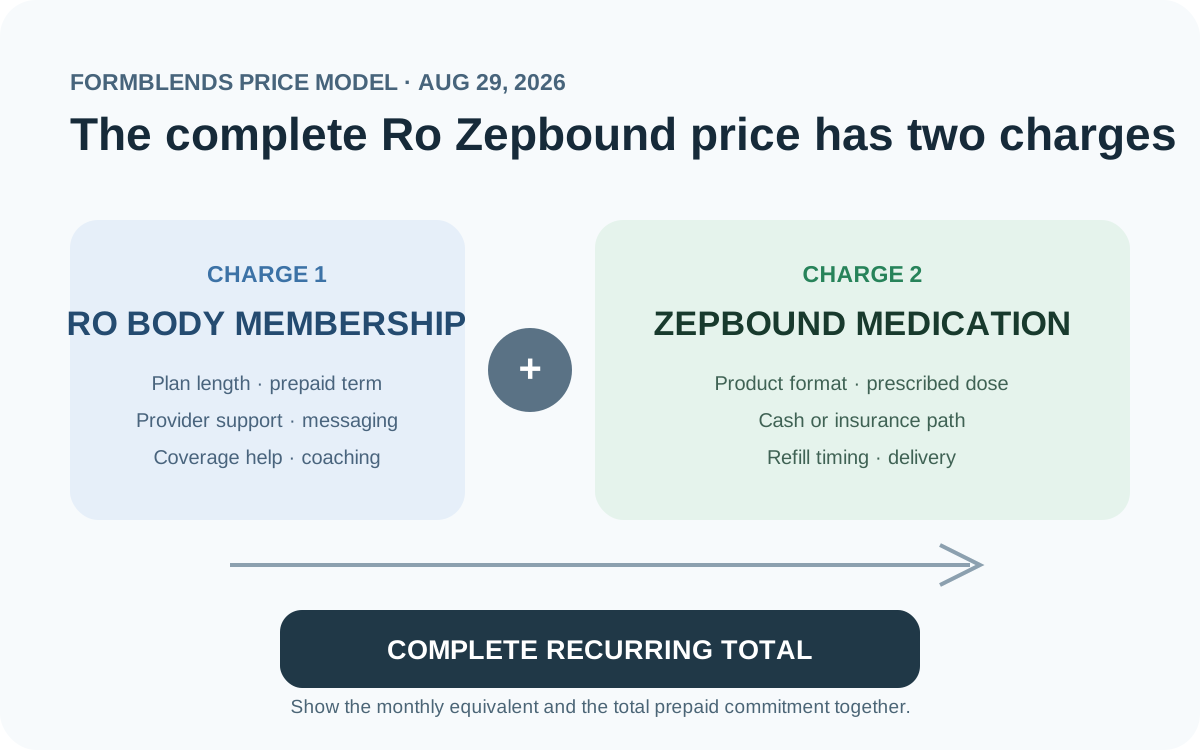
- On top of the medication, Ro Body membership is $39 for the first month, then $149 a month, or $99, $89 or $74 a month when you prepay 3, 6 or 12 months; that fee, not the drug price, is what separates Ro from ordering through LillyDirect with your own prescriber
- LillyDirect sells the same brand Zepbound vial or KwikPen at $299, $399 or $449 a month with no membership (seen September 4, 2026); the $349 to $499 ladder printed here earlier was the October 2025 pricing, cut in December 2025
- Compounded tirzepatide still exists at other telehealth providers (month-one median $299 across 14 providers in the FormBlends price index, September 3, 2026); it is not FDA-approved, and FDA had logged more than 730 adverse-event reports for it as of May 31, 2026
Direct answer
Correction, September 2026: the premise of the earlier version of this article was wrong. As of September 5, 2026, Ro sells brand Zepbound, not compounded tirzepatide. Through Ro, the Zepbound KwikPen costs $299 a month at 2.5 mg, $399 at 5 mg and $449 at 7.5 mg and above, the same self-pay prices Lilly charges through LillyDirect, as long as you complete Ro's check-in and refill within 45 days (otherwise $499 to $699). Ro Body membership is billed separately: $39 for the first month, then $149 a month, or $74 to $99 a month on 3-, 6- or 12-month prepay. So a first month at 2.5 mg is about $338 all-in, and a steady month at 7.5 mg or higher is $598 month to month or $523 on an annual plan. Ro's pricing page also lists brand Wegovy and Foundayo and no compounded medication. Confirm current pricing directly with Ro or Lilly before ordering.
See transparent compounded pricing
Review compounded GLP-1 pricing and what provider-reviewed care includes, with no surprises at checkout.
Try the Cost Calculator →Table of contents
- What Ro actually offers in the tirzepatide category
- Compounded vs. brand: the legal and clinical difference
- Ro's pricing structure
- What Ro's membership and visit fees include
- The regulatory landscape for compounded tirzepatide
- How Ro compares to Lilly Direct vials
- How Ro compares to other telehealth compounding platforms
- Quality and safety considerations with compounded products
- What happens if your Ro program is disrupted
- The decision framework
- What Ro actually charges (September 2026)
- Ro vs LillyDirect vs WeightWatchers vs Walgreens
- Ro no longer sells compounded tirzepatide
- Using insurance through Ro
- Annual cost scenarios (cash)
- FAQ
- Sources
What Ro actually offers in the tirzepatide category
Ro (Roman/Rory) is a direct-to-consumer telehealth platform offering treatments for sexual health, weight management, hair loss, and other categories. Its Ro Body weight-loss program, as listed on ro.co/weight-loss/pricing on September 5, 2026, offers FDA-approved GLP-1s only: Zepbound KwikPen ($299, $399, $449 by dose), Wegovy pen ($199, $349, $399), Wegovy pill ($149, $199, $299) and Foundayo ($149 to $299). No compounded semaglutide or tirzepatide appears on the page.
Important distinction: Ro markets these products under its "Ro Body" brand, but the product dispensed is the manufacturer's own drug. Ro was one of the first telehealth companies to sell Zepbound vials when Lilly opened that channel in December 2024, and its vials page (updated December 1, 2025) and Zepbound page both describe brand Zepbound at LillyDirect prices with Ro's membership added on top.
Patients sometimes assume Ro is dispensing compounded tirzepatide because so many telehealth brands do. It is not. The choice for a patient is therefore not compounded versus brand; it is which wrapper you buy the same brand drug in: Ro with a membership, LillyDirect with your own prescriber, WeightWatchers Med+ with its membership, Walgreens with per-visit fees, or a retail pharmacy with insurance.
Compounded vs. brand: the legal and clinical difference
| Attribute | Compounded tirzepatide (other telehealth providers; not sold by Ro as of September 2026) | Brand Zepbound (what Ro sells) |
|---|---|---|
| FDA approval | Not FDA-approved | FDA-approved for chronic weight management and OSA with obesity |
| Manufacturer | 503A state-licensed compounding pharmacy | Eli Lilly and Company |
| Production scale | Patient-by-patient under individual prescription | Industrial manufacturing under FDA cGMP |
| Quality oversight | State board of pharmacy; USP 797 standards | FDA inspections and approval |
| Concentration | Varies by pharmacy | Standardized by Lilly |
| Interchangeability | Not interchangeable with brand | Reference product |
| Adverse event reporting | State boards and MedWatch (less robust) | FAERS |
Compounded tirzepatide is not a generic version of Zepbound. Generics require FDA approval and demonstration of bioequivalence to the brand product. Compounded preparations have neither.
Ro's pricing structure
Ro's pricing page on September 5, 2026 separates the medication from the membership. Medication (billed at manufacturer self-pay prices):
- Zepbound KwikPen: $299 (2.5 mg), $399 (5 mg), $449 (7.5, 10, 12.5 or 15 mg) with a check-in and refill within 45 days; full refill price $499 to $699 if you miss the window
- Membership: $39 first month (refundable if you are not eligible), then $149 a month; or $99 a month billed every 3 months, $89 a month billed every 6 months, $74 a month billed annually
- No separate per-visit fee is listed; provider support, dose adjustments and the insurance concierge are described as included in the membership
- All-in examples: month one at 2.5 mg about $338; month two at 5 mg $548 month to month; month three onward at 7.5 mg or higher $598 month to month, $548 on the 3-month plan, $538 on the 6-month plan, $523 on the annual plan
Patients should verify current Ro pricing at the time of enrollment. The $39 first-month membership is the promotional element; the medication prices are Lilly's and identical everywhere. Ro's own cost article (updated June 26, 2026) prints $499 rather than $449 for the 7.5 to 15 mg tier, an inconsistency with its pricing page; we use the pricing page.
What Ro's membership and visit fees include
Ro bundles several components into its weight-loss subscription:
- Asynchronous prescriber visit (sometimes synchronous video)
- Prescription writing and pharmacy coordination
- Monthly product shipment
- Customer support and ongoing check-ins
- Some bundles include nutrition guidance or app access
Patients should compare Ro's membership against the alternatives that deliver the same $299 to $449 medication: LillyDirect with your own prescriber (no membership), WeightWatchers Med+ ($25 a month for the first two months then $74 on a 12-month auto-renewing plan, offer through September 8, 2026), or Walgreens virtual visits at $49 each with no subscription (28 states, self-pay only). The right comparison is monthly total cost, not the drug price, which is fixed.
The regulatory landscape for compounded tirzepatide
Compounded tirzepatide's regulatory status has been contested since 2023:
- Initially permitted under FDA shortage list rules allowing 503A pharmacies to compound from active pharmaceutical ingredient (API)
- FDA declared the tirzepatide shortage resolved on December 19, 2024, ending the shortage-based allowance for compounding copies of Zepbound in bulk
- Litigation by compounding pharmacies and telehealth platforms followed
- Subsequent FDA guidance and court rulings have shifted the operational landscape multiple times
- As of September 5, 2026: 503A patient-specific compounding continues at many telehealth providers (23 tracked by the FormBlends price index), FDA counts more than 730 adverse-event reports for compounded tirzepatide as of May 31, 2026, and the Fifth Circuit upheld FDA's shortage decision on August 27, 2026; Ro itself has exited the compounded market
This regulatory history is why Ro's catalog looks the way it does. By selling only FDA-approved products, Ro is exposed to Lilly's pricing decisions (the LillyDirect program terms run through December 31, 2026) rather than to compounding rulings.
How Ro compares to Lilly Direct vials
| Factor | Ro (brand Zepbound plus Ro Body membership) | LillyDirect (brand Zepbound, your own prescriber) |
|---|---|---|
| FDA-approved | Yes | Yes |
| Monthly drug cost (September 2026) | $299, $399, $449 by dose; $499 to $699 if the 45-day check-in is missed | $299, $399, $449 by dose; $499 or $699 if refilled after 45 days |
| Additional fees | $39 first month, then $149 a month, or $74 to $99 a month prepaid | None from Lilly; you pay your own prescriber |
| Format | KwikPen (multi-dose pen); vials also offered | Single-dose vials with syringes, or KwikPen |
| Manufacturer-direct | Medication at manufacturer self-pay pricing; Ro supplies the prescriber, shipping (under a week for cash orders) and insurance concierge | Yes |
| Subject to FDA compounding rules | No (approved drug) | No (approved drug) |
Both routes deliver the identical FDA-approved product at the identical price. Ro costs $74 to $149 more per month and in return handles the prescription, the 45-day check-ins and any insurance paperwork. LillyDirect is cheaper only if you already have a prescriber who will write and renew the Zepbound prescription for less than that.
How Ro compares to other telehealth compounding platforms
Ro is no longer in the compounded GLP-1 space, but the space is large: the Compounded GLP-1 Price Index tracked 23 telehealth providers selling compounded tirzepatide on September 3, 2026, including Henry Meds, Mochi Health, Noom Med, Eden and FormBlends, with a month-one median of $299 (range $149 to $470). Pricing varies, as does pharmacy partner transparency. Key differentiators among reputable platforms:
- Whether the partnered compounding pharmacy is named publicly
- Whether the pharmacy is 503A (typical) or 503B (less common; 503B compounding of GLP-1s for office-stock is differently regulated)
- Visit format (asynchronous vs. synchronous, frequency of follow-up)
- All-in monthly cost (drug + membership + visit)
- Cancellation and refund policies
- Quality assurance practices documented by the pharmacy
FormBlends operates a transparent 503A pharmacy partnership for compounded semaglutide and tirzepatide with published all-in pricing.
Quality and safety considerations with compounded products
Compounded medications carry quality considerations that brand drugs do not:
- Concentration verification: reputable compounders use certificates of analysis from API suppliers and may perform potency testing
- Sterility: USP 797 sterile compounding standards apply; pharmacies must demonstrate compliance
- Stability: beyond-use dates are set per USP guidance; pharmacies should not exceed
- Labeling accuracy: patients should verify the label matches the prescription
- Cold chain: vials must arrive properly refrigerated
Documented quality failures have occurred at some compounding pharmacies, including mislabeling, overconcentration, and contamination. Patients should investigate the specific pharmacy filling their prescription, not just the telehealth platform's brand.
What happens if your Ro program is disrupted
Regulatory shifts can disrupt access. Scenarios patients should plan for:
- Lilly changes the self-pay program: the LillyDirect and savings-program terms run through December 31, 2026; Ro's medication price would move with Lilly's
- Specific pharmacy ceases operations: a new prescription is needed for a different product or pharmacy
- You miss the 45-day check-in: the next fill is billed at $499 to $699 instead of $299 to $449; the same rule applies at LillyDirect
- Personal circumstances change: clinical re-evaluation may suggest stopping, dose adjustment, or alternative therapy
Continuous-treatment patients should have a contingency plan, especially given Lilly Direct's availability as a brand-name fallback at known pricing.
The decision framework
Use Ro if: you want brand Zepbound at Lilly's $299 to $449 self-pay price and you value having the prescriber, refills, 45-day check-ins and insurance paperwork handled for $74 to $149 a month.
Use LillyDirect directly if: you already have a prescriber willing to write and renew Zepbound. The medication price is identical to Ro's and there is no membership; the vial or KwikPen ships from Lilly's pharmacy partner or can be picked up at Walmart.
Use brand Zepbound through insurance if: your plan covers it at a copay that beats both Ro and Lilly Direct on monthly cost.
If you have Medicare: since July 1, 2026 the Medicare GLP-1 Bridge covers the Zepbound KwikPen at $50 a month for enrollees who meet obesity criteria and do not have type 2 diabetes (Lilly's Medicare page; program runs through December 31, 2027). Ro's membership would still apply if you use Ro as the prescriber. Whether Lilly's charitable Lilly Cares program includes Zepbound changes over time; check lillycares.com rather than assuming.
What Ro actually charges for Zepbound in September 2026 (membership plus medication)
Ro publishes both halves of the bill. The medication half is Lilly's self-pay price; the membership half is Ro's. Figures below are from ro.co/weight-loss/pricing and ro.co/weight-loss/zepbound as read on September 5, 2026.
| Month (cash, no insurance) | Zepbound KwikPen through Ro | Ro Body membership | All-in |
|---|---|---|---|
| Month 1, 2.5 mg | $299 | $39 | $338 |
| Month 2, 5 mg | $399 | $149 (month to month) | $548 |
| Month 3 onward, 7.5 mg or higher, month to month | $449 | $149 | $598 |
| Same, 3-month prepay | $449 | $99 | $548 |
| Same, 6-month prepay | $449 | $89 | $538 |
| Same, 12-month prepay | $449 | $74 | $523 |
| Any month after a missed 45-day check-in | $499 to $699 | as above | $573 to $848 |
Ro says cash orders ship in under a week and insured orders take about two weeks. The 45-day rule is Lilly's, not Ro's: every seller of the $449 tier applies it, and Ro's check-in is how it is enforced on their platform.
Ro vs LillyDirect vs WeightWatchers vs Walgreens: same Lilly price, different fees
Because the medication price is fixed by Lilly, the only variable is what you pay for access.
| Where you buy the same $299 to $449 Zepbound (checked September 5, 2026) | Fee on top of the medication | What the fee buys | Catch |
|---|---|---|---|
| LillyDirect | $0 | Home delivery or Walmart pickup | You need your own prescriber; 45-day refill rule |
| Ro | $39 first month, then $149 a month; $99, $89 or $74 a month on 3-, 6- or 12-month prepay | Prescriber, dose changes, insurance concierge, shipping in under a week | 45-day check-in or the fill is $499 to $699 |
| WeightWatchers Med+ | $25 a month for the first two months, then $74 a month on a 12-month plan (offer through September 8, 2026) | Clinician, WW program, insurance coordinators (commercial plans only) | Auto-renews for another 12 months; medication not included |
| Walgreens Weight Management | $49 per video visit, $49 follow-ups, no subscription | Prescriber; Lilly $449 offer honored through December 31, 2026 | Self-pay only, no prior authorization handling, 28 states |
| Retail pharmacy with the Lilly offer | $0 beyond your prescriber | GoodRx lists the $299 KwikPen at Walgreens, CVS, Walmart, Costco, Sam's Club and Target | Prescriber and offer enrollment are on you |
Ro's own cost article (updated June 26, 2026) also gives the anchors that make these prices look cheap: list price $499 to $1,086.37 per month for single-dose pens and a Costco cash price of $1,078.79. GoodRx (May 18, 2026) puts average retail at $1,291.34 for single-dose pens and $599.85 for KwikPens and vials without an offer.
Ro no longer sells compounded tirzepatide: what changed
Three dates explain the shift. On December 19, 2024 the FDA declared the tirzepatide shortage resolved, removing the basis for compounding copies of Zepbound in bulk. In mid-December 2024 Lilly and Ro announced that Ro would offer Zepbound vials at LillyDirect pricing, and Ro's vials page (updated December 1, 2025) still describes that arrangement. And on August 27, 2026 the Fifth Circuit upheld the FDA's shortage decision. Ro's September 5, 2026 pricing page lists only Zepbound, Wegovy and Foundayo. Compounded tirzepatide did not disappear from the market; the Compounded GLP-1 Price Index tracked 23 telehealth providers selling it on September 3, 2026 at a month-one median of $299 (range $149 to $470), and FormBlends is one of them. The FDA counts more than 730 adverse-event reports for compounded tirzepatide as of May 31, 2026 and reminds patients that compounded drugs are not FDA-approved.
Using insurance through Ro: concierge, prior authorization and the $25 card
| Insurance route through Ro (September 2026) | What applies |
|---|---|
| Commercial plan covers Zepbound | Ro's concierge files the prior authorization; Lilly's savings card brings the copay to as little as $25, with savings caps of $100, $200 and $300 per 1-, 2- and 3-month fill, $1,300 a year, 13 fills, through December 31, 2026 |
| Commercial plan excludes Zepbound | Lilly's not-covered price of $499 a month through the savings program, or the $299 to $449 self-pay ladder |
| Medicare | Since July 1, 2026 the Medicare GLP-1 Bridge covers the Zepbound KwikPen at $50 a month for enrollees with a BMI of 35 or higher, or 30 or 27 with specific conditions, and no type 2 diabetes; prior authorization at the first fill; runs through December 31, 2027 |
| Timeline | Insured orders take about two weeks; cash orders ship in under a week (ro.co/zepbound) |
| Membership | Billed by Ro regardless of how the medication is paid for |
WeightWatchers notes that vials and KwikPens are cash-only formats while single-dose pens are the insurable form; if your plan covers Zepbound, the pharmacy claim will typically be for single-dose pens.
Annual cost scenarios (cash) for a patient reaching 7.5 mg by month 3
| Year-one cash scenario (2.5 mg, 5 mg, then 7.5 mg or higher for 10 months) | Medication | Fees | Total |
|---|---|---|---|
| LillyDirect with your own prescriber | $299 + $399 + 10 x $449 = $5,188 | Your prescriber's charges | $5,188 plus visits |
| Ro, month to month | $5,188 | $39 + 11 x $149 = $1,678 | $6,866 |
| Ro, annual prepay | $5,188 | 12 x $74 = $888 | $6,076 |
| WeightWatchers Med+ (offer terms through September 8, 2026) | $5,188 | 2 x $25 + 10 x $74 = $790 | $5,978 |
| Walgreens, assuming four $49 visits | $5,188 | $196 | $5,384 |
The medication is 75 to 96 percent of every total. If you have a prescriber, LillyDirect wins on price; if you do not, Walgreens and WeightWatchers cost less than Ro month to month, and Ro's annual plan narrows the gap to about $100 a year against WeightWatchers. None of these totals include a single missed 45-day window, which adds $50 to $250 per affected fill.
FAQ
Does Ro sell brand Zepbound?
Yes. As of September 5, 2026, Ro sells brand Zepbound as a KwikPen (and vials) at Lilly's self-pay prices of $299, $399 and $449 a month by dose, plus a Ro Body membership. Ro's pricing page lists no compounded tirzepatide; an earlier version of this answer said the opposite and was wrong.
How much does compounded tirzepatide cost through Ro?
Ro no longer lists compounded tirzepatide. Brand Zepbound through Ro is $299 (2.5 mg), $399 (5 mg) or $449 (7.5 mg and up) a month with a check-in within 45 days, plus membership of $39 the first month, then $149 a month or $74 to $99 a month prepaid (ro.co, September 5, 2026).
Is Ro's compounded tirzepatide the same as Zepbound?
The question no longer applies: Ro dispenses brand Zepbound itself, the FDA-approved Lilly product, not a compounded version. Compounded tirzepatide sold by other telehealth providers is not FDA-approved and is not interchangeable with Zepbound.
Is compounded tirzepatide legal in 2026?
Yes, with conditions. FDA declared the tirzepatide shortage resolved on December 19, 2024, which ended bulk compounding of Zepbound copies, but state-licensed 503A pharmacies still compound for individual prescriptions and many telehealth providers sell it. It is not FDA-approved, and FDA had recorded more than 730 adverse-event reports for compounded tirzepatide as of May 31, 2026. Ro does not sell it.
How does Ro's tirzepatide compare to Lilly Direct's vials?
They are the same FDA-approved drug at the same price: $299, $399 or $449 a month by dose with a refill within 45 days. The difference is Ro's membership ($39 first month, then $149, or $74 to $99 prepaid), which buys the prescriber, check-ins and insurance help. LillyDirect has no membership but requires your own prescriber.
Is Ro a safe place to get tirzepatide?
Ro is a licensed telehealth platform that has sold brand Zepbound since Lilly opened the vial channel in December 2024, and it dispenses the FDA-approved Lilly product rather than a compounded copy. The medication is the same as at any pharmacy; what you are evaluating is Ro's service, its $74 to $149 monthly membership and its 45-day check-in rule.
Can I get my Ro prescription transferred to another pharmacy?
A brand Zepbound prescription written by a Ro clinician is an ordinary prescription and can be transferred like any other, but the $299 to $449 self-pay price is a LillyDirect program price, so to keep it you would fill through LillyDirect's channel (including Walmart pickup) or use the Lilly offer at a retail pharmacy; GoodRx lists the $299 KwikPen offer at Walgreens, CVS, Walmart, Costco, Sam's Club and Target.
What happens to Ro's program if tirzepatide compounding is restricted?
Nothing, because Ro already sells brand Zepbound rather than compounded tirzepatide. The risks to watch are different: Lilly's self-pay program terms run through December 31, 2026, and a missed 45-day check-in raises the next fill to $499 to $699.
Does Ro offer brand Wegovy or brand Mounjaro?
Ro's pricing page (September 5, 2026) lists brand Wegovy pen at $199, $349 and $399 by dose, Wegovy pill at $149, $199 and $299, Zepbound KwikPen at $299, $399 and $449, and Foundayo at $149 to $299. Mounjaro is not on the pricing page. All are FDA-approved manufacturer products at manufacturer self-pay prices.
Can I use insurance with Ro?
Yes for the medication, not for the membership. Ro's Zepbound page says its team checks coverage and files prior authorization, that insured orders take about two weeks versus under a week for cash, and Lilly's savings card ($25 with commercial coverage, $100 to $300 caps, $499 if the plan excludes Zepbound) applies. Medicare enrollees can use the $50 GLP-1 Bridge for the KwikPen since July 1, 2026.
What is the long-term safety profile of compounded tirzepatide?
Less established than brand Zepbound, which is what Ro sells. Compounded preparations are not FDA-reviewed for safety, effectiveness or quality, the SURMOUNT trials studied Lilly's product, and FDA had logged more than 730 adverse-event reports involving compounded tirzepatide as of May 31, 2026.
How much is Zepbound through Ro without insurance?
As of September 5, 2026, the medication is $299 a month at 2.5 mg, $399 at 5 mg and $449 at 7.5 mg and above, the same as LillyDirect, provided you complete Ro's check-in and refill within 45 days (otherwise $499 to $699). Ro Body membership adds $39 the first month, then $149 a month, or $99, $89 or $74 a month on 3-, 6- or 12-month prepay. A steady month at 7.5 mg is $598 month to month or $523 on the annual plan.
Is Ro legit for Zepbound?
Ro is a licensed telehealth company that dispenses brand Zepbound, the FDA-approved Lilly product, at Lilly's published self-pay prices; it has done so since Lilly opened the vial channel to Ro in December 2024, and its September 5, 2026 pricing page lists no compounded medication. The legitimacy question is about the service, not the drug: a $74 to $149 monthly membership, a 45-day check-in rule, and a full refill price of $499 to $699 if you miss it.
How does Ro work for Zepbound?
You pay a $39 first-month membership, complete an online medical intake, and a Ro clinician decides whether to prescribe. Cash orders of the KwikPen ship in under a week at $299, $399 or $449 by dose; if you use insurance, Ro's concierge files prior authorization and the process takes about two weeks. Every 45 days you complete a check-in to keep the discounted price and adjust the dose. Membership then runs $149 a month or $74 to $99 prepaid (ro.co, September 5, 2026).
Is Ro cheaper than LillyDirect for Zepbound?
No. The medication costs the same ($299, $399, $449 by dose, refill within 45 days), and Ro adds a membership of $74 to $149 a month, so Ro is $888 to $1,678 more per year on the fee alone. LillyDirect is cheaper only if you already have a prescriber; if you need one, compare Ro against WeightWatchers Med+ ($25 then $74 a month on a 12-month plan through September 8, 2026) and Walgreens ($49 per visit, 28 states).
Related guides
- Mounjaro Injection Price Equivalent: What You'll Actually Pay for Brand vs Compounded Tirzepatide in 2026
- Best Price Tirzepatide in 2026: Brand-Name vs Compounded Cost Breakdown
- Cheap Compounded Tirzepatide in 2026: What "Affordable" Actually Means and When Low Price Signals Risk
- How to Access Affordable Tirzepatide in 2026: Brand vs Compounded Cost Breakdown
- Where to Find the Cheapest Compounded Tirzepatide Without Sacrificing Quality in 2026
- Where to Get the Cheapest Compounded Tirzepatide in 2026 (And What "Cheapest" Actually Means)
- Tool: cost calculator
Sources
- Ro. Weight loss pricing page, seen September 5, 2026. https://ro.co/weight-loss/pricing/
- Eli Lilly. LillyDirect Zepbound self-pay pricing, seen September 4, 2026. https://www.lilly.com/lillydirect/zepbound
- U.S. Food and Drug Administration. Tirzepatide shortage resolution decision, December 19, 2024. https://www.fda.gov/media/185577/download
- USP. Standards for Compounded Sterile Preparations (USP 797). 2023.
- Outsourcing Facilities Association v. FDA. Litigation documentation on compounded GLP-1 products. 2024-2025.
- Jastreboff AM et al. Tirzepatide Once Weekly for the Treatment of Obesity. New England Journal of Medicine. 2022.
- Aronne LJ et al. Continued Treatment With Tirzepatide for Maintenance of Weight Reduction. JAMA. 2024.
- U.S. Food and Drug Administration. FDA's concerns with unapproved GLP-1 drugs used for weight loss (counts as of May 31, 2026). https://www.fda.gov/drugs/postmarket-drug-safety-information-patients-and-providers/fdas-concerns-unapproved-glp-1-drugs-used-weight-loss
- National Association of Boards of Pharmacy. 503A compounding pharmacy oversight summary. 2025.
- Pew Charitable Trusts. Federal and State Oversight of Drug Compounding. 2023.
- Ro. Weight loss pricing (Ro Body membership $39 first month then $149, or $99, $89, $74 a month on 3-, 6- and 12-month prepay; Zepbound KwikPen $299, $399, $449), seen September 5, 2026. https://ro.co/weight-loss/pricing/
- Ro. Zepbound through Ro (45-day check-in rule; $499 to $699 full refill price; cash orders ship in under a week), seen September 5, 2026. https://ro.co/weight-loss/zepbound/
- Ro. Zepbound cost with and without insurance (list $499 to $1,086.37; Costco $1,078.79), updated June 26, 2026. https://ro.co/weight-loss/zepbound-cost-with-and-without-insurance/
- Ro. Zepbound vials ($299, $399, $449 with the 45-day refill rule), updated December 1, 2025. https://ro.co/weight-loss/zepbound-vials/
- Eli Lilly. LillyDirect Zepbound self-pay pricing ($299, $399, $449 with a refill within 45 days; otherwise $499 or $699), seen September 4, 2026. https://www.lilly.com/lillydirect/zepbound
- Eli Lilly. Zepbound coverage and savings (savings card $25 with $100, $200 and $300 caps, $1,300 a year, 13 fills, through December 31, 2026; $499 when a commercial plan does not cover it), seen September 4, 2026. https://zepbound.lilly.com/coverage-savings
- Eli Lilly. Zepbound and the Medicare GLP-1 Bridge ($50 a month for the KwikPen; prior authorization at first fill), seen September 5, 2026. https://zepbound.lilly.com/medicare
- GoodRx. How much does Zepbound cost without insurance? (list $499 to $1,086; average retail $1,291.34 for single-dose pens and $599.85 for KwikPens and vials; $299 KwikPen offer), updated May 18, 2026. https://www.goodrx.com/zepbound/weight-loss-tirzepatide-cost
- WeightWatchers. Zepbound through WeightWatchers Med+ (LillyDirect price ladder and beyond-45-day prices), seen September 5, 2026. https://www.weightwatchers.com/us/weight-loss-medication/zepbound
- WeightWatchers. Tirzepatide and Med+ membership offer ($25 a month for the first two months on a 12-month plan, then $74; offer through September 8, 2026), seen September 5, 2026. https://www.weightwatchers.com/us/weight-loss-medication/tirzepatide
- Walgreens. Virtual weight management with Zepbound ($49 visits, self-pay only, 28 states, Lilly $449 offer through December 31, 2026), seen September 5, 2026. https://www.walgreens.com/topic/virtual-healthcare/weight-loss/zepbound.jsp
- U.S. Food and Drug Administration. Tirzepatide shortage resolution decision, December 19, 2024. https://www.fda.gov/media/185577/download
- U.S. Food and Drug Administration. FDA's concerns with unapproved GLP-1 drugs used for weight loss (adverse-event report counts as of May 31, 2026). https://www.fda.gov/drugs/postmarket-drug-safety-information-patients-and-providers/fdas-concerns-unapproved-glp-1-drugs-used-weight-loss
- FormBlends. Compounded GLP-1 Price Index methodology and current medians, data as of September 3, 2026. https://formblends.com/report/data/compounded-glp1-price-index
Footer disclaimers
Platform Disclaimer. FormBlends is a digital health platform connecting patients with independent licensed clinicians and partnered pharmacies. We are not affiliated with Ro, Roman, Rory, or any of their corporate entities. References to Ro's program reflect publicly available information about that company.
Compounded Medication Notice. Compounded tirzepatide and compounded semaglutide referenced in this article are prepared by 503A state-licensed compounding pharmacies in response to individual prescriptions. These preparations are not FDA-approved, are not generic equivalents to brand Zepbound or brand Wegovy, and have not undergone the FDA drug review process.
Results Disclaimer. Pricing, program structure, and regulatory information cited reflects publicly available data as of September 5, 2026. Ro's pricing and program terms change frequently. The regulatory environment for compounded GLP-1s continues to evolve. Verify current information directly with Ro, Lilly Direct, or your pharmacy before relying on figures here.
Trademark Notice. Ro, Roman, and Rory are registered trademarks of Ro/Roman Health. Zepbound, Mounjaro, Lilly Direct, and Lilly Cares are registered trademarks of Eli Lilly and Company. Wegovy and Ozempic are registered trademarks of Novo Nordisk A/S. FormBlends has no affiliation with any of these companies.
See your options in about 2 minutes
Take the free quiz and see what fits you. Quick, private, and no commitment to continue.
See my options →