Key Takeaways
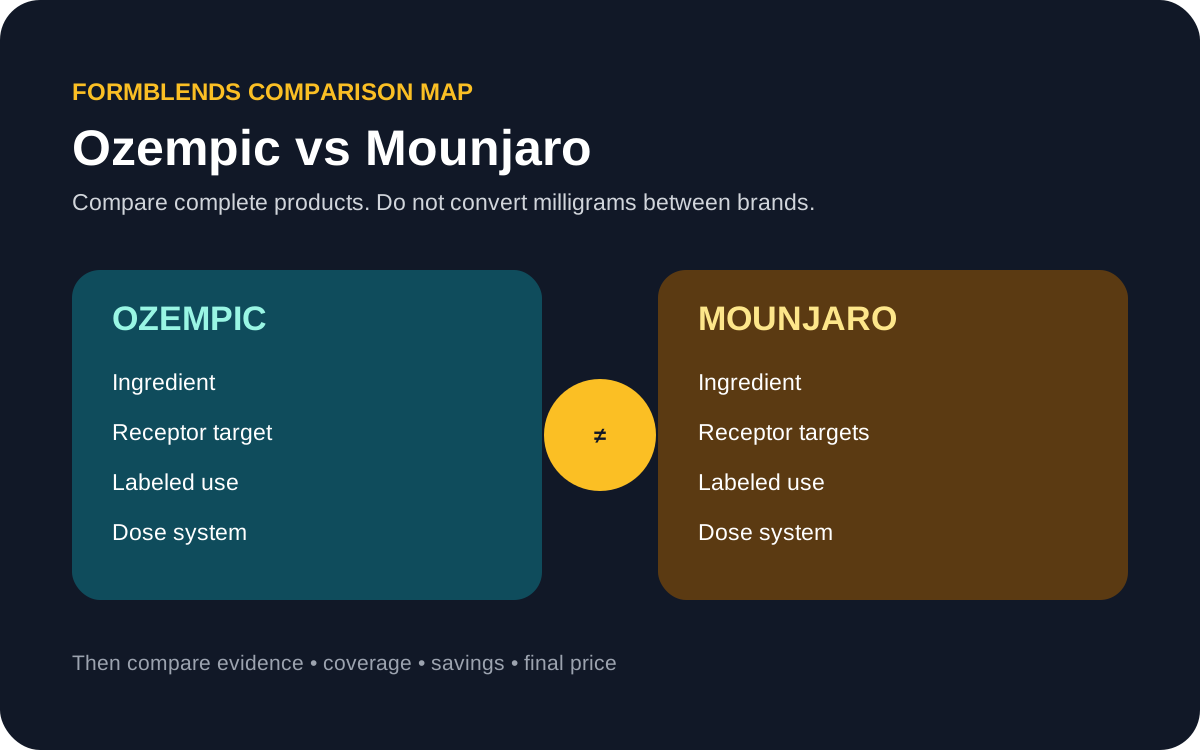
- Ozempic contains semaglutide, a single GLP-1 receptor agonist. Mounjaro contains tirzepatide, which hits both GLP-1 and GIP receptors.
- Both are FDA-approved for type 2 diabetes only. Their weight-loss-approved twins are Wegovy (semaglutide) and Zepbound (tirzepatide).
- Head-to-head trials show tirzepatide produces more weight loss and stronger A1C reduction at maximum dose than semaglutide.
- Side effect profiles are similar (nausea, constipation, reflux), with tirzepatide showing slightly higher nausea rates and slightly lower reflux rates in trial data.
- Out-of-pocket cash prices are roughly comparable ($1,000 to $1,200 per month). Insurance coverage often differs because each plan tiers them separately.
The short answer
Ozempic is semaglutide, a once-weekly GLP-1 receptor agonist made by Novo Nordisk. Mounjaro is tirzepatide, a once-weekly dual GLP-1 and GIP receptor agonist made by Eli Lilly. Both are FDA-approved for type 2 diabetes. Tirzepatide produces greater average weight loss and A1C reduction in head-to-head trials. They are not the same drug.
Table of contents
- The 30-second answer
- Active ingredients and mechanism of action
- FDA-approved uses for each drug
- Head-to-head trial data on weight loss and A1C
- Side effect comparison
- Dosing schedule and titration
- Storage, injection technique, and packaging
- Cost and insurance coverage
- Compounded alternatives
- How to choose between them with your provider
- FAQ
- Sources
Active ingredients and mechanism of action
Ozempic and Mounjaro are different molecules with different receptor targets.
Not sure which GLP-1 is right for you?
Take a 2-minute assessment and get a personalized recommendation after licensed provider review.
Take the Assessment →Ozempic (semaglutide). Semaglutide is a GLP-1 receptor agonist. GLP-1 (glucagon-like peptide-1) is a hormone the gut releases after meals. It tells the pancreas to release insulin, tells the liver to slow glucose output, slows stomach emptying, and tells the brain you are full. Semaglutide imitates that signal at higher doses than the body produces naturally.
Mounjaro (tirzepatide). Tirzepatide is a dual GLP-1 and GIP receptor agonist. It activates the same GLP-1 pathway as semaglutide and also activates GIP (glucose-dependent insulinotropic polypeptide), a second incretin hormone. The dual signal appears to drive stronger appetite suppression and stronger insulin response than GLP-1 alone (Frias et al., NEJM 2021).
The practical effect: Mounjaro pulls two metabolic levers, Ozempic pulls one. That single mechanistic difference is the reason head-to-head data favors Mounjaro on weight loss and A1C.
FDA-approved uses for each drug
Both drugs are FDA-approved for type 2 diabetes only. Neither carries a weight-loss indication, even though both produce significant weight loss in non-diabetic patients.
| Drug | Active ingredient | FDA-approved uses (2026) | Weight-loss-approved sister drug |
|---|---|---|---|
| Ozempic | Semaglutide | Type 2 diabetes; reducing major adverse cardiovascular events in T2D adults with established CV disease | Wegovy (semaglutide 2.4 mg) |
| Mounjaro | Tirzepatide | Type 2 diabetes | Zepbound (tirzepatide 5-15 mg) |
If a patient is using Ozempic or Mounjaro for weight loss without diabetes, the prescription is off-label. Many insurance plans deny coverage for off-label use, which is the single biggest driver of the $1,000+ monthly cash price most weight-loss patients see.
The weight-loss-approved versions (Wegovy and Zepbound) use the same active ingredients at higher or weight-loss-specific dose schedules. Coverage rules and prior authorization criteria for the weight-loss versions differ from the diabetes versions even within the same plan.
Head-to-head trial data on weight loss and A1C
Eli Lilly funded a direct head-to-head trial called SURPASS-2, comparing tirzepatide to semaglutide in patients with type 2 diabetes (Frias et al., NEJM 2021).
A1C reduction at 40 weeks:
| Treatment | A1C drop from baseline |
|---|---|
| Semaglutide 1 mg | 1.86% |
| Tirzepatide 5 mg | 2.01% |
| Tirzepatide 10 mg | 2.24% |
| Tirzepatide 15 mg | 2.30% |
Weight loss at 40 weeks (T2D patients, baseline ~94 kg / 207 lb):
| Treatment | Average weight loss |
|---|---|
| Semaglutide 1 mg | 5.7 kg (12.6 lb) |
| Tirzepatide 5 mg | 7.6 kg (16.8 lb) |
| Tirzepatide 10 mg | 9.3 kg (20.5 lb) |
| Tirzepatide 15 mg | 11.2 kg (24.7 lb) |
For non-diabetic obesity, the cleanest comparison is between the SURMOUNT-1 (tirzepatide) and STEP 1 (semaglutide) trials, which used the weight-loss doses of each drug:
- STEP 1 (semaglutide 2.4 mg, 68 weeks): 14.9% average weight loss (Wilding et al., NEJM 2021)
- SURMOUNT-1 (tirzepatide 15 mg, 72 weeks): 20.9% average weight loss (Jastreboff et al., NEJM 2022)
The roughly 6 percentage point gap is consistent across multiple endpoints. Tirzepatide produces more weight loss than semaglutide on average, and the gap widens at higher doses.
A 2024 real-world cohort study from the Cleveland Clinic compared 18,000 patients on each drug outside the trial setting (Rodriguez et al., JAMA Internal Medicine 2024). Tirzepatide patients lost an average of 15.3% body weight at 12 months versus 8.3% for semaglutide patients, with similar adherence rates.
The data is consistent: at maximum dose, tirzepatide outperforms semaglutide on weight loss. That does not mean every patient does better on tirzepatide. Individual response varies, and some patients tolerate semaglutide better than tirzepatide.
Side effect comparison
Both drugs share the same general side effect categories (gastrointestinal, primarily). Severity and incidence differ slightly.
| Side effect | Semaglutide (Ozempic/Wegovy) | Tirzepatide (Mounjaro/Zepbound) |
|---|---|---|
| Nausea | 20% (STEP 1) | 25-31% (SURMOUNT-1) |
| Vomiting | 9.2% | 8-12% |
| Diarrhea | 30% | 21-23% |
| Constipation | 24% | 11-17% |
| Acid reflux | 5.7% | 9.4% |
| Severe hypoglycemia (T2D, alone) | < 1% | < 1% |
| Pancreatitis | 0.2% | 0.2% |
| Gallbladder issues | 2.6% | 0.6-1.6% |
Differences worth knowing:
- Nausea is more common on tirzepatide, especially during the first 2-3 weeks at each new dose.
- Constipation is more common on semaglutide. Tirzepatide patients more often report diarrhea or normal bowel function.
- Reflux is more common on tirzepatide. This appears to relate to slower gastric emptying.
- Gallbladder events are more common on semaglutide in trial data, possibly because of greater rapid weight loss in pre-diabetic patients in some trials.
Both drugs carry the same boxed warning for thyroid C-cell tumors, based on rodent studies. There is no confirmed human signal for medullary thyroid cancer with either drug. Both are contraindicated for patients with personal or family history of medullary thyroid carcinoma or MEN 2.
Dosing schedule and titration
Both drugs are once-weekly subcutaneous injections. Dose ladders are similar in shape but not identical in numbers.
Ozempic dose ladder (T2D):
- Weeks 1-4: 0.25 mg
- Weeks 5-8: 0.5 mg
- Weeks 9-12: 1 mg (some patients stay here)
- Weeks 13+: 2 mg if needed
Mounjaro dose ladder (T2D):
- Weeks 1-4: 2.5 mg
- Weeks 5-8: 5 mg
- Weeks 9-12: 7.5 mg
- Then 10 mg, 12.5 mg, or 15 mg in 4-week increments
The escalation schedule is meant to reduce GI side effects. Skipping steps or escalating too fast usually increases nausea and vomiting. Most providers will hold a dose level longer if symptoms aren't tolerable.
Patients sometimes ask whether they can switch from one to the other. The answer is usually yes, but the new drug starts at its own beginning dose level, not at an "equivalent" higher dose. There is no clean conversion table because the two drugs aren't equipotent.
Storage, injection technique, and packaging
| Feature | Ozempic | Mounjaro |
|---|---|---|
| Form | Pre-filled multi-dose pen | Pre-filled single-dose pen |
| Doses per pen | 4 (some doses), 2 (others) | 1 |
| Refrigeration before first use | Required (36-46°F) | Required (36-46°F) |
| Room temperature shelf life after first use | Up to 56 days | Up to 21 days |
| Needle | Pen needle attached separately | Built-in hidden needle |
| Injection sites | Abdomen, thigh, upper arm | Abdomen, thigh, upper arm |
The pen design is the most visible difference. Ozempic uses a click-and-dial multi-dose pen that the user attaches a needle to and dials the prescribed dose. Mounjaro uses a single-dose auto-injector with a hidden needle that fires when pressed against the skin.
Patients afraid of seeing needles often prefer Mounjaro for that reason. Patients who prefer dose flexibility (e.g., physicians who micro-titrate) often prefer Ozempic.
Cost and insurance coverage
Cash prices in early 2026 are roughly comparable.
| Drug | Walmart cash | CVS cash | Costco cash (member) |
|---|---|---|---|
| Ozempic 1 mg pen | $980-1,100 | $1,025-1,150 | $895-980 |
| Mounjaro 5 mg pen | $1,025-1,135 | $1,055-1,175 | $935-1,015 |
Manufacturer savings cards exist for both:
- Ozempic savings card (Novo Nordisk): copays as low as $25 for commercial-insurance patients with T2D. No Medicare, no Medicaid.
- Mounjaro savings card (Eli Lilly): copays as low as $25 for commercial-insurance patients with T2D. No Medicare, no Medicaid.
Insurance coverage:
- For type 2 diabetes, both drugs are commonly on Tier 2 or Tier 3 of most commercial formularies.
- Many plans cover one but not the other, or prefer one (lower copay) over the other.
- Medicare Part D covers both for T2D. Specialty tier, $200-500 monthly copays.
- Most plans deny coverage for off-label weight-loss use of either drug.
- Wegovy and Zepbound (the weight-loss-labeled versions) have separate coverage rules and require their own prior authorization.
If your plan covers Ozempic but not Mounjaro (or vice versa), the practical answer to "which should I use" gets simpler. The drug your plan covers, with the lower copay, is usually the right starting point unless side effects force a switch.
Compounded alternatives
For patients without insurance coverage and without ability to pay $1,000+ monthly, compounded versions of both drugs exist.
- Compounded semaglutide is the same active ingredient as Ozempic and Wegovy.
- Compounded tirzepatide is the same active ingredient as Mounjaro and Zepbound.
Differences from brand-name versions:
- Not FDA-approved. Prepared by a state-licensed compounding pharmacy in response to an individual prescription.
- Drawn from a vial with a U-100 insulin syringe rather than dispensed by an auto-injector.
- Pricing typically $179-$399 monthly.
- Quality and sterility depend on the compounding pharmacy. Look for 503A pharmacies that test every batch for sterility, potency, and endotoxins.
Compounded versions are not interchangeable with brand-name products. The pharmacological action is similar in well-compounded preparations because the active ingredient is the same, but FormBlends does not make equivalency claims.
For more on this topic, see /articles/answers-hub/why-is-my-compounded-semaglutide-red-understanding-the-color-variations and /articles/answers-hub/ozempic-cost-at-walmart-with-insurance-what-youll-actually-pay.
How to choose between them with your provider
The choice depends on three things: medical history, insurance coverage, and side effect tolerance.
Reasons a provider might pick semaglutide (Ozempic) first:
- Strongest cardiovascular outcomes data in patients with established CV disease (Marso et al., NEJM 2016)
- Better insurance coverage on your specific plan
- Lower nausea reported in the patient's prior experience with GLP-1 medications
- Patient prefers Ozempic's reusable pen
- Patient has chronic acid reflux
Reasons a provider might pick tirzepatide (Mounjaro) first:
- Stronger weight-loss target needed (BMI > 35 with comorbidities)
- A1C above 9% needing the most aggressive reduction available
- Better insurance coverage on your specific plan
- Patient has chronic constipation
- Patient prefers single-dose auto-injector
For most patients, the practical first decision is "which one does my insurance cover" or "which one can I afford cash." The clinical differences matter, but the coverage and cost differences usually matter more for the first 6 months of treatment.
Switching is possible if the first choice doesn't work. Most providers will try a 12-16 week trial at maximum tolerated dose before switching, because both drugs need time to show their full effect.
FAQ
Are Ozempic and Mounjaro the same drug?
No. Ozempic is semaglutide. Mounjaro is tirzepatide. They are different molecules with different mechanisms, made by different manufacturers, with different dose ladders. They share a once-weekly injection schedule and a similar side effect profile, but they are not interchangeable.
Which is better for weight loss, Ozempic or Mounjaro?
On average, tirzepatide (Mounjaro) produces more weight loss than semaglutide (Ozempic) at maximum dose. The SURMOUNT-1 trial showed 20.9% body weight loss with tirzepatide 15 mg vs 14.9% with semaglutide 2.4 mg in STEP 1. Individual response varies.
Is Mounjaro safer than Ozempic?
The safety profiles are similar. Both carry the same boxed warning for thyroid C-cell tumors. Mounjaro patients report somewhat more nausea and reflux. Ozempic patients report somewhat more constipation and gallbladder issues. Severe events are rare on both.
Can I switch from Ozempic to Mounjaro?
Yes, with provider guidance. The new drug usually starts at its lowest dose, not at an "equivalent" higher dose. Switching typically takes 12-16 weeks to fully retitrate. Common reasons to switch include side-effect intolerance, insurance changes, or weight-loss plateau.
Why is Mounjaro stronger than Ozempic?
Mounjaro activates two incretin receptors (GLP-1 and GIP), while Ozempic activates only GLP-1. The dual mechanism appears to drive stronger appetite suppression and stronger insulin response. The trial evidence for the strength gap comes from SURPASS-2 (Frias et al., NEJM 2021).
Do Ozempic and Mounjaro have the same dose?
No. Ozempic doses run 0.25, 0.5, 1, and 2 mg weekly. Mounjaro doses run 2.5, 5, 7.5, 10, 12.5, and 15 mg weekly. The numbers aren't equivalent. A patient on Ozempic 1 mg isn't equivalent to any specific Mounjaro dose.
Is the Ozempic savings card and Mounjaro savings card the same?
No. Each manufacturer offers its own savings card. Both reduce eligible commercial-insurance copays to as low as $25 monthly for type 2 diabetes patients. Both exclude Medicare, Medicaid, TRICARE, and VA. You can use only one at a time, on the matching drug.
Does Medicare cover both drugs?
Medicare Part D covers both for type 2 diabetes management. Specialty tier copays typically run $200-500 monthly. Medicare does not cover either drug for weight loss. Medicare patients are not eligible for either manufacturer's savings card.
Can I take Ozempic and Mounjaro at the same time?
No. They work on overlapping receptors. Combining them increases side effect risk without proportional benefit. Patients who don't tolerate one switch to the other; they don't stack.
Which has worse side effects?
Both have similar overall side effect rates in clinical trials. Mounjaro patients report slightly more nausea and reflux. Ozempic patients report slightly more constipation. The difference is small for most patients. Tolerance is highly individual.
How long does each drug take to work?
Both start lowering blood glucose within days. Weight loss begins within 2-4 weeks. Maximum weight loss usually occurs around 60-72 weeks at maximum tolerated dose. The trajectory is similar between the two drugs even though the endpoint differs.
Are compounded versions of these drugs the same?
Compounded semaglutide and compounded tirzepatide contain the same active ingredients as Ozempic and Mounjaro respectively. They are not FDA-approved and are not interchangeable with brand-name products. Quality depends on the compounding pharmacy.
Related guides
- What Is the Difference Between Ozempic and Mounjaro? The Receptor Mechanism, Clinical Data, and Which One Works Better
- What's the Difference Between Ozempic and Mounjaro: The Molecular Mechanism, Clinical Data, and Which One Works Better for Weight Loss
- What Is the Difference Between Mounjaro and Ozempic: Mechanism, Efficacy, and Which Patients Respond Better
- What's the Difference Between Mounjaro and Ozempic: The Receptor Mechanism, Weight Loss Data, and Which One Works Better
- What Is the Difference Between Compounded Semaglutide and Ozempic? The Complete Comparison
- What Is the Difference Between Mounjaro and Zepbound? Eight Things That Actually Differ
Sources
- Frias JP, et al. Tirzepatide versus semaglutide once weekly in patients with type 2 diabetes. N Engl J Med. 2021;385:503-515.
- Jastreboff AM, et al. Tirzepatide once weekly for the treatment of obesity. N Engl J Med. 2022;387:205-216.
- Wilding JPH, et al. Once-weekly semaglutide in adults with overweight or obesity. N Engl J Med. 2021;384:989-1002.
- Marso SP, et al. Semaglutide and cardiovascular outcomes in patients with type 2 diabetes. N Engl J Med. 2016;375:1834-1844.
- Rodriguez J, et al. Comparative effectiveness of tirzepatide and semaglutide for weight reduction. JAMA Intern Med. 2024;184(8):907-915.
- Ozempic (semaglutide) prescribing information. Novo Nordisk. Revised 2024.
- Mounjaro (tirzepatide) prescribing information. Eli Lilly. Revised 2024.
- American Diabetes Association. Standards of Medical Care in Diabetes 2025. Diabetes Care. 2025;48(Suppl 1).
- Sattar N, et al. Cardiovascular, mortality and kidney outcomes with GLP-1 receptor agonists in patients with type 2 diabetes. Lancet Diabetes Endocrinol. 2021;9:653-662.
- FDA. Mounjaro Approval Letter. 2022.
- FDA. Ozempic Approval Letter. 2017.
Footer disclaimers
Platform Disclaimer. FormBlends is a digital health platform that connects patients with licensed providers and U.S.-based pharmacies. We do not manufacture, prescribe, or dispense medication directly. All clinical decisions are made by independent licensed providers.
Compounded Medication Notice. Compounded semaglutide and tirzepatide are not FDA-approved. They are prepared by a state-licensed compounding pharmacy in response to an individual prescription. Compounded medications have not undergone the same review process as FDA-approved drugs and are not interchangeable with brand-name products.
Results Disclaimer. Individual results vary. Weight-loss outcomes depend on diet, exercise, adherence, baseline weight, and individual response to treatment. Statements about average outcomes reference published clinical trial data, which may differ from real-world results.
Trademark Notice. Ozempic, Wegovy, and Rybelsus are registered trademarks of Novo Nordisk A/S. Mounjaro and Zepbound are registered trademarks of Eli Lilly and Company. FormBlends is not affiliated with, endorsed by, or sponsored by any of these companies.
See your options in about 2 minutes
Take the free quiz and see what fits you. Quick, private, and no commitment to continue.
See my options →