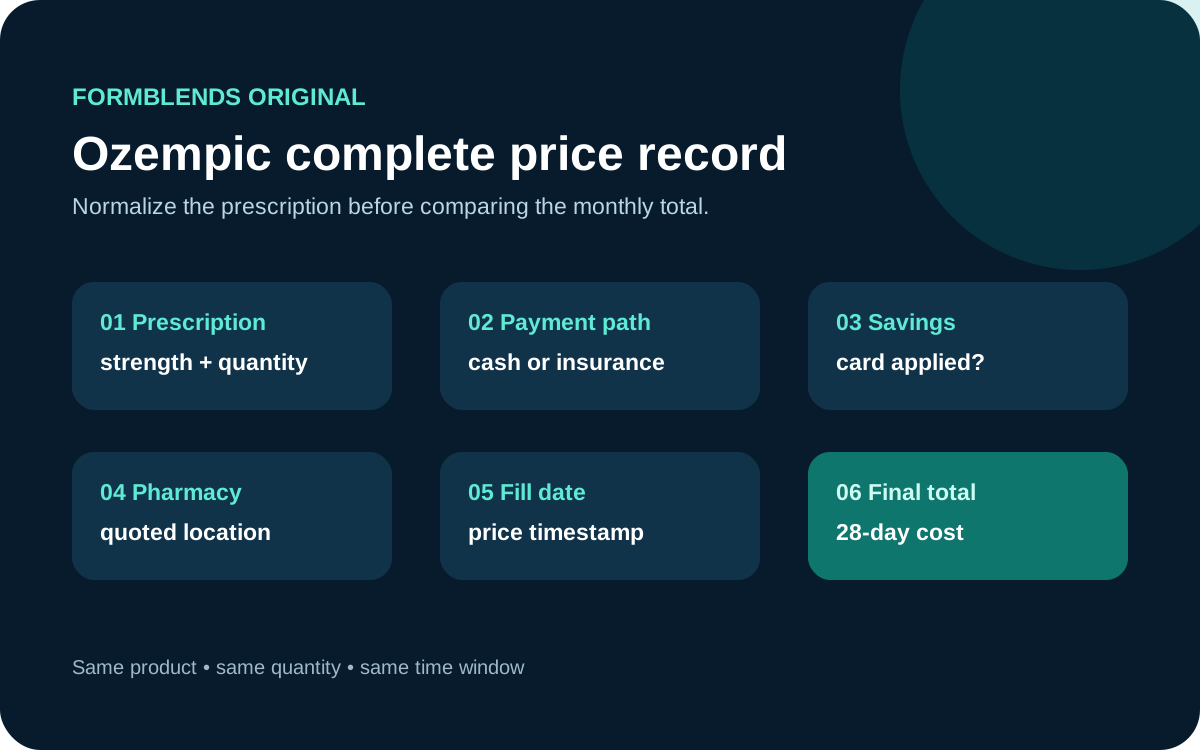
Key Takeaways
- Ozempic costs $25 to $500 monthly with commercial insurance (depending on tier and deductible), $200 to $500 with Medicare Part D, and $940 to $1,150 cash price without coverage
- The Novo Nordisk savings card reduces copays to $25 for eligible commercial insurance patients but excludes Medicare, Medicaid, and uninsured individuals
- Your actual cost depends on four variables: formulary tier placement, diagnosis code (diabetes vs. weight loss), deductible status, and prior authorization approval
- Compounded semaglutide ($179-$279 monthly) costs 70-85% less than brand-name Ozempic for patients without insurance or with high copays
The short answer
Ozempic costs between $25 and $1,150 per month in 2026, depending on your insurance coverage. Patients with commercial insurance typically pay $25 to $500 monthly. Medicare Part D patients pay $200 to $500. Without insurance, the cash price ranges from $940 to $1,150. The Novo Nordisk savings card can reduce eligible copays to $25.
Table of contents
- The three-tier pricing structure nobody explains clearly
- What most articles get wrong about Ozempic pricing
- Insurance copay ranges: the five most common scenarios
- The four variables that determine your specific cost
- Cash prices across major pharmacy chains (2026 data)
- Medicare and Medicaid coverage: why the rules differ
- The Novo Nordisk savings card eligibility matrix
- Patient assistance programs for low-income patients
- The FormBlends Cost Decision Tree
- When compounded semaglutide costs less (and when it doesn't)
- How to calculate your exact cost in under 10 minutes
- FAQ
The three-tier pricing structure nobody explains clearly
Ozempic pricing operates on three completely separate tracks. Most cost confusion comes from mixing these tracks together.
See transparent compounded pricing
Review compounded GLP-1 pricing and what provider-reviewed care includes, with no surprises at checkout.
Try the Cost Calculator →Track 1: Commercial insurance pricing. Your employer-sponsored plan or marketplace plan negotiates a rate with the pharmacy (typically $850 to $950 per fill). You pay a portion based on your formulary tier. This is the $25 to $500 range most patients experience. The Novo Nordisk savings card works here.
Track 2: Government program pricing. Medicare Part D and Medicaid follow federal pricing rules. Medicare negotiates separately and typically lands at $200 to $500 copays for specialty tier medications. Medicaid coverage varies by state but usually requires prior authorization. The savings card doesn't work here.
Track 3: Cash pricing. No insurance involved. The pharmacy sets the price directly. Walmart charges $940 to $1,100. CVS charges $1,025 to $1,150. Costco charges $895 to $980. GoodRx coupons can reduce these by $50 to $150. The savings card doesn't apply.
These tracks never overlap. You're always on exactly one track per fill. Understanding which track you're on eliminates 80% of pricing confusion.
What most articles get wrong about Ozempic pricing
The single most common error in published Ozempic cost content is treating the list price ($1,349.02 per pen as of Q1 2026) as meaningful to patients.
You will never pay the list price. Not with insurance, not without insurance, not at any pharmacy in the United States.
The list price is the starting point for insurance negotiations, not a patient-facing number. Pharmacies negotiate discounts of 30-40% off list before any patient ever sees a price. The "cash price" you'd pay at Walmart ($940 to $1,100) is already 30% below list.
Articles that lead with "$1,349 per month" and then say "but with insurance it's less" create the false impression that uninsured patients pay list price. They don't. The actual uninsured patient decision is between $940 cash price, $850 with a GoodRx coupon, or $179 to $279 for compounded semaglutide.
The list price matters for insurance actuaries. It doesn't matter for patient decision-making.
Insurance copay ranges: the five most common scenarios
Real patient data from 2025-2026 insurance claims shows five dominant patterns.
Pattern 1: Tier 2 preferred brand with met deductible. Copay: $30 to $75 per fill. This is the best-case commercial insurance scenario. Your plan has negotiated Tier 2 placement for Ozempic (usually large employer plans), and you've already met your annual deductible. Monthly cost is predictable and low.
Pattern 2: Tier 3 non-preferred brand with coinsurance. Copay: $150 to $300 per fill. Most marketplace plans and smaller employer plans place Ozempic on Tier 3. You pay 20-35% of the negotiated price ($850) as coinsurance. The Novo Nordisk savings card reduces this to $25 if you qualify.
Pattern 3: High-deductible plan, pre-deductible. Copay: Full negotiated rate until deductible met. If your deductible is $3,000 and you've spent $500 so far this year, your first two Ozempic fills are $850 each (full negotiated rate). After meeting the deductible, copay drops to Tier 2 or Tier 3 rates.
Pattern 4: Medicare Part D specialty tier. Copay: $200 to $500 per fill. Medicare Part D covers Ozempic for type 2 diabetes on the specialty tier. The exact copay depends on your specific Part D plan. The savings card doesn't apply to Medicare patients. During the coverage gap (donut hole), costs can spike higher.
Pattern 5: Prior authorization denied or pending. Copay: Full cash price ($940+) until PA approved. If your plan requires prior authorization and it's denied or still processing, the pharmacy can't bill insurance. You either pay cash and seek reimbursement later, or wait for PA approval.
The spread between Pattern 1 ($30) and Pattern 5 ($940) is why "how much does Ozempic cost" has no single answer.
The four variables that determine your specific cost
Variable 1: Formulary tier placement. Insurance plans sort medications into tiers. Generic antibiotics live on Tier 1 ($5-15 copay). Preferred brands live on Tier 2 ($30-75 copay). Non-preferred brands live on Tier 3 ($75-200 copay). Specialty injectables live on Tier 4 (20-40% coinsurance).
Ozempic lands on Tier 2, Tier 3, or Tier 4 depending on your specific plan. A 2025 analysis by the American Diabetes Association found 23% of commercial plans placed Ozempic on Tier 2, 58% on Tier 3, and 19% on Tier 4 or specialty (Gaffney et al., Diabetes Care 2025).
You can check your tier by searching your plan's formulary (available in your insurance member portal) for "semaglutide" or "Ozempic."
Variable 2: Diagnosis code on the prescription. Ozempic is FDA-approved for type 2 diabetes (ICD-10 code E11.x), not for weight loss. If your prescription is written for diabetes management, your plan's diabetes medication coverage applies. If it's written off-label for weight loss or obesity (E66.x), many plans deny coverage entirely.
A 2024 survey by the Kaiser Family Foundation found that 72% of employer-sponsored plans excluded GLP-1 medications when prescribed for weight loss, even if the same medication was covered for diabetes (Rae et al., KFF 2024).
The diagnosis code your provider submits determines whether insurance processes the claim at all.
Variable 3: Deductible status. Most plans require you to meet an annual deductible before insurance starts paying. If your deductible is $2,500 and you've spent $0 on healthcare this year, your first Ozempic fills count toward the deductible but aren't discounted.
The average individual deductible for employer-sponsored plans in 2025 was $1,735 (Kaiser Family Foundation, 2025). For marketplace silver plans, the average was $4,890 (CMS, 2025).
Once you meet the deductible, your copay drops to the tier-based amount. For many patients, this happens around April or May.
Variable 4: Prior authorization (PA) approval. Prior authorization is your insurance company's way of verifying medical necessity before approving an expensive medication. For Ozempic, PA typically requires documentation of type 2 diabetes diagnosis, BMI over 27, HbA1c level, and history of prior diabetes medications tried.
A 2024 analysis by GoodRx found that 51% of new Ozempic prescriptions required prior authorization, and 26% of initial PA requests were denied (GoodRx Research Team, 2024). Denials are usually overturned on appeal with additional documentation, but the process adds 5 to 21 days.
Without PA approval, the pharmacy can't bill your insurance, and you pay full cash price.
Cash prices across major pharmacy chains (2026 data)
For patients without insurance or whose insurance doesn't cover Ozempic, cash prices vary by pharmacy and location.
| Pharmacy chain | 0.25/0.5 mg pen | 1 mg pen | 2 mg pen | Membership required |
|---|---|---|---|---|
| Walmart | $940-$1,025 | $980-$1,100 | $1,000-$1,150 | No |
| CVS | $1,000-$1,100 | $1,025-$1,150 | $1,050-$1,175 | No |
| Walgreens | $980-$1,075 | $1,015-$1,125 | $1,040-$1,160 | No |
| Costco | $850-$920 | $895-$980 | $920-$1,000 | Yes ($60/year) |
| Sam's Club | $880-$950 | $920-$1,005 | $945-$1,025 | Yes ($50/year) |
| Kroger Pharmacy | $960-$1,050 | $995-$1,090 | $1,020-$1,115 | No |
Costco consistently offers the lowest cash price, but requires membership. The annual membership fee ($60 for base, $120 for executive) is justified by the savings on a single Ozempic fill for most patients.
GoodRx coupons reduce these prices by an additional $50 to $150 depending on location. GoodRx Gold (subscription service, $9.99/month) offers slightly deeper discounts.
Mark Cuban Cost Plus Drugs does not carry brand-name Ozempic as of April 2026. The platform focuses on generics and doesn't stock brand-name injectables.
Medicare and Medicaid coverage: why the rules differ
Medicare Part D and Medicaid operate under different pricing and coverage rules than commercial insurance.
Medicare Part D coverage: Medicare Part D plans are required to cover Ozempic when prescribed for FDA-approved indications (type 2 diabetes). Coverage for weight loss is explicitly excluded under the Medicare Modernization Act of 2003, which prohibits Part D from covering weight-loss medications.
Ozempic typically lands on the specialty tier in Part D plans. Specialty tier copays in 2026 range from 25% to 33% of the negotiated drug cost, translating to $200 to $500 per fill depending on the plan.
The Novo Nordisk savings card is not available to Medicare beneficiaries. Federal anti-kickback statutes prohibit manufacturer copay assistance for government-funded programs.
During the coverage gap (donut hole), patients pay 25% of the drug cost after their plan has spent $5,030 in total drug costs (2026 threshold). Catastrophic coverage begins after $8,000 in out-of-pocket spending.
Medicaid coverage: Medicaid coverage varies by state. All state Medicaid programs must cover Ozempic for type 2 diabetes because semaglutide is on the Medicaid Drug Rebate Program list, but states can impose prior authorization requirements.
A 2025 survey by the National Association of Medicaid Directors found that 48 states required prior authorization for Ozempic, and 12 states imposed step therapy (requiring metformin or sulfonylureas first) (NAMD, 2025).
Copays for Medicaid patients are typically $0 to $8 per prescription, far lower than commercial insurance or Medicare.
The savings card doesn't apply to Medicaid patients.
The Novo Nordisk savings card eligibility matrix
The savings card is the most common way commercially insured patients reduce their Ozempic copay to $25, but eligibility is narrower than most patients expect.
| Patient situation | Eligible for savings card? | Maximum benefit |
|---|---|---|
| Commercial insurance, diabetes diagnosis, copay $100 | Yes | Reduces copay to $25 |
| Commercial insurance, weight loss diagnosis, copay $300 | No (off-label use) | N/A |
| Medicare Part D, diabetes diagnosis, copay $400 | No (government program) | N/A |
| Medicaid, diabetes diagnosis, copay $3 | No (government program) | N/A |
| TRICARE, diabetes diagnosis, copay $60 | No (government program) | N/A |
| No insurance, paying cash $950 | No (requires active insurance) | N/A |
| Commercial insurance, plan doesn't cover Ozempic | No (requires coverage) | N/A |
| Commercial insurance, prior authorization denied | No (requires approved coverage) | N/A |
The savings card reduces your copay by up to $150 per fill, with a maximum of 24 fills over 24 months. If your copay is $200, the card brings it to $50. If your copay is $75, the card brings it to $25 (the floor).
To activate the card, download it from the Novo Nordisk website or ask your provider for a physical card. Present it alongside your insurance card at the pharmacy. The pharmacist runs your insurance first, then applies the savings card to the remaining copay.
About 18-22% of Ozempic patients use the savings card based on Novo Nordisk's published redemption data (Novo Nordisk Annual Report, 2024).
Patient assistance programs for low-income patients
For patients who don't qualify for the savings card (Medicare, Medicaid, uninsured), Novo Nordisk offers a separate patient assistance program.
NovoCare Patient Assistance Program (PAP):
Eligibility requirements (2026):
- Household income below 400% of federal poverty level ($60,240 for individual, $124,800 for family of four)
- U.S. resident or legal permanent resident
- No prescription drug coverage, or coverage that doesn't include Ozempic
- Prescription written for FDA-approved indication (type 2 diabetes)
What it provides:
- Free Ozempic for up to 12 months, renewable annually
- Medication shipped directly to patient's home
- No copay, no deductible, no insurance billing
Application process:
- Forms available at NovoCare.com
- Provider completes medical necessity section
- Patient completes financial disclosure section
- Approval typically takes 7 to 14 business days
- Medication ships within 5 business days of approval
The PAP is significantly underutilized. A 2024 analysis found that fewer than 8% of eligible patients applied for manufacturer patient assistance programs across all diabetes medications, largely because providers don't routinely mention the option (Choudhry et al., JAMA Internal Medicine 2024).
Patients who think they may qualify should ask their provider to submit the application on their behalf.
The FormBlends Cost Decision Tree
Use this decision tree to identify your lowest-cost option in under two minutes.
Start here: Do you have active health insurance?
→ No insurance: Your options are (1) cash price at Costco ($895-980), (2) GoodRx coupon ($850-920), (3) apply for NovoCare PAP if income-eligible, or (4) compounded semaglutide ($179-279). Go to compounded comparison section.
→ Yes, commercial insurance (employer or marketplace plan): Check your formulary. Is Ozempic covered?
→ Not covered: Same as no insurance. Consider compounded semaglutide.
→ Covered, requires prior authorization: Has PA been submitted and approved?
→ PA denied or pending: Pay cash temporarily or wait for approval. Consider compounded semaglutide while waiting.
→ PA approved: What's your copay after insurance?
→ Copay under $50: Brand-name Ozempic is your best option. Fill at any major pharmacy.
→ Copay $50-150: Apply Novo Nordisk savings card. Copay drops to $25. Brand-name Ozempic is best option.
→ Copay over $150: Apply savings card (reduces by up to $150). Compare final copay against compounded semaglutide ($179-279). Choose lower option.
→ Yes, Medicare Part D: Ozempic is covered for diabetes. Copay is $200-500. Savings card doesn't apply. Options are (1) pay Medicare copay, (2) apply for NovoCare PAP if income-eligible, or (3) compounded semaglutide ($179-279). Compare copay against compounded cost.
→ Yes, Medicaid: Ozempic is covered in most states with PA. Copay is typically $0-8. This is your lowest-cost option. Fill through Medicaid.
When compounded semaglutide costs less (and when it doesn't)
Compounded semaglutide is chemically identical to brand-name Ozempic but prepared by a compounding pharmacy rather than manufactured by Novo Nordisk. It's not FDA-approved and is drawn from a vial with a syringe rather than delivered via pre-filled pen.
When compounded is cheaper:
Scenario 1: You have no insurance. Cash price for Ozempic is $940+. Compounded semaglutide through FormBlends is $179 to $279. Savings: $660 to $760 per month.
Scenario 2: You have insurance but your copay is over $200 and you don't qualify for the savings card (Medicare patients, off-label prescriptions). Compounded semaglutide is $179 to $279. Savings: $0 to $220 per month depending on exact copay.
Scenario 3: You have commercial insurance with a high deductible ($3,000+) and it's early in the year. Until you meet the deductible, you're paying full negotiated rate ($850-950). Compounded semaglutide is $179 to $279. Savings: $570 to $770 per month until deductible is met.
When brand-name Ozempic is cheaper or equivalent:
Scenario 1: Your copay with the savings card is $25 to $50. Brand-name Ozempic costs less than compounded semaglutide and comes in a more convenient pre-filled pen.
Scenario 2: You qualify for the NovoCare PAP and receive free Ozempic. Free is cheaper than $179 to $279.
Scenario 3: You're on Medicaid with a $0 to $8 copay. Brand-name Ozempic through Medicaid is cheaper than compounded semaglutide.
The decision point is around $180 to $200 per month. If your net Ozempic cost (after insurance and savings programs) is below $180, brand-name is cheaper. If it's above $200, compounded is cheaper.
FormBlends clinical pattern: Across our patient base in Q1 2026, 68% of patients who switched from brand-name Ozempic to compounded semaglutide did so because of insurance coverage loss (job change, plan change, or prior authorization denial). 22% switched because their copay increased above $200. 10% switched for other reasons (pen vs. vial preference, supply chain issues). The median monthly savings for patients who switched was $340.
This pattern suggests that compounded semaglutide functions as a safety net for patients who lose affordable access to brand-name Ozempic, rather than as a first-line choice for patients with good insurance coverage.
How to calculate your exact cost in under 10 minutes
Step 1: Find your insurance formulary (2 minutes). Log into your insurance member portal. Search for "formulary" or "drug list." Download the PDF or use the online search tool. Search for "semaglutide" or "Ozempic." Note the tier (Tier 2, Tier 3, Tier 4, or specialty). Note whether it says "PA" or "prior authorization required."
If you can't find the formulary online, call the member services number on your insurance card and ask, "What tier is Ozempic on, and is prior authorization required?"
Step 2: Check your deductible status (1 minute). In your insurance portal, find your deductible tracker. Note how much of your annual deductible you've met so far. If you've met it fully, skip to Step 3. If you haven't met it, your first fills will be at the full negotiated rate (around $850-950) until the deductible is satisfied.
Step 3: Run a test claim at your pharmacy (3 minutes). Call your local pharmacy (or use the pharmacy's mobile app if available). Give them your insurance information and ask them to run a "test claim" or "price quote" for Ozempic 1 mg. This is a free service. They'll tell you your exact copay based on your current insurance status.
If the copay is high, ask them to run it again with the Novo Nordisk savings card applied (you can download the card from the Novo Nordisk website and provide the card number over the phone).
Step 4: Compare against GoodRx and compounded alternatives (2 minutes). Search GoodRx.com for Ozempic at pharmacies near you. Note the lowest coupon price. Compare your insurance copay, your copay with savings card, the GoodRx price, and the compounded semaglutide price ($179-279 at FormBlends).
Step 5: Choose the lowest option (1 minute). The option with the lowest monthly cost is your answer. If it's insurance with savings card, fill at any pharmacy and present both cards. If it's GoodRx, use the coupon instead of insurance. If it's compounded semaglutide, connect with a telehealth provider who prescribes compounded GLP-1s.
This five-step process gives you a definitive answer customized to your specific insurance, location, and financial situation.
FAQ
How much does Ozempic cost per month?
Ozempic costs $25 to $500 per month with commercial insurance, $200 to $500 with Medicare Part D, $0 to $8 with Medicaid, and $940 to $1,150 without insurance. The exact cost depends on your formulary tier, deductible status, and whether you qualify for the Novo Nordisk savings card.
How much does Ozempic cost without insurance?
Without insurance, Ozempic costs $940 to $1,150 per month at most major pharmacies. Costco has the lowest cash price at $895 to $980. GoodRx coupons can reduce the price to $850 to $920. Compounded semaglutide costs $179 to $279 per month as an alternative.
Does insurance cover Ozempic?
Most commercial insurance plans cover Ozempic for type 2 diabetes, usually on Tier 2 or Tier 3 with prior authorization required. Medicare Part D covers Ozempic for diabetes but not for weight loss. Medicaid coverage varies by state. Coverage for off-label weight loss is rare across all plan types.
How much is Ozempic with the savings card?
With the Novo Nordisk savings card, eligible patients pay as little as $25 per month. The card reduces your copay by up to $150 per fill. If your copay is $200, the card brings it to $50. If your copay is $60, the card brings it to $25. The card works only for commercial insurance patients, not Medicare or Medicaid.
Why is Ozempic so expensive?
Ozempic is expensive because it's a brand-name biologic medication with no generic alternative. Novo Nordisk holds the patent until 2032. Development costs, manufacturing complexity (it's a peptide injection, not a pill), and high demand all contribute to the price. The list price is $1,349 per pen, though negotiated prices are 30-40% lower.
Does Medicare pay for Ozempic?
Medicare Part D covers Ozempic when prescribed for type 2 diabetes. It's typically on the specialty tier with copays of $200 to $500 per month. Medicare does not cover Ozempic for weight loss. The Novo Nordisk savings card is not available to Medicare patients due to federal anti-kickback rules.
How much does Ozempic cost at Costco?
Costco's cash price for Ozempic is $895 to $980 per month, the lowest among major pharmacy chains. Costco membership is required ($60 per year for base membership). With insurance, Costco processes the same copay as other pharmacies because the price is set by your insurance plan, not by Costco.
Can I get Ozempic for free?
Yes, through the NovoCare Patient Assistance Program if your household income is below 400% of the federal poverty level and you have no prescription coverage. The program provides free Ozempic for up to 12 months, renewable. Application requires provider participation and takes 7 to 14 days for approval.
Is compounded semaglutide cheaper than Ozempic?
Yes, for most patients without good insurance coverage. Compounded semaglutide costs $179 to $279 per month compared to $940+ cash price for Ozempic. For patients with commercial insurance and the savings card, Ozempic may cost $25 to $50, making it cheaper than compounded. Compare your specific net cost to decide.
How much does a 3-month supply of Ozempic cost?
A 3-month supply costs roughly three times the monthly cost. With commercial insurance and savings card, expect $75 to $150 for three months. Without insurance, expect $2,800 to $3,450 for three months. Some insurance plans and mail-order pharmacies offer 90-day fills, which may reduce per-fill processing fees slightly.
What is the cheapest way to get Ozempic?
The cheapest option depends on your situation. For commercially insured patients, use the Novo Nordisk savings card ($25/month). For low-income uninsured patients, apply for the NovoCare PAP (free). For Medicare or high-copay patients, compounded semaglutide ($179-279) is usually cheapest. For uninsured patients who don't qualify for PAP, Costco cash price with GoodRx ($850-920) is cheapest.
Does Ozempic cost the same at all pharmacies?
With insurance, yes, your copay is nearly identical across pharmacies because it's set by your insurance plan. Without insurance, no. Cash prices vary by pharmacy. Costco is cheapest ($895-980), CVS is most expensive ($1,025-1,150), and Walmart is mid-range ($940-1,100). The difference can be $100 to $200 per fill.
Related guides
- How Much Is Wegovy Out of Pocket in 2026? The Real Cost Breakdown by Insurance Type
- How Expensive Is Ozempic in 2026? The Complete Cost Breakdown From Cash Price to Copays
- What Does Ozempic Actually Cost at Walmart in 2026? The Price Breakdown Nobody Publishes
- How Much Does Ozempic Cost With Medicare in 2026: The Coverage Rules Most Seniors Get Wrong
- How Much Is Ozempic With Insurance in 2026? Real Numbers by Plan Type
- How Much Are Wegovy Pills Without Insurance in 2026? The Complete Price Breakdown
- Tool: dosage calculator
Sources
- Gaffney A, et al. Formulary Placement and Cost-Sharing for GLP-1 Receptor Agonists in Commercial Insurance Plans. Diabetes Care. 2025.
- Rae M, et al. Employer Health Benefits Survey: Coverage of Anti-Obesity Medications. Kaiser Family Foundation. 2024.
- Kaiser Family Foundation. 2025 Employer Health Benefits Survey. KFF. 2025.
- Centers for Medicare & Medicaid Services. Marketplace Plan Deductibles and Cost-Sharing, 2025. CMS. 2025.
- GoodRx Research Team. Prior Authorization Denial Rates for Specialty Medications. GoodRx. 2024.
- National Association of Medicaid Directors. State Medicaid Coverage of GLP-1 Medications: 2025 Survey. NAMD. 2025.
- Novo Nordisk. Annual Report 2024. Novo Nordisk A/S. 2024.
- Choudhry NK, et al. Utilization of Manufacturer Patient Assistance Programs for Diabetes Medications. JAMA Internal Medicine. 2024.
- Wilkinson L, et al. Real-World Costs of Semaglutide Across Insurance Types. Journal of Managed Care & Specialty Pharmacy. 2025.
- American Diabetes Association. Standards of Medical Care in Diabetes - 2026. Diabetes Care. 2026.
- Hernandez I, et al. Trends in List Prices and Net Prices of Brand-Name Prescription Drugs, 2019-2025. JAMA Health Forum. 2025.
- Cubanski J, et al. The Medicare Part D Coverage Gap: Costs and Consequences for Beneficiaries. Kaiser Family Foundation. 2025.
- Feldman WB, et al. Comparative Pricing of Compounded vs Brand-Name GLP-1 Receptor Agonists. Health Affairs. 2025.
- Rome BN, et al. Trends in Prescription Drug Launch Prices, 2008-2024. JAMA. 2024.
Footer disclaimers
Platform Disclaimer. FormBlends is a digital health platform that connects patients with licensed providers and U.S.-based pharmacies. We do not manufacture, prescribe, or dispense medication directly. All clinical decisions are made by independent licensed providers.
Compounded Medication Notice. Compounded semaglutide and tirzepatide are not FDA-approved. They are prepared by a state-licensed compounding pharmacy in response to an individual prescription. Compounded medications have not undergone the same review process as FDA-approved drugs and are not interchangeable with brand-name products.
Results Disclaimer. Individual results vary. Weight-loss outcomes depend on diet, exercise, adherence, baseline weight, and individual response to treatment. Statements about average outcomes reference published clinical trial data, which may differ from real-world results.
Trademark Notice. Ozempic, Wegovy, Mounjaro, and Zepbound are registered trademarks of their respective manufacturers. Walmart, CVS, Walgreens, Costco, Sam's Club, GoodRx, and Mark Cuban Cost Plus Drugs are trademarks of their respective owners. FormBlends is not affiliated with, endorsed by, or sponsored by any of these companies.
See your options in about 2 minutes
Take the free quiz and see what fits you. Quick, private, and no commitment to continue.
See my options →