Key Takeaways
- "Ozempic face" describes facial volume loss after meaningful weight loss on GLP-1 medications: hollowed cheeks, deeper nasolabial folds, more prominent tear troughs
- The Reddit consensus, refined since 2022, is that the appearance is not unique to GLP-1 and tracks with total pounds lost rather than medication choice
- Reddit captures a richer dermatology conversation than mainstream coverage, including specific filler protocols, timing relative to weight stabilization, and what didn't work
- Younger posters generally describe better skin elasticity recovery; older posters describe more persistent hollowing
- This summary describes community-level patterns and does not link to or quote individual posts or photos
Direct answer
Reddit users on r/Ozempic, r/Wegovy, and r/Mounjaro describe Ozempic face as the predictable facial consequence of meaningful fat loss, not a unique medication side effect. The community has converged on a few stable observations: the change tracks with total pounds lost, not with which GLP-1 drug is used; it is more visible in people over forty due to reduced skin elasticity; and partial visual recovery is common during weight stabilization. Patients seeking restoration most often discuss hyaluronic acid fillers and Sculptra, with cautious timing to avoid overcorrection while weight is still changing.
Table of contents
- What the term "Ozempic face" actually refers to
- How the Reddit conversation matured between 2022 and 2026
- The before-and-after sharing culture
- Age and elasticity: the biggest predictor on Reddit
- The dermatology consult conversation
- What posters wish they had known before
- The prevention checklist that emerged from the community
- What clinical literature actually says about facial volume after weight loss
- The contrary view: is Ozempic face a useful warning or a stigma generator?
- How to read Ozempic face threads well
- FAQ
- Sources
What the term "Ozempic face" actually refers to
Dermatologist Paul Jarrod Frank coined the term in a 2022 New York Times piece. It described facial changes he was seeing in cosmetic patients who had recently lost weight on semaglutide.
Get provider-reviewed GLP-1 therapy
Side effects are manageable with the right support. A licensed provider can adjust your dose when you need it.
Start Free Assessment →The specific features:
- Hollowing in the medial and lateral cheek fat pads
- Deepening of the nasolabial folds
- More visible tear troughs and infraorbital hollowing
- Loss of mid-face projection
- Slight jowling as supporting fat reduces
- A longer-looking neck if submental and platysmal fat reduces
None of these features is unique to GLP-1 weight loss. Bariatric surgery, prolonged caloric restriction, and intentional dieting produce the same changes when total loss is in the 15 to 40+ pound range. A 2022 study in Plastic and Reconstructive Surgery (Rohrich et al.) found facial fat-pad reduction correlated strongly with total pounds lost (r = 0.76) regardless of method.
What the Reddit community has internalized: the medication is not directly responsible. The weight loss the medication enables is responsible. The fix, if a fix is wanted, is either to lose less weight, lose more slowly, or address volume loss cosmetically.
How the Reddit conversation matured between 2022 and 2026
The conversation has gone through three distinct phases:
Phase 1 (2022 to early 2023): panic. The term arrived alongside viral celebrity speculation. Many posters expressed alarm at facial changes they were seeing in themselves or in photos. The framing was that GLP-1 medications were causing accelerated aging.
Phase 2 (mid-2023 to 2024): contextualization. Posters with bariatric surgery experience pointed out the same pattern in their own histories. Dermatology-trained posters explained the fat-pad mechanism. The community gradually accepted that this was a weight-loss phenomenon, not a medication phenomenon.
The discussion shifted from "is this happening to me because of the drug" to "how do I manage facial volume changes during a longer arc of weight loss."
Phase 3 (2025 to 2026): protocol refinement. The current conversation is mostly practical. Filler timing relative to weight stabilization. Recommendations for board-certified dermatologists who have experience with weight-loss patients. Discussions about whether to slow down on dose escalation if facial changes are bothering the user. Conversations about photography, lighting, and the way social media compresses these changes into something that looks worse than it does in person.
The maturation of this conversation tracks roughly with the maturation of the broader GLP-1 discourse: from alarm to context to integration into routine care.
The before-and-after sharing culture
r/Ozempic and r/WegovyWeightLoss both permit face photos under specific tags. The informal etiquette has stabilized:
- Posters typically include starting and current weight, time on medication, and dose
- Faces are often partially obscured (eye crop, no smile lines visible)
- The community generally avoids unsolicited assessments of attractiveness
- Comments focused on health markers (skin, energy, posture) rather than aesthetics
- Filler photos and pre-procedure questions are tagged separately
The before-and-after culture is sometimes criticized as performative or appearance-focused. The community defense is that visual context matters when you're trying to understand what kind of change to expect. A poster who has lost 60 pounds will look meaningfully different from a poster who has lost 20 pounds, and the photo sharing helps calibrate expectations.
The risks: comparison-induced dysmorphia, oversharing personal images, and a subset of posts that read more like attention-seeking than information-sharing. Active moderation has shaped the norms but not eliminated these dynamics.
Age and elasticity: the biggest predictor on Reddit
If you sort r/Ozempic face threads by age of poster, a clear pattern emerges:
| Age range | Typical reports | Common interventions discussed |
|---|---|---|
| 20s | Mild hollowing during loss; mostly resolves with weight stabilization | None or minimal; some preventive skincare |
| 30s | Moderate hollowing; partial resolution with stabilization | Lifestyle and topical first; occasional small filler for tear troughs |
| 40s | Noticeable hollowing; partial resolution; common to seek cosmetic input | Hyaluronic acid filler, Sculptra, mid-face support |
| 50s+ | Pronounced hollowing; less resolution; more sagging | Combination filler and Sculptra; some surgical consultations |
The pattern is consistent with the biology of skin elasticity. Collagen production peaks in the late teens and declines roughly one percent per year after age twenty. Elastin behaves similarly. By age fifty, the dermis has lost meaningful structural reserve. A rapid weight loss reveals what the volume was supporting.
This does not mean older patients should avoid GLP-1 therapy. It means the cosmetic management should be planned for.
The dermatology consult conversation
Reddit reports about dermatology consults show several recurring themes:
Theme 1: Wait for weight stabilization. Most experienced posters report that dermatologists recommend waiting three to six months after weight stabilizes before substantial filler placement. Placing filler while weight is still changing risks overcorrection if more loss follows, or under-correction if regain occurs.
Theme 2: Less is more. The community has been burned enough times by aggressive filler approaches (overfilled cheeks, pillow face) that current threads emphasize conservative volumes and natural-looking placement. The corollary: lower-volume products like Restylane Refyne, Volbella, and small amounts of Sculptra are preferred over high-volume products.
Theme 3: Choose a dermatologist familiar with weight-loss patients. Standard cosmetic filler protocols assume stable underlying anatomy. Patients on active GLP-1 therapy don't have stable anatomy. The community pushes hard for board-certified providers (dermatologists, plastic surgeons, or carefully selected aesthetic medicine clinicians) with specific experience in significant weight-loss aesthetics.
Theme 4: Photo timeline. Many posters take monthly face photos under consistent lighting. This becomes invaluable for the dermatologist when discussing where to place support and when to revisit.
Theme 5: Don't catastrophize early changes. A subset of posts describes panicking at facial changes during month three or four, then being reassured when month six photos showed the face filling out as weight loss slowed.
What posters wish they had known before
Hindsight threads on r/Ozempic surface a few recurring regrets:
- "I should have started taking face photos from day one for comparison"
- "I should have prioritized protein and resistance training from the beginning, not month six"
- "I should have asked my prescriber about a slower titration since I was already at a lower BMI"
- "I should have waited longer before filler appointments"
- "I shouldn't have looked at celebrity photos as my benchmark; my body and skin aren't theirs"
- "I shouldn't have judged my face on bathroom lighting"
These reflections are consistent with the protocol refinement in clinical aesthetics for weight-loss patients. The community guidance has often arrived at the same conclusions as the experts, sometimes a year or two earlier.
The prevention checklist that emerged from the community
Reddit has converged on a fairly stable prevention list. Not all of it is supported by strong clinical evidence; some is mechanism-plausible and consistent with reasonable dermatology guidance.
- Slower weight loss when possible. Holding at a stable lower dose for an extra few weeks tends to produce milder facial changes
- Adequate protein. Most commonly cited target: 0.7 to 1.0 grams per pound of goal body weight, daily. Higher than typical Western intake.
- Resistance training. Two to three sessions weekly, focusing on compound movements. Preserves lean mass, including the muscles that support facial structure indirectly.
- Hydration. Dehydration worsens both the appearance of volume loss and skin texture.
- Sun protection. UV damage compounds elasticity loss. Daily SPF use is universally recommended.
- Topical retinoids. Encourage collagen production over time. Tretinoin is most commonly recommended in the community.
- Vitamin C and antioxidant skincare. Supports collagen synthesis and reduces oxidative damage.
- Sleep. Inadequate sleep amplifies the visible appearance of hollowing.
- Avoid stacking weight loss with other facial-thinning factors. Heavy alcohol use, smoking, and crash dieting on top of GLP-1 therapy compound the appearance.
Most of this is good practice regardless of GLP-1 use. The community has framed it as Ozempic-face-specific prevention because the audience is paying attention now.
What clinical literature actually says about facial volume after weight loss
The published evidence supports the Reddit consensus:
Rohrich et al. (Plastic and Reconstructive Surgery, 2022) found that facial fat-pad reduction correlates strongly with total weight loss (r = 0.76), regardless of method. The face changes in proportion to what comes off.
Gierloff et al. (Aesthetic Surgery Journal, 2019) characterized age-related fat pad changes that occur naturally; weight loss accelerates the visible expression of these changes.
Surgical literature on post-bariatric facial volume loss predates Ozempic entirely. The aesthetic medicine field has been treating "weight loss face" for decades; the GLP-1 era added new patients, not a new condition.
The SURMOUNT-1 and STEP 1 trials did not report facial volume loss as a separate adverse event because it is not a medication-specific effect. It is a body composition consequence of the therapeutic effect.
The contrary view: is Ozempic face a useful warning or a stigma generator?
Two positions worth taking seriously:
The "useful warning" view. Naming the change helps patients prepare. Knowing that meaningful weight loss will produce facial changes lets patients plan: take photos, build muscle and protein habits, consider cosmetic timing, choose a slower titration if desired.
The "stigma generator" view. Naming a change after a medication implies the medication is the cause. This isn't quite accurate (the weight loss is the cause), and it nudges public perception toward seeing GLP-1 users as accelerated agers. The framing also reinforces appearance-focused commentary about people's bodies. The same change after bariatric surgery would not be called "bariatric face."
Both positions have merit. The compromise position emerging on Reddit: use the term as shorthand among patients and clinicians, but understand that it is shorthand, not a diagnosis. The face change is real. The attribution should be honest.
How to read Ozempic face threads well
Three practical filters:
Focus on posters who include weight loss magnitude and time. Someone reporting "horrible face changes" who has lost 75 pounds in nine months is reporting expected anatomy, not unusual side effect. Someone reporting similar changes after a 10-pound loss is reporting something more unusual.
Take dermatology recommendations as starting points, not protocols. The community can identify general approaches; individual treatment plans should come from a board-certified provider familiar with weight-loss aesthetics.
Discount the most dramatic before-and-after posts. They reflect outlier cases that get amplified. The median experience is less visually striking and more easily managed.
Ozempic face evidence scorecard
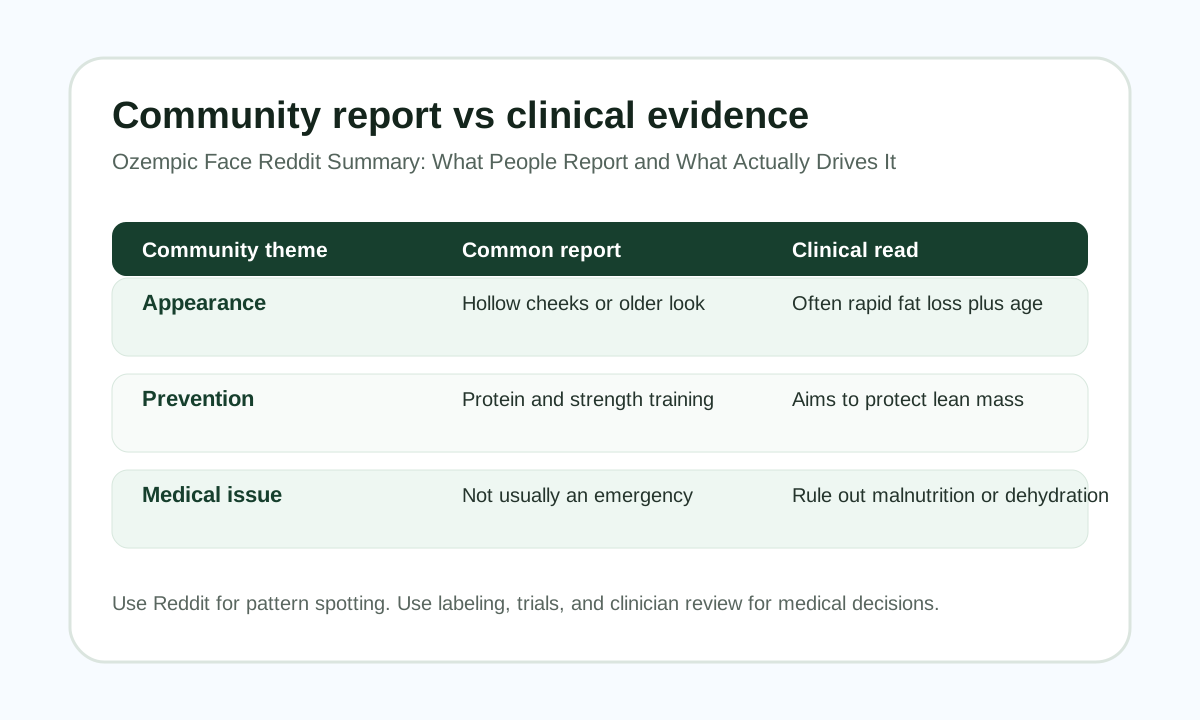
Ozempic face Reddit threads usually describe facial volume loss after meaningful weight reduction, not a unique facial disease caused by Ozempic. The more useful analysis is weight-loss speed, starting facial fullness, age, skin elasticity, protein intake, resistance training, hydration, and whether the person also lost muscle. This framing answers the fear without turning normal fat-loss changes into a made-up diagnosis.
| Community theme | Common report | Clinical read |
|---|---|---|
| Appearance | Hollow cheeks or older look | Often rapid fat loss plus age |
| Prevention | Protein and strength training | Aims to protect lean mass |
| Medical issue | Not usually an emergency | Rule out malnutrition or dehydration |
Where to go next on FormBlends
Use this Reddit summary as a starting point, then compare it with clinical and practical pages before making a health decision.
FAQ
What is Ozempic face according to Reddit?
Facial volume loss after meaningful weight loss on GLP-1 medications: hollowed cheeks, deeper nasolabial folds, prominent tear troughs. The community broadly understands it as a weight-loss phenomenon rather than a medication-specific side effect.
Is Ozempic face permanent?
Most posters describe partial reversal during weight stabilization. Younger skin recovers more visibly. Older patients often pursue cosmetic restoration.
What dermatology treatments do Reddit users discuss?
Hyaluronic acid fillers (Restylane, Juvederm, Volbella), Sculptra, occasional fat grafting, conservative radiofrequency and microneedling for skin tightening.
Do Reddit posters share before and after photos?
Yes, under self-tagged threads with informal etiquette around partial face obscuring and avoiding aesthetic commentary.
Is Ozempic face worse on semaglutide than tirzepatide?
No clear difference. Facial change tracks total weight lost, not medication.
What can prevent Ozempic face?
Slower weight loss, adequate protein, resistance training, hydration, sun protection, retinoids. Most of these are general good practice that becomes more visible in the GLP-1 context.
Do younger people get Ozempic face?
Yes, in milder forms that typically resolve with skin elasticity.
When should I get filler if I'm losing weight on Ozempic?
Most experienced posters and dermatologists recommend waiting until weight has been stable for three to six months. Filler during active loss risks overcorrection.
Does pausing Ozempic restore facial volume?
Partially. Some volume returns during stabilization or regain. Most patients pause for medical reasons, not facial reasons. Discuss with your prescriber rather than the community.
Is Ozempic face really worse than bariatric face?
No clinical evidence supports a meaningful difference. Both reflect significant weight loss with the same fat-pad reduction pattern.
Why does my face look worse in some photos than others?
Lighting, angle, and camera lens compression dramatically affect perceived facial volume. Bathroom mirror lighting is unflattering for everyone, particularly during weight loss. Consistent photos taken in natural light show the actual trajectory more reliably.
Should fear of Ozempic face stop me from starting?
No. The decision should be based on whether you meet clinical criteria for GLP-1 therapy. Facial change is a foreseeable consequence of weight loss that can be planned for and partly mitigated.
Sources
- Rohrich RJ et al. Facial Volume Loss After Weight Loss: A Three-Dimensional Analysis. Plastic and Reconstructive Surgery. 2022.
- Gierloff M et al. Aging Changes of the Midfacial Fat Compartments. Aesthetic Surgery Journal. 2019.
- Wilding JPH et al. Once-Weekly Semaglutide in Adults with Overweight or Obesity. New England Journal of Medicine. 2021.
- Jastreboff AM et al. Tirzepatide Once Weekly for the Treatment of Obesity. New England Journal of Medicine. 2022.
- American Academy of Dermatology. Consensus Statement on Weight-Loss Facial Aesthetics. 2024.
- American Society for Aesthetic Plastic Surgery. Procedural Statistics: Weight-Loss Patient Trends. 2024.
- Coleman SR. Structural Fat Grafting: More Than a Permanent Filler. Plastic and Reconstructive Surgery. 2006.
- Pessa JE, Rohrich RJ. Facial Topography: Clinical Anatomy of the Face. CRC Press, 2012.
- Mendelson BC, Wong CH. Surgical Anatomy of the Midcheek. Aesthetic Plastic Surgery. 2013.
- Frank PJ. Public comments to The New York Times: Aesthetic Effects of Semaglutide. 2022 and follow-ups through 2024.
- Endocrine Society. Pharmacological Management of Obesity Clinical Practice Guideline. Updated 2024.
- British Association of Dermatologists. Position Statement on Aesthetic Considerations During Rapid Weight Loss. 2024.
Footer disclaimers
Platform Disclaimer. FormBlends is a digital health company connecting patients with independent licensed prescribers and U.S. state-licensed pharmacies. We do not provide aesthetic or dermatologic services. Cosmetic decisions should be discussed with a board-certified dermatologist or plastic surgeon.
Compounded Medication Notice. Compounded semaglutide and tirzepatide are not FDA-approved products. They are prepared by 503A compounding pharmacies in response to individual prescriptions and are not therapeutically interchangeable with brand Ozempic, Wegovy, Mounjaro, or Zepbound.
Results Disclaimer. Aesthetic outcomes after weight loss vary by age, skin elasticity, total pounds lost, rate of loss, genetics, and lifestyle. Reddit-reported experiences are not predictive of individual outcomes.
Trademark Notice. Ozempic and Wegovy are registered trademarks of Novo Nordisk A/S. Mounjaro and Zepbound are registered trademarks of Eli Lilly and Company. Restylane, Juvederm, Volbella, and Sculptra are registered trademarks of their respective manufacturers. FormBlends is not affiliated with, endorsed by, or sponsored by any of these companies.
See your options in about 2 minutes
Take the free quiz and see what fits you. Quick, private, and no commitment to continue.
See my options →