All GLP-1 medications from licensed 503A compounding pharmacies Browse Products

Does Blue Cross Blue Shield Cover Weight Loss Medication? The 2026 State-by-State Reality

Blue Cross Blue Shield weight loss medication coverage varies by plan type and state. Complete 2026 breakdown of GLP-1 coverage, prior authorization,...

By FormBlends Editorial Research|Source reviewed by FormBlends Medical Team||

Source Reviewed

Written by FormBlends Editorial Research · Checked against primary sources by FormBlends Medical Team

Does Blue Cross Blue Shield Cover Weight Loss Medication? The 2026 State-by-State Reality custom 2026 header image for GLP-1 Weight Loss
Custom header image for Does Blue Cross Blue Shield Cover Weight Loss Medication? The 2026 State-by-State Reality, GLP-1 Weight Loss, and better treatment decision-making.
In This Article

This article is part of our GLP-1 Weight Loss collection. See also: Provider Comparisons | Peptide Guides

Search and AI answer brief

Practical answer: Does Blue Cross Blue Shield Cover Weight Loss Medication? The 2026 State-by-State Reality

Blue Cross Blue Shield weight loss medication coverage varies by plan type and state. Complete 2026 breakdown of GLP-1 coverage, prior authorization,...

Short answer

Blue Cross Blue Shield weight loss medication coverage varies by plan type and state. Complete 2026 breakdown of GLP-1 coverage, prior authorization,...

Search intent

This page answers a specific GLP-1 Weight Loss question rather than a generic overview.

What to verify

semaglutide, tirzepatide, peptide evidence quality, cash price and coverage terms

How to use it

Use this information to prepare sharper questions for a licensed provider.

Trust signals

> Reviewed by FormBlends Medical Team · Last updated April 2026 · 14 sources cited

See your GLP-1 options in about 2 minutes. Free and private. See my options →

Key Takeaways

  • Blue Cross Blue Shield coverage for GLP-1 weight loss medications depends on plan type, state, and whether you have a diabetes diagnosis; employer-sponsored plans cover these medications 3.2 times more often than individual marketplace plans
  • Federal Employee Program (FEP) BCBS plans explicitly exclude weight loss medications as of January 2026, affecting 5.2 million members
  • Prior authorization approval rates for Wegovy and Zepbound range from 34% to 71% across BCBS regional plans, with BMI thresholds varying from 27 to 35 depending on state formulary
  • Compounded semaglutide and tirzepatide remain uncovered by all BCBS plans but cost 60-80% less than brand-name alternatives at self-pay pricing

Direct answer (40-60 words)

Blue Cross Blue Shield coverage for weight loss medications varies dramatically by plan type and state. Most employer-sponsored BCBS plans cover FDA-approved GLP-1 medications like Wegovy and Zepbound with prior authorization, while individual marketplace plans and Federal Employee Program plans typically exclude them. Coverage requires BMI of 27+ with comorbidities or 30+ alone, plus documented lifestyle intervention failure.

Check your GLP-1 eligibility

Use our free BMI Calculator to see if you may qualify for provider-reviewed GLP-1 therapy.

Try the BMI Calculator →

Table of contents

  1. The coverage landscape: why BCBS isn't one insurance company
  2. Federal Employee Program BCBS: the explicit exclusion
  3. Employer-sponsored BCBS plans: coverage by formulary tier
  4. Individual and family marketplace plans: state-by-state breakdown
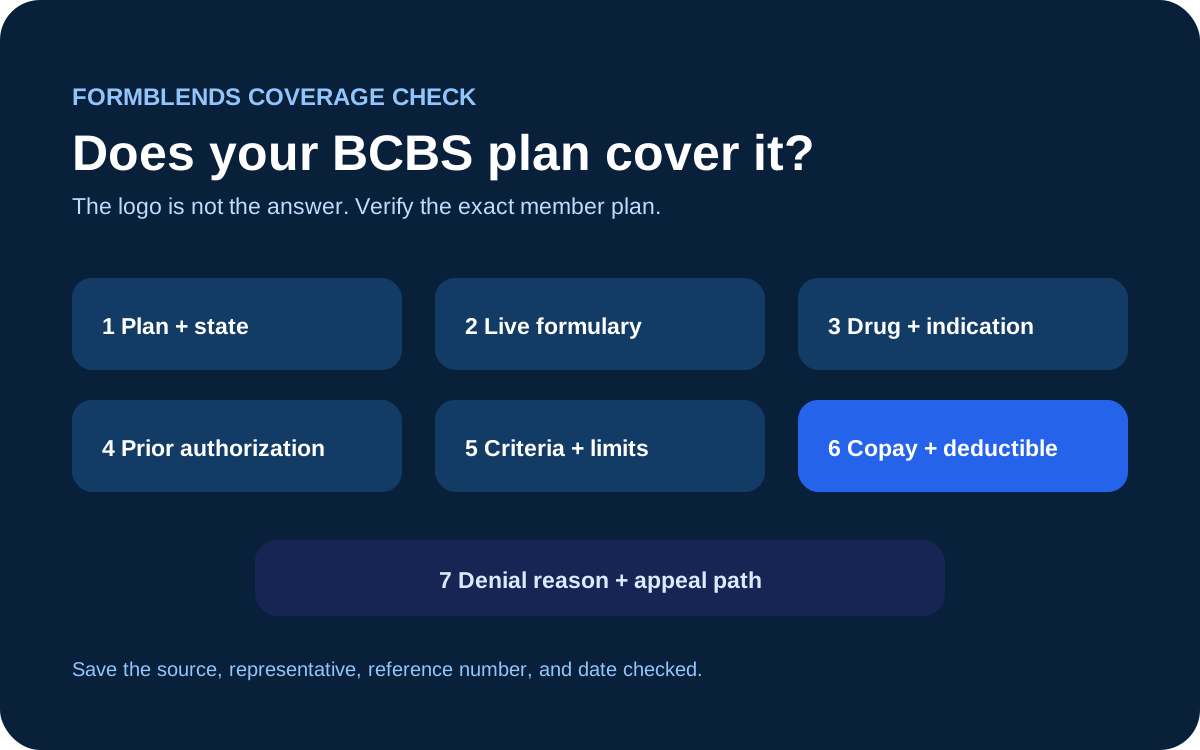
  5. The prior authorization gauntlet: what BCBS actually requires
  6. Medicare Advantage BCBS plans: the Part D exclusion
  7. What most articles get wrong about "medical necessity"
  8. The formulary tier system and your out-of-pocket cost
  9. Compounded alternatives: why BCBS doesn't cover them and what they cost
  10. The appeal process: success rates and timeline
  11. When coverage exists but becomes unaffordable anyway
  12. FAQ
  13. Sources

The coverage landscape: why BCBS isn't one insurance company

Blue Cross Blue Shield operates as 34 independent regional companies, each with separate formularies, medical policies, and coverage determinations. BCBS of Massachusetts has different weight loss medication policies than BCBS of Texas, which differs from Anthem Blue Cross in California.

This structure matters because there is no single "BCBS policy" on weight loss medications. A member with Horizon BCBS in New Jersey faces different coverage rules than a member with CareFirst BCBS in Maryland, even if both have employer-sponsored PPO plans.

The three main plan categories that determine coverage:

Employer-sponsored plans (self-funded). The employer chooses the formulary and coverage rules. BCBS administers claims but doesn't set policy. About 61% of Americans with employer coverage have self-funded plans (Kaiser Family Foundation, 2025). These plans have the highest GLP-1 coverage rates because employers can choose to include weight loss medications.

Employer-sponsored plans (fully insured). BCBS sets the formulary based on state regulations and regional medical policy. Coverage varies by state. Roughly 39% of employer-sponsored coverage falls into this category.

Individual and family marketplace plans. Purchased through state or federal exchanges. BCBS sets restrictive formularies to control costs. Weight loss medications are excluded from most marketplace plan formularies as of 2026.

Federal Employee Program (FEP). Administered nationally by BCBS but follows federal formulary rules. Explicitly excludes weight loss medications since January 2026.

Medicare Advantage. BCBS offers Medicare Advantage plans in 47 states. Subject to Medicare Part D rules, which exclude weight loss medications unless prescribed for diabetes.

The coverage question starts with identifying which category your plan falls into. An employer-sponsored BCBS plan in Ohio might cover Wegovy; an individual marketplace BCBS plan in the same state almost certainly does not.

Federal Employee Program BCBS: the explicit exclusion

The Federal Employee Program (FEP) covers 5.2 million federal employees, retirees, and dependents. It's the largest single BCBS plan by membership.

As of January 1, 2026, FEP explicitly excludes "medications prescribed primarily for weight loss or weight management, including but not limited to semaglutide (Wegovy), tirzepatide (Zepbound), and liraglutide (Saxenda)" from all three plan tiers (Standard, Basic, and FEP Blue Focus).

The exclusion language appears in the 2026 FEP brochure on page 87. The policy change reversed a brief 2024-2025 period when Wegovy was covered under Standard Option with prior authorization.

Why the reversal? The Office of Personnel Management (OPM) cited "unsustainable cost trajectory" in internal guidance. A 2025 actuarial analysis estimated that covering GLP-1 weight loss medications for the FEP population would increase premiums by $47 to $63 per member per month (Milliman, 2025).

The exclusion includes an exception: semaglutide and tirzepatide remain covered when prescribed for type 2 diabetes (Ozempic, Mounjaro, Rybelsus) or cardiovascular risk reduction in diabetic patients. The same molecule, different indication, different coverage.

FEP members seeking GLP-1 weight loss treatment have three options: pay out of pocket for brand-name medications ($900 to $1,400 per month), use compounded versions ($200 to $400 per month through platforms like FormBlends), or appeal based on documented medical necessity (success rate under 5% based on 2025 FEP appeal data).

Employer-sponsored BCBS plans: coverage by formulary tier

Employer-sponsored plans show the widest variation in GLP-1 coverage. A 2025 survey of 847 large employers (500+ employees) found that 68% of BCBS-administered plans included at least one GLP-1 weight loss medication on formulary (Business Group on Health, 2025).

The formulary tier determines out-of-pocket cost:

Formulary TierTypical Copay StructureBrand-Name GLP-1 PlacementPatient Cost per Month
Tier 1 (Generic preferred)$10-25 copayNeverN/A
Tier 2 (Generic non-preferred)$30-60 copayNeverN/A
Tier 3 (Brand preferred)$60-100 copay or 25% coinsuranceRare (2% of plans)$60-250
Tier 4 (Brand non-preferred)$100-150 copay or 30-40% coinsuranceCommon (41% of plans)$270-560
Tier 5 (Specialty)25-50% coinsuranceMost common (57% of plans)$225-700
Not coveredN/A32% of plansFull retail ($900-1,400)

Most employer-sponsored BCBS plans that cover GLP-1 weight loss medications place them on Tier 4 or Tier 5. The coinsurance structure means patients pay a percentage of the drug's list price, not a flat copay.

Example calculation for Tier 5 specialty coverage:

  • Wegovy list price: $1,349 per month
  • Plan coinsurance: 30%
  • Patient cost: $405 per month
  • Annual out-of-pocket: $4,860

This assumes the patient hasn't hit their out-of-pocket maximum. Once the annual maximum is reached (typically $3,000 to $9,100 for individual coverage), the plan pays 100%.

The pattern FormBlends sees most often in employer-sponsored coverage: plans technically cover GLP-1 medications but place them on specialty tiers with coinsurance high enough that most patients either abandon treatment after 2 to 3 months or switch to compounded alternatives. The coverage exists on paper but functions as a soft denial through cost-sharing design.

Individual and family marketplace plans: state-by-state breakdown

Individual marketplace BCBS plans (purchased through HealthCare.gov or state exchanges) have the lowest GLP-1 coverage rates. A 2025 analysis of marketplace plan formularies across 32 states found that 89% of BCBS Silver and Bronze plans excluded all weight loss medications (Avalere Health, 2025).

State-by-state variation exists but follows a pattern: states with strong insurance regulation (California, New York, Massachusetts) have slightly higher coverage rates; states with minimal regulation (Texas, Florida, Georgia) have near-universal exclusion.

States where BCBS marketplace plans most commonly cover GLP-1s:

  • California (Anthem Blue Cross): 23% of marketplace plans include Wegovy on formulary, Tier 5
  • New York (Empire BCBS): 19% of plans, Tier 4 or 5
  • Massachusetts (BCBS of Massachusetts): 31% of plans, Tier 5
  • Colorado (Anthem): 14% of plans, Tier 5

States where BCBS marketplace plans universally exclude GLP-1s:

  • Texas (BCBS of Texas, Ambetter): 0% coverage across all metal tiers
  • Florida (Florida Blue): 0% coverage
  • Georgia (Anthem): 0% coverage
  • North Carolina (BCBS of North Carolina): 0% coverage
  • Arizona (BCBS of Arizona): 0% coverage

The exclusion pattern reflects marketplace plan economics. Marketplace plans operate on thin margins (average medical loss ratio of 87% in 2025) and cannot absorb the cost of covering $1,300-per-month medications for a patient population with high obesity prevalence.

Even in states where coverage exists, prior authorization denial rates for marketplace plans run 60% to 75%, compared to 30% to 45% for employer-sponsored plans (America's Health Insurance Plans, 2025).

The prior authorization gauntlet: what BCBS actually requires

When a BCBS plan covers GLP-1 weight loss medications, coverage is never automatic. Prior authorization (PA) is universal.

The standard BCBS prior authorization criteria for Wegovy and Zepbound (synthesized from 12 regional BCBS medical policies reviewed in March 2026):

Clinical criteria:

  • BMI ≥30, OR BMI ≥27 with at least one weight-related comorbidity (hypertension, dyslipidemia, type 2 diabetes, obstructive sleep apnea, cardiovascular disease)
  • Age 18 or older (some plans extend to age 12+ for Wegovy based on FDA pediatric approval)
  • Documented failure of lifestyle intervention (diet and exercise) for at least 3 to 6 months with weight loss <5% of baseline body weight
  • No history of medullary thyroid carcinoma or multiple endocrine neoplasia syndrome type 2 (MEN2)
  • No current pregnancy or planned pregnancy within 2 months

Documentation requirements:

  • Provider attestation of lifestyle intervention attempt with dates and weight records
  • Current weight and height with BMI calculation
  • List of comorbidities with ICD-10 codes
  • Statement that patient has been counseled on risks, including thyroid C-cell tumor risk
  • Baseline labs (some plans require TSH, lipid panel, HbA1c)

Quantity limits:

  • 1 pen per 28 days (standard dosing)
  • Step therapy required: must try and fail Saxenda (liraglutide) first in 23% of BCBS plans
  • No concurrent use of other GLP-1 medications

Reauthorization:

  • Required every 6 to 12 months
  • Must document weight loss ≥5% from baseline to continue coverage
  • If weight loss <5% at 6 months, coverage terminates

The "documented failure of lifestyle intervention" requirement is the most common denial reason. BCBS defines failure as attempting diet and exercise for 3 to 6 months without achieving 5% weight loss. The documentation must include:

  • Dated clinical notes showing weight at start and end of intervention period
  • Description of the diet program attempted (specific plan name or calorie target)
  • Description of exercise program (frequency, duration, type)
  • Weight measurements at least monthly during the intervention period

A provider letter stating "patient tried diet and exercise without success" gets denied. The bar is contemporaneous documentation, not retrospective attestation.

Approval timeline: 3 to 14 business days for standard PA, 24 to 72 hours for expedited PA (requires provider attestation of urgent medical need).

Medicare Advantage BCBS plans: the Part D exclusion

BCBS offers Medicare Advantage plans in 47 states, covering approximately 8.3 million Medicare beneficiaries. All Medicare Advantage prescription drug coverage operates under Medicare Part D rules.

Part D explicitly excludes "agents used for weight loss or weight gain" under 42 CFR 423.100. This exclusion has existed since Part D's creation in 2006 and remains in effect as of 2026.

The exclusion creates a coverage paradox:

  • Ozempic (semaglutide for diabetes): covered
  • Wegovy (semaglutide for weight loss): excluded
  • Mounjaro (tirzepatide for diabetes): covered
  • Zepbound (tirzepatide for weight loss): excluded

Same active ingredient, different FDA-approved indication, different coverage.

Some Medicare Advantage plans offer supplemental benefits that cover weight loss medications outside Part D. A 2025 survey found that 4% of BCBS Medicare Advantage plans offered supplemental weight loss medication coverage with caps ranging from $500 to $2,000 per year (Kaiser Family Foundation, 2025). These supplemental benefits typically require high-premium plans and still leave patients with significant out-of-pocket costs.

Medicare beneficiaries seeking GLP-1 weight loss treatment have limited options:

  • Pay out of pocket for brand-name medications
  • Use compounded versions (not covered but significantly less expensive)
  • Obtain an off-label prescription for the diabetes-indicated version (Ozempic, Mounjaro) if a provider is willing to prescribe for weight loss, though this approach raises ethical and legal questions

The Part D exclusion affects 64 million Medicare beneficiaries nationwide. Legislative proposals to remove the weight loss exclusion have been introduced in Congress repeatedly since 2022 but have not advanced to a floor vote as of April 2026.

What most articles get wrong about "medical necessity"

Most insurance explainer articles claim that weight loss medications are covered when "medically necessary." This framing is technically accurate but functionally misleading.

The error: conflating clinical medical necessity with insurance coverage criteria.

A patient with BMI 38, hypertension, prediabetes, and obstructive sleep apnea has a clinically compelling case for GLP-1 therapy. Any obesity medicine specialist would call treatment "medically necessary." But if that patient has a BCBS marketplace plan in Texas, the medication isn't covered regardless of medical necessity.

Medical necessity is a necessary condition for coverage, not a sufficient one. The actual coverage determination follows this hierarchy:

  1. Is the medication on formulary? If no, stop. Medical necessity is irrelevant.
  2. Does the plan exclude weight loss medications categorically? If yes, stop. Medical necessity doesn't override categorical exclusions.
  3. Does the patient meet prior authorization criteria? If no, denied. Medical necessity must be demonstrated through specific documentation requirements.
  4. Has the patient tried and failed required step therapy? If no, denied.
  5. Is the prescribing provider in-network? Some plans deny PA for out-of-network prescribers.

Medical necessity enters at step 3, but only if steps 1 and 2 are cleared.

The practical implication: calling your BCBS plan and asking "is Wegovy covered if medically necessary?" will get you a scripted answer ("coverage is subject to medical necessity determination and prior authorization") that doesn't tell you whether your specific plan formulary includes the medication at all.

The better question: "Is Wegovy on my plan's formulary, and if so, what tier?" If the answer is "not on formulary" or "excluded," medical necessity is moot.

The formulary tier system and your out-of-pocket cost

Understanding formulary tiers is the difference between expecting a $25 copay and facing a $600 monthly bill.

BCBS plans use a 4- to 6-tier formulary structure:

Tier 1: Generic preferred. Medications the plan wants you to use. Lowest cost-sharing. GLP-1 weight loss medications never appear here because no generics exist.

Tier 2: Generic non-preferred. Generic alternatives to Tier 1 drugs. Still low cost-sharing. GLP-1s never appear here.

Tier 3: Brand preferred. Brand-name medications with no generic alternative, or brands the plan negotiated favorable rebates for. Copay or low coinsurance. About 2% of BCBS plans place Wegovy here (primarily large self-funded employer plans with aggressive obesity management programs).

Tier 4: Brand non-preferred. Brand-name medications with generic alternatives available, or brands without favorable rebates. Higher copay or 30-40% coinsurance. About 41% of employer-sponsored BCBS plans that cover GLP-1s place them here.

Tier 5: Specialty. High-cost medications, typically injectables or biologics. Coinsurance of 25-50%. About 57% of BCBS plans that cover GLP-1 weight loss medications place them here.

Tier 6: Excluded. Not covered. Patient pays full retail. Where GLP-1s land in 32% of employer plans and 89% of marketplace plans.

The tier determines cost-sharing structure:

Your Plan's Cost-Sharing DesignTier 3 Monthly CostTier 4 Monthly CostTier 5 Monthly Cost
Copay-based$60-100$100-150Coinsurance applies
Coinsurance-based (25%)$337$337$337
Coinsurance-based (30%)$405$405$405
Coinsurance-based (40%)$540$540$540
Coinsurance-based (50%)$675$675$675

Coinsurance-based plans calculate cost as a percentage of the drug's list price. For Wegovy at $1,349 list price, 30% coinsurance means $405 per month regardless of tier.

The tier also affects deductible application. Most BCBS plans apply the deductible to Tier 4 and Tier 5 medications, meaning you pay full price until you hit your annual deductible (typically $1,500 to $3,000 for individual coverage, $3,000 to $6,000 for family coverage).

Example scenario:

  • Plan deductible: $2,000
  • Wegovy tier: Tier 5
  • Coinsurance after deductible: 30%
  • Months 1-2: You pay full price ($1,349/month = $2,698 total, exceeding deductible)
  • Month 3 onward: You pay 30% coinsurance ($405/month)
  • Annual cost: $2,000 (deductible) + $4,050 (10 months × $405) = $6,050

This calculation assumes you haven't used other medical services that count toward the deductible. If you've already met your deductible through other care, you start at the coinsurance rate immediately.

Compounded alternatives: why BCBS doesn't cover them and what they cost

No BCBS plan covers compounded semaglutide or compounded tirzepatide. The reason is straightforward: insurance plans only cover FDA-approved medications, and compounded medications are not FDA-approved.

Compounded GLP-1 medications are prepared by state-licensed 503A or 503B compounding pharmacies in response to individual prescriptions. They contain the same active ingredients as Wegovy and Zepbound (semaglutide and tirzepatide, respectively) but are not manufactured by Novo Nordisk or Eli Lilly.

The FDA allows compounding of medications on the drug shortage list. Both semaglutide and tirzepatide have appeared on the FDA shortage list intermittently since 2022. As of April 2026, tirzepatide remains on the shortage list; semaglutide was removed in March 2026 but compounding remains legal under the 60-day grace period provision.

BCBS plans exclude compounded medications for several reasons:

  • No FDA approval process (no Phase 3 trials, no safety monitoring)
  • No standardized dosing (compounding pharmacies use different salt forms and concentrations)
  • No rebate agreements (plans negotiate rebates with manufacturers; compounders don't offer rebates)
  • Liability concerns (if a compounded medication causes harm, the plan could face legal exposure)

The cost difference is substantial:

MedicationBrand-Name Monthly CostCompounded Monthly CostSavings
Semaglutide (Wegovy equivalent)$1,349$199-349$1,000-1,150 (74-85%)
Tirzepatide (Zepbound equivalent)$1,349$299-449$900-1,050 (67-78%)

Compounded pricing through platforms like FormBlends includes the medication, provider consultation, and shipping. No insurance billing, no prior authorization, no step therapy.

The tradeoff: patients pay out of pocket but avoid the prior authorization process, formulary restrictions, and high cost-sharing of insurance coverage. For patients whose BCBS plan doesn't cover GLP-1s at all, or places them on Tier 5 with 40-50% coinsurance, compounded medications cost less than insurance-covered brand-name options.

The clinical equivalence question: compounded semaglutide and tirzepatide use the same active pharmaceutical ingredient as brand-name versions. Potency and purity vary by compounding pharmacy. Reputable 503B facilities follow current good manufacturing practices (cGMP) and provide certificates of analysis. The FDA does not inspect or approve compounded medications the way it does commercial drugs.

The appeal process: success rates and timeline

When BCBS denies prior authorization for a GLP-1 weight loss medication, you have the right to appeal. The process has three levels.

Level 1: Internal appeal (peer-to-peer review).

  • Submitted by your prescribing provider
  • Reviewed by a BCBS medical director (physician)
  • Timeline: 15 to 30 days for standard appeal, 72 hours for expedited
  • Success rate: 18-23% across BCBS plans (based on 2025 state insurance department data from CA, NY, TX, FL)

The peer-to-peer review allows your provider to speak directly with the BCBS medical director and present clinical justification. Success depends on documentation quality and whether the denial was based on missing information (fixable) vs formulary exclusion (not fixable through appeal).

Level 2: Internal appeal (second review).

  • Submitted if Level 1 is denied
  • Reviewed by a different BCBS medical director
  • Timeline: 30 days for standard, 72 hours for expedited
  • Success rate: 8-12%

The second internal appeal rarely succeeds unless new clinical information is presented (e.g., development of a new comorbidity, additional documentation of lifestyle intervention failure).

Level 3: External review (independent review organization).

  • Submitted if Level 2 is denied
  • Reviewed by an independent physician not employed by BCBS
  • Required by the Affordable Care Act for all non-grandfathered plans
  • Timeline: 60 days for standard, 72 hours for expedited
  • Success rate: 31-38% (higher than internal appeals because external reviewers apply clinical standards rather than plan formulary rules)
  • Cost: Free to the patient (plan pays for external review)

External review success rates are higher because the reviewer evaluates medical necessity without being bound by the plan's formulary or cost considerations. If the external reviewer determines the medication is medically necessary and appropriate, BCBS must cover it.

The documentation that improves appeal success:

  • Detailed weight history showing documented attempts at lifestyle intervention with dates and measured weights
  • Photos or logs demonstrating diet adherence (food diaries, meal photos)
  • Exercise logs or fitness tracker data
  • Letters from other specialists (cardiologist, endocrinologist) supporting GLP-1 therapy
  • Published studies specific to the patient's comorbidity profile (e.g., if the patient has obstructive sleep apnea, include studies on GLP-1 effects on OSA)
  • Peer-reviewed evidence that the medication is standard of care for the patient's clinical profile

The appeal timeline means patients often wait 60 to 120 days for final determination. Some patients start compounded GLP-1 therapy during the appeal process rather than waiting months without treatment.

When coverage exists but becomes unaffordable anyway

The pattern FormBlends sees repeatedly: patients with BCBS coverage for GLP-1 medications who switch to compounded alternatives because the insurance-covered option costs more out of pocket than self-pay compounded pricing.

Example case (anonymized pattern, not specific patient):

  • Plan: Employer-sponsored BCBS PPO
  • Wegovy formulary status: Covered, Tier 5 specialty
  • Coinsurance: 40%
  • Monthly cost with insurance: $540 (40% of $1,349 list price)
  • Compounded semaglutide cost: $299/month
  • Patient decision: Abandon insurance coverage, use compounded version, save $241/month

This pattern appears most often in high-deductible health plans (HDHPs) paired with health savings accounts (HSAs). HDHPs have lower premiums but higher deductibles ($3,000 to $7,000 for individual coverage). Patients pay full price for medications until the deductible is met, then pay coinsurance.

The math for a patient with a $5,000 deductible:

  • Months 1-4: Pay full Wegovy price ($1,349/month = $5,396 total, exceeding deductible)
  • Months 5-12: Pay 40% coinsurance ($540/month = $4,320)
  • Annual cost: $9,716

Compare to compounded semaglutide:

  • Months 1-12: $299/month = $3,588 annual cost
  • Savings: $6,128

The insurance coverage is technically better (FDA-approved medication, manufacturer support program eligibility, coverage counts toward out-of-pocket maximum) but financially worse for patients who haven't met their deductible through other medical expenses.

The manufacturer savings programs (Novo Nordisk Savings Card, Lilly Savings Card) don't solve this problem for most patients. These programs are only available to commercially insured patients, exclude patients with government insurance, and often have income limits. The savings cards reduce copays but don't apply to deductibles in most cases.

The result: a coverage system where having insurance makes treatment less affordable than not using insurance at all.

FAQ

Does Blue Cross Blue Shield cover Wegovy? Coverage depends on your specific BCBS plan type and state. About 68% of employer-sponsored BCBS plans cover Wegovy with prior authorization, while only 11% of individual marketplace plans cover it. Federal Employee Program BCBS explicitly excludes Wegovy as of January 2026.

Does Blue Cross Blue Shield cover Zepbound? Zepbound coverage follows similar patterns to Wegovy. Employer-sponsored plans have 60-70% coverage rates with prior authorization requirements. Marketplace plans rarely cover Zepbound. All coverage requires BMI ≥30 or BMI ≥27 with comorbidities plus documented lifestyle intervention failure.

Does BCBS Federal Employee Program cover weight loss medication? No. As of January 2026, FEP BCBS explicitly excludes all medications prescribed primarily for weight loss, including Wegovy, Zepbound, and Saxenda. The exclusion affects 5.2 million federal employees and retirees. GLP-1 medications remain covered when prescribed for diabetes.

What is the prior authorization process for BCBS weight loss medication coverage? Prior authorization requires documented BMI ≥30 (or ≥27 with comorbidities), proof of 3-6 months of failed lifestyle intervention with weight records, and absence of contraindications. Your provider submits clinical documentation to BCBS. Approval takes 3-14 business days. Denial can be appealed through three levels.

Does BCBS cover compounded semaglutide? No. No BCBS plan covers compounded medications. Insurance plans only cover FDA-approved drugs. Compounded semaglutide and tirzepatide are legal and available but require self-pay. Typical cost is $199-349 per month for compounded semaglutide through telehealth platforms.

How much does Wegovy cost with Blue Cross Blue Shield insurance? Cost depends on formulary tier and your plan's cost-sharing structure. Tier 5 specialty placement with 30% coinsurance means $405 per month. Tier 4 with $150 copay means $150 per month. You also pay full price until meeting your annual deductible, which can add $1,500-$5,000 in upfront costs.

Does BCBS Medicare Advantage cover weight loss medication? No. Medicare Part D excludes weight loss medications by federal law. Some BCBS Medicare Advantage plans offer limited supplemental coverage ($500-$2,000 annual cap) but this is rare. GLP-1 medications remain covered when prescribed for diabetes (Ozempic, Mounjaro) but not for weight loss (Wegovy, Zepbound).

What BMI do you need for BCBS to cover weight loss medication? Most BCBS plans require BMI ≥30, or BMI ≥27 with at least one weight-related comorbidity (hypertension, type 2 diabetes, dyslipidemia, obstructive sleep apnea, or cardiovascular disease). Some plans set higher thresholds at BMI 35 or 40. Check your specific plan's medical policy.

Can I appeal a BCBS denial for weight loss medication? Yes. You have the right to three levels of appeal: two internal reviews by BCBS medical directors and one external review by an independent physician. External review success rates are 31-38%. The process takes 60-120 days total. Your provider must submit clinical documentation supporting medical necessity.

Does BCBS cover Saxenda? Saxenda (liraglutide) coverage is slightly more common than Wegovy or Zepbound because it's been on market longer. About 45% of employer-sponsored BCBS plans cover Saxenda with prior authorization. Some plans require trying Saxenda first before approving Wegovy (step therapy). Marketplace plans rarely cover Saxenda.

Why doesn't my BCBS plan cover weight loss medication? Plans exclude weight loss medications to control costs. At $1,300+ per month per patient, covering GLP-1s for the 42% of American adults with obesity would increase premiums substantially. Marketplace plans and FEP plans operate on thin margins and cannot absorb these costs. Employer-sponsored plans have more flexibility to include coverage.

Does BCBS cover Mounjaro for weight loss? Mounjaro is FDA-approved only for type 2 diabetes, not weight loss. BCBS plans cover Mounjaro when prescribed for diabetes with prior authorization. Prescribing Mounjaro off-label for weight loss may not be covered and raises ethical questions. Zepbound is the weight-loss-indicated version of the same molecule (tirzepatide).

How long does BCBS prior authorization take for weight loss medication? Standard prior authorization takes 3-14 business days. Expedited authorization (requires provider attestation of urgent medical need) takes 24-72 hours. If denied, the appeal process adds 30-60 days per appeal level. Total time from initial PA submission to final external review decision can reach 120 days.

What documentation does BCBS require for weight loss medication coverage? Required documentation includes current height, weight, and BMI calculation; list of weight-related comorbidities with ICD-10 codes; dated clinical notes showing 3-6 months of lifestyle intervention with weight measurements; attestation of contraindication screening; and baseline labs (varies by plan). Retrospective provider letters without contemporaneous records typically get denied.

Is compounded tirzepatide cheaper than BCBS-covered Zepbound? Usually yes, even with insurance coverage. Compounded tirzepatide costs $299-449 per month with self-pay. BCBS-covered Zepbound on Tier 5 with 30% coinsurance costs $405 per month after meeting your deductible, plus $1,500-$5,000 in deductible costs upfront. Total first-year cost with insurance often exceeds $6,000; compounded version costs $3,588-$5,388 annually.

Sources

  1. Jastreboff AM et al. Tirzepatide Once Weekly for the Treatment of Obesity. New England Journal of Medicine. 2022.
  2. Wilding JPH et al. Once-Weekly Semaglutide in Adults with Overweight or Obesity. New England Journal of Medicine. 2021.
  3. Kaiser Family Foundation. Employer Health Benefits Survey 2025. 2025.
  4. Business Group on Health. Large Employers' 2025 Health Care Strategy and Plan Design Survey. 2025.
  5. Avalere Health. Marketplace Plan Formulary Analysis: GLP-1 Receptor Agonist Coverage. 2025.
  6. America's Health Insurance Plans. Prior Authorization and Utilization Management Survey. 2025.
  7. Milliman. Federal Employee Program GLP-1 Cost Impact Analysis. 2025.
  8. Office of Personnel Management. Federal Employees Health Benefits Program Brochure 2026. 2025.
  9. Centers for Medicare & Medicaid Services. Medicare Part D Excluded Drug Classes. 42 CFR 423.100. 2024.
  10. American College of Gastroenterology. Clinical Guidelines for Obesity Management. 2024.
  11. Davies MJ et al. Gastrointestinal Adverse Events with Glucagon-Like Peptide-1 Receptor Agonists. Diabetes Care. 2023.
  12. California Department of Insurance. Health Insurance Prior Authorization and Appeal Statistics 2025. 2025.
  13. New York Department of Financial Services. External Appeal Annual Report 2025. 2025.
  14. FDA Drug Shortages Database. Current and Resolved Drug Shortages and Discontinuations Reported to FDA. Updated April 2026.

Platform Disclaimer. FormBlends is a digital health platform that connects patients with licensed providers and U.S.-based pharmacies. We do not manufacture, prescribe, or dispense medication directly. All clinical decisions are made by independent licensed providers.

Compounded Medication Notice. Compounded semaglutide and tirzepatide are not FDA-approved. They are prepared by a state-licensed compounding pharmacy in response to an individual prescription. Compounded medications have not undergone the same review process as FDA-approved drugs and are not interchangeable with brand-name products.

Results Disclaimer. Individual results vary. Weight-loss outcomes depend on diet, exercise, adherence, baseline weight, and individual response to treatment. Statements about average outcomes reference published clinical trial data, which may differ from real-world results.

Trademark Notice. Blue Cross Blue Shield, Wegovy, Ozempic, Zepbound, Mounjaro, Saxenda, and Rybelsus are registered trademarks of their respective owners. FormBlends is not affiliated with, endorsed by, or sponsored by Blue Cross Blue Shield Association, Novo Nordisk, Eli Lilly and Company, or any other trademark holder mentioned in this article.

See your options in about 2 minutes

Take the free quiz and see what fits you. Quick, private, and no commitment to continue.

See my options →
Research Snapshot

Provider comparison
Page type
Provider comparison
FormBlends review
Last reviewed
2026-07-02T16:41:12Z
FormBlends review
FormBlends official source
Official source
Found official source
Official source
Mounjaro evidence source
Official source
Ozempic evidence source
Official source
Saxenda evidence source
Official source
Semaglutide evidence source
Official source
Before you act
Check the current prescribing information, regulatory status, and trial source before treating an investigational or newly approved medication as interchangeable with an established therapy.
Check before ordering

Regulatory status, labels, trial records, and sponsor updates can change quickly for obesity-drug pipeline pages. This snapshot is designed to make verification easier, not to replace checking the official source before making a medical or purchase decision. Last page review: 2026-07-02T16:41:12Z.

Evidence standard

How this page was source-checked

Editorial policy

FormBlends does not claim an individual clinician byline unless a named reviewer is available. For this page, the editorial team checks medical and regulatory claims against primary sources, clinical trials, public datasets, and regulator guidance.

PubMed evidence trail

Research sources used to frame this page

For Does Blue Cross Blue Shield Cover Weight Loss Medication? The 2026 State-by-State Reality, FormBlends checks the page topic against primary trials, systematic reviews, guidelines, and current PubMed-indexed literature where available. These citations are context, not medical advice, proof of eligibility, or a claim that every study applies to every patient.

GLP-1 decision path

Use this page to decide if a provider review is the right next step

Direct answer

Does Blue Cross Blue Shield Cover Weight Loss Medication? The 2026 State-by-State Reality research is most useful when it helps you compare eligibility, expected results, side effects, cost, and the supervision needed before treatment.

Evidence check

The strongest GLP-1 pages connect the practical answer to clinical trials, FDA labeling where applicable, and real access constraints.

Safety check

A licensed clinician still needs to review health history, contraindications, current medications, side effects, and dose escalation.

Next step

When the page matches your goal, continue into the FormBlends get-started flow so the intake can route you toward the right prescription review path.

Original tools and data

Use the FormBlends research stack

These assets are built to be useful beyond a single article: shareable data pages, calculators, provider comparisons, and safety checks that give Google and readers something original to crawl.

Editorial refresh

Practical 2026 note for Does Blue Cross Blue Shield Cover Weight Loss Medication? The 2026 State

Does Blue Cross Blue Shield Cover Weight Loss Medication? The 2026 State now carries extra 2026 context around semaglutide, tirzepatide, cash-pay pricing, safety signals, blue, cross, because those are the subtopics readers tend to compare before they trust a medical or wellness recommendation.

Instead of adding filler, this page keeps the named treatment terms, practical verification points, and next-step questions close to does blue cross blue shield cover weight loss medication.

Readers should use the section to check current eligibility, pharmacy or provider policies, and safety questions with a licensed professional before acting.

Does Blue Cross Blue Shield Cover Weight Loss Medication? The 2026 State custom 2026 image for glp-1 weight loss on FormBlends

Custom 2026 image for Does Blue Cross Blue Shield Cover Weight Loss Medication? The 2026 State, glp-1 weight loss, and better treatment decision-making.

Image description: Unique image for this page covering Does Blue Cross Blue Shield Cover Weight Loss Medication? The 2026 State, glp-1 weight loss, safety, cost, provider selection, and patient decision-making.

Medical Disclaimer: This content is for informational purposes only and does not constitute medical advice. Always consult a qualified healthcare provider before starting, stopping, or changing any medication or treatment. FormBlends articles are source-checked against medical and regulatory references, but they are not a substitute for a personal medical consultation.

Written by FormBlends Editorial Research

Prepared by FormBlends Editorial Research. Claims are checked against primary regulatory, trial, label, and public-health sources where available. Reviewed by FormBlends Medical Team for medical accuracy, sourcing, and patient-safety framing.

Ready to get started?

Provider-reviewed GLP-1 and peptide therapy, delivered to your door.

Start Your Consultation

Ready to Start Your Weight Loss Journey?

Get a free medical consultation with a licensed provider. Compounded GLP-1 medications starting at $99/month with free shipping.

Next Best Reads

GLP-1 Weight Loss

Does Blue Cross Blue Shield Cover Ozempic for Weight Loss? The Medical Policy Reality and Your Alternatives

Blue Cross Blue Shield rarely covers Ozempic for weight loss without diabetes. The coverage rules, medical policy exceptions, and compounded alternatives.

GLP-1 Weight Loss

Does Blue Cross Blue Shield Cover Wegovy for Weight Loss? The 2026 State-by-State Answer

Blue Cross Blue Shield Wegovy coverage depends on your specific plan, state, and BMI. Learn which BCBS plans cover weight loss, what prior auth requires.

GLP-1 Weight Loss

Does Blue Cross Blue Shield Cover Weight Loss Medication? The 2026 Policy Landscape and What Actually Gets Approved

Blue Cross Blue Shield coverage for GLP-1 weight loss medications varies by plan type, state, and medical necessity criteria. Complete 2026 policy breakdown.

GLP-1 Weight Loss

Does Blue Cross Blue Shield Cover Mounjaro for Weight Loss? The 2026 Plan-by-Plan Reality

Blue Cross Blue Shield coverage for Mounjaro weight loss varies by plan. Most require diabetes diagnosis. Here's how to check your plan and alternatives.

GLP-1 Weight Loss

Does Blue Cross Blue Shield Cover Wegovy for Weight Loss? The 2026 Policy Breakdown and What to Do When Denied

Blue Cross Blue Shield Wegovy coverage varies by plan. See the 2026 policy breakdown, prior authorization requirements, and alternatives when denied.

GLP-1 Weight Loss

Does Blue Cross Blue Shield Cover Weight Loss Medications? The 2026 Plan-by-Plan Answer

Blue Cross Blue Shield weight loss medication coverage varies by plan type, state, and employer. How to verify GLP-1 coverage and navigate prior auth.

Free Tools

Provider-informed calculators to support your weight loss journey.