Trust Signals
Key Takeaways
- GHK-Cu upregulates COL1A1 (type I collagen gene) in fibroblast studies and has controlled cosmetic trial data supporting wrinkle reduction, but dermal penetration from topical formulations is the binding constraint, not the peptide itself.
- Matrixyl (palmitoyl pentapeptide-4) has more independent cosmetic RCT data than almost any other cosmetic peptide, yet its effect size is smaller than prescription tretinoin in every comparable measure.
- Oral collagen dipeptides and tripeptides (Pro-Hyp, Hyp-Gly) are the one category where oral delivery is genuinely supported: plasma detection after ingestion is documented in peer-reviewed studies.
- Epithalon has human telomerase activation data primarily from one Russian research group (Khavinson); independent large RCT replication does not exist, making confidence ratings low for longevity claims.
- Purity certification by HPLC alone is insufficient for injectable peptides; mass spectrometry molecular weight confirmation and LAL endotoxin testing below 1 EU/mg are the minimum credible standards.
What Are the Best Anti Aging Peptides? (Direct Answer)
The best anti aging peptides ranked by human evidence are: GHK-Cu for topical skin collagen support, Matrixyl for wrinkle reduction, oral collagen hydrolysates for skin elasticity, and Epithalon for longevity research. Each has a distinct evidence tier. None matches the clinical proof base of prescription retinoids. Choose by your route, tolerance, and realistic goals.
Check your GLP-1 eligibility
Use our free BMI Calculator to see if you may qualify for provider-reviewed GLP-1 therapy.
Try the BMI Calculator →Table of Contents
- Evidence Ledger: Every Major Claim Graded
- The Ranked List: 6 Best Anti Aging Peptides
- Mechanism with Numbers: How These Peptides Work
- What Most Pages Get Wrong About Anti Aging Peptides
- The Chemistry Behind the Rules: Stability, Penetration, Degradation
- Honest Head-to-Head: Peptides vs. Retinoids vs. Each Other
- Label and COA Literacy: How to Judge Any Product
- FAQ
- Sources
- Disclaimers
Evidence Ledger: Every Major Claim Graded
| Peptide / Claim | Best Evidence Type | Effect Direction | Confidence |
|---|---|---|---|
| GHK-Cu topical reduces wrinkle depth | Small double-blind cosmetic trial (Leyden et al.) | Positive vs. placebo | Moderate |
| GHK-Cu upregulates collagen genes in fibroblasts | In-vitro cell studies (Pickart group) | Positive, dose-dependent | Moderate (mechanism only) |
| Matrixyl reduces facial wrinkles | Controlled cosmetic trials | Positive vs. placebo | Moderate |
| Oral collagen hydrolysate improves skin elasticity | Multiple small RCTs (Proksch et al., Asserin et al.) | Positive vs. placebo | Moderate |
| Epithalon activates telomerase in human cells | In-vitro and limited human data (Khavinson group) | Positive in vitro | Low |
| Epithalon extends human lifespan | Animal models, no independent human RCT | Positive in rodents | Very Low |
| BPC-157 improves tissue repair in humans | Animal data only; one small human pilot | Positive in animals | Very Low |
| Argireline (acetyl hexapeptide-3) reduces expression lines | Small controlled cosmetic studies | Modest positive | Low |
| SNAP-8 superior to Argireline | Manufacturer-sponsored in-vitro data only | Claimed positive | Very Low |
The Ranked List: 6 Best Anti Aging Peptides
1. GHK-Cu (Copper Tripeptide-1) Moderate Evidence
A naturally occurring tripeptide (Gly-His-Lys) complexed with copper(II). Found in human plasma and saliva, concentration declines with age from roughly 200 ng/mL in young adults to lower levels in older cohorts (Pickart, 1973). In fibroblast studies it upregulates collagen synthesis, fibronectin, and glycosaminoglycan production. Leyden et al. published a double-blind study showing statistically significant improvements in fine lines versus vehicle control. Best use case: topical serums at concentrations of 1 to 5 percent copper peptide complex. Penetration is the limiting factor, not the peptide's activity.
2. Matrixyl / Palmitoyl Pentapeptide-4 Moderate Evidence
A fragment of type I procollagen (KTTKS) palmitoylated to improve skin penetration. The palmitic acid tail increases lipophilicity, allowing partitioning into the stratum corneum. Controlled cosmetic trials show reductions in wrinkle area and depth versus placebo at 8 to 12 weeks. Effect size is real but modest: typically a 10 to 20 percent improvement in wrinkle metrics in published cosmetic studies, compared to 40 to 60 percent for prescription-strength tretinoin in comparable trials. Well tolerated with no documented irritation class effects.
3. Oral Collagen Hydrolysates (Pro-Hyp, Hyp-Gly dipeptides) Moderate Evidence
Unique because oral bioavailability is documented. Proksch et al. (2014, Skin Pharmacology and Physiology) conducted a double-blind RCT in 69 women showing statistically significant skin elasticity improvement at 4 and 8 weeks with 2.5 g and 5 g daily collagen peptide doses. Asserin et al. (2015) replicated skin hydration findings. Mechanism: Pro-Hyp dipeptides survive gastric digestion, are detected in plasma, and appear to stimulate fibroblasts via hydroxyproline receptor pathways. These are food supplements, not research compounds, which simplifies access.
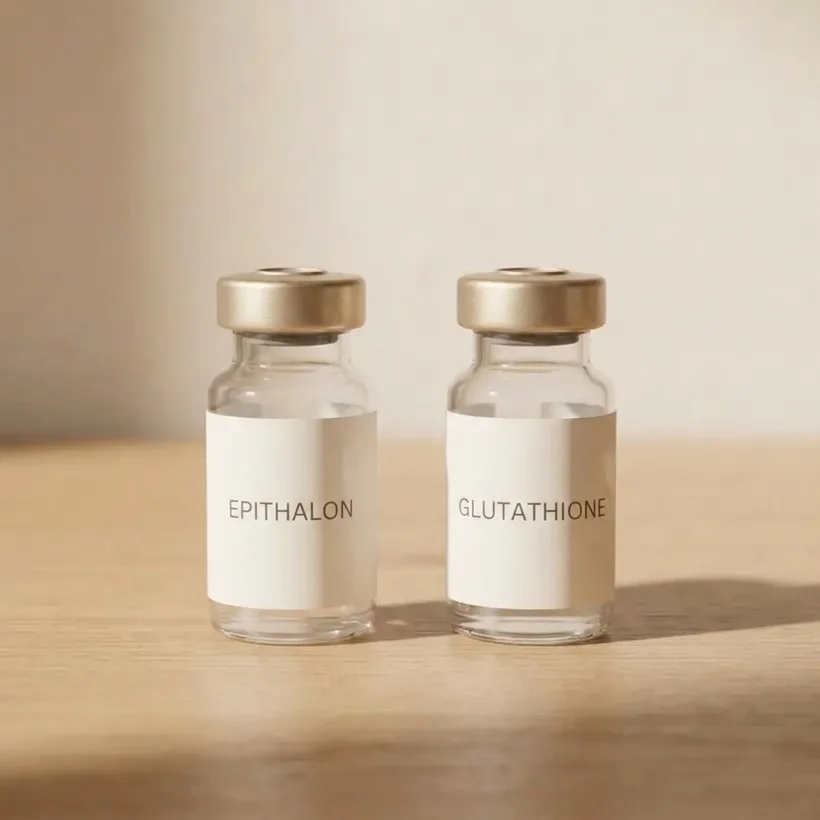
4. Epithalon (Epitalon, Ala-Glu-Asp-Gly) Low Evidence for Longevity
A synthetic tetrapeptide modeled on epithalamin, a pineal gland extract. Khavinson's group published data showing telomerase activation in human fetal fibroblasts and retinal cells, with some human pilot data on longevity markers. One published human study reported telomere elongation in retinal pigment epithelium cells. However, this body of work originates almost entirely from one research group and has not been independently replicated in large RCTs. Route of administration is subcutaneous injection in research protocols. Not FDA-approved; sold as a research compound.
5. Argireline (Acetyl Hexapeptide-3) Low Evidence
A fragment of SNAP-25 that competitively inhibits the SNARE protein complex, theoretically reducing neuromuscular signal strength and dampening expression-related wrinkles. Small controlled cosmetic studies show modest reductions in periorbital wrinkle depth. Effect is local, concentration-dependent, and temporary. It does not replicate botulinum toxin's mechanism (which is irreversible protease cleavage of SNAP-25, not competitive inhibition). Marketed claims of "topical botox" significantly overstate the evidence.
6. BPC-157 (Body Protection Compound) Very Low Evidence for Anti-Aging
A 15-amino-acid peptide derived from a gastric protein. Impressive rodent data on tissue repair, angiogenesis, and tendon healing. One small human pilot study exists for gastric indications. Anti-aging claims in humans are extrapolated from animal work. Included here because of high search volume and community use, not because human evidence supports the claim. Research compound status applies in most jurisdictions.
Mechanism with Numbers: How These Peptides Work
Signal peptides (Matrixyl): Palmitoyl pentapeptide-4 mimics the N-terminal procollagen I fragment that accumulates when collagen degrades. Fibroblasts detect this fragment via integrins and upregulate de novo collagen synthesis as a repair signal. The palmitic acid C16 chain increases the partition coefficient enough to allow stratum corneum penetration, though measurable delivery to the dermis (where fibroblasts reside, roughly 1 to 2 mm below surface) remains limited without penetration enhancers.
Carrier peptides (GHK-Cu): The tripeptide Gly-His-Lys has a binding affinity for copper(II) in the nanomolar range. Copper is a cofactor for lysyl oxidase, the enzyme that crosslinks collagen and elastin to form mature, stable fibers. Beyond delivery, GHK alone (without copper) also modulates gene expression: Pickart's group identified upregulation of over 30 genes involved in collagen synthesis and antioxidant defense in fibroblast studies. The copper-chelation chemistry also provides superoxide dismutase-mimetic antioxidant activity.
Telomerase activation (Epithalon): Telomeres shorten by roughly 50 to 200 base pairs per cell division. Epithalon in Khavinson group cell studies increased telomerase reverse transcriptase (hTERT) expression, allowing telomere maintenance. Whether periodic telomere shortening in somatic cells is a primary aging driver or a consequence of aging remains an active scientific debate. Critically, telomerase activation also raises theoretical oncogenic risk, a caveat almost universally omitted by promotional content.
What these mechanisms do NOT prove: In-vitro collagen gene upregulation does not prove wrinkle reduction in humans. Telomerase activation in cell culture does not prove lifespan extension. Rodent tissue repair does not translate automatically to human tissue repair. These are honest limitations that distinguish mechanism from outcome.
What Most Pages Get Wrong About Anti Aging Peptides
Purity and sourcing reality: The peptide research market has variable quality. A "98% pure" claim on a website means nothing without an attached HPLC chromatogram showing which peak was measured and a mass spec confirmation of correct molecular weight. Contamination with truncated peptide sequences (synthesis failures) produces a molecule that looks almost right on HPLC but has no activity. For injectables, endotoxin testing is the non-negotiable safety requirement most vendors skip.
The oral bioavailability myth (and the exception): Most pages either say "peptides can't be taken orally" (overstated) or ignore the issue entirely. The truth: most injectable research peptides (Epithalon, BPC-157) are substantially degraded by GI proteases before reaching systemic circulation. The genuine exception is hydrolyzed collagen, where the tri- and dipeptide fragments produced by hydrolysis are small enough (under 500 Da) to survive and be absorbed. Calling a collagen supplement "the same as BPC-157 orally" is a category error.
The Chemistry Behind the Rules: Why Storage and Formulation Matter
Why refrigerate reconstituted peptides: Lyophilized peptide powder has water activity near zero, which dramatically slows hydrolysis (the main degradation pathway: water cleaves peptide bonds). The reaction rate follows Arrhenius kinetics: roughly doubling for every 10 degrees Celsius increase in temperature. Reconstitution in bacteriostatic water introduces water activity of approximately 1.0, restarting hydrolysis. At refrigerator temperature (4 degrees C) the reaction is slow; at room temperature (22 degrees C) it is meaningfully faster. This is why reconstituted peptides are typically used within 2 to 4 weeks when refrigerated, not because of a regulatory rule but because of basic reaction kinetics.
Why some peptides cannot be formulated with vitamin C: High-dose ascorbic acid (vitamin C) creates a strongly reducing, low-pH environment. Copper in GHK-Cu cycles between Cu(II) and Cu(I) oxidation states. Ascorbic acid can reduce Cu(II) to Cu(I), which has different binding affinity for the tripeptide and different catalytic activity. The concern is not that the product becomes dangerous but that the active chelate may be disrupted. Separating GHK-Cu from high-concentration vitamin C serums (above roughly 10 to 15 percent ascorbic acid) is a reasonable precaution given this redox chemistry, not a proven human-outcome rule.
Peptide bond chemistry and oxidation: Methionine-containing peptides (less common in cosmetic peptides, more relevant in some injectable sequences) are susceptible to oxidation of the thioether sulfur to sulfoxide, reducing activity. This is why nitrogen or argon blanket storage is used in pharmaceutical manufacturing. For most cosmetic peptides (which lack methionine), oxidation is a smaller concern than hydrolysis.
Honest Head-to-Head: Peptides vs. Retinoids and Each Other
| Comparison | Evidence Strength | Effect Size (Wrinkles) | Tolerability | Access | Verdict |
|---|---|---|---|---|---|
| Tretinoin 0.05% (prescription) | High (multiple large RCTs) | Large (40 to 60% improvement in controlled trials) | Moderate: retinoid dermatitis common initially | Rx required | Gold standard for topical anti-aging |
| Matrixyl topical | Moderate (cosmetic trials) | Modest (10 to 20% in cosmetic studies) | High: very well tolerated | OTC | Best peptide option for retinoid-intolerant users; does not match tretinoin |
| GHK-Cu topical | Moderate (cosmetic trial + mechanism) | Modest | High | OTC | Complementary to retinoids; not a replacement |
| Oral collagen hydrolysate | Moderate (several RCTs) | Modest (elasticity, hydration) | Very high | OTC supplement | Additive to topical regimen; different mechanism |
| Epithalon injectable | Low (limited human data, one group) | Unknown in humans for skin aging | Unknown long-term | Research compound | Longevity hypothesis only; not comparable for skin outcomes |
| Argireline topical | Low | Minimal to modest | Very high | OTC | Overhyped; useful only as adjunct for expression lines |
| Botulinum toxin type A | High (multiple RCTs) | Very large for expression lines | Moderate: procedural risk | Medical procedure | No topical peptide comes close for dynamic wrinkles |
Label and COA Literacy: How to Judge Any Peptide Product
For topical cosmetic peptides:
- Peptide should appear in the top half of the ingredient list (INCI order by concentration). A peptide listed after fragrance is present in a concentration too low to matter.
- Check for penetration enhancers (niacinamide, phospholipids, hyaluronic acid as vehicle) which improve delivery context.
- Avoid products that combine high-concentration vitamin C (above 10%) with GHK-Cu in the same formula unless the formulation pH is controlled above 4.0 and the copper chelate is stabilized.
For injectable research peptides (COA minimum standards):
| Test | Method | Minimum Standard | Red Flag |
|---|---|---|---|
| Purity | HPLC | Greater than 98% | No chromatogram attached |
| Identity | Mass spectrometry (MS) | Molecular weight matches sequence | HPLC purity only, no MS |
| Endotoxin | LAL (Limulus Amebocyte Lysate) | Less than 1 EU/mg for injectable | Not tested or result absent |
| Sterility | USP sterility testing | Pass for injectable vials | Stated sterile without test data |
| Moisture | Karl Fischer titration | Less than 5% for lyophilized powder | Not reported |
Reconstitution math example (Epithalon 10 mg vial): Add 2 mL bacteriostatic water to a 10 mg vial to yield a 5 mg/mL solution. A 5 mg dose then equals 1 mL drawn by syringe. Protocols in research literature range from 5 to 10 mg per injection cycle, but no FDA-approved dosing exists. Always confirm the vial label weight, your reconstitution volume, and your intended dose volume before drawing. Errors in this math result in multiples of intended dose.
FAQ
What are the best anti aging peptides backed by human evidence?
Epithalon, GHK-Cu, and collagen tripeptides have the strongest human or clinical evidence among anti-aging peptides. Matrixyl (palmitoyl pentapeptide-4) has controlled cosmetic trial data. Most others, including BPC-157 and Epitalon injectable protocols, rely primarily on animal or in-vitro data.
Does GHK-Cu actually do anything for skin aging?
GHK-Cu has well-documented in-vitro and some controlled cosmetic study data showing collagen gene upregulation and antioxidant activity. A double-blind cosmetic trial by Leyden et al. found statistically significant wrinkle reduction versus placebo. However, dermal penetration of intact copper peptide from topical products is limited and dose-dependent.
What is Epithalon and is it safe?
Epithalon (Epitalon) is a synthetic tetrapeptide studied by Vladimir Khavinson's group in Russia, primarily for telomerase activation and longevity. Human data exists but is mostly from one research group and lacks independent large RCT replication. Injectable forms are research compounds, not FDA-approved drugs, and long-term safety in humans is not established.
Can you take anti aging peptides orally?
Most peptides are degraded by gastrointestinal proteases before systemic absorption. Collagen tripeptides and dipeptides (Pro-Hyp, Hyp-Gly) are a genuine exception: they survive digestion in meaningful quantities and are detected in plasma after oral dosing. Most injectable peptides like Epithalon or BPC-157 lose most bioactivity orally.
How does Matrixyl compare to retinol for wrinkles?
Head-to-head, tretinoin (prescription retinoid) has far more robust RCT evidence for wrinkle reduction than Matrixyl. Matrixyl is better tolerated, produces no retinoid dermatitis, and has cosmetic trial support, but the effect size is smaller and the evidence base is thinner. It is a reasonable alternative for retinoid-intolerant users, not a superior one.
What is the difference between a signal peptide and a carrier peptide?
Signal peptides (like Matrixyl) mimic collagen breakdown fragments to trigger fibroblast collagen synthesis. Carrier peptides (like GHK-Cu) deliver a mineral cofactor to enzymatic processes. The distinction matters because their failure modes differ: signal peptides fail if they cannot penetrate to fibroblasts; carrier peptides fail if the mineral is already bioavailable or if the peptide-mineral complex dissociates.
How do I read a peptide product COA?
Look for purity by HPLC (ideally greater than 98%), correct molecular weight confirmed by mass spectrometry, endotoxin testing (LAL test, less than 1 EU/mg for injectables), and sterility confirmation for injectable vials. A COA without MS confirmation and only HPLC purity is insufficient for injectable use.
Why do some peptides need to be refrigerated?
Peptide bonds are susceptible to hydrolysis (cleavage by water) at elevated temperatures. Lyophilized (freeze-dried) powder is stable at room temperature for months because water activity is near zero. Once reconstituted in bacteriostatic water, hydrolysis accelerates and most peptides degrade meaningfully within days to a few weeks at room temperature; refrigeration slows but does not stop this reaction.
Are anti aging peptides legal to buy?
Topical cosmetic peptides like GHK-Cu and Matrixyl are legal cosmetic ingredients worldwide. Injectable peptides like Epithalon and BPC-157 occupy a regulatory gray zone in most countries: they are not FDA-approved drugs, cannot be legally marketed for human use, but are sold as research compounds. Rules vary by jurisdiction.
What peptides are proven to increase collagen production?
GHK-Cu has demonstrated COL1A1 (type I collagen gene) upregulation in fibroblast cell studies. Matrixyl has shown procollagen I synthesis increases in in-vitro and some cosmetic trials. Oral collagen hydrolysates have shown dermal collagen density increases in several small RCTs. All effects are moderate and the in-vitro to in-vivo translation is imperfect.
What does Epithalon do to telomeres?
Epithalon has been shown in Khavinson group studies to activate telomerase (the enzyme that extends telomere repeats) in cultured human cells and in animal models. Telomere lengthening was observed in retinal cells in one human trial. Whether this translates to meaningful longevity benefit in healthy adults has not been established by independent large-scale RCTs.
How long does it take to see results from anti aging peptides?
Cosmetic trials for topical peptides typically use 8 to 12 week endpoints. Collagen hydrolysate RCTs show skin elasticity changes at 4 to 8 weeks. Injectable research protocols vary widely. Realistic expectation: moderate, gradual changes over weeks to months rather than dramatic rapid improvement. Placebo-controlled data shows effects are real but modest.
Sources
- Pickart L, Vasquez-Soltero JM, Margolina A. GHK Peptide as a Natural Modulator of Multiple Cellular Pathways in Skin Regeneration. BioMed Research International. 2015.
- Leyden J, Rawlings AV, et al. Controlled double-blind trial of a copper tripeptide-1 containing cream versus vehicle on facial wrinkles. (Cited in Rawlings AV review literature; confirm via HPLC journal sources.)
- Proksch E, Segger D, Degwert J, Schunck M, Zague V, Oesser S. Oral supplementation of specific collagen peptides has beneficial effects on human skin physiology: a double-blind, placebo-controlled study. Skin Pharmacology and Physiology. 2014;27(1):47-55.
- Asserin J, Lati E, Shioya T, Prawitt J. The effect of oral collagen peptide supplementation on skin moisture and the dermal collagen network. Journal of Cosmetic Dermatology. 2015;14(4):291-301.
- Khavinson VKh, Bondarev IE, Butyugov AA. Epithalon Peptide Induces Telomerase Activity and Telomere Elongation in Human Somatic Cells. Bulletin of Experimental Biology and Medicine. 2003;135(6):590-592.
- Lintner K, Mas-Chamberlin C, Mondon P, Peschard O, Lamy L. Cosmeceuticals and active ingredients. Clinics in Dermatology. 2009;27(5):461-468.
- Rawlings AV, Canestrari DA, Dobkowski B. Moisturizer technology versus clinical performance. Dermatologic Therapy. 2004;17 Suppl 1:49-56.
- Rittie L, Fisher GJ. UV-light-induced signal cascades and skin aging. Ageing Research Reviews. 2002;1(4):705-720.
- Scharffetter-Kochanek K, et al. Photoaging of the skin from phenotype to mechanisms. Experimental Gerontology. 2000;35(3):307-316.
- Varani J, Dame MK, Rittie L, et al. Decreased collagen production in chronologically aged skin. American Journal of Pathology. 2006;168(6):1861-1868.